

A one minute push up test is simple, uncomfortable, and surprisingly revealing. You need no equipment beyond a clear floor, a timer, and an honest standard for each repetition. Yet the result can tell you a great deal about your upper body muscular endurance, relative strength, pacing ability, and control under fatigue.
The key word is relative. A push up requires you to repeatedly move a large proportion of your body mass using your chest, shoulders, triceps, and trunk. This means a strong lifter with a higher body mass may score lower than a lighter athlete with excellent muscular endurance. A high score does not automatically mean you are stronger in every way, and a modest score does not define your fitness. It is still a useful performance test when you perform it consistently and compare your result with people of a similar age and sex.


The one minute format adds a challenge that an untimed maximum set does not. You must decide how quickly to start, how strictly to control your technique, and whether to use brief rests without losing too much time. If you want a clear test of your current upper body endurance, this is one worth adding to your training.
What Does the One Minute Push Up Test Measure?
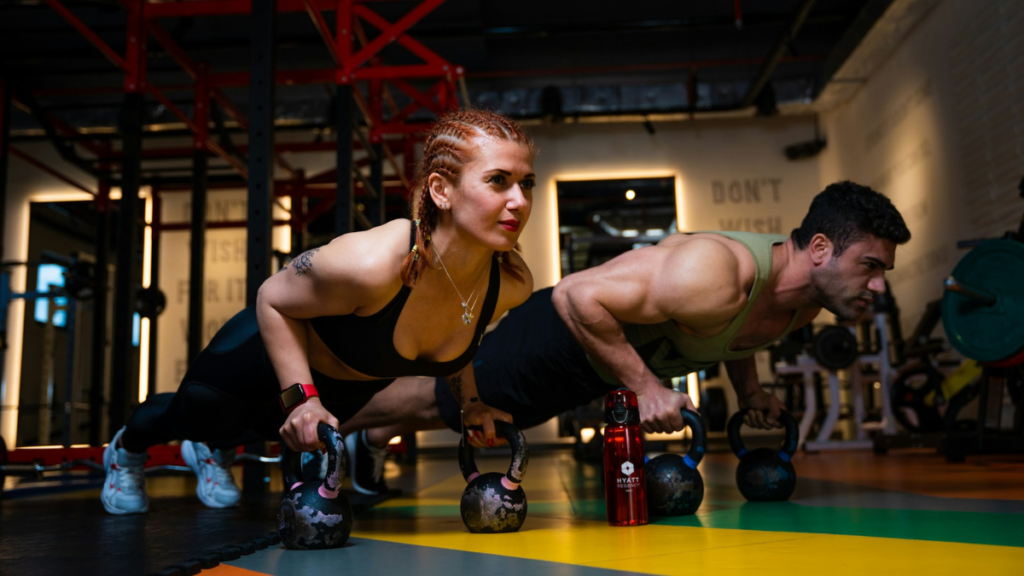
Push ups are a closed chain upper body exercise. Your hands remain fixed on the floor while your body moves through space. The prime movers are the chest, triceps, and front of the shoulders, while the abdominal muscles, spinal stabilizers, glutes, and legs work to keep the body rigid from head to heels.
Research comparing push ups with bench pressing has found that a standard push up can produce substantial activation in the chest and triceps. The exact training effect depends on hand position, depth, tempo, body position, and the amount of body weight being moved. A push up is therefore much more than an arm exercise. It is a full body movement that depends on strength, stability, coordination, and the ability to maintain quality reps as fatigue builds.
A one minute score mainly reflects muscular endurance. This is the ability of a muscle group to perform repeated contractions or sustain work over time. It also reflects relative strength because you must repeatedly lift a meaningful proportion of your own mass. People with more upper body strength relative to body weight will usually find each rep less demanding than people who have less strength or more mass to move.
This is why your push up score should be treated as one useful data point, not a complete judgment of health or athletic ability. It does not measure pulling strength, lower body strength, sprint speed, aerobic capacity, mobility, or technical strength with a barbell. It does, however, provide a practical snapshot of pressing endurance and body control.
How to Test Your Maximum Push Ups in One Minute
The value of the test depends on using the same rules every time. If your range of motion changes from one test to the next, you are not measuring progress accurately.
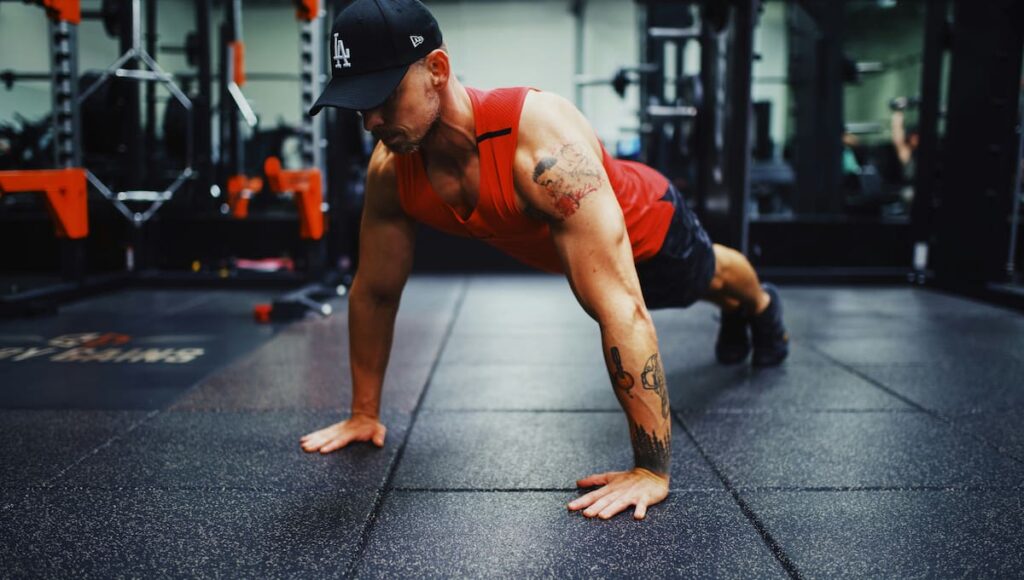
Start in a high plank with your hands slightly wider than shoulder width. Keep your fingers facing forward and create a straight line from your head through your hips to your heels. Lower under control until your chest reaches a consistent depth target, such as a fist placed on the floor, or until your upper arms reach at least parallel with the floor. Then press back to full elbow extension.
Each repetition should have a clear bottom position and a clear lockout at the top. Hips that sag toward the floor, hips that rise into a pike, partial reps, and failure to lock out should not count. You can rest during the minute, but do so only at the top position with your arms extended and body held straight.
Before testing, complete a short warm up that includes shoulder circles, easy scapular push ups, a few incline push ups, and several controlled full push ups. Rest for a few minutes, start the timer, and count only repetitions that meet your chosen standard.
Testing with a training partner is helpful because it removes the temptation to count questionable reps. Film yourself if you are testing alone. It can show whether your range of motion changes significantly in the final 20 seconds, which is often where optimistic counting begins.
Are You Better Than Your Peers?
The table below uses one minute, full body push up reference values published by the Cooper Institute. The figures show the 25th percentile, median, and 75th percentile for the specific reference groups used in that dataset.
A median score means that roughly half of the people in the reference group scored above it and half scored below it. Reaching the 75th percentile means your score is above approximately three quarters of that reference group. These are useful comparison points, but they are not universal standards for every adult.
The male data came from an employee wellness population, while the female data came from a group of US Army soldiers. That means the figures are reference values from specific groups, not a perfectly representative sample of all adults. They are best used as a broad benchmark and a way to track your own progress over time.
One Minute Full Body Push Up Reference Values
| Age group | Men: 25th percentile | Men: median | Men: 75th percentile | Women: 25th percentile | Women: median | Women: 75th percentile |
|---|---|---|---|---|---|---|
| 20 to 29 | 24 | 33 | 44 | 11 | 18 | 27 |
| 30 to 39 | 19 | 27 | 36 | 9 | 14 | 19 |
| 40 to 49 | 13 | 21 | 29 | 7 | 11 | 15 |
| 50 to 59 | 10 | 15 | 24 | Not available | Not available | Not available |
| 60 and over | 7 | 15 | 22 | Not available | Not available | Not available |
If you are a man aged 30 to 39 and complete 27 strict push ups in one minute, you are around the midpoint of this reference group. If you hit 36, you are around the 75th percentile. A woman aged 30 to 39 who completes 19 strict reps is around the 75th percentile of the available female reference group.
It is important not to compare a strict chest to floor rep with a fast partial rep. The higher score only matters if the movement standard is comparable. A set of 30 controlled, full range push ups is a better performance measure than 45 shallow repetitions completed by bouncing through the bottom.
Why Scores Change With Age
Push up performance commonly declines with age, although the rate of change varies greatly between individuals. Losses in muscle mass, maximal strength, power, joint mobility, and physical activity can all reduce the number of quality repetitions a person can complete. This is not inevitable at the same rate for everyone.
Regular resistance training can preserve and improve muscle strength and function across adulthood. Research consistently shows that resistance exercise improves strength in younger and older adults, and higher training volumes can support larger gains in muscle size when recovery and technique are managed well.
Your score can also improve rapidly when you simply practice push ups. Early progress is often driven by better coordination, improved movement efficiency, and a clearer sense of pacing. You learn how to keep your trunk tight, use your breathing efficiently, and avoid wasting energy at the bottom of each repetition.
For this reason, a score that looks average on paper may still represent excellent progress for you. Someone moving from eight strict reps to 18 has made a meaningful improvement in strength and endurance, even if they are not yet near the upper end of a benchmark table.
The Biggest Factors That Affect Your Score
Body mass is one of the biggest variables. Push ups require you to move your own body, so the movement becomes harder as the load increases unless strength rises at the same time. This is not a criticism of body mass. It is simply a mechanical reality of bodyweight exercise.
Upper body pressing strength matters, but so does trunk control. When your hips sink, force leaks through the body and the chest, shoulders, and triceps must work harder to complete each rep. Keeping the glutes squeezed and the ribs controlled allows you to transfer force more efficiently.
Your pacing strategy can make a dramatic difference. Starting at maximum speed often feels impressive for the first 15 seconds, but it can create a rapid buildup of fatigue that leads to long rests later. Most people perform better by using a smooth rhythm early, then increasing effort only when the clock is running down.
Your hand position also affects the test. A wider position may feel easier on the triceps but can place greater demand on the chest and shoulders. A narrower position usually increases triceps involvement. Choose a hand placement that feels strong and comfortable, then keep it consistent whenever you retest.
Sleep, recent training, hydration, body temperature, and shoulder discomfort can all affect your result on a particular day. Test under similar conditions whenever possible. A monthly test is often enough to reveal progress without turning every training session into a competition.
How to Improve Your One Minute Push Up Score
The most direct way to improve is to practice high quality push ups two or three times per week. You do not need to take every set to failure. In fact, frequent practice with a few repetitions left in reserve is often a better way to improve technique and accumulate useful volume.
If your current maximum is low, use incline push ups with your hands on a stable bench, box, or bar. Raising the hands reduces the amount of body mass supported by the upper body. As you get stronger, lower the height of the support until you can perform full push ups from the floor.
If you can already perform several strict reps, build volume through multiple manageable sets. For example, someone with a maximum of 20 reps could perform five sets of eight to 10 controlled repetitions. This builds capacity without making every set a maximal effort.
Add supporting strength work as well. Bench presses, dumbbell presses, overhead presses, triceps extensions, rows, and pulldowns can all help build the pressing strength and shoulder balance needed for more confident push ups. Pulling exercises are particularly important because strong upper back muscles help support good shoulder mechanics and posture.
Once per week, include a short pacing session. Perform two or three rounds of 20 to 30 seconds of push ups at a controlled rhythm, resting fully between rounds. This teaches you to produce steady output without sprinting into fatigue. Retest your one minute maximum every four to six weeks, not every day.
Use the Test as Motivation, Not a Verdict
A one minute push up test is a useful challenge because it is accessible, repeatable, and easy to understand. It asks a simple question: how much high quality upper body work can you complete before the clock runs out?
Your score matters most when you compare it with your own previous result. Age based benchmarks can add context, but they cannot account for your body size, training history, injury history, sport, or goals. A strict test, a sensible training plan, and steady improvement will always tell you more than chasing a number through poor form.
Key Takeaways
| Point | What it means |
|---|---|
| The test measures muscular endurance | It mainly assesses repeated pressing ability in the chest, shoulders, and triceps, alongside trunk control. |
| Strict form makes the score meaningful | Use a consistent depth target, full lockout, and a straight body position for every counted rep. |
| Age and sex influence comparison values | Compare your result with an appropriate reference group, while recognizing that benchmark datasets have limitations. |
| Body mass affects difficulty | Push ups are a relative strength movement because you repeatedly move a substantial proportion of your body weight. |
| Pacing matters | A controlled early rhythm usually produces a better one minute result than starting at maximum speed. |
| Consistent training improves scores | Practice push ups regularly, build supporting pressing and pulling strength, and retest every four to six weeks. |
References
- Calatayud, J., Borreani, S., Colado, J.C., Martin, F., Rogers, M.E., Behm, D.G. and Andersen, L.L. (2015) ‘Muscle activation during the bench press and push up at comparable levels of muscle activity’, Journal of Strength and Conditioning Research, 29(1), pp. 246 to 249.
- Cogley, R.M., Archambault, T.A., Fibeger, J.F., Koverman, M.M., Youdas, J.W. and Hollman, J.H. (2005) ‘Comparison of muscle activation using various hand positions during the push up exercise’, Journal of Strength and Conditioning Research, 19(3), pp. 628 to 633.
- Cooper Institute (2013) Physical Fitness Assessments and Norms for Adults and Law Enforcement. Dallas, TX: Cooper Institute.
- Dhahbi, W., Chaabene, H., Chaouachi, A., Padulo, J., Behm, D.G., Cochrane, J., Burnett, A. and Chamari, K. (2022) ‘Kinetic analysis of push up exercises: A systematic review with practical recommendations’, Sports Biomechanics, 21(1), pp. 1 to 40.
- Ebben, W.P., Wurm, B., VanderZanden, T.L., Spadavecchia, M.L., Durocher, J.J., Bickham, C.T. and Petushek, E.J. (2011) ‘Kinetic analysis of several variations of push ups’, Journal of Strength and Conditioning Research, 25(10), pp. 2891 to 2894.
- Grgic, J., Schoenfeld, B.J., Skrepnik, M., Davies, T.B. and Mikulic, P. (2020) ‘Effects of rest interval duration in resistance training on measures of muscular strength: A systematic review’, Sports Medicine, 50(1), pp. 145 to 160.
- Schoenfeld, B.J., Ogborn, D. and Krieger, J.W. (2017) ‘Dose response relationship between weekly resistance training volume and increases in muscle mass: A systematic review and meta analysis’, Journal of Sports Sciences, 35(11), pp. 1073 to 1082.
- Steib, S., Schoene, D. and Pfeifer, K. (2010) ‘Dose response relationship of resistance training in older adults: A meta analysis’, Medicine and Science in Sports and Exercise, 42(5), pp. 902 to 914.