

Building muscle as a beginner does not require a complicated program, a cupboard full of supplements, or hours in the gym. It does require regular resistance training, enough effort to challenge your muscles, and a plan you can follow for long enough to see progress.
Research supports several effective approaches to building muscle. You can use different exercises, rep ranges, and weekly schedules, so the best plan is usually one you can do consistently and perform with good technique. These ten tips cover the basics, from choosing exercises to eating and recovering well.


1. Train consistently before you chase the perfect program
A basic routine followed regularly is more useful than an advanced plan you keep changing. Beginners can make progress with a few weekly sessions that train the major muscle groups. Choose a schedule that fits your life, such as three full body workouts or four upper and lower body sessions.

Training frequency is mainly a way to organize your weekly workload. Research comparing different training frequencies has found that, when weekly training volume is similar, frequency alone does not appear to make a meaningful difference to muscle growth. In practice, training a muscle more than once a week can make it easier to spread out your sets and maintain good effort throughout each workout.
2. Start with exercises you can perform well
Build your routine around movements that train several muscles at once, such as squats, presses, rows, and hip hinges. Add simpler exercises for areas you want to work more directly, such as curls for your biceps or calf raises for your calves.
You do not have to use a barbell to build muscle. Dumbbells, machines, cables, and bodyweight exercises can all provide resistance. The important thing is that the movement suits your body and that you can perform it through a comfortable range of motion with control. If an exercise causes pain or you cannot maintain steady technique, choose a variation that feels better.
3. Use a manageable amount of training
More sets can help build muscle, but piling on extra work does not automatically mean faster results. Research has found a general relationship between weekly resistance training volume and muscle growth, though the best amount varies between people. As a beginner, start with a modest number of challenging sets for each muscle group across the week. Add more only when your current routine feels manageable and you are recovering well.

A useful starting point is a few sets of each exercise, rather than trying to copy a high volume plan designed for an experienced lifter. Keep a record of your exercises, sets, and repetitions. That makes it easier to notice whether your current plan is working and helps prevent you from adding work simply because a workout feels too short.
4. Choose a weight that challenges you
You do not need to lift the heaviest weight possible to build muscle. Research suggests that a range of loads can increase muscle size when the sets provide a sufficient challenge. Heavier weights are useful for practicing strength, but moderate or lighter weights can also work.
Choose a weight that lets you perform the exercise with control and within your target rep range. The final repetitions should feel demanding, but your technique should stay steady. If you could easily do many more repetitions, the weight may be too light. If you have to twist, bounce, or shorten the movement to finish, it may be too heavy.
5. Finish most sets close to your limit, with good form
Muscles need to be challenged, but you do not have to force every set until you cannot complete another repetition. Recent research suggests that muscle growth tends to improve when sets end closer to failure, although the exact ideal distance is still uncertain. For a beginner, a practical approach is to stop when you think you could complete one to three more good repetitions.
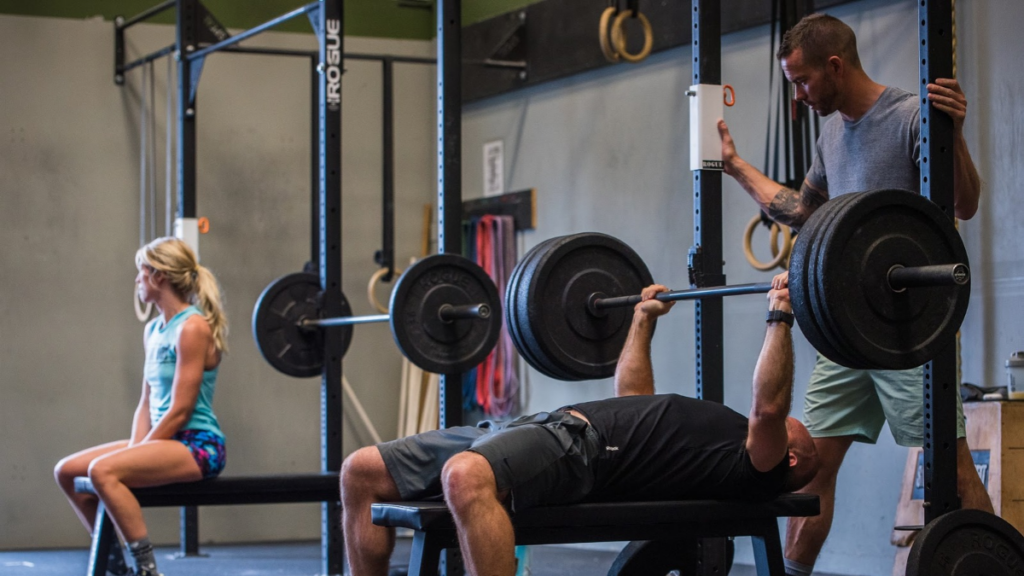
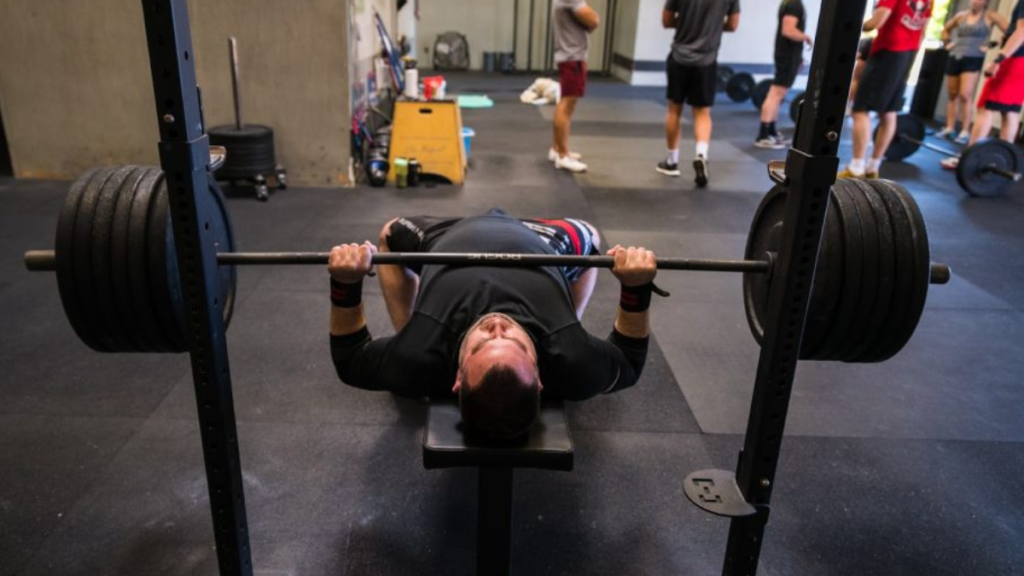
This effort level gives you a useful challenge while leaving room to learn the movement and maintain control. As your experience grows, you can judge more accurately how close you are to your limit. On exercises where losing control could be risky, such as heavy squats or bench presses, keep a larger margin and use safety equipment or a spotter where appropriate.
6. Progress gradually
To keep building muscle, your training needs to remain challenging as you get stronger. Progress does not mean adding weight every workout. You can also aim to complete more repetitions with the same weight, improve your technique, or add a set when the current workload is no longer enough.

A simple method is to use a repetition range. For example, if your plan calls for 8 to 12 repetitions, keep the same weight until you can complete 12 controlled repetitions for all your sets. Then increase the weight slightly and build your repetitions back up. Research in previously untrained adults has found that increasing repetitions or increasing load can both support strength and muscle gains.
7. Use a comfortable, controlled range of motion
Move through as much of the exercise’s range as you can control comfortably. A controlled lowering phase and a complete repetition help you practice the movement consistently and work the muscles through the exercise.
The research on range of motion is still developing, and the best approach can differ between muscles and exercises. You do not need to force a deep position that causes pain or makes your technique fall apart. Instead, use a range that feels stable and gradually improve it as your mobility and confidence allow.
8. Eat enough protein across the day
Protein supplies the amino acids your body uses to build and repair muscle tissue. A large meta analysis found that protein supplementation can add to the muscle and strength gains from resistance training, with benefits leveling off at around 1.6 grams of protein per kilogram of body weight per day for many adults. That is a useful target, not a requirement to hit an exact number every day.

You can get protein from foods such as eggs, dairy, fish, poultry, meat, beans, lentils, tofu, and other soy products. Protein powder is a convenient option if it helps you meet your needs, but it is not essential. Focus on your overall daily intake rather than worrying about a narrow post workout window.
9. Eat enough food to support training
Muscle growth requires energy as well as training and protein. A large calorie surplus is not a guarantee of faster muscle growth, and the evidence does not establish one exact surplus that works for everyone. Start by eating regular meals that support your training and daily activity. If your body weight is dropping unintentionally and your energy or performance is suffering, you may need to eat more.
Pay attention to trends over several weeks rather than reacting to a single weigh in. Your weight can shift from day to day for reasons unrelated to muscle gain. If you are new to training, overweight, or returning after a long break, you may be able to gain muscle without deliberately eating above maintenance. The goal is to support training without forcing food when you do not need it.
10. Give yourself time to recover
Muscle building happens over repeated cycles of training and recovery, so make room for rest days and aim for consistent sleep. One small controlled study found that a night without sleep reduced muscle protein synthesis in healthy young adults. That study does not tell us exactly how much sleep every lifter needs, but it reinforces the value of avoiding repeated sleep deprivation where possible.
How Many Chin-Ups Should You Be Able to Do Based on Your Age?
You do not need to be perfectly recovered after every workout, and some muscle soreness can happen when you start a new routine. However, if your performance keeps falling, you feel unusually run down, or soreness makes it difficult to train with good form, consider reducing your workload or taking an extra recovery day. A sustainable routine will serve you better than a schedule that leaves you exhausted.
Key Takeaways
| Tip | What to do |
|---|---|
| Consistency | Follow a routine you can repeat from week to week. |
| Exercise choice | Use movements you can perform comfortably and with control. |
| Training volume | Start with a manageable number of challenging sets. |
| Weight selection | Use a load that challenges you without breaking your technique. |
| Effort | End most sets with a few good repetitions left. |
| Progression | Gradually add repetitions, weight, or sets when appropriate. |
| Range of motion | Use a controlled range that feels stable and pain free. |
| Protein | Include protein rich foods throughout the day. |
| Food intake | Eat enough to support your training and monitor longer term trends. |
| Recovery | Make time for rest and consistent sleep. |
References
- Kassiano, W., Costa, B., Nunes, J.P., Ribeiro, A.S., Schoenfeld, B.J. and Cyrino, E.S. (2023) ‘Which ROMs lead to Rome? A systematic review of the effects of range of motion on muscle hypertrophy’, Journal of Strength and Conditioning Research, 37(5), pp. 1135–1144.
- Lamon, S., Morabito, A., Arentson-Lantz, E., Knowles, O., Vincent, G.E., Condo, D., Alexander, S.E., Garnham, A., Paddon-Jones, D. and Aisbett, B. (2021) ‘The effect of acute sleep deprivation on skeletal muscle protein synthesis and the hormonal environment’, Physiological Reports, 9(1), e14660.
- Morton, R.W., Murphy, K.T., McKellar, S.R., Schoenfeld, B.J., Henselmans, M., Helms, E., Aragon, A.A., Devries, M.C., Banfield, L., Krieger, J.W. and Phillips, S.M. (2018) ‘A systematic review, meta-analysis and meta-regression of the effect of protein supplementation on resistance training-induced gains in muscle mass and strength in healthy adults’, British Journal of Sports Medicine, 52(6), pp. 376–384.
- Pelland, J.C., Remmert, J.F., Robinson, Z.P., Hinson, S.R. and Zourdos, M.C. (2026) ‘The resistance training dose response: Meta-regressions exploring the effects of weekly volume and frequency on muscle hypertrophy and strength gains’, Sports Medicine, 56(2), pp. 481–505.
- Pelland, J.C., Remmert, J.F., Robinson, Z.P., Hinson, S.R. and Zourdos, M.C. (2025) ‘Exploring the dose-response relationship between estimated resistance training proximity to failure, strength gain, and muscle hypertrophy: A series of meta-regressions’, Sports Medicine, 55, pp. 1779–1795.
- Schoenfeld, B.J., Ogborn, D. and Krieger, J.W. (2017) ‘Dose-response relationship between weekly resistance training volume and increases in muscle mass: A systematic review and meta-analysis’, Journal of Sports Sciences, 35(11), pp. 1073–1082.
- Schoenfeld, B.J., Grgic, J. and Krieger, J. (2019) ‘How many times per week should a muscle be trained to maximize muscle hypertrophy? A systematic review and meta-analysis of studies examining the effects of resistance training frequency’, Journal of Sports Sciences, 37(11), pp. 1286–1295.
- Slater, G.J., Dieter, B.P., Marsh, D.J., Helms, E.R., Shaw, G. and Iraki, J. (2019) ‘Is an energy surplus required to maximize skeletal muscle hypertrophy associated with resistance training?’, Frontiers in Nutrition, 6, 131.
- Vieira, A.F., Umpieri, M.T., Nunes, J.P., Bottaro, M., Gentil, P., Steele, J. and de Salles, B.F. (2022) ‘Muscle hypertrophy and strength gains after resistance training with different volume-matched loads: A systematic review and meta-analysis’, Applied Physiology, Nutrition, and Metabolism, 47(4), pp. 357–368.
- Zhang, Z., et al. (2024) ‘Effects of resistance training overload progression protocols on strength and muscle mass’, International Journal of Sports Medicine, 45(9), pp. 687–694.