

Building bigger arms does not require a long list of curl variations. Beginners can make a strong start with three movements: the standing dumbbell curl, the incline dumbbell curl, and the hammer curl. Together, they train the elbow flexors with different hand and arm positions, while keeping the workout simple enough to learn and progress.
The biceps brachii is the muscle most people picture when they think of biceps. It bends the elbow and helps turn the palm upward. Other muscles, including the brachialis and brachioradialis, also help bend the elbow. Training all of these muscles contributes to overall arm development, although no single exercise isolates just one muscle.


Exercise choice matters, but it is only part of the picture. Consistent training, good technique, and gradually increasing the challenge over time are what make a routine productive. These three exercises give beginners a practical starting point without making the workout complicated.
1. Standing Dumbbell Curl
The standing dumbbell curl is a simple way to train the biceps through elbow flexion while using a palms up grip. Dumbbells let each arm work independently, which can make it easier to notice if one side is doing more of the work.
How to perform the standing dumbbell curl
Stand tall with a dumbbell in each hand and your arms by your sides. Keep your palms facing inward at the start, then turn them forward as you curl the weights toward your shoulders. Keep your upper arms close to your sides and bend at the elbows. Lower the dumbbells under control until your arms are nearly straight, then begin the next repetition.
Choose a weight that lets you move smoothly without swinging your torso or lifting your elbows forward to finish each repetition. Your wrists should stay in a comfortable position rather than bending sharply backward. If you cannot control the lowering portion, the dumbbells are likely too heavy for your current level.
Why it belongs in a beginner’s routine
Turning the palms upward as you curl adds the forearm rotation that the biceps helps produce. In a small study comparing different curl grips, researchers found greater biceps muscle activity during the lifting phase with a supinated grip than with neutral or pronated grips. That study measured muscle activity during exercise, not long term muscle growth, so it helps explain how grip position changes the movement without proving that one grip always produces more size.
The standing curl is also easy to adjust. Beginners can use lighter dumbbells, work one arm at a time, or keep both hands facing forward throughout the repetition while they learn to control the movement. Once the technique feels steady, turning the palm upward during the curl adds a straightforward way to coordinate elbow bending and forearm rotation.
2. Incline Dumbbell Curl
The incline dumbbell curl changes the position of your upper arms by placing your torso back against an incline bench. This puts the arms slightly behind the body at the bottom of the repetition. Because the shoulder position affects the length of the biceps, the exercise offers a different challenge from a standing curl.
How to perform the incline dumbbell curl
Set an adjustable bench to a comfortable incline and sit back with your feet planted firmly on the floor. Let your arms hang toward the floor, palms facing forward or slightly inward. Curl the dumbbells by bending your elbows while keeping your upper arms in place. Lower the weights slowly until your elbows are close to straight and your arms return to the hanging position.
Use a lighter load than you would for a standing curl if needed. The stretched starting position can make the movement feel more demanding, and there is no advantage to forcing a deep stretch or using a range of motion that causes discomfort. Keep your shoulders relaxed against the bench and avoid letting your elbows drift forward as the weights rise.
Why it belongs in a beginner’s routine
Resistance training through a full range of motion, and training muscles at longer lengths, can support muscle growth. A systematic review of range of motion research found that full range of motion and partial repetitions performed in the initial, more lengthened portion of a movement tended to produce more growth in the biceps than partial repetitions performed only in the final portion. The evidence does not mean every repetition must be exaggerated or uncomfortable. It supports using a controlled range that includes the lower part of the curl.
5 Best Free Weights Exercises for Wider Shoulders
A study directly comparing incline curls and preacher curls found that both exercises increased elbow flexor muscle size and strength over the training period. The incline curl produced a greater increase in proximal muscle thickness, while the preacher curl produced a greater increase in distal thickness. The results suggest that arm position can influence where growth occurs, but they do not show that beginners need to use both exercises or that either one is universally superior.
For a beginner, the incline curl is a useful second movement because it feels different from the standing curl and encourages control in the lower part of the repetition. Keep the weight modest and lower the dumbbells smoothly. If the position bothers your shoulders, use a less steep bench angle or choose another curl variation that feels comfortable.
3. Dumbbell Hammer Curl
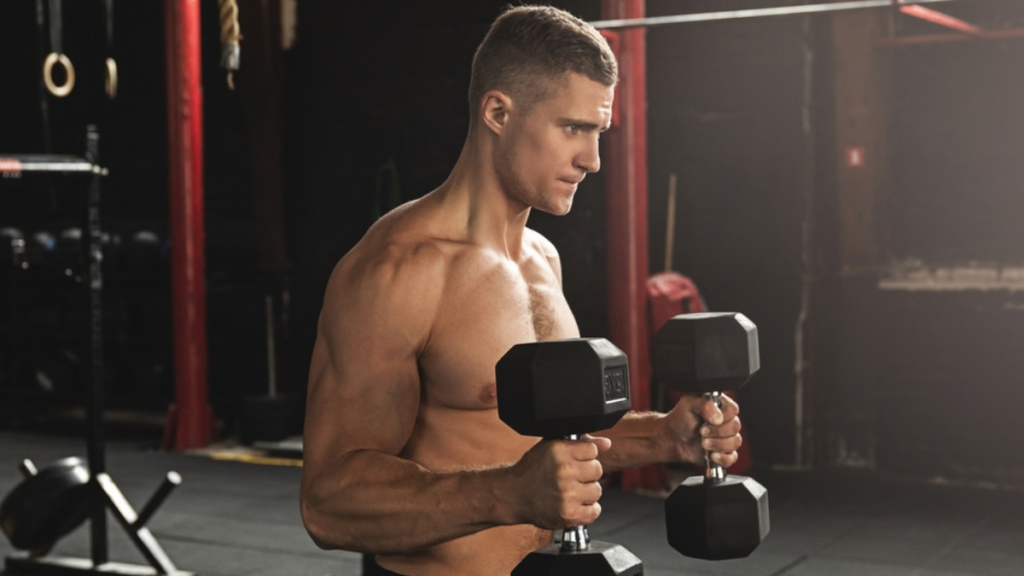
The hammer curl uses a neutral grip, with the palms facing each other throughout the repetition. It trains the biceps along with other elbow flexors, particularly the brachialis and brachioradialis. Those muscles contribute to elbow bending and help build the surrounding upper arm and forearm.
How to perform the hammer curl
Stand with a dumbbell in each hand and your palms facing your body. Keep your upper arms near your sides as you bend your elbows and lift the weights toward your shoulders. Pause briefly near the top without lifting your shoulders, then lower the dumbbells under control to the starting position.
You can perform the exercise with both arms at once or alternate sides. Avoid rocking your body to lift the weights. If your elbows move forward or your torso swings, reduce the load and focus on keeping the movement centered around the elbow.
Why it belongs in a beginner’s routine
The neutral grip makes the hammer curl a useful complement to palms up curls. Research comparing supinated, neutral, and pronated curl grips found differences in muscle activity, including greater biceps activity with the supinated grip than with the neutral grip during the lifting phase. The neutral grip still trains the elbow flexors, but it changes how the muscles share the work.
That does not make the hammer curl a replacement for a traditional biceps curl. Use it as a third option that adds variety in grip position and trains the muscles around the biceps as well. If your goal is bigger arms, building the whole elbow flexor group is more useful than chasing a feeling of isolation in one part of the arm.
How to put the exercises together
Beginners can start with two sets of each exercise for 8 to 12 controlled repetitions. Rest long enough between sets to perform the next set with good technique, usually around one to two minutes. If you are new to resistance training, start with a load that leaves you able to complete the planned repetitions without swinging or shortening the movement.
Train the exercises once or twice per week as part of a broader strength routine. Your biceps already help during pulling exercises such as rows and pullups, so direct curl work can be added after those larger movements. If you train the biceps twice weekly, leave at least a day between sessions and adjust the number of sets if soreness affects your next workout.
You do not need to reach complete failure on every set. A practical goal is to finish most sets when you feel you could perform one or two more good repetitions. As the exercises become easier, first build toward the top of your repetition range. When you can complete 12 clean repetitions on every set, increase the dumbbell weight slightly and build your repetitions back up.
Progression should be gradual. Adding weight is one option, but improving control, completing more repetitions with the same weight, or using a comfortable fuller range of motion can also make training more challenging. Muscle growth is supported by resistance training across a range of loads when the sets are sufficiently challenging, so beginners do not need to test maximal weights to make progress.
Common mistakes to avoid
Using too much weight is one of the most common curl mistakes. Heavy dumbbells often lead to body swinging, shortened repetitions, or shoulders taking over the movement. Reduce the load until you can control both the lift and the lowering phase.
Another mistake is treating every variation as a completely separate muscle building secret. The standing curl, incline curl, and hammer curl are useful because their positions and grips differ, but consistency matters more than frequent exercise changes. Keep the same movements long enough to learn them and track progress.
Finally, avoid forcing a stretch or pushing through sharp pain. Mild effort and muscle fatigue are normal during training, but pain in the elbow, wrist, or shoulder is a reason to stop and adjust. Try a lighter weight, a smaller comfortable range, or another variation. If the discomfort continues, seek advice from a qualified health professional.
Key Takeaways
| Key takeaway | What to do |
|---|---|
| Keep the routine simple | Start with standing dumbbell curls, incline dumbbell curls, and hammer curls. |
| Use controlled technique | Keep your upper arms steady and lower each weight smoothly. |
| Train consistently | Perform two sets of 8 to 12 repetitions per exercise once or twice weekly. |
| Progress gradually | Add repetitions or a small amount of weight when your form stays consistent. |
| Train the whole arm | Use palms up and neutral grip curls to train the elbow flexors from different positions. |
References
- American College of Sports Medicine (2026) ‘Resistance training prescription for muscle function, hypertrophy, and physical performance in healthy adults: An overview of reviews’, Medicine & Science in Sports & Exercise, 58(4), pp. 851–872.
- Coratella, G., Tornatore, G., Longo, S., Esposito, F. and Cè, E. (2023) ‘Biceps brachii and brachioradialis excitation in biceps curl exercise: Different handgrips, different synergy’, Sports, 11(3), 64.
- Kassiano, W., Costa, B., Nunes, J.P., Ribeiro, A.S., Schoenfeld, B.J. and Cyrino, E.S. (2023) ‘Which ROMs lead to Rome? A systematic review of the effects of range of motion on muscle hypertrophy’, Journal of Strength and Conditioning Research, 37(5), pp. 1135–1144.
- Kassiano, W., Costa, B., Kunevaliki, G., Lisboa, F., Stavinski, N., Prado, A., Tricoli, I., Francsuel, J., Lima, L., Nunes, J.P., Ribeiro, A.S. and Cyrino, E.S. (2025) ‘Distinct muscle growth and strength adaptations after preacher and incline biceps curls’, International Journal of Sports Medicine, 46(5), pp. 334–343.
- Schoenfeld, B.J., Ogborn, D. and Krieger, J.W. (2017) ‘ dose-response relationship between weekly resistance training volume and increases in muscle mass: A systematic review and meta-analysis’, Journal of Sports Sciences, 35(11), pp. 1073–1082.