

Starting the gym can feel unnecessarily complicated. There are countless training methods, exercises, and opinions, yet the goal for most beginners is simple: build a stronger, more muscular body while learning how to train properly.
A well designed three day routine is an excellent place to start. It gives you enough weekly training to build muscle, while leaving time to recover, improve technique, and fit training into a busy schedule. Research consistently shows that resistance training can increase muscle size and strength in beginners when the program includes enough effort, progressive overload, and regular practice.



The most effective beginner routine is not the one with the greatest number of exercises. It is the one you can perform consistently, progress gradually, and recover from. This plan uses three full body gym sessions each week, with each workout emphasizing a different area of the body. You will train your major muscle groups multiple times per week without turning every session into an exhausting marathon.
Why a Three Day Routine Works for Beginners
Muscle growth happens when training provides a challenging stimulus and recovery allows the body to adapt. Resistance training creates mechanical tension in the muscles, which is one of the primary drivers of muscle hypertrophy. Over time, the body responds by building stronger muscle tissue that is better prepared for similar demands in the future.
Beginners do not need to train six days per week to make progress. In fact, more training can make it harder to recover, learn movements well, and stay consistent. A three day routine allows you to train frequently enough to practice the main movement patterns while still having rest days between sessions.
Training each muscle group more than once per week can be useful because it spreads your training volume across several sessions. Instead of doing a very high number of chest, back, or leg sets in one workout, you can perform a manageable amount of quality work each time you train. This can help you maintain better technique and effort from set to set.
The routine below works best when you train on nonconsecutive days. Monday, Wednesday, and Friday is a simple option, although any three days with rest between them can work.
The Rules That Make This Routine Effective
Focus on Good Technique Before Heavy Weight
Your first priority is learning how each exercise should feel. A squat should challenge your legs, a row should challenge your upper back, and a press should challenge your chest, shoulders, or triceps. If you are swinging weights, shortening every repetition, or feeling sharp pain, reduce the load and improve your control.
Research shows that resistance training performed across a range of loads can build muscle, provided the sets are challenging enough. However, moderate loads are often practical for beginners because they allow you to learn the movement without needing to handle extremely heavy weight. Choose a load that lets you complete the target repetitions with good form while feeling that you could only do around two or three additional repetitions.
Add Progress Slowly
Progressive overload means gradually asking your body to do more over time. You can increase the weight, complete more repetitions, improve your technique, or perform the same work with better control. You do not need to add weight every workout. Small improvements made consistently are more important than dramatic jumps that lead to poor form or missed training.
5 Secrets Tips for Guys 30+ to Get Jacked Arms
Use a simple double progression method. If an exercise calls for eight to 12 repetitions, begin with a weight that allows you to get eight good repetitions on every set. Over the following weeks, aim to add repetitions until you can complete 12 on all sets. Then increase the weight slightly and return to eight or nine repetitions.
Rest Long Enough Between Sets
Many beginners rush through their workouts because they think fatigue is always productive. Fatigue can make training feel difficult, but it can also reduce your performance on later sets. Resting for around two minutes after larger compound exercises gives your muscles and nervous system time to recover enough to produce quality repetitions.
For smaller exercises, such as curls and lateral raises, one to two minutes is usually sufficient. The goal is not to make the workout feel easy. The goal is to perform enough high quality work to create a reason for your body to grow.
Day One: Build Your Foundation
The first session prioritizes the major movements that build the base of a muscular body. You will train your legs, chest, back, shoulders, and arms in a balanced way.
Goblet Squat
Perform three sets of eight to 12 repetitions.
Hold a dumbbell close to your chest, keep your torso tall, and lower yourself under control. Squat as deeply as your mobility and comfort allow while keeping your feet flat on the floor. The goblet squat is beginner friendly because the front loaded position can help you stay upright and learn a controlled squat pattern.
Your quadriceps, glutes, and adductors work hard during this exercise. Strong legs do more than improve how your lower body looks. They also support better movement in everyday life and create a foundation for future exercises such as barbell squats and deadlifts.
Dumbbell Bench Press
Perform three sets of eight to 12 repetitions.
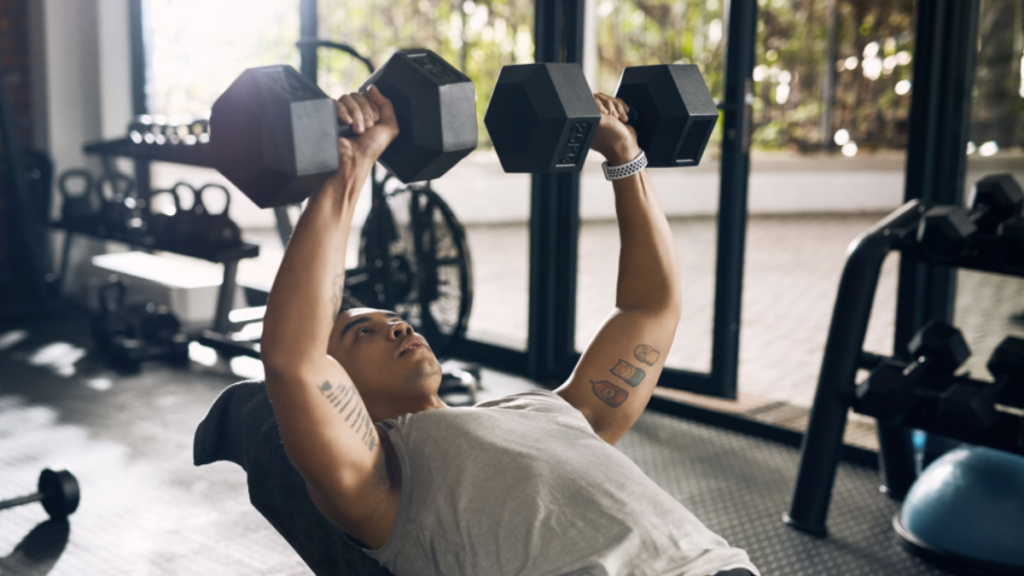
Lie on a flat bench with a dumbbell in each hand. Lower the weights with control until your upper arms are close to parallel with the floor, then press them upward until your elbows are straight without forcefully locking them. Keep your shoulder blades gently pulled back against the bench.
The dumbbell bench press trains the chest, triceps, and front shoulders. Dumbbells also allow each arm to work independently, which can help you develop coordination and identify differences in strength between sides.
Seated Cable Row
Perform three sets of eight to 12 repetitions.
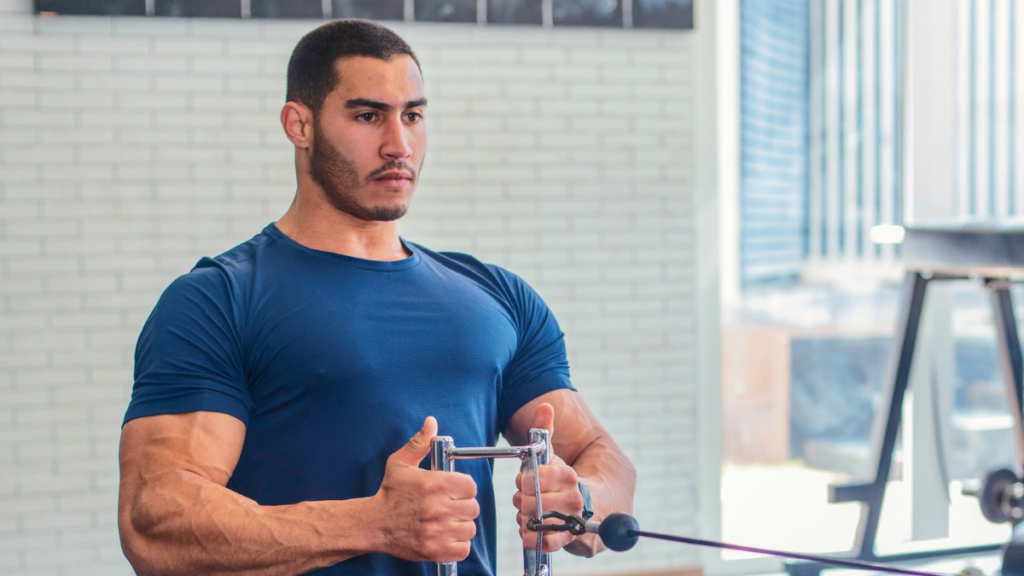
Sit tall, brace your torso, and pull the handle toward your lower ribs. Focus on moving your elbows back rather than pulling with your hands. Pause briefly when your upper back muscles are squeezed, then return the weight under control.
Rows are essential for developing the back muscles that make the torso look thicker and more athletic. They also balance pressing exercises by training the muscles that pull the shoulder blades back and help support good upper body posture.
Dumbbell Romanian Deadlift
Perform three sets of eight to 12 repetitions.
Stand tall with dumbbells held in front of your thighs. Push your hips backward while maintaining a neutral spine and a soft bend in your knees. Lower the dumbbells until you feel a significant stretch in your hamstrings, then drive your hips forward to stand tall.
This movement trains the hamstrings, glutes, and muscles of the lower back. It teaches the hip hinge pattern, which is one of the most valuable movement skills you can learn in the gym.
Cable Triceps Pressdown
Perform two sets of 10 to 15 repetitions.
Keep your elbows close to your sides and straighten your arms by pushing the cable handle downward. Control the return rather than allowing the stack to pull your arms upward quickly. This exercise gives your triceps extra direct work after pressing.
Day Two: Add Muscle to Your Upper Body
This workout emphasizes your upper body while still giving the lower body an effective training stimulus. It is particularly useful for beginners who want to build a broader back, stronger shoulders, and more visible arm development.
Leg Press
Perform three sets of 10 to 15 repetitions.
Place your feet around shoulder width apart on the platform. Lower the platform slowly until you can do so without your lower back rounding away from the pad. Drive through your feet and return to the start with control.
The leg press is a useful lower body exercise because it allows beginners to train the quadriceps and glutes hard without needing to balance a barbell. It can help you build confidence and leg strength while you continue to improve your squat technique.
Lat Pulldown
Perform three sets of eight to 12 repetitions.
Use a grip that feels comfortable for your shoulders. Pull the bar toward the top of your chest by driving your elbows down toward your sides. Avoid leaning far backward or using momentum to move the weight.
The lat pulldown trains the latissimus dorsi, the large muscles that run down the sides of the back. Developing these muscles contributes to a wider looking upper body and provides valuable pulling strength for later chin ups and pull ups.
Incline Dumbbell Press
Perform three sets of eight to 12 repetitions.
Set the bench to a modest incline and press the dumbbells upward from the upper chest area. Keep your shoulders stable and lower the weights smoothly. A modest incline angle can emphasize the upper portion of the chest while still training the shoulders and triceps.
Changing pressing angles can be a practical way to train the chest through slightly different movement paths. You do not need many chest exercises in one workout, but including both flat and incline pressing across the week provides balanced development.
Dumbbell Lateral Raise
Perform two sets of 12 to 15 repetitions.
Stand tall and raise the dumbbells out to your sides until your upper arms are close to shoulder height. Keep a slight bend in your elbows and use a weight you can control without swinging.
The lateral raise directly trains the side portion of the shoulders. Strong, well developed shoulders can make the upper body appear broader, even before major changes in body weight occur.
Dumbbell Curl
Perform two sets of 10 to 15 repetitions.
Keep your upper arms close to your sides and curl the dumbbells toward your shoulders. Lower them slowly and avoid moving your torso backward to create momentum. Direct biceps work is not essential for general strength, but it is useful for beginners who want more complete arm development.
Day Three: Train the Full Body Again
The final workout reinforces the important movement patterns while adding more work for the areas that contribute most to a muscular appearance. Treat it as another opportunity to practice, not as a test of how exhausted you can become.
Dumbbell Split Squat
Perform three sets of eight to 12 repetitions per leg.
Stand in a staggered stance and lower your back knee toward the floor while keeping your front foot flat. Push through the front foot to return to standing. Start with body weight if necessary, then add dumbbells when you can control the movement.
Single leg exercises challenge the quadriceps and glutes while helping you develop balance and coordination. Training each side separately can also reveal whether one leg is significantly weaker or less stable than the other.
Machine Chest Press
Perform three sets of eight to 12 repetitions.
Set the seat so the handles begin around mid chest height. Press the handles forward with control and return until you feel a comfortable stretch through the chest. A machine chest press is a valuable addition because it lets you focus on effort and technique without needing to stabilize free weights.
Chest Supported Row
Perform three sets of eight to 12 repetitions.
Lie face down on an incline bench or use a chest supported row machine. Pull the dumbbells or handles toward your ribs, then lower them slowly. Supporting your chest reduces the need to stabilize your lower back, which can help you focus on your upper back muscles.
Hip Thrust
Perform three sets of 10 to 15 repetitions.
Position your upper back against a bench and place a dumbbell, barbell, or padded load across your hips. Lower your hips under control, then drive them upward by squeezing your glutes. Stop when your torso is roughly parallel to the floor and avoid overextending your lower back.
Hip thrusts are an effective glute focused exercise. Building the glutes improves lower body muscularity and can support strength in squats, lunges, and other athletic movements.
Cable Face Pull
Perform two sets of 12 to 15 repetitions.
Set a rope attachment around face height. Pull the rope toward your face while moving your elbows outward and back. Finish with your hands near your temples and your shoulder blades gently pulled together.
Face pulls train the upper back and rear shoulders. Including them alongside pressing work helps ensure that your shoulders receive balanced training across the week.
How Long Should You Follow This Routine?
Follow this program for at least eight to 12 weeks before making major changes. Early progress often comes from improved coordination, better movement skill, and gradual increases in strength. These improvements create the foundation for more muscle growth over the months that follow.
Keep a record of every workout. Write down the exercise, weight used, repetitions completed, and any notes about technique. Training logs make progression visible and prevent you from guessing what to do each session.
Nutrition also matters. Building muscle is easier when you regularly consume enough protein and total energy to support training and recovery. Evidence suggests that a daily protein intake around 1.4 to 2.0 grams per kilogram of body weight is sufficient for most people who perform resistance training. Spread protein across your meals, include carbohydrates to fuel training, and aim for consistent sleep.
Most importantly, avoid program hopping. The perfect routine is not a secret collection of exercises. It is a balanced plan that you can perform consistently, progress patiently, and recover from well. Master these movements, gradually become stronger, and your body will have a clear reason to become more muscular.
References
- American College of Sports Medicine (2009) ‘American College of Sports Medicine position stand: Progression models in resistance training for healthy adults’, Medicine & Science in Sports & Exercise, 41(3), pp. 687 to 708.
- Grgic, J., Schoenfeld, B.J., Skrepnik, M., Davies, T.B. and Mikulic, P. (2018) ‘Effects of rest interval duration in resistance training on measures of muscular strength: A systematic review’, Sports Medicine, 48(1), pp. 137 to 151.
- Grgic, J., Schoenfeld, B.J., Orazem, J. and Sabol, F. (2022) ‘Effects of resistance training performed to repetition failure or nonfailure on muscular strength and hypertrophy: A systematic review and meta analysis’, Journal of Sport and Health Science, 11(2), pp. 202 to 211.
- Krieger, J.W. (2010) ‘Single versus multiple sets of resistance exercise for muscle hypertrophy: A meta analysis’, Journal of Strength and Conditioning Research, 24(4), pp. 1150 to 1159.
- Morton, R.W., Murphy, K.T., McKellar, S.R., Schoch, R.D., Henselmans, M., Helms, E., Aragon, A.A., Devries, M.C., Banfield, L., Krieger, J.W. and Phillips, S.M. (2018) ‘A systematic review, meta analysis and meta regression of the effect of protein supplementation on resistance training induced gains in muscle mass and strength in healthy adults’, British Journal of Sports Medicine, 52(6), pp. 376 to 384.
- Schoenfeld, B.J., Grgic, J., Ogborn, D. and Krieger, J.W. (2017) ‘Strength and hypertrophy adaptations between low versus high load resistance training: A systematic review and meta analysis’, Journal of Strength and Conditioning Research, 31(12), pp. 3508 to 3523.
Key Takeaways
| Focus | What to do | Why it matters |
|---|---|---|
| Weekly schedule | Train three nonconsecutive days each week | This provides regular muscle building practice while allowing recovery |
| Exercise selection | Use squats, presses, rows, hinges, and single leg exercises | These movements train the major muscle groups efficiently |
| Sets and repetitions | Complete two to three sets of eight to 15 controlled repetitions | This is a practical range for learning technique and building muscle |
| Progression | Add repetitions first, then increase the load slightly | Gradual overload gives your muscles a continued reason to adapt |
| Effort | Finish most sets with around two or three repetitions left in reserve | Challenging sets promote progress without forcing beginners to train recklessly |
| Recovery | Rest for about two minutes after larger exercises | Better recovery supports stronger, higher quality sets |
| Consistency | Follow the plan for at least eight to 12 weeks | Repeated practice and gradual progression produce meaningful results |