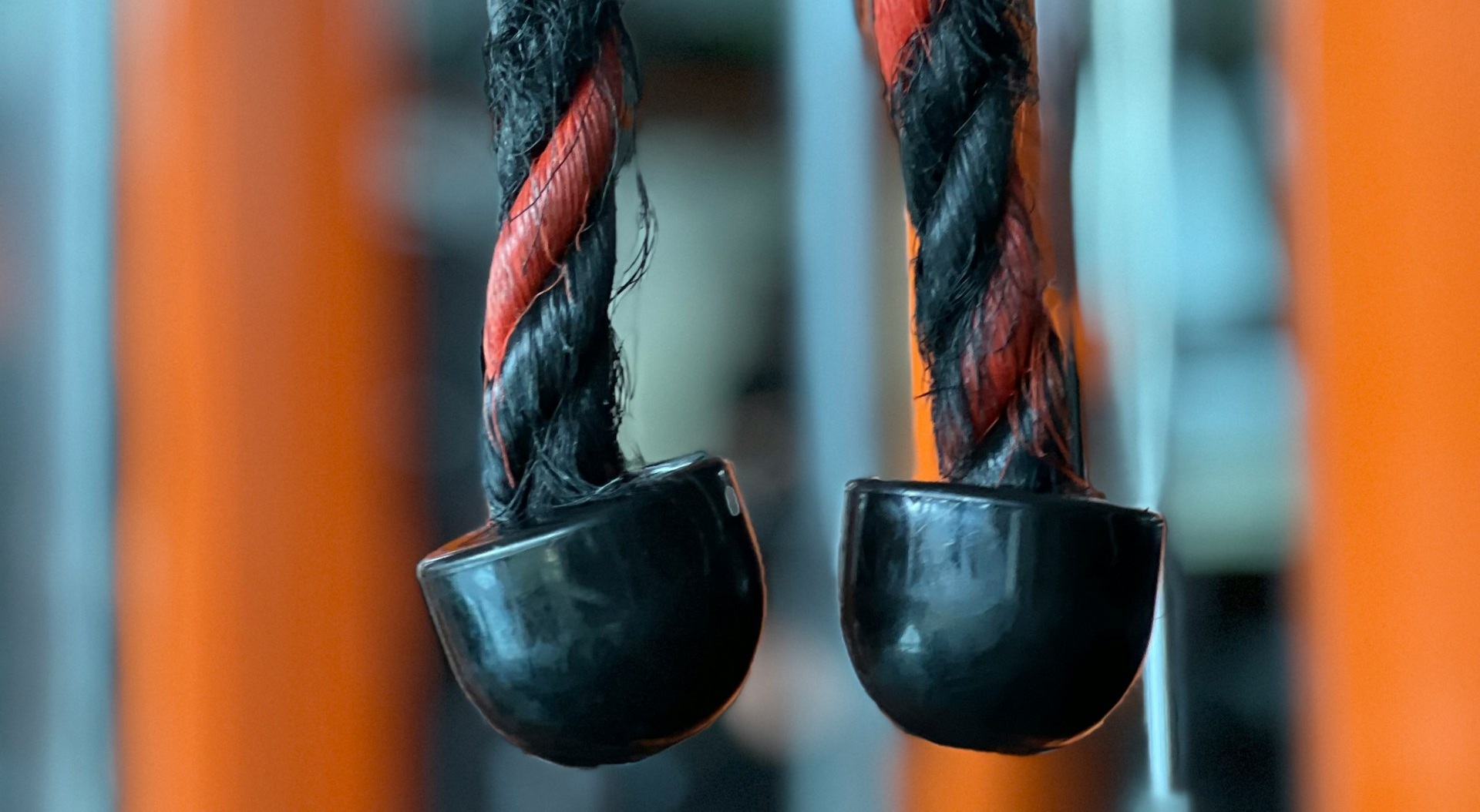


Building bigger arms does not require a barbell, dumbbells, or a complicated workout plan. A cable machine can provide everything a beginner needs to train the biceps and triceps effectively, provided the exercises are performed with control, enough effort, and consistent progression.
Cables are particularly useful for beginners because they provide resistance throughout the movement and make it easy to adjust the load in small increments. You can also change the angle of the cable to find a position that feels comfortable for your joints. This makes cable training a practical way to learn the movements, build confidence, and add high quality arm training to a wider strength program.


The biceps flex the elbow and help turn the palm upward, while the triceps straighten the elbow. Although biceps training gets plenty of attention, the triceps are the larger muscle group of the upper arm. Training both muscles well is essential if your goal is visibly bigger arms.
The three exercises below are simple, efficient, and cover the major actions needed to build your arms. Use a weight that allows you to control every repetition without swinging your torso or forcing your joints into uncomfortable positions. Your target is not simply to move the weight. Your target is to make the intended muscle do the work.
Why Cables Work So Well for Bigger Arms
Muscle growth occurs when resistance training provides a repeated challenge that the body adapts to over time. Mechanical tension is a central driver of this adaptation. In practical terms, your muscles need to work hard enough through a useful range of motion, and the challenge must gradually increase as you become stronger.
Cables can help create this challenge because the resistance remains present from the start to the end of each repetition. With some free weight exercises, the resistance can feel easier at certain points because of the changing relationship between the weight, gravity, and your joints. A cable machine gives you more freedom to choose the line of pull, making it easier to keep tension on the target muscle.

This does not mean cables are automatically superior to free weights. Research shows that muscle growth can occur across a wide range of loads when sets are taken sufficiently close to muscular failure. What matters most is performing enough hard, well controlled work and progressing it over time. Cables are simply an excellent tool for doing this safely and consistently.
For a beginner, this consistency matters. The fixed path of a cable makes it easier to focus on the elbow, shoulder, and wrist positions that let the biceps or triceps work effectively. You do not need to balance two dumbbells, stabilize a barbell, or worry about dropping a weight. That means more attention can go toward quality repetitions.
Exercise 1: Standing Cable Curl
The standing cable curl is the most straightforward cable exercise for the biceps. It teaches elbow flexion in a stable position and allows you to use either a straight bar, an angled bar, or two single handles. The key is to keep your upper arms still so the biceps perform the majority of the work.
How to Do It
Set a cable pulley at its lowest position and attach your preferred handle. Stand tall facing the machine, then take a small step back so the stack does not touch down between repetitions. Hold the handle with your palms facing upward and begin with your arms straight but not aggressively locked.
Keep your chest lifted, ribs relaxed, and elbows close to your sides. Curl the handle upward by bending your elbows. Squeeze your biceps as your hands approach the front of your shoulders, then lower the handle slowly until your arms are straight again.
Avoid leaning backward to get the weight moving. If your shoulders roll forward, your elbows drift far behind your body, or your torso begins to swing, reduce the load. A lighter weight performed with a full, controlled range of motion will provide a better training stimulus than a heavy weight moved with momentum.
Why It Builds Your Biceps
The biceps brachii is heavily involved in flexing the elbow, particularly when the forearm is turned so the palm faces upward. The standing cable curl lets you train that action directly while keeping the movement simple enough to repeat with good form.
A cable curl is also easy to progress. Once you can complete all of your chosen repetitions with clean technique, add a small amount of weight at the next session. This gradual increase in training demand is one of the most reliable ways to support long term muscle and strength gains.
Start with two or three sets of eight to 15 repetitions. Rest for around one to two minutes between sets. Finish each set feeling that you could perhaps complete one to three more good repetitions. You do not need to reach complete failure on every set, especially when you are learning.
Exercise 2: Rope Cable Pressdown
The rope cable pressdown is a beginner friendly triceps exercise that trains elbow extension without requiring you to hold a bar overhead. It is easy to set up, simple to learn, and gives you immediate feedback when your form starts to slip.
How to Do It
Set the pulley above head height and attach a rope handle. Stand facing the machine and hold one end of the rope in each hand. Begin with your elbows bent and tucked close to your sides. Your forearms should be roughly parallel to the floor or angled slightly upward.
Keep your shoulders down and your chest tall. Push the rope downward by straightening your elbows. As your arms reach the bottom, gently separate the rope ends so your hands finish just outside your thighs. Pause briefly, then return under control until your elbows are bent again.
Your upper arms should stay relatively still throughout the set. If your elbows move forward and backward dramatically, you are likely using too much body movement. Do not turn the pressdown into a full body exercise by leaning over the handle or using your hips to drive the load down.
Why It Builds Your Triceps
The triceps brachii is responsible for extending the elbow, which is the exact action used in a pressdown. The rope attachment allows your hands to move naturally and may feel more comfortable than a rigid straight bar for many lifters.
The triceps contribute substantially to upper arm size, so they should not be treated as an afterthought. Pressdowns are an efficient starting point because the upper arm stays by the torso, giving beginners a stable position in which to learn the movement.
Use two or three sets of 10 to 15 repetitions. Choose a load that lets you fully straighten your elbows without snapping them into a hard lockout. Control the return phase for roughly two seconds. The lowering portion of a repetition also contributes to the total tension experienced by the muscle, so do not let the weight stack pull your arms back up.
Exercise 3: Overhead Rope Cable Triceps Extension
The overhead rope cable triceps extension adds a different position for the triceps. It is especially useful because the long head of the triceps crosses both the shoulder and elbow joints. Raising the arms overhead places this part of the muscle in a longer position while it works to extend the elbow.
How to Do It
Set a pulley at its lowest position and attach a rope. Face away from the machine, hold the rope behind your head, and step forward until there is gentle tension from the stack. Your elbows should point upward, with your upper arms close to your ears but not forced into an uncomfortable position.
Start with your elbows bent and the rope behind your head. Extend your elbows until your hands are above and slightly in front of your head. Keep your torso steady, then lower the rope slowly back behind your head.
It is normal for your elbows to move slightly, but avoid allowing them to flare very wide apart. Keep your neck relaxed and do not force your shoulders into an extreme range. If the position feels uncomfortable, use a lighter weight, shorten the range slightly, or move the pulley a little higher.
Why It Adds Valuable Arm Size Work
Training muscles through a meaningful range of motion is generally important for hypertrophy. Research also suggests that exercises performed at longer muscle lengths can produce strong growth outcomes, although the exact response depends on the muscle, exercise, range of motion, and individual.
The overhead cable extension gives your triceps a different challenge from the pressdown. The pressdown is stable and easy to learn, while the overhead extension exposes the triceps to resistance with the shoulder flexed. Together, these two movements provide more complete direct triceps work than relying on one exercise alone.
Begin with two sets of 10 to 15 repetitions. This exercise can feel demanding with surprisingly light weight, so prioritize comfort and control over the number on the stack. As your coordination improves, add a third set or increase the load in small increments.
How to Build This Into an Effective Beginner Arm Workout
You can perform these three exercises one or two times per week. Start with two sets of each movement. This gives you six direct arm sets in a session, split evenly between the biceps and triceps. It is enough work to learn the exercises and make progress without creating excessive soreness.
After several weeks, you can build toward three sets of each exercise if you are recovering well and your form remains strong. Higher weekly training volume is generally associated with greater muscle growth, but more is not always better when you are new to training. The best amount is the amount you can recover from, perform consistently, and gradually improve.
Keep a note of the weight, repetitions, and sets you complete. When you reach the top of your target repetition range on every set with clean form, increase the load slightly. For example, if you complete three sets of 15 cable curls comfortably, increase the stack at your next session and work back toward 15 repetitions.
You should also train the rest of your body. Rows, pulldowns, presses, push ups, and other compound exercises involve the arms as supporting muscles. Direct cable work is highly effective for adding focused volume, but it works best as part of a balanced program that trains your chest, back, shoulders, legs, and core.
Nutrition and recovery matter as well. Muscle growth is supported by adequate protein intake, enough total food to support your goal, and sufficient sleep. Training hard once is not what builds bigger arms. Repeating quality sessions over months is what changes your physique.
Common Mistakes That Slow Progress
The biggest mistake is using too much weight. Heavy stacks can look impressive, but they are not useful if your shoulders, hips, and lower back take over. Make each repetition look as similar as possible. Your elbows should be the main joints moving during curls, pressdowns, and extensions.
Another mistake is rushing. Fast repetitions often reduce control and encourage momentum. Lift the weight smoothly, pause briefly in the contracted position, and lower it with purpose. You do not need an exaggeratedly slow tempo, but you should always be able to feel where the resistance is.
Finally, do not change exercises every week. These three cable movements are simple enough to improve steadily. Keep them in your routine for at least six to eight weeks, focus on better execution and gradual progression, then decide whether you need more variety.
The Bottom Line
Cable training gives beginners a safe, adaptable, and highly effective route to bigger arms. The standing cable curl targets the biceps through a simple elbow flexion pattern. The rope pressdown builds the triceps in a stable position. The overhead rope extension adds a valuable second triceps movement with the arms raised.
Perform these exercises with control, train close enough to fatigue that the muscles have a reason to adapt, and progress gradually. The cable machine does not need to be complicated. With these three movements, you have all the direct arm training you need to start building noticeably bigger arms.
Key Takeaways
| Exercise | Main focus | Beginner prescription |
|---|---|---|
| Standing cable curl | Biceps and elbow flexion | Two to three sets of eight to 15 repetitions |
| Rope cable pressdown | Triceps and elbow extension | Two to three sets of 10 to 15 repetitions |
| Overhead rope cable triceps extension | Triceps, including the long head | Two to three sets of 10 to 15 repetitions |
| Progression | Gradually increase training demand | Add weight when all sets reach the top of the repetition range with clean form |
| Weekly frequency | Consistent direct arm work | Perform the workout one or two times per week |
References
- American College of Sports Medicine (2009) ‘American College of Sports Medicine position stand. Progression models in resistance training for healthy adults’, Medicine and Science in Sports and Exercise, 41(3), pp. 687–708.
- Grgic, J., Schoenfeld, B.J., Davies, T.B., Lazinica, B., Krieger, J.W. and Pedisic, Z. (2018) ‘Effect of resistance training frequency on gains in muscular strength: A systematic review and meta analysis’, Sports Medicine, 48(5), pp. 1207–1220.
- Schoenfeld, B.J. (2010) ‘The mechanisms of muscle hypertrophy and their application to resistance training’, Journal of Strength and Conditioning Research, 24(10), pp. 2857–2872.
- Schoenfeld, B.J., Grgic, J., Ogborn, D. and Krieger, J.W. (2017) ‘Strength and hypertrophy adaptations between low versus high load resistance training: A systematic review and meta analysis’, Journal of Strength and Conditioning Research, 31(12), pp. 3508–3523.
- Schoenfeld, B.J., Ogborn, D. and Krieger, J.W. (2017) ‘Dose response relationship between weekly resistance training volume and increases in muscle mass: A systematic review and meta analysis’, Journal of Sports Sciences, 35(11), pp. 1073–1082.
- Schoenfeld, B.J., Grgic, J., Van Every, D.W. and Plotkin, D.L. (2021) ‘Loading recommendations for muscle strength, hypertrophy, and local endurance: A re examination of the repetition continuum’, Sports, 9(2), 32.
- Wolf, M., Mota, J.A., Pereira, P.M., Kapsis, D., Acar, S., Volek, J.S. and Schoenfeld, B.J. (2025) ‘Does longer muscle length resistance training cause greater longitudinal growth in humans? A systematic review’, Journal of Sport and Health Science, 14(3), pp. 282–295.