

If you are new to lifting and want to build a bigger chest, you may be wondering whether to start with dumbbells or a barbell. Both exercises train the pectoral muscles, but they feel different, allow different amounts of weight, and ask different things of your coordination and control.
The short answer is that neither version has been shown to build a better-looking chest for everyone. The best choice is the one you can perform with good control, take through a comfortable range of motion, and gradually make more challenging. For many beginners, that means learning both over time. If you are choosing just one to start, dumbbells can help you learn to control each side independently, while a barbell can make it easier to add weight in small, consistent steps.
What makes a chest look more developed?
The chest is mainly made up of the pectoralis major, a large muscle that spans the front of the upper torso. Building this muscle can add size and shape to the chest. The pectoralis minor sits beneath it, but it is not the muscle that gives the chest its visible bulk.
Your appearance depends on more than the exercise you choose. The amount of chest muscle you build, your overall body composition, your genetics, and how your chest muscles attach all affect how your torso looks. No bench press can change the shape of your muscle attachments or make fat disappear from one specific area.
For muscle growth, the important part is giving the chest a challenging training stimulus repeatedly over time. Research reviews show that resistance training can increase muscle size across a range of loads. Training volume also matters, with more weekly sets generally associated with greater muscle growth up to a point. That does not mean beginners need to start with a large amount of work. A manageable routine that you can recover from and progress is a better place to begin.
What is the difference between the two presses?
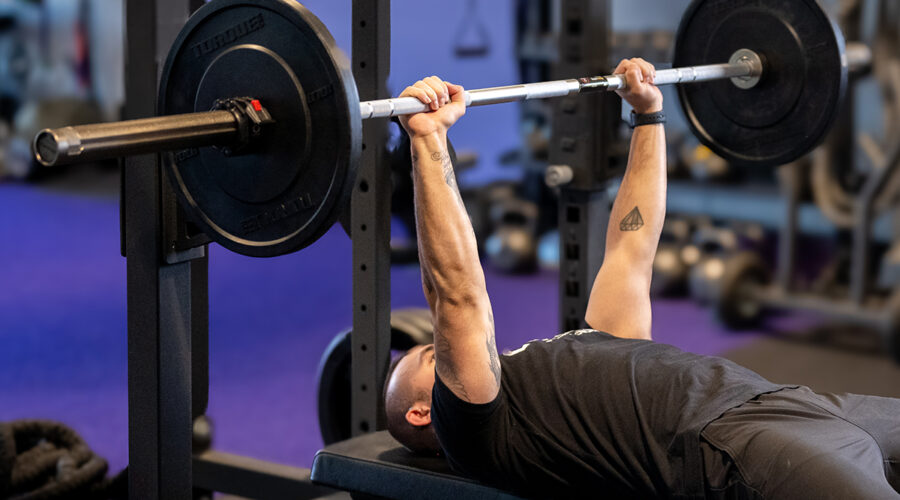
Barbell bench press
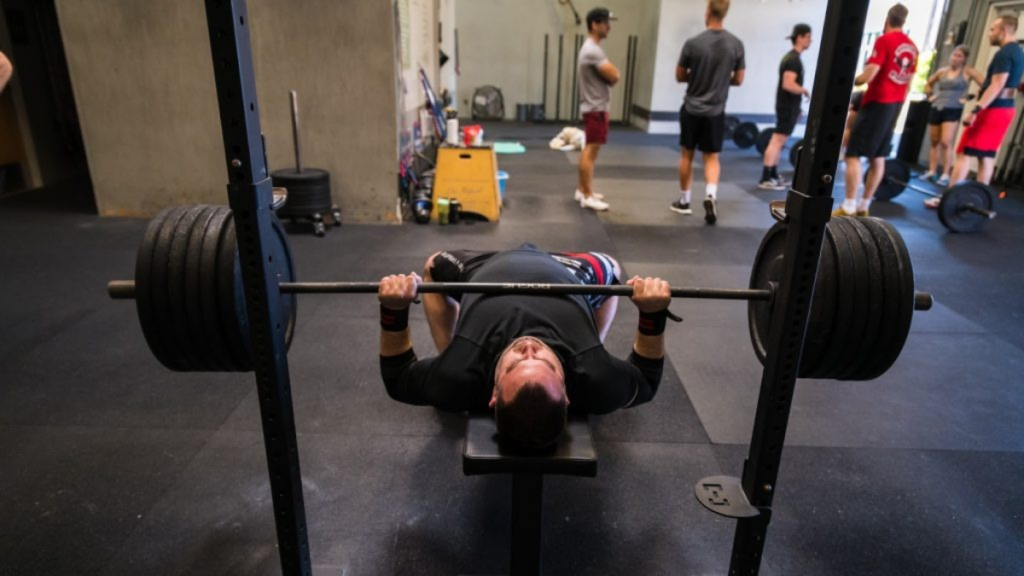
In a barbell bench press, both hands hold a single bar. Your arms move together as you lower the bar toward your chest and press it back up. The bar follows a shared path, which can make the movement feel more stable once you have learned the setup.
A barbell also makes it straightforward to add small amounts of weight as you get stronger. That can be useful when you want to track progress from week to week. However, the bar limits how far your hands can move below your torso, and the fixed grip may not feel comfortable for every beginner.
Dumbbell bench press
With a dumbbell bench press, each hand holds its own weight. This means each arm must control its dumbbell independently. You can adjust your hand position slightly as you lower and press, which some people find more comfortable.
Dumbbells may let you lower your hands a little farther than a barbell, depending on your mobility and control. A deeper position is not automatically better, though. Lower the weights only as far as you can while keeping your shoulders comfortable and your upper body stable.
The independent weights also make the exercise more demanding to set up and control. Beginners may find that their arms wobble or that getting the dumbbells into position takes effort before the chest set even begins.
Which one activates the chest more?
Studies that compare dumbbell and barbell presses have mostly measured muscle activity during individual workouts, rather than comparing chest growth over several months. In one study of trained men, researchers found similar pectoralis major activity during the barbell and dumbbell chest presses. The dumbbell press required a lighter maximum load, likely because controlling two separate weights is more demanding.
This is useful information, but muscle activity measured during one session does not tell us exactly which exercise will build more muscle over time. It would be a mistake to assume that the exercise showing more activity in a single test must produce better long term growth.
There is no strong basis for saying that dumbbells automatically build a fuller chest because they allow more stretch, or that barbells automatically build more muscle because you can lift more total weight. Both can challenge the chest. A comfortable range of motion, controlled repetitions, sufficient effort, and consistent progression matter more than the equipment alone.
Which is better for beginners?
Choose dumbbells if control and comfort are your priorities
Dumbbells let each arm move independently, which can help you notice if one side is less coordinated or feels different from the other. You can also adjust your wrist and elbow positions slightly during the movement. If the barbell grip feels uncomfortable, dumbbells may offer a more natural pressing position.
The tradeoff is that balancing the weights can be difficult at first. Start light enough that you can control the dumbbells without wobbling or rushing the repetitions. If getting into position feels awkward, ask a qualified coach to show you a safe setup, or begin with a chest press machine while you learn the pressing pattern.
Choose a barbell if you want a stable, measurable lift
Once the setup feels familiar, the barbell can be easier to track and progress. You can add small plates as your strength improves, and your hands work together to control one load. For a beginner who wants to build strength alongside chest size, this can make the barbell a practical main lift.
The barbell has a safety consideration: if you cannot complete a repetition, the bar can become difficult to manage. Use a rack with safety bars set at the right height, or have a competent spotter help you. Do not attempt a heavy set alone without a safe way to end it.
Let your body help you decide
A bench press should challenge your chest and arms without causing sharp pain. Some variation in comfort between exercises is normal, but you should not push through pain in your shoulder, wrist, or chest. If one version consistently feels uncomfortable, try a lighter load, a shorter range of motion, a different grip, or another pressing option.
Your proportions and mobility affect how each lift feels. The position that works well for one person may not suit another. Use a range you can control while keeping your upper back supported and your shoulders comfortable.
How should beginners train for chest growth?
Start with two or three working sets of a press, using a weight that lets you perform controlled repetitions. A set of roughly 8 to 12 repetitions is a convenient starting point, although research supports muscle growth with a wider range of loads when sets are sufficiently challenging. You do not need to reach complete muscular failure on every set. Finish most sets feeling that you could perform a few more good repetitions.
When you can complete all your planned repetitions with consistent technique, increase the weight by a small amount or add a repetition. Do not increase the load if you have to bounce the weight, shorten the range substantially, or lose control. A gradual increase helps you keep the exercise productive as you become stronger.
For a beginner, two weekly chest training sessions can be a practical way to spread out your work. Begin with a modest number of challenging chest sets across the week and add more only if you are recovering well and continuing to progress. The exact amount that works best will vary between people.
You can use one press as your main lift and add another chest exercise later in the workout, such as a push-up or a machine press. You do not need to perform both dumbbell and barbell bench presses in every session. Alternating them across workouts is another simple way to learn both without making the routine unnecessarily complicated.
How to perform each press with control
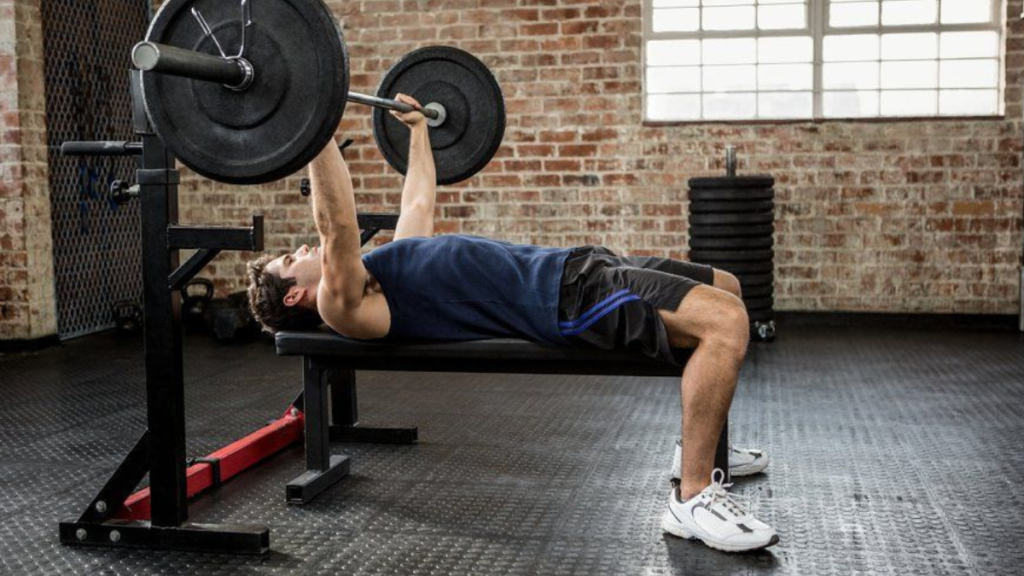
For either exercise, lie on the bench with your feet planted on the floor. Keep your upper back supported and your shoulder blades gently drawn back against the bench. Lower the weights under control toward the middle of your chest, then press them up without bouncing or letting your shoulders roll forward.
For a barbell press, choose a grip that lets your wrists stay stacked over your forearms and your elbows sit at a comfortable angle as the bar comes down. For dumbbells, keep the weights steady and avoid letting them drift far out to the sides. Your elbows do not need to flare straight out from your shoulders.
How Many Chin-Ups Should You Be Able to Do Based on Your Age?
A slow, controlled lowering phase can help you maintain position and use a consistent range of motion. There is no need to exaggerate the tempo or force an uncomfortable stretch. Stop the descent at the point where you can still keep your shoulders comfortable and the weights under control.
The verdict
For beginners, dumbbell and barbell bench presses are both effective ways to train the chest. Current comparisons do not show that one consistently builds a better-looking chest than the other. The barbell can make progressive loading and tracking simpler, while dumbbells let each arm move independently and may feel more comfortable for some lifters.
If you are new to lifting, start with the version you can perform safely and consistently. Learn the movement, use a manageable load, and make gradual progress. You can add the other version later. Over time, the training you can repeat and improve is more likely to shape your chest than a debate over which tool is superior.
Key Takeaways
| Topic | Takeaway |
|---|---|
| Chest growth | Both dumbbell and barbell bench presses can train the pectoral muscles effectively. |
| Research | Acute muscle activity studies do not prove that one version creates more long term chest growth. |
| Barbell advantage | It can be easier to track and increase the load in small steps. |
| Dumbbell advantage | Each arm controls its own weight, and hand position can be adjusted more freely. |
| Beginner priority | Use a controlled, comfortable range and progress gradually. |
| Safety | Use rack safety bars or a spotter for challenging barbell sets. |
References
- American College of Sports Medicine (2026) ‘Resistance training prescription for muscle function, hypertrophy, and physical performance in healthy adults: an overview of reviews’, Medicine & Science in Sports & Exercise, 58(4), pp. 851–872.
- Korakakis, P.A., Wolf, M., Coleman, M., Burke, R., Piñero, A., Nippard, J. and Schoenfeld, B.J. (2024) ‘Optimizing resistance training technique to maximize muscle hypertrophy: a narrative review’, Journal of Functional Morphology and Kinesiology, 9(1), p. 9.
- Saeterbakken, A.H., van den Tillaar, R. and Fimland, M.S. (2011) ‘A comparison of muscle activity and 1-RM strength of three chest-press exercises with different stability requirements’, Journal of Sports Sciences, 29(5), pp. 533–538.
- Schoenfeld, B.J., Grgic, J., Ogborn, D. and Krieger, J.W. (2017) ‘Strength and hypertrophy adaptations between low- vs. high-load resistance training: a systematic review and meta-analysis’, Journal of Strength and Conditioning Research, 31(12), pp. 3508–3523.
- Schoenfeld, B.J., Ogborn, D. and Krieger, J.W. (2017) ‘Dose-response relationship between weekly resistance training volume and increases in muscle mass: a systematic review and meta-analysis’, Journal of Sports Sciences, 35(11), pp. 1073–1082.