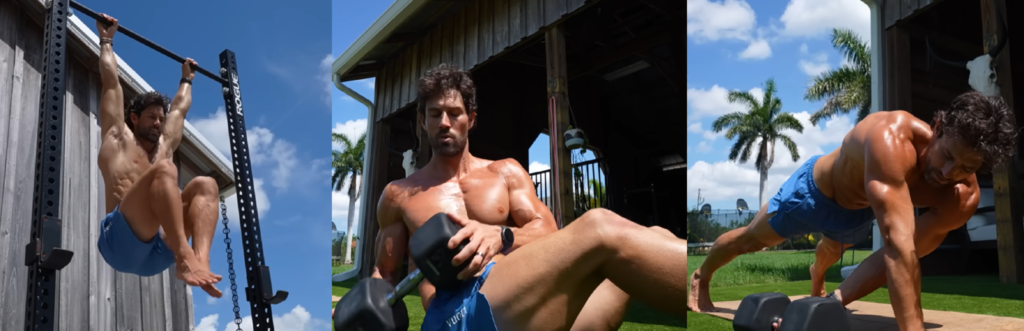


The lower abs are one of the most popular areas to train, but they are often misunderstood. The rectus abdominis is one continuous muscle that runs from the rib cage to the pelvis. You cannot completely isolate the lower section, but you can use exercises that challenge pelvic control, trunk stability, and resistance to unwanted movement.
A ripped lower ab look also depends on overall body fat. Dumbbell exercises can build the abs and obliques, but they cannot remove fat only from the lower stomach. Direct core training must be paired with full body resistance training, regular activity, and nutrition that supports fat loss if visible definition is your goal.


The three exercises below are the dumbbell reverse crunch, dumbbell dead bug, and suitcase carry. They train the abdominal muscles through controlled pelvic movement, anti extension strength, and resistance to sideways bending.
What the Lower Abs Do
The rectus abdominis helps flex the trunk and control the pelvis. During lower ab focused exercises, the important action is usually posterior pelvic tilt. This means gently curling the pelvis toward the ribs rather than simply lifting the legs with the hip flexors.
The obliques also play a major role. They help control rotation and side bending while keeping the trunk organized during movement. A strong lower ab region is not only about appearance. It helps you brace during lifting, running, carrying, jumping, and changing direction.
Research on abdominal training shows that the rectus abdominis and obliques can be trained effectively through controlled resistance exercise. However, visible definition requires overall fat loss because localized exercise does not selectively reduce abdominal fat.
1. Dumbbell Reverse Crunch
The dumbbell reverse crunch is the most direct lower ab exercise in this article. It challenges the rectus abdominis by teaching you to curl the pelvis upward toward the rib cage.
Lie on your back with your knees bent and hips flexed. Hold a light dumbbell securely between your feet or ankles only if you can control it safely. Beginners should begin without the dumbbell until the bodyweight version is smooth.
Bring your knees toward your chest, then gently lift your tailbone from the floor by curling your pelvis upward. Avoid swinging the legs. Lower slowly until your hips return to the floor, then repeat.
The important part is the pelvic curl. If you only raise the knees, the hip flexors do more of the work. Think about drawing your belt buckle toward your ribs as you reach the top.
How to Progress the Dumbbell Reverse Crunch
Start with two or three sets of eight to twelve repetitions. Use no load or a very light dumbbell until you can keep the movement controlled.
Progress by slowing the lowering phase, pausing at the top, adding repetitions, or using slightly more load. Stop the set if you begin swinging or lose control of the dumbbell.
2. Dumbbell Dead Bug
The dumbbell dead bug trains the abs to resist extension while the arms and legs move. It is a useful exercise for building control through the trunk and pelvis. Lie on your back with your arms extended above your chest, holding one dumbbell securely with both hands. Bring your hips and knees to about 90 degrees. Gently press your lower back toward the floor without forcing it flat.
Slowly lower one heel toward the floor while keeping the dumbbell stable above the chest. Return to the starting position, then repeat with the other leg. Your ribs and pelvis should remain controlled throughout the exercise.
The dumbbell adds a forward load that increases the demand on the abs. Your rectus abdominis and obliques must resist the urge to arch the lower back as the leg extends.
How to Progress the Dumbbell Dead Bug
Begin with two or three sets of six to ten repetitions per side. Use a light dumbbell and move slowly enough that you can stop at any point.
Progress by lowering the heel closer to the floor, extending the leg farther, adding a small amount of weight, or slowing the return. Quality matters more than range of motion.
3. Dumbbell Suitcase Carry
The suitcase carry is a powerful exercise for the obliques, grip, upper back, and trunk. Hold one dumbbell at your side and walk with control. The uneven load tries to pull your torso sideways, while your core works to resist that movement.
Stand tall with a dumbbell beside one foot. Hinge down, grip the handle, and stand up with control. Keep your shoulders level, ribs stacked over your pelvis, and neck relaxed.
Walk forward slowly with short, natural steps. Do not lean away from the dumbbell or let the shoulder on the loaded side rise toward your ear. Complete the carry, set the dumbbell down safely, and repeat on the other side.
The suitcase carry trains the lower abs and obliques as part of a larger stability task. It does not isolate the rectus abdominis, but it develops the ability to resist side bending under load.
How to Progress the Suitcase Carry
Start with two or three carries of twenty to thirty seconds per side. Choose a load that challenges you without changing your walking pattern.
Progress by adding weight, carrying for a longer time, or walking farther. Change only one variable at a time so you can maintain upright posture.
How to Program These Exercises
Train your core two or three times per week. Perform the reverse crunch first because it is the most direct abdominal movement. Follow with dead bugs and suitcase carries for controlled trunk stability.
A simple session can include three sets of reverse crunches, two sets of dead bugs per side, and two suitcase carries per side. This provides direct lower ab work without creating excessive fatigue.
Most sets should end with one to three good repetitions still available. Progressive overload matters, but clean technique matters more. Build the exercise gradually rather than rushing to use heavier dumbbells.
Final Thoughts
The dumbbell reverse crunch, dumbbell dead bug, and suitcase carry are three effective exercises for building stronger lower abs and obliques. The reverse crunch trains pelvic control. The dead bug builds anti extension strength. The suitcase carry develops loaded trunk stability.
They cannot isolate the lower abs completely or reveal them without overall fat loss. Combine these exercises with full body strength training, sustainable nutrition, and regular activity for the best results.
Key Takeaways
| Exercise | Main core demand | Starting recommendation | Main technique priority |
|---|---|---|---|
| Dumbbell reverse crunch | Pelvic curl and trunk flexion | Two or three sets of eight to twelve repetitions | Curl the pelvis instead of swinging the legs |
| Dumbbell dead bug | Resisting lower back extension | Two or three sets of six to ten repetitions per side | Keep the ribs and pelvis controlled |
| Dumbbell suitcase carry | Resisting side bending under load | Two or three carries of twenty to thirty seconds per side | Walk tall without leaning |
| Overall strategy | Core strength and visible definition | Train core two or three times weekly | Combine core work with full body training and nutrition |
References
- Escamilla, R.F., Babb, E., DeWitt, R., Jew, P., Kelleher, P., Burnham, T., Busch, J., D Anna, K. and Montalvo, S. (2006) ‘Electromyographic analysis of traditional and nontraditional abdominal exercises: Implications for rehabilitation and training’, Physical Therapy, 86(5), pp. 656 to 671.
- McGill, S.M. and Karpowicz, A. (2009) ‘Exercises for spine stabilization: Motion and motor patterns, stability progressions, and clinical technique’, Archives of Physical Medicine and Rehabilitation, 90(1), pp. 118 to 126.
- Schoenfeld, B.J., Ogborn, D. and Krieger, J.W. (2017) ‘Dose response relationship between weekly resistance training volume and increases in muscle mass: A systematic review and meta analysis’, Journal of Sports Sciences, 35(11), pp. 1073 to 1082.
- Vispute, S.S., Smith, J.D., LeCheminant, J.D. and Hurley, K.S. (2011) ‘The effect of abdominal exercise on abdominal fat’, Journal of Strength and Conditioning Research, 25(9), pp. 2559 to 2564.