

If you want to refine and develop your lower pecs, then you might need to switch things up in your training.
Here’s how to do it.
Why The Flat Barbell Bench Press Often Leaves Lower Chest Growth Behind
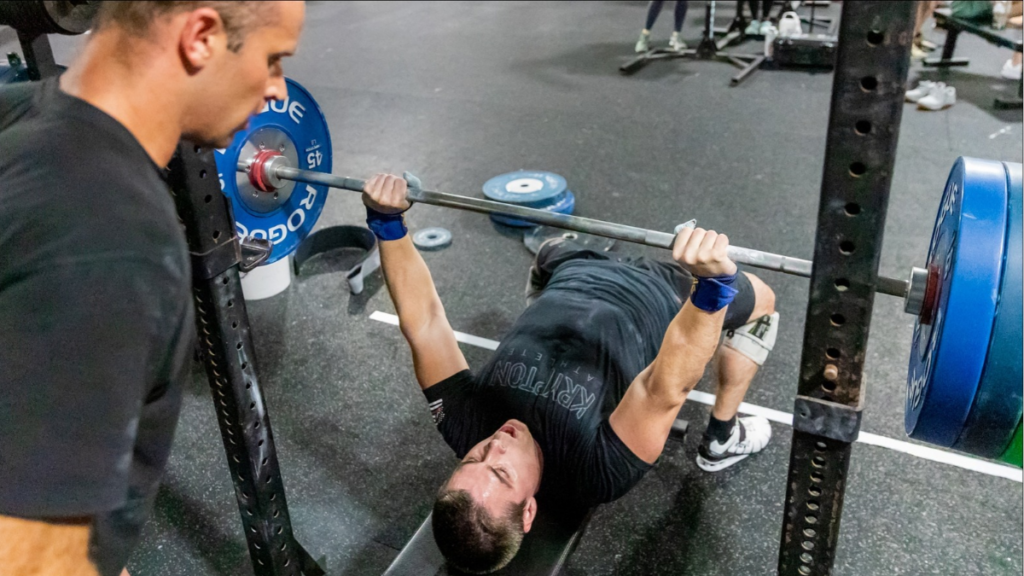
The flat barbell bench press is an effective exercise for moving heavy external loads across a horizontal plane, yet lying flat on a horizontal bench creates distinct anatomical limitations when your goal is maximizing lower chest hypertrophy. The pectoralis major is a broad, fan-shaped muscle divided into functionally distinct regions, including the upper clavicular head near the collarbone and the larger sternocostal head spanning the middle and lower chest.
Because the lower fibers of the sternocostal head run diagonally upward and outward from the lower sternum and costal cartilages toward the humerus, they generate their strongest mechanical pull when your upper arms move downward and across your torso rather than straight out in front of your chest.
In addition to fiber angle, a straight barbell imposes rigid mechanical constraints on how deeply your chest can stretch and contract on every repetition. When you lower a barbell during a flat bench press, the bar physically stops against your sternum before your shoulder joint reaches full extension, cutting off the bottom portion of the stretch where muscle growth signaling is exceptionally strong. At the top of the lift, a fixed straight bar prevents your hands from converging inward toward the midline of your body, which means the lower pectoral fibers never reach complete horizontal adduction and peak contraction together.
Revealing The Exercise: The Weighted Chest Dip
The undervalued lower chest exercise that can trigger faster lower pectoral muscle growth than the flat barbell bench press is the chest-focused parallel bar dip, progressed gradually with external weight once bodyweight repetitions become manageable. At first glance, lifting your own body between two parallel bars might seem like a basic gymnastics drill or a secondary triceps finisher, yet adjusting your torso angle slightly forward transforms the dip into one of the highest-tension lower chest builders in strength training.
When you lean your torso forward roughly twenty to thirty degrees and allow your elbows to flare slightly outward as you descend, the line of resistance aligns directly with the lower sternocostal fibers of the pectoralis major.
Unlike a flat barbell bench press where a bar stops early against your rib cage, parallel bars sit beside your torso and leave the space between your hands completely open.
That open pathway allows your shoulders to move smoothly into controlled extension at the bottom of every repetition, placing the lower chest fibers into a deep, loaded stretch before you press your body upward. Furthermore, because your hands are fixed on the bars while your torso moves freely in space, your shoulder blades can glide naturally around your rib cage without being pinned flat against a padded bench.
Comparing Weighted Chest Dips and Flat Barbell Bench Press For Lower Chest Growth
| Training Characteristic | Weighted Chest Dips | Flat Barbell Bench Press |
|---|---|---|
| Line of Force Alignment | Matches the downward diagonal angle of lower chest fibers | Horizontal force favors middle sternocostal fibers |
| Bottom Range of Motion | Deep loaded stretch unconstrained by a barbell hitting the chest | Bar contact on sternum terminates downward travel early |
| Scapular Freedom | Closed kinetic chain allows natural shoulder blade movement | Scapulae remain pinned against the bench pad under load |
| Progression Potential | Easily loaded via dip belt, dumbbells, or slow eccentric tempo | Loaded via incremental barbell plates |
What Scientific Research Shows About Dips, Angles, And Chest Hypertrophy
Exercise science and electromyography research consistently demonstrate that changing the angle of humeral movement alters muscle fiber recruitment across the different subdivisions of the pectoralis major. Studies comparing flat pressing against downward-angled pressing and dip variations show that pressing downward relative to the torso increases activation in the lower sternocostal region of the pectoralis major while maintaining strong overall pectoral recruitment.

Because the lower pectoral fibers pull the humerus downward from a flexed or abducted position toward the hip, the biomechanical trajectory of a forward-leaning dip matches their anatomical function far more closely than a horizontal press.
Modern sports science research on muscle hypertrophy also emphasizes the powerful role of mechanical tension and training through long muscle lengths. Systematic reviews and meta-analyses comparing full range of motion against partial range of motion consistently show that exercises challenging a muscle in its lengthened, stretched position promote robust increases in muscle thickness and architectural growth.
Why Closed-Chain Pressing Protects Shoulders While Building Muscle
Another overlooked advantage of chest dips lies in their closed kinetic chain mechanics, where your hands remain anchored on stationary bars while your torso moves around the shoulder joint.
Biomechanical investigations of shoulder kinematics show that closed-chain pressing movements encourage coordinated activation of the serratus anterior and rotator cuff stabilizers alongside the prime movers. When your shoulder blades are free to upwardly rotate, protract, and retract naturally rather than being locked into a bench, you can train the lower chest hard while supporting healthy scapulohumeral rhythm.
How To Perform And Program Chest Dips For Maximum Lower Chest Growth
Executing parallel bar dips for lower chest hypertrophy requires deliberate posture and controlled range of motion rather than bouncing rapidly up and down for high repetitions. Grasp the parallel bars slightly wider than shoulder width, press yourself to the top with your elbows extended, and tilt your torso forward roughly twenty to thirty degrees by bending your knees slightly and letting your legs drift subtly behind your hips. Keep your chest lifted, your shoulders pulled down away from your ears, and lower your body under a smooth three-second count until your upper arms drop slightly below parallel to the floor and you feel a firm, comfortable stretch across your lower chest.

From that deep stretched bottom position, press smoothly back up until your elbows reach near lockout while maintaining that slight forward torso lean throughout the entire set. Once you can complete twelve to fifteen clean bodyweight repetitions with full control, add external resistance using a dip belt or a dumbbell held securely between your feet so you can keep challenging the lower chest in the eight to twelve repetition range.
3 Perfect Exercises for Building the Lower Pecs Beginners Often Overlook
Performing three to four working sets once or twice per week provides ample mechanical tension and metabolic stress without overwhelming shoulder recovery.
Smart Progression And Joint Comfort Guidelines
Because deep dips place meaningful stretch across the anterior shoulder capsule and sternum, respecting individual mobility limits is essential for long-term progress. Never force your shoulders into a painful depth just to chase extra range of motion, and warm up thoroughly with light sets before adding external weight. Placing weighted chest dips either as your primary lower-chest movement or immediately after your main compound lift allows you to apply maximal focus and clean technique while your nervous system is fresh.
Practical Programming Guide For Weighted Chest Dips
| Programming Variable | Recommended Approach | Practical Purpose |
|---|---|---|
| Torso Lean Angle | Twenty to thirty degrees forward lean | Shifts mechanical tension directly onto lower chest fibers |
| Weekly Frequency | One to two sessions per week | Balances high growth stimulus with shoulder and tendon recovery |
| Repetitions Per Set | Eight to twelve controlled repetitions | Accumulates strong mechanical tension for hypertrophy |
| Lowering Tempo | Two to three seconds eccentric phase | Maximizes time under tension in the stretched bottom range |
Key Takeaways For Faster Lower Chest Growth
| Key Takeaway | Practical Application |
|---|---|
| Flat Benching Misses Lower Fiber Angle | Horizontal pressing favors middle chest fibers and stops early when the bar hits the chest. |
| Forward-Leaning Dips Target Lower Chest | Tilting the torso forward twenty to thirty degrees aligns resistance with lower sternal fibers. |
| Deep Stretch Drives Hypertrophy | Parallel bars allow safe downward travel into a deep stretch under high mechanical tension. |
| Closed-Chain Mechanics Aid Stability | Free scapular movement supports coordinated shoulder stability during heavy pressing. |
| Progress Gradually With Clean Form | Master strict bodyweight reps before adding weight with a dip belt for steady growth. |
References
- Barnett, C., Kippers, V. and Turner, P., 1995. Effects of variations of the bench press exercise on the EMG activity of five shoulder muscles. Journal of Strength and Conditioning Research, 9(4), pp.222-227.
- Glass, S.C. and Armstrong, T., 1997. Electromyographical activity of the pectoralis muscle during incline and decline bench presses. Journal of Strength and Conditioning Research, 11(3), pp.163-167.
- Lauver, J.D., Cayot, T.E. and Scheuermann, B.W., 2016. Influence of bench angle on upper extremity muscular activation during bench press exercise. European Journal of Sport Science, 16(3), pp.309-316.
- McKenzie, A., Crowley-McHattan, Z., Meir, R., Whitting, J. and Volschenk, W., 2022. Bench, bar, and ring dips: do kinematics and muscle activity differ? International Journal of Environmental Research and Public Health, 19(20), p.13211.
- Schoenfeld, B.J. and Grgic, J., 2020. Effects of range of motion on muscle development during resistance training interventions: A systematic review. SAGE Open Medicine, 8, pp.1-11.
- Wolf, M., Androulakis-Korakakis, P., Wang, Y., Fisher, J.P. and Steele, J., 2023. Partial vs full range of motion resistance training: a systematic review and meta-analysis. International Journal of Strength and Conditioning, 3(1), pp.1-44.