



























The Best Chest Workout Men Over 40 Can Do


Walking into the gym in your forties often feels very different than it did when you were twenty. There are more challenges to face, but thankfully, you’re smarter now so there is no need to worry.
Gone are the days when you can simply destroy yourself with bench presses and watch the gains pile in. You need an intelligent plan involving mobility, recovery and good programming.
In this article we will explore all of these aspects of your training, and provide you with a solid chest workout to add into your routine.
Why Your Chest Training Needs to Evolve After 40
Once you pass your 40th birthday, your body undergoes natural physiological shifts that directly impact how you recover from heavy resistance training.
Tendons and ligaments lose some of their natural elasticity and blood supply over time, which means the connective tissues around your shoulder capsule take longer to repair after intense mechanical stress. At the same time, natural anabolic hormone production begins a gradual decline, making your muscles slightly less responsive to sloppy training sessions or junk volume.

Research consistently shows that men over forty can build just as much muscle as younger lifters when they manage joint stress and optimize mechanical tension.
The Science of Muscle Growth Without Heavy Joint Stress
Muscle fibers respond primarily to mechanical tension and proximity to muscular failure rather than the absolute weight on the bar. Studies comparing low-load training to high-load training demonstrate that using moderate weights for higher repetitions produces muscle growth while drastically reducing compressive forces on the shoulder joint.
Another crucial factor for lifters over forty is exercise order and pre-exhaustion. Performing an isolation movement or a machine press before your primary compound lift drives blood into the pectoral muscles, warms up the synovial fluid in the shoulder capsule, and ensures your chest fatigues before your anterior deltoids or triceps take over the movement.
The Ultimate Chest Workout Routine for Men Over 40
This workout is structured to maximize muscle fiber recruitment across the upper, middle, and lower regions of your chest while protecting your rotator cuffs. You should perform this routine once or twice per week, allowing at least seventy-two hours of recovery between sessions so your connective tissues can fully repair.
Rest for ninety seconds to two minutes between sets to maintain high force output without letting your heart rate spike unnecessarily.
Workout
| Exercise | Sets | Repetitions | Rest Period | Primary Target |
| Seated Cable Fly | 3 | 12 to 15 | 90 seconds | Upper and Inner Chest Activation |
| Incline Dumbbell Press | 4 | 8 to 10 | 120 seconds | Clavicular Head (Upper Chest) |
| Machine Chest Press | 3 | 10 to 12 | 90 seconds | Sternal Head (Mid Chest) |
| Weighted Dip or Decline Press | 3 | 10 to 12 | 90 seconds | Lower Chest and Triceps |
| Pushup to Failure | 2 | AMRAP | 60 seconds | Metabolic Stress and Finisher |
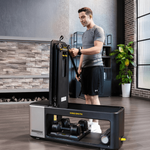
Seated Cable Fly
Starting your workout with a seated cable fly acts as a targeted primer that wakes up the mind-muscle connection in your pectorals before you touch a heavy weight.
Set the pulleys to just above shoulder height, press your back firmly against an upright bench, and bring your hands together in a wide arcing motion while keeping a slight bend in your elbows.
Squeeze your chest hard for a full second at the peak of every repetition, then control the weight slowly on the way back until you feel a deep, comfortable stretch across your chest.
Incline Dumbbell Press
The incline dumbbell press is the undisputed king of upper chest development for men over forty because the thirty-degree bench angle highlights the clavicular fibers that give your torso a powerful, athletic shelf.
Using dumbbells instead of a barbell lets you rotate your palms slightly inward at a forty-five-degree angle, which creates massive space in the subacromial joint and eliminates shoulder pinching.
Lower the weights until your elbows are just below the level of the bench, pause briefly to eliminate momentum, and drive the dumbbells back up without clanking them together at the top.
Machine Chest Press
After your free weight pressing is complete, moving to a converging plate-loaded or selectorized chest press machine allows you to push close to muscular failure without worrying about stabilizing the load.
Because the handles move inward as you press forward, the machine mimics the natural adduction function of the pectoral muscles far better than a straight bar ever could. Keep your shoulder blades pinned back against the pad throughout the entire set so your front deltoids do not roll forward and steal tension from your chest.
Weighted Dip or Decline Press
Training the lower portion of the pectoral muscles adds thickness and definition to the bottom border of your chest. If your shoulders feel completely pain-free, lean your torso forward at a thirty-degree angle on a wide-grip dip station and lower yourself until your upper arms are parallel to the floor.
If dips cause any tightness in the front of your shoulders or sternum, substitute a slight decline dumbbell press or a low-to-high cable crossover to stimulate the exact same muscle fibers safely.
Pushup to Failure
Finishing your session with two bodyweight sets of pushups taken close to technical failure floods the chest with nutrient-rich blood and triggers significant metabolic stress. Elevate your hands slightly on pushup handles or dumbbells if your wrists feel stiff, keep your core braced like a rigid plank, and perform smooth repetitions until your movement speed slows down noticeably.
Nutrition and Recovery Rules for Over-40 Lifters
Even the smartest training program will stall if your nutrition and recovery habits do not match the demands of your workouts. As men age, the body experiences a phenomenon known as anabolic resistance, which means your muscles require a higher dose of dietary protein to trigger the same muscle protein synthesis response you enjoyed in your twenties.
Aiming for roughly two grams of protein per kilogram of body weight each day, spread evenly across three or four meals, ensures your chest has a steady supply of amino acids for repair.

Sleep quality also plays a massive role in tissue regeneration and hormone balance. Getting seven to eight hours of uninterrupted sleep each night maximizes natural growth hormone release and keeps cortisol levels in check so your joints stay resilient week after week.
Key Takeaways for Chest Growth After 40
| Training Principle | Old School Approach | Over-40 Science-Backed Strategy |
| Primary Pressing Tool | Flat Barbell Bench Press | Incline Dumbbells and Converging Machines |
| Rep Ranges | Heavy 3 to 5 Reps | Moderate 8 to 15 Reps |
| Exercise Order | Heavy Compound First | Cable Isolation Primer First |
| Grip Position | Wide Pronated Overhand | Neutral or 45-Degree Angled Grip |
| Daily Protein Intake | Low to Moderate | 1.6 to 2.2 Grams per Kilogram of Body Weight |
References
- Breen, L. and Phillips, S.M. (2011) ‘Skeletal muscle protein metabolism in the elderly: Interventions to counteract the “anabolic resistance” of ageing’, Nutrition & Metabolism, 8(1), p. 68.
- Green, C.M. and Comfort, P. (2007) ‘The affect of grip width on bench press performance and risk of injury’, Strength and Conditioning Journal, 29(5), pp. 10–14.
- Lauver, J.D., Cayot, T.E. and Scheuermann, B.W. (2016) ‘Influence of bench angle on upper extremity muscular activation during bench press exercise’, European Journal of Sport Science, 16(3), pp. 309–316.
- Morton, R.W., Oikawa, S.Y., Wavell, C.G., Mazara, N., McGlory, C., Quadrilatero, J., Baechler, B.L., Baker, S.K. and Phillips, S.M. (2016) ‘Neither load nor systemic hormones determine resistance training-mediated hypertrophy or strength gains in resistance-trained young men’, Journal of Applied Physiology, 121(1), pp. 129–138.
- Schoenfeld, B.J., Grgic, J., Ogborn, D. and Krieger, J.W. (2017) ‘Strength and hypertrophy adaptations between low- vs. high-load resistance training: A systematic review and meta-analysis’, Journal of Strength and Conditioning Research, 31(12), pp. 3508–3523.
- Soares, E.G., Brown, L.E., Gomes, W.A., Corrêa, D.A., Serpa, É.P., da Silva, J.J., Junior, G.D.B.V., Fioravanti, G.Z., Aoki, M.S., Lopes, C.R. and Marchetti, P.H. (2016) ‘Comparison between pre-exhaustion and traditional exercise order on muscle activation and performance in trained men’, Journal of Sports Science & Medicine, 15(1), pp. 111–117.
Robbie Wild Hudson
Editor-In-Chief at BOXROX. I come from a background of rugby and weightlifting. Growing up in the English Lake District, I spent a great deal of time swimming in its stunning lakes and rivers. In 2015 my brothers and I became the first people to swim the 145km length of the River Eden, from source to mouth, in 9 days. We also swam the Corryvreckan whirlpool, the third largest in the world, and Crossfit is a huge part of my training for these events.
More from Robbie Wild Hudson