

A well developed chest does not come from doing one popular press over and over again. The pectoralis major is a large, fan shaped muscle with fibers that run in different directions, and your exercise selection can influence which region receives the greatest challenge.
Many beginners spend most of their chest training on flat bench presses, push ups, and incline work. Those are useful exercises, but they can leave the lower portion of the chest undertrained. This area includes much of the sternocostal portion of the pectoralis major, which contributes to the fuller, more complete look of the chest.



It is important to be realistic about what training can do. You cannot completely isolate one small section of the chest, and genetics will influence the shape of your pecs. However, choosing pressing and fly movements that use a downward line of force can help you train the lower fibers more deliberately. When you combine that with progressive overload, enough weekly training volume, solid technique, and recovery, you give your chest a strong reason to grow.
The three exercises below are beginner friendly when scaled correctly. They also offer something many standard chest routines miss: a direct challenge to the lower and middle chest fibers through a useful range of motion.
What Are the Lower Pecs?
The pectoralis major has two broad regions. The clavicular portion begins near the collarbone, while the larger sternocostal portion attaches along the breastbone and rib cartilage. The fibers of the sternocostal portion make up much of what people informally call the middle and lower chest.
The chest works to bring the upper arm toward the center of the body. It also assists with moving the arm downward from a raised position. This is why the direction of a press or fly matters. Exercises that place the hands above the chest and bring them downward and inward can provide a useful training stimulus for the sternocostal fibers.
3 Best Beginner Exercises for Great Looking Arms
Research using electromyography has found that bench angle changes muscle activity across the chest and shoulder muscles. Flat and decline pressing variations tend to create substantial activity in the sternocostal portion of the pectoralis major, while steeper incline pressing places more demand on the upper chest and front delts. Electromyography does not directly measure muscle growth, but it can help explain why different pressing angles feel different and may be useful within a balanced chest program.
The goal is not to abandon flat presses. Instead, use a small number of well chosen movements to make sure your entire chest receives hard, productive work.
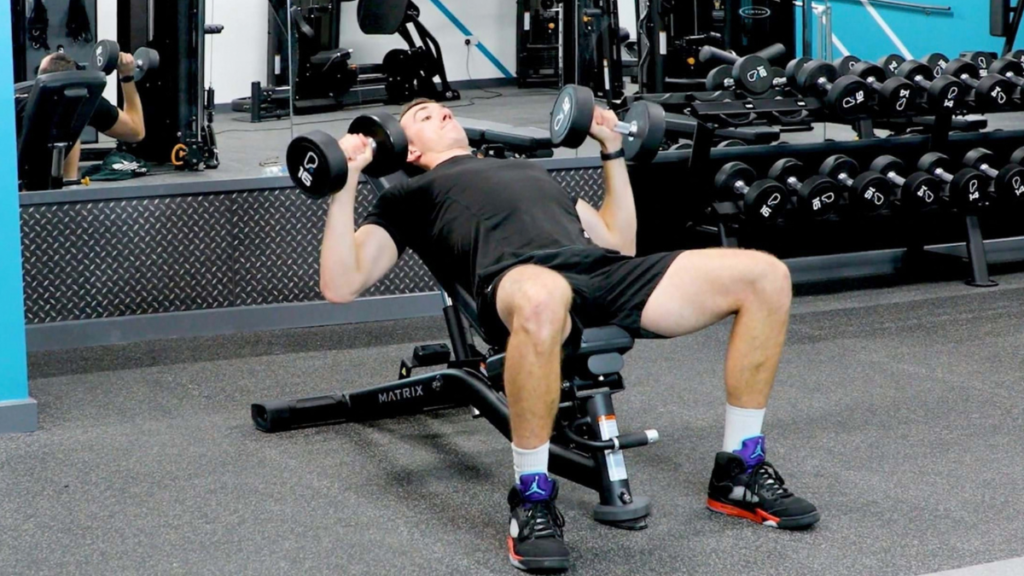
1. Decline Dumbbell Press
The decline dumbbell press is one of the most effective exercises beginners often overlook. It uses a slight downward bench angle, which changes the path of the press and can place greater emphasis on the sternocostal region of the pectoralis major.
Dumbbells are especially helpful for beginners because each arm works independently. This can expose strength differences between sides and encourages you to control the weight rather than relying on one stronger arm. Dumbbells also allow a more natural pressing path than a fixed barbell, which some lifters find more comfortable for their shoulders.
How to Perform the Decline Dumbbell Press
Set the bench to a modest decline angle rather than an extreme position. Secure your feet under the pads if the bench has them. Begin with the dumbbells above your lower chest, with your palms facing forward or turned slightly inward.
Lower the dumbbells slowly toward the lower portion of your chest. Keep your elbows at a comfortable angle from your torso rather than flaring them directly to the sides. Press the weights upward and slightly inward until your arms are straight, but do not aggressively smash the dumbbells together at the top.
Start with a weight that allows you to control every repetition. The lowering phase matters because mechanical tension across the full range of motion is a major driver of hypertrophy. A rushed descent can reduce control and make the exercise less comfortable for the shoulders.
Why It Works
Bench angle has been shown to influence pectoralis major activity. Studies comparing pressing angles indicate that flatter and decline positions can strongly recruit the sternocostal chest fibers. The decline press also reduces the amount of shoulder flexion required compared with a steep incline press, which may help some beginners feel the chest working more clearly.
The dumbbell version is not automatically superior to a barbell version, but it is a valuable option. It allows you to use a comfortable grip and a controlled range of motion. If getting into position with dumbbells feels awkward, ask a training partner for help or begin with a decline chest press machine.
Use two or three sets of eight to 15 repetitions. Stop each set with one to three good repetitions still possible. As your technique improves, gradually add repetitions or a small amount of load.
2. Assisted Chest Dips
Dips are often thought of as a triceps exercise, but a chest focused dip can be an excellent movement for the lower pecs. The difference comes from body position. Staying upright tends to shift more work toward the triceps, while a modest forward lean allows the chest to contribute more strongly.
For a beginner, the assisted dip machine is the best starting point. It lets you experience the movement pattern without having to lift your full body weight. Band assisted dips can also work, but the assistance changes through the repetition and can make the exercise harder to control.
How to Perform an Assisted Chest Dip
Set the machine to provide enough assistance that you can complete eight to 12 smooth repetitions. Grip the handles firmly and begin with your elbows straight. Lean your torso slightly forward and keep your chest lifted.
Lower yourself by bending your elbows. Allow them to travel back and slightly outward in a comfortable path. Descend only as far as you can without pain or an aggressive stretch at the front of the shoulder. Press the handles down to return to the starting position while keeping the slight forward lean.
Think about moving your chest between your hands rather than simply pushing your body upward. This cue can help you maintain a chest focused position.
Why It Works
The dip involves the pectoralis major, triceps brachii, and anterior deltoid. Research examining the bar dip identifies the chest and triceps as key contributors to the movement. The forward torso position and the arm path make it a useful complement to horizontal pressing.
Dips also provide a large range of motion, which can make them demanding even with assistance. You do not need to force an unusually deep repetition to make progress. The safest effective range is the one you can control without shoulder pain, pinching, or loss of position.
Beginners should be conservative with volume. Two sets of six to 10 assisted repetitions once or twice per week is plenty when you are also doing presses and flyes. As you become stronger, reduce the machine assistance gradually. Full bodyweight dips are a milestone, not a requirement for chest growth.
3. High to Low Cable Fly
The high to low cable fly is a simple exercise that provides something pressing movements cannot fully match. It allows the chest to work through horizontal adduction with consistent resistance, particularly when you bring the handles down and together in front of the lower chest.
Unlike a dumbbell fly, cables maintain tension through more of the movement. This can make it easier to control the contraction at the point where your hands come together. It is not a substitute for pressing, but it is a useful accessory exercise after your main compound movement.
How to Perform the High to Low Cable Fly
Set both cable pulleys slightly above shoulder height. Take one handle in each hand and step forward until the weight stack is lifted. Use a staggered stance for stability, soften your knees, and lean forward slightly.
Begin with your arms open wide and your elbows gently bent. Bring the handles down and inward in a smooth arc, aiming to finish with your hands in front of the lower chest or upper abdomen. Pause briefly when your hands meet, then slowly return to the stretched position.
Keep your shoulders down and avoid turning the movement into a press. Your elbows should remain softly bent throughout the repetition. Use a weight that lets you control the stretch and avoid twisting your torso to move the handles.
Why It Works
The pectoralis major is a primary muscle responsible for bringing the arm toward the midline of the body. A cable fly trains this action directly. The high to low angle also gives the movement a line of pull that many lifters find useful for emphasizing the lower chest region.
Research on chest training shows that exercise angle and movement pattern affect pectoralis major activation. Although no single exercise can guarantee isolated lower chest growth, the cable fly is a logical addition because it challenges the chest in a different way from pressing. It also provides a low skill option for accumulating additional quality training volume without needing to use very heavy loads.
Perform two or three sets of 10 to 15 repetitions after your pressing work. Focus on smooth repetitions and a controlled return. The goal is to make the chest do the work, not to use momentum.
How to Build Your Lower Chest Into a Beginner Program
You do not need a complicated chest routine. A beginner can make excellent progress with six to 10 challenging chest sets per week, spread over two sessions if possible. Research suggests that higher weekly resistance training volume is generally associated with greater muscle hypertrophy, although more is not always better if recovery and technique fall apart.
A practical approach is to use the decline dumbbell press as your main lower chest focused lift, then add either assisted dips or high to low cable flyes. You do not need all three exercises in every workout.

For example, one chest session could include decline dumbbell presses followed by high to low cable flyes. A second session later in the week could include a flat press followed by assisted chest dips. This gives you a mixture of heavier compound work and controlled isolation work without overwhelming your shoulders or elbows.
Progressive overload should be gradual. Try to add one repetition while maintaining good form. When you reach the top of your target repetition range for every set, increase the weight slightly and build the repetitions again. This approach is more sustainable than chasing large jumps in load.
Training close to muscular failure can be effective, but beginners do not need to reach failure on every set. Leaving a small margin allows you to learn technique, recover well, and perform more quality work over the week.
Common Mistakes That Limit Lower Chest Growth
The first mistake is trying to train the lower chest with extremely heavy weights before mastering the movement. This is especially common with dips and decline presses. Heavy loading is useful, but only when you can keep your shoulders stable and control the lowering phase.
The second mistake is turning chest dips into triceps dips. If you remain completely upright, keep your elbows very close to your sides, and rush through shallow repetitions, the triceps may take over. A small forward lean and a comfortable depth can make the movement more chest focused.
The third mistake is using too much weight on cable flyes. If you need to bend and straighten your elbows repeatedly, swing your torso, or shrug your shoulders, the load is too heavy. Cable flyes work best when you can control the stretch and squeeze your chest without momentum.
Finally, do not judge progress only by soreness. Muscle soreness is not a reliable measure of a productive workout. Better signs include stronger performance, more controlled repetitions, improved technique, and gradual changes in chest size over months of consistent training.
The Bottom Line
Building the lower chest does not require secret exercises or endless sets. It requires enough hard training, sensible exercise selection, and patience. Decline dumbbell presses, assisted chest dips, and high to low cable flyes give beginners three practical ways to challenge the sternocostal portion of the pectoralis major.
Start light, prioritize control, and progress gradually. Combined with a well rounded chest routine, these exercises can help you build a fuller and more balanced upper body.
References
- Calatayud, J., Borreani, S., Colado, J.C., Martin, F., Flandez, J. and Page, P., 2015. Muscle activation during the bench press with different loads and stability conditions. Journal of Strength and Conditioning Research, 29(12), pp. 3279 to 3283.
- Glass, S.C. and Armstrong, T., 1997. Electromyographical activity of the pectoralis muscle during incline and decline bench presses. Journal of Strength and Conditioning Research, 11(3), pp. 163 to 167.
- Lauver, J.D., Cayot, T.E. and Scheuermann, B.W., 2016. Influence of bench angle on upper extremity muscular activation during bench press exercise. European Journal of Sport Science, 16(3), pp. 309 to 316.
- Martín Fuentes, I., Olivares, J.A., Rodríguez, M., Gutiérrez, J., Muyor, J.M. and Alcaraz, P.E., 2020. Effect of five bench inclinations on the electromyographic activity of the pectoralis major, anterior deltoid, and triceps brachii during the bench press exercise. International Journal of Environmental Research and Public Health, 17(19), 7339.
- Schoenfeld, B.J., Ogborn, D. and Krieger, J.W., 2017. Dose response relationship between weekly resistance training volume and increases in muscle mass: A systematic review and meta analysis. Journal of Sports Sciences, 35(11), pp. 1073 to 1082.
- Schoenfeld, B.J., Grgic, J., Ogborn, D. and Krieger, J.W., 2017. Strength and hypertrophy adaptations between low versus high load resistance training: A systematic review and meta analysis. Journal of Strength and Conditioning Research, 31(12), pp. 3508 to 3523.
- Tsoukos, A., Bogdanis, G.C., Terzis, G., Veligekas, P., Brown, L.E. and Sotiropoulos, A., 2022. Fatigue increases muscle activations but does not change maximal joint angles during the bar dip. Sports, 10(12), 207.
Key Takeaways
| Focus | What beginners should do |
|---|---|
| Lower chest training | Use exercises that challenge the sternocostal region of the pectoralis major through pressing and fly movements. |
| Main press | Perform decline dumbbell presses with controlled repetitions and a comfortable range of motion. |
| Bodyweight option | Use an assisted dip machine first, with a slight forward lean to make the movement more chest focused. |
| Isolation work | Add high to low cable flyes after presses to train the chest through a controlled inward and downward arm path. |
| Progression | Add repetitions or small increases in load over time while maintaining consistent technique. |
| Weekly volume | Build gradually toward six to 10 challenging chest sets per week, adjusted to your recovery and experience. |