

Most beginners who want bigger arms focus on making their biceps look taller. That can help, but it is only part of the picture. If you want biceps that look wider from the front and fill out your sleeves more convincingly, you need to develop the muscles around the upper arm as well as the biceps brachii itself.
Your arm width is influenced by the biceps brachii, brachialis, and brachioradialis. The brachialis sits underneath the biceps and can push it outward as it grows. The brachioradialis runs down the upper forearm and adds thickness around the elbow area. Training these muscles well will not change your bone structure, but it can make your upper arms look far more substantial.


Beginners are in a great position because consistent resistance training can produce noticeable changes in strength and muscle size within the first few months. The key is not chasing a huge list of curl variations. It is applying a few simple principles consistently, improving your performance over time, and eating enough to support the work you do.
Understand What Makes Biceps Look Wider
The biceps brachii is the obvious arm muscle that people associate with curls. It has two heads and crosses both the shoulder and elbow joints. Its main jobs include bending the elbow and helping rotate the forearm so that the palm faces upward.
However, a wider looking upper arm does not come from the biceps alone. The brachialis is a powerful elbow flexor that sits beneath it. Because it is positioned under the biceps, adding muscle to the brachialis can create a thicker appearance from the front and side. The brachioradialis contributes to elbow flexion too, particularly when the hand is held in a neutral position with the thumb facing upward.
This is why a good arm routine should not rely exclusively on standard supinated dumbbell curls. Those are useful, but they are only one tool. A wider arm look comes from building the whole elbow flexor group and making gradual progress with exercises that are easy to control.
Secret One: Use More Than One Grip Position
The first secret is to include curls that use different hand positions. Your grip changes which elbow flexors receive the greatest emphasis and gives you a more complete route to arm development.
Start With the Standard Dumbbell Curl
The standard dumbbell curl is an excellent foundation movement for beginners. Hold the dumbbells with your palms facing forward, keep your elbows close to your sides, and curl the weights without swinging your torso backward. This exercise strongly involves the biceps brachii because the forearm is supinated.
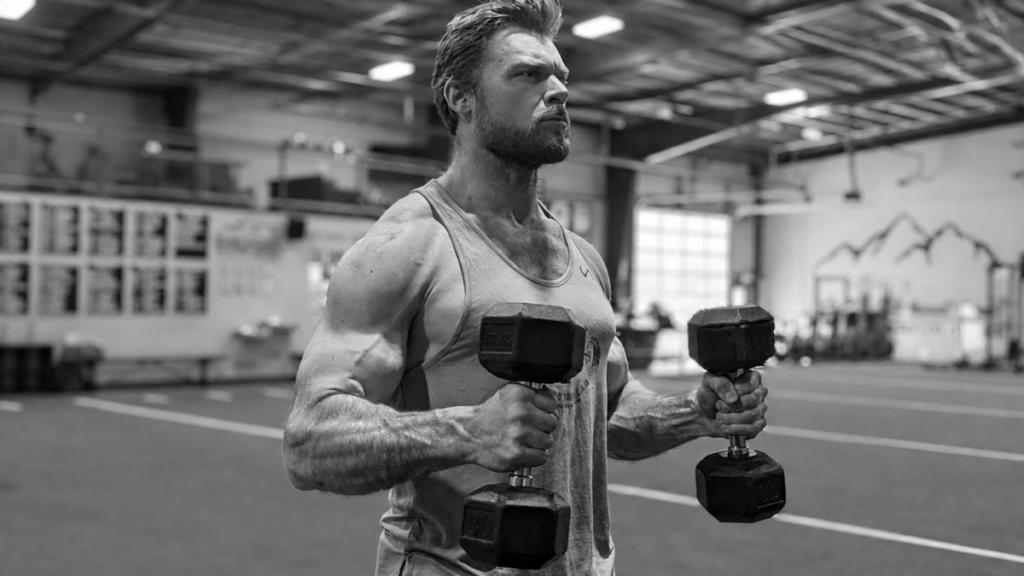
Use a weight that allows you to move with control. Let your arms straighten near the bottom, then curl until the biceps are fully contracted without forcing your elbows far forward. A steady lowering phase matters because it helps you maintain tension and gives you a repeatable movement you can progressively overload.
Begin with two or three sets of eight to 15 repetitions. The exact number matters less than using a challenging load with clean technique and gradually improving your performance.
Add Hammer Curls for Thickness
Hammer curls are one of the most useful exercises for beginners who want wider biceps. Hold the dumbbells with your palms facing each other and maintain that neutral grip throughout the movement. This position reduces the advantage of the biceps brachii and increases the contribution of the brachialis and brachioradialis.
Keep your upper arm relatively still and avoid turning the curl into a hip driven movement. You can perform hammer curls with both arms at the same time, alternate sides, or use a rope attachment on a cable machine.
A simple approach is to place standard curls first in your workout, then follow them with hammer curls. The first exercise gives direct work to the biceps brachii, while the second adds important volume for the muscles that can make the arm look thicker.
Use Reverse Curls Sparingly
Reverse curls use an overhand grip, with the palms facing downward. They place more emphasis on the brachioradialis and forearm muscles while still training elbow flexion. They can be particularly useful for people whose arms look narrow around the elbow and upper forearm.
Use lighter weights than you would for dumbbell curls. Reverse curls can be demanding on the wrists and elbows when performed carelessly, so start with one or two controlled sets of 10 to 15 repetitions. An EZ curl bar is often more comfortable than a straight bar, although dumbbells work well too.
Secret Two: Train Through a Long and Controlled Range of Motion
The second secret is to use a comfortable but substantial range of motion. Many people cut their curls short because the hardest part of the rep is near the bottom. Unfortunately, this often means they miss valuable training stimulus.
Research comparing different resistance profiles in curl exercises has shown that exercise selection can influence where hypertrophy occurs along the biceps. This does not mean there is one magical movement that completely transforms an arm overnight. It does mean that your exercise choices and the part of the range where the muscle is challenged can matter.
Try the Incline Dumbbell Curl
The incline dumbbell curl is a strong option because it places the shoulder slightly behind the torso. This puts the biceps in a longer position at the start of each repetition. Sit on a bench set to a moderate incline, allow your arms to hang naturally, and curl the dumbbells while keeping your shoulders stable.
Use lighter weights than you would for standing curls. The longer starting position makes this exercise challenging, and trying to lift too much often leads to shoulders rolling forward or elbows drifting excessively.
Perform two or three sets of eight to 12 repetitions. Lower the dumbbells smoothly and avoid rushing the bottom portion of the movement. The goal is not to stretch aggressively or force uncomfortable positions. The goal is to control a large range that you can repeat consistently.
Do Not Chase Partial Repetitions
Partial repetitions can have a place in advanced training, but beginners usually benefit more from learning full, controlled repetitions first. Full range training helps you practice the movement, monitor progress, and make better use of each set.
If you cannot lower the weight with control or if your shoulders are doing most of the work, the dumbbells are too heavy. Reducing the load is not a setback. It is how you create the conditions for your arms to grow.
Secret Three: Build Enough Weekly Training Volume
The third secret is to give your biceps enough hard work each week without turning every session into an arm marathon. Training volume refers broadly to the amount of productive work you perform. Research consistently shows a dose response relationship between weekly resistance training volume and muscle hypertrophy, although more is not always better when recovery and technique begin to suffer.
For a beginner, six to 10 challenging direct sets for the biceps and related elbow flexors each week is an effective place to start. This can be spread across two sessions. For example, you might perform three sets of dumbbell curls and two sets of hammer curls on Monday, then repeat a slightly different combination on Thursday.
Your back training also matters. Pull ups, chin ups, rows, and pulldowns involve the biceps as assisting muscles. If you already perform a lot of hard pulling work, you may need fewer direct curl sets. If you hardly train your back, your arm development will be limited and your physique will not look balanced.

Give Your Arms Time to Recover
You do not need to train biceps every day to make them grow. Muscles adapt to training when hard sessions are followed by enough recovery. Training the same sore muscle intensely day after day can make it difficult to improve performance and may irritate your elbows or wrists.
Two focused biceps sessions per week gives beginners a useful balance. It provides regular practice while leaving time to recover. If your elbows feel achy, reduce the total number of sets, improve your technique, and make sure you are not gripping every repetition excessively hard.
Secret Four: Train Close to Failure, Not Carelessly to Failure
The fourth secret is understanding effort. A set must be difficult enough to challenge the muscle, but you do not need to fail every set by grinding until the weight stops moving.
Research comparing resistance training to failure and nonfailure training suggests that muscle growth can occur with both approaches. For beginners, staying close to failure while maintaining good form is usually more sustainable than forcing every set to complete failure.
A useful practical target is to finish most working sets with roughly one to three repetitions still possible. In other words, you should feel that you could perform only a small number of additional clean repetitions. This keeps the set challenging while reducing the chance that technique falls apart.
Let Technique Decide When the Set Ends
End your set when you can no longer curl with the same basic form. If you must throw your hips forward, lean back dramatically, or let your elbows travel all over the place, the set is finished.
Some natural movement is normal, especially during hard curls. The problem begins when momentum becomes the main reason the dumbbell reaches the top. Strict technique ensures the biceps, brachialis, and brachioradialis are doing the work rather than your lower back.
Track your workouts in a notebook or phone. Record the exercise, weight, sets, and repetitions. When you can complete the top end of your target rep range with strong form, add a small amount of weight or an extra repetition next time.
Secret Five: Eat and Recover Like Your Arms Depend on It
The fifth secret is to support your training outside the gym. Your biceps do not grow during the curl itself. Training provides the stimulus, while food and recovery help support adaptation.

Protein is especially important because it provides amino acids used in muscle protein synthesis. Research examining protein supplementation alongside resistance training found that higher protein intake can support gains in fat free mass and strength, particularly when people were not already consuming enough protein.
A practical target for many active adults is around 1.6 grams of protein per kilogram of body weight per day. You do not need to obsess over perfect timing. Instead, aim to spread protein rich foods across your meals and make your total daily intake consistent.
Do Not Accidentally Diet Away Your Progress
If you are trying to build noticeably wider arms as quickly as possible, staying in a severe calorie deficit will make the process harder. Beginners with higher body fat can still build muscle while losing some fat, especially early in training. However, aggressive dieting reduces the energy available for hard training and recovery.
Eat mostly nutrient dense foods, include enough carbohydrate to fuel your workouts, and make sure your body weight is not falling rapidly if muscle gain is the main goal. Sleep matters too. Regular, adequate sleep supports recovery, training quality, and your ability to keep progressing.
A Simple Beginner Plan for Wider Biceps
Train this routine twice per week, leaving at least two days between sessions. Start at the lower end of the suggested sets if you are completely new to resistance training.
Session One
Perform three sets of standing dumbbell curls for eight to 12 repetitions. Follow with two sets of hammer curls for 10 to 15 repetitions. Finish with two sets of a row or pulldown variation for eight to 12 repetitions.
Session Two
Perform three sets of incline dumbbell curls for eight to 12 repetitions. Follow with two sets of reverse curls for 10 to 15 repetitions. Finish with two or three sets of chin ups, assisted chin ups, or a pulldown variation.
Keep most sets within one to three repetitions of technical failure. Once you can perform the highest target repetitions with clean form, increase the load by the smallest available amount. Stick with the plan for at least eight weeks before deciding whether it works.
Wider looking biceps are not built through random curls or brutal arm workouts. They come from training the full elbow flexor group, using a controlled range of motion, accumulating enough weekly hard sets, and improving your performance patiently. Combine that training with adequate protein, food, and recovery, and your arms will have every reason to grow.
References
- Grgic, J., Schoenfeld, B.J., Orazem, J. and Sabol, F. (2021) ‘Effects of resistance training performed to repetition failure or nonfailure on muscular strength and hypertrophy: A systematic review and meta analysis’, Journal of Sport and Health Science, 11(2), pp. 202 to 211.
- Lopez, P., Radaelli, R., Taaffe, D.R., Newton, R.U., Galvão, D.A., Trajano, G.S., Teodoro, J.L., Kraemer, W.J., Häkkinen, K. and Pinto, R.S. (2021) ‘Resistance training load effects on muscle hypertrophy and strength gain: A systematic review and network meta analysis’, Medicine and Science in Sports and Exercise, 53(6), pp. 1206 to 1216.
- Morton, R.W., Murphy, K.T., McKellar, S.R., Schoenfeld, B.J., Henselmans, M., Helms, E., Aragon, A.A., Devries, M.C., Banfield, L., Krieger, J.W. and Phillips, S.M. (2018) ‘A systematic review, meta analysis and meta regression of the effect of protein supplementation on resistance training induced gains in muscle mass and strength in healthy adults’, British Journal of Sports Medicine, 52(6), pp. 376 to 384.
- Schoenfeld, B.J., Ogborn, D. and Krieger, J.W. (2017) ‘Dose response relationship between weekly resistance training volume and increases in muscle mass: A systematic review and meta analysis’, Journal of Sports Sciences, 35(11), pp. 1073 to 1082.
- Zabaleta Korta, A., Fernandez Gil, S., Gonzalez Martinez, J., Mielgo Ayuso, J. and Barranco Gil, D. (2023) ‘Regional hypertrophy: The effect of exercises at long and short muscle lengths in trained women’, Journal of Human Kinetics, 88, pp. 121 to 130.
Key Takeaways
| Training secret | What beginners should do |
|---|---|
| Train the whole elbow flexor group | Use standard curls, hammer curls, and occasional reverse curls to develop the biceps, brachialis, and brachioradialis. |
| Use a controlled range | Include incline dumbbell curls and lower every repetition smoothly without forcing painful positions. |
| Accumulate productive volume | Start with six to 10 direct hard sets each week, spread across two sessions. |
| Work close to failure | End most sets with one to three clean repetitions left in reserve. |
| Support growth outside the gym | Eat sufficient protein, recover between sessions, and avoid aggressive dieting when muscle gain is the main goal. |