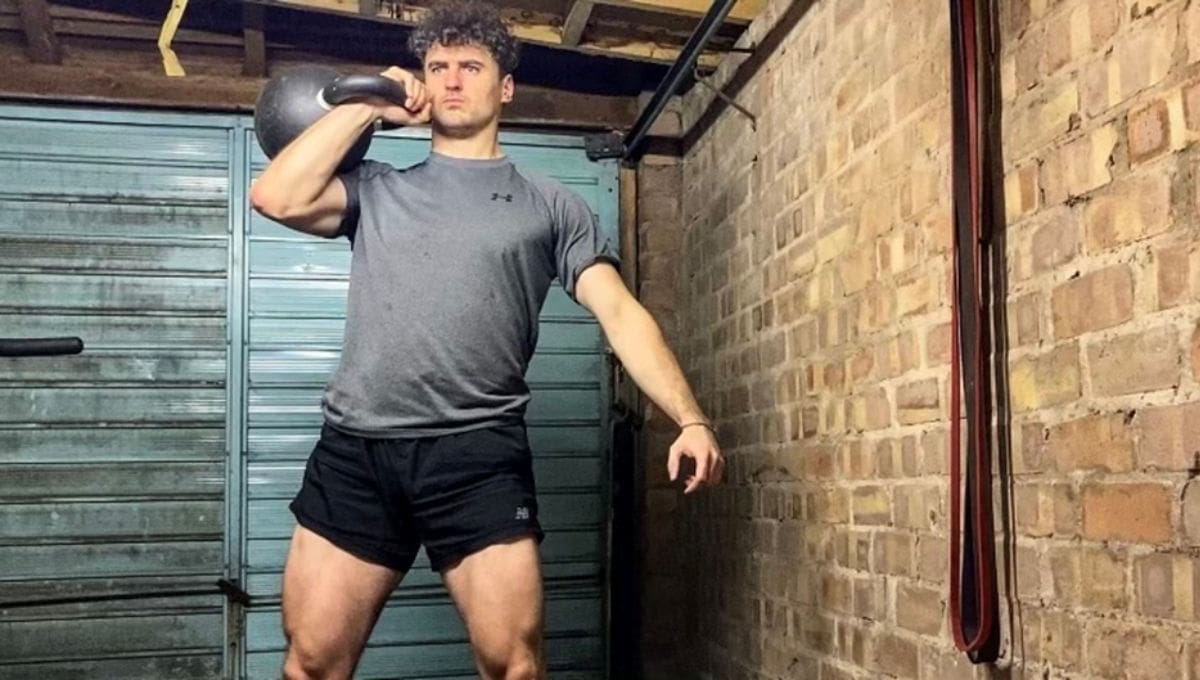


A wider back changes how your whole physique looks. It makes the waist appear narrower, gives the upper body a stronger frame, and helps create the V shaped torso that many lifters want. Kettlebells can be a highly effective tool for this goal because they are simple, accessible, and make it easy to train hard at home, in a busy gym, or outdoors.
The key is not randomly swinging a kettlebell until your grip gives out. To make your back visibly wider, you need to challenge the muscles that create width, especially the latissimus dorsi, while also developing the muscles around the shoulder blades that support better posture and a thicker upper back. You also need enough productive training volume, gradual progression, and quality repetitions that keep tension where it belongs.


The following three secrets will help you use kettlebells intelligently. They combine effective exercise selection, better technique, and a progression plan that gives your back a reason to grow.
Understand What Creates a Wider Back
The latissimus dorsi, usually called the lats, are the largest muscles of the upper body. They run from the lower back and pelvis up toward the upper arm. When developed, they create much of the visual width between the waist and the upper arms.
The lats are heavily involved when you pull your upper arm down toward your torso or draw it backward. This is why rowing movements are so valuable, especially when you use a full range of motion and avoid turning every rep into a biceps curl. The teres major also contributes to this pulling action, while the middle trapezius, lower trapezius, rhomboids, and rear deltoids help control the shoulder blades.

A kettlebell will not replicate every cable or machine movement. However, it can provide a very effective pulling challenge through rowing variations, supported rows, suitcase carries, and movements that require the lats to stabilize the shoulder during loaded exercise. Research on resistance training consistently shows that muscle growth is driven primarily by sufficiently challenging sets performed over time, rather than by one supposedly perfect piece of equipment.
The important point is that you must create enough tension and give your back enough weekly work to adapt. A light kettlebell can work if you take sets close to the point where another clean repetition would be difficult. A heavier kettlebell can work with fewer repetitions, provided you control the movement and do not sacrifice range of motion.
Secret 1: Make the One Arm Kettlebell Row Your Main Width Builder
The one arm kettlebell row should be the foundation of your wider back training. It lets you use a strong pulling path, load each side separately, and concentrate on moving your elbow toward your hip. That last detail matters because it encourages a lat focused row rather than a shrugging movement dominated by the upper traps.
How to Perform the Row for Lat Growth
Place one hand on a bench, sturdy chair, rack, or your front thigh. Step one foot back and hinge at the hips until your torso is close to parallel with the floor. Let the kettlebell hang from your working arm with a neutral grip.
Before you pull, create tension through your trunk and keep your rib cage controlled. Pull the kettlebell toward your hip rather than straight toward your chest. Your elbow should travel beside your body and slightly behind it, but there is no need to force it far upward. Pause briefly when the kettlebell reaches the top, then lower it under control until your arm is fully extended again.
This full stretch matters. A complete range of motion gives the back muscles more time under tension and helps ensure that each repetition begins from a consistent position. Do not twist your torso to lift a heavier kettlebell. If your shoulders repeatedly open toward the ceiling, the load is too heavy for the target you are trying to train.
The goal is to feel the side of your back working, especially as your upper arm moves toward your torso. Your forearm and hand are only the connection between you and the bell. Think about driving the elbow backward and down, rather than trying to pull the kettlebell with your hand.
Use Enough Challenging Sets
For most people, three to five hard sets of one arm rows per session is a productive starting point. Train them twice per week and you will build a meaningful amount of direct back volume without making your training overly complicated.
Aim for around eight to fifteen controlled repetitions per side when the kettlebell is challenging enough. If your bell is lighter, use fifteen to twenty five repetitions, slow down the lowering phase, and stop only when you are close to technical failure. This means you could possibly perform another repetition or two, but not without losing the same controlled rowing path.
Evidence suggests that a wide range of loads can produce muscle growth when sets are performed with high effort. This is useful for kettlebell training because many people have only a few bells available. You do not need to wait until you own a huge collection of weights to start building a wider back.
Secret 2: Use Longer Range Rows and Pauses to Make One Kettlebell Feel Heavier
The limitation of kettlebells is also what makes them useful. You may not be able to add tiny weight increases every week, so you need other ways to increase the difficulty. Better leverage, a larger range of motion, slower lowering phases, and pauses all make the same kettlebell more demanding.

The best option is the supported kettlebell row from an elevated position. This variation gives you more stability than a standing row, allowing you to work closer to your true limit without your lower back becoming the weak link.
Try the Chest Supported Kettlebell Row
Set an adjustable bench to a low incline, lie face down, and hold one kettlebell in each hand if you have a pair. If you only own one kettlebell, perform all repetitions on one side before switching. Let the bells hang toward the floor and allow your shoulder blades to move naturally at the bottom.
Row the kettlebells toward the sides of your lower ribs. Keep your neck relaxed and avoid trying to pull your chest away from the bench. At the top, squeeze your upper back and pause for one second before lowering slowly.
This exercise is especially useful because it reduces the opportunity to cheat. The bench gives your torso support, which means the lats, rhomboids, middle trapezius, and rear deltoids must do more of the work. It is a simple way to increase the quality of each set.
If you do not have a bench, use a long range one arm row instead. Place your free hand on a stable support that allows your working arm to reach completely downward without the kettlebell hitting the floor. This gives you a deep stretch at the bottom of every repetition.
Make the Eccentric Phase Count
Lowering the kettlebell with control is one of the easiest ways to improve a light or moderate load. Take roughly two to three seconds to lower the bell, then pull smoothly without jerking it upward. This increases the total challenge of the set and gives you more control over your technique.
You do not need to exaggerate every repetition until it becomes painfully slow. The aim is simply to prevent gravity from doing all the work. A controlled lowering phase also makes it easier to notice if you are losing position through the shoulder, elbow, or torso.
Use a one second pause in the stretched position when you need another progression option. This removes momentum and makes the next pull harder. It also encourages you to achieve a complete range of motion instead of performing shortened repetitions.
Higher training volumes tend to produce greater muscle growth than very low volumes, although there is a point where additional work becomes difficult to recover from. Pauses and controlled repetitions allow you to make fewer sets more productive, which is particularly useful when your available kettlebell load is limited.
Secret 3: Build Your Back Around Progressive Overload, Not Random Workouts
A wider back does not come from changing exercises every few days. Your muscles need repeated exposure to a movement pattern that becomes gradually harder. The most reliable way to do this with kettlebells is to track your repetitions, sets, technique, and load.

Choose two main rowing variations and perform them for at least six weeks. For example, you could use the one arm kettlebell row as your first exercise and the chest supported row as your second exercise. Add a carry variation at the end for extra lat, grip, and trunk work.
Use the Suitcase Carry to Train Lat Stability
The suitcase carry is simple but surprisingly demanding. Hold one kettlebell by your side, stand tall, and walk slowly while resisting the urge to lean toward or away from the weight. Keep your ribs stacked over your pelvis and let your shoulder remain pulled gently down rather than creeping toward your ear.
Your lats help stabilize the upper arm and shoulder while your trunk resists side bending. This makes the suitcase carry a valuable complement to rows. It will not replace direct pulling work, but it adds useful time under tension for the muscles that support a strong, athletic back.
Perform two or three carries per side after your rows. Start with twenty to thirty seconds per side and progress toward forty five to sixty seconds while keeping your posture clean. If you have enough space, measure the distance. If space is limited, use time.
Follow a Simple Progression Plan
Start by selecting a repetition range. For one arm rows, use eight to fifteen repetitions per side. For chest supported rows, use ten to twenty repetitions. For suitcase carries, use twenty to sixty seconds per side.
When you can complete the top end of the range for every set with strong technique, progress the exercise. You can use a heavier kettlebell, add a repetition, add a set, slow the lowering phase, extend the pause at the stretched position, or reduce support slightly. Change only one variable at a time so you know what is working.
For example, if you currently perform three sets of ten one arm rows with a 24 kilogram kettlebell, keep the same weight and build toward three sets of fifteen. Once you reach that target, move up in load if possible and return to the lower end of the range. If you cannot increase weight, use a three second lowering phase or add a fourth set.
Rest long enough to perform high quality work. Around ninety seconds to two minutes between hard rowing sets is a practical target for most people. Research suggests that rest periods longer than sixty seconds may offer a small advantage for hypertrophy, likely because they help preserve training performance and total volume.
A Kettlebell Back Workout for Width
Perform this session twice per week, leaving at least one rest day between sessions.
Start with the one arm kettlebell row for four sets of eight to fifteen repetitions per side. Follow with the chest supported kettlebell row for three sets of ten to twenty repetitions. Finish with the suitcase carry for three rounds of thirty to sixty seconds per side.
The Only 3 Exercises Beginners Need For Wider Shoulders
Keep one to three repetitions in reserve on most sets. On the final set of each rowing exercise, you can work closer to failure if your form remains solid. Training all the way to failure is not required for muscle growth, but hard sets that are close to failure are often necessary when the available load is light.
The Fastest Route Is Consistent, Not Reckless
Building a visibly wider back takes time, but the process can move quickly when you stop treating kettlebells as a conditioning only tool. Use rows as your main growth movement, improve each repetition through a full range of motion, and progress your training week by week.
Train your back twice per week, record your performance, and make small improvements whenever you can. Eat enough protein and total calories to support your goal, sleep well, and avoid adding so much extra volume that your elbows, shoulders, or lower back become constantly irritated.
The kettlebell does not need to be complicated. A few hard, controlled exercises performed consistently can create the tension and progressive overload your lats need to grow. Build your plan around that principle and your back will become stronger, thicker, and noticeably wider.
References
- Morton, R.W., Murphy, K.T., McKellar, S.R., Schoenfeld, B.J., Henselmans, M., Helms, E., Aragon, A.A., Devries, M.C., Banfield, L., Krieger, J.W. and Phillips, S.M. (2018) ‘A systematic review, meta analysis and meta regression of the effect of protein supplementation on resistance training induced gains in muscle mass and strength in healthy adults’, British Journal of Sports Medicine, 52(6), pp. 376 to 384.
- Refalo, M.C., Helms, E.R., Trexler, E.T., Hamilton, D.L. and Fyfe, J.J. (2023) ‘Influence of resistance training proximity to failure on skeletal muscle hypertrophy: A systematic review with meta analysis’, Sports Medicine, 53(3), pp. 649 to 665.
- Schoenfeld, B.J., Ogborn, D. and Krieger, J.W. (2017) ‘Dose response relationship between weekly resistance training volume and increases in muscle mass: A systematic review and meta analysis’, Journal of Sports Sciences, 35(11), pp. 1073 to 1082.
- Schoenfeld, B.J., Grgic, J., Ogborn, D. and Krieger, J.W. (2017) ‘Strength and hypertrophy adaptations between low versus high load resistance training: A systematic review and meta analysis’, Journal of Strength and Conditioning Research, 31(12), pp. 3508 to 3523.
- Singer, A., Wolf, M., Generoso, L., Arias, E., Delcastillo, K., Echevarria, E., Martinez, A., Androulakis Korakakis, P., Refalo, M.C., Swinton, P.A. and Schoenfeld, B.J. (2024) ‘Give it a rest: A systematic review with Bayesian meta analysis on the effect of interset rest interval duration on muscle hypertrophy’, Frontiers in Sports and Active Living, 6, 1429789.
Key Takeaways
| Focus | What to do | Why it matters |
|---|---|---|
| Main exercise | Use one arm kettlebell rows twice per week | Rows directly challenge the lats and upper back muscles that create a wider appearance |
| Technique | Pull the elbow toward the hip and use a full stretch | This keeps the rowing pattern focused on the back instead of relying on momentum |
| Progression | Add repetitions, load, sets, pauses, or slower lowering phases over time | Muscles need progressively harder training to continue growing |
| Training effort | Finish most sets with one to three repetitions left in reserve | Hard sets close to failure can create a strong growth stimulus without requiring failure every time |
| Recovery | Rest for at least ninety seconds between demanding row sets | Better recovery helps maintain performance and productive training volume |