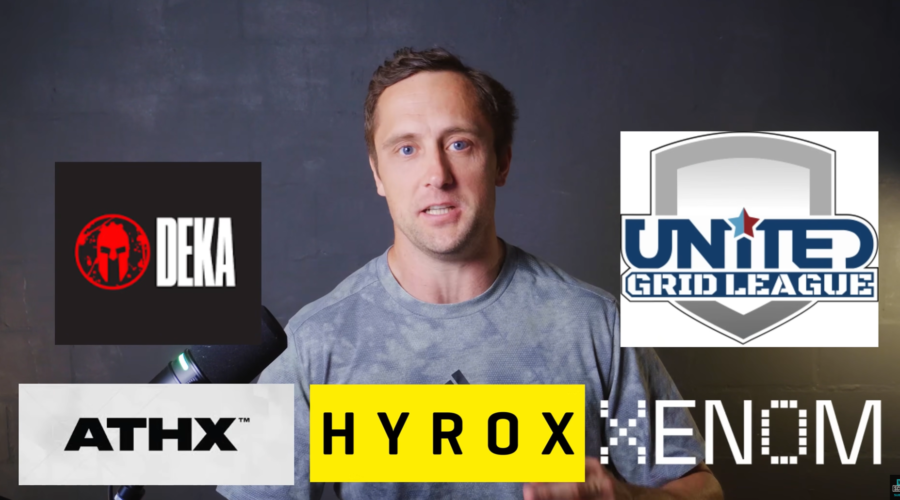


For more than 20 years, CrossFit has been the dominant force in competitive fitness. But in recent years, new formats such as HYROX, ATHX, XENOM, DEKA, and the Grid League have emerged, each attracting different athletes and rewarding different physical qualities.
In a recent YouTube video, exercise scientist Dr. Gommaar D’Hulst of WOD-Science explained why these sports may look similar on the surface but place very different demands on the body.


CrossFit: Broad Fitness Across Multiple Domains
D’Hulst begins with CrossFit’s original definition of fitness, developed by founder Greg Glassman: increasing work capacity across broad time and modal domains.

CrossFit athletes must be prepared for anything. Workouts are often unknown until competition day and can range from short, explosive efforts to longer endurance challenges.
According to D’Hulst, CrossFit heavily develops:
- Glycolytic energy systems
- Creatine phosphate power production
- Technical skills and gymnastics
- Strength and power output
- Adaptability under unpredictable conditions
This combination creates powerful, highly skilled athletes capable of performing across a wide range of tasks.
HYROX: The Endurance-Focused Fitness Race
HYROX uses many functional fitness movements familiar to CrossFit athletes, but D’Hulst argues it challenges an entirely different physiology.
With eight 1-kilometer runs and standardized workout stations, races typically last between 60 and 90 minutes. Success depends heavily on aerobic capacity rather than technical skill.

Key HYROX demands include:
- Aerobic endurance
- Running economy
- Cardiovascular efficiency
- Sustainable pacing
- Race-specific conditioning
“Don’t be fooled,” D’Hulst explains. “The aerobic system is going to make you the best athlete in HYROX.”
This is why Elite 15 athletes often look different from CrossFit Games competitors, typically carrying less muscle mass while possessing exceptional endurance capabilities.
ATHX: A Hybrid Between Strength and Conditioning
Among the newer formats, D’Hulst highlights ATHX as one of the most interesting. He describes it as “structured CrossFit,” combining three distinct components:

Strength Event
Athletes perform maximum-effort compound lifts such as strict presses, squats, or deadlifts.
Conditioning Event
A 22-minute running and rowing challenge focused on aerobic fitness.
Functional Fitness Workout
A longer-style MetCon featuring functional movements but minimal technical gymnastics.
The format rewards athletes who can blend strength, endurance, and work capacity without requiring the advanced skill level often seen in CrossFit.
What This Means for Training
One of D’Hulst’s biggest messages is that athletes should train according to the specific demands of their sport.
CrossFit competitors need a balance of strength, power, conditioning, and skill work. HYROX athletes should prioritize aerobic development and running performance. ATHX competitors sit somewhere in the middle, requiring both strength and endurance.
He also warns against a common trend of elite CrossFit athletes jumping into HYROX preparation for several months.
While CrossFit athletes can often perform well in HYROX, D’Hulst argues that the training demands are fundamentally different. Time spent preparing for one discipline may come at the expense of performance in another.
Ultimately, understanding the physiological demands of each sport can help athletes build smarter training plans and maximize performance where it matters most.
About the Author
Jeremiah Oliva

Jeremiah Oliva is a writer passionate about fitness, sports, and active living. He has experience in songwriting and managing content and social media for online radio and magazine platforms.
He covers HYROX, CrossFit®, and competitive fitness, with a focus on performance, mindset, and athlete development.
Outside of writing, Jeremiah trains in boxing, cycles, explores the outdoors with his kids, and plays the guitar.