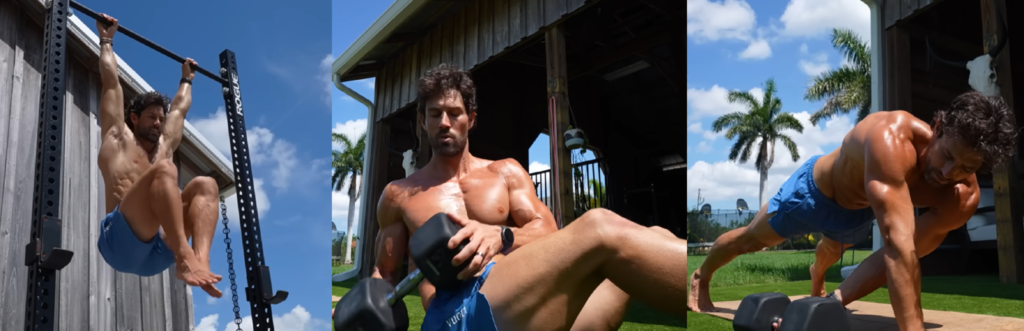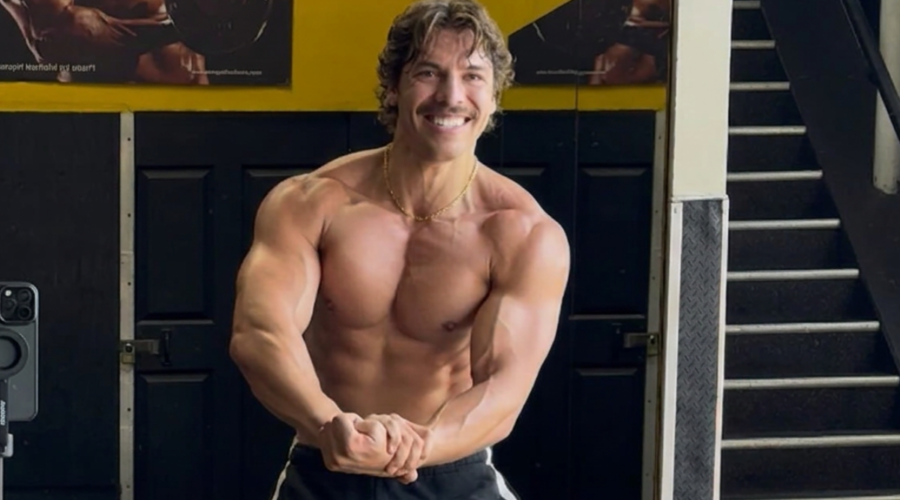


Joseph Baena is continuing to build a physique that rightfully earns comparisons to his father, Arnold Schwarzenegger.
The 28-year-old has taken bodybuilding much further than simply looking the part. Earlier this year, Baena made his competitive debut at the NPC Natural Colorado State Championships, winning three divisions and finishing second in Classic Physique Open Class C.


He followed that performance by winning the INBA Iron Gladiator Classic Physique competition, further establishing himself as a competitive bodybuilder rather than simply a fitness personality with famous genetics.
And when it comes to building his back, Baena’s approach is refreshingly straightforward.
In a recent training session shared on social media, he revealed four exercises he uses to target the lats, traps, rear delts and the rest of the upper back.
There are no elaborate machines or complicated exercise variations involved. Instead, Baena relies on pull-ups, heavy rows and pulldowns, movements that would not look out of place in a bodybuilding gym several decades ago.
Joseph Baena’s Back Workout
The workout consists of:
- Pull-Ups – 50 total reps
- T-Bar Row – 4 sets of 10 reps
- High Cable Row – 3 sets of 10-12 reps
- Single-Arm Pulldown – 3 sets of 10 reps per side
Here is how each exercise fits into the session.
Pull-Ups – 50 Total Reps
Baena begins the workout with one of the most fundamental back-building exercises available: the pull-up. Rather than treating the movement purely as a strength exercise, he uses it to prepare his back and shoulders while accumulating plenty of early volume.
His target is 50 total repetitions. That could mean five sets of 10, but the important number is the total rather than completing a predetermined number of sets.
Pull-ups provide the first major vertical pulling movement of the workout, challenging the lats while also involving the upper back, biceps and grip.
For lifters unable to complete 50 strict repetitions, the same idea can be scaled. Accumulate a smaller number of quality reps, use an assisted pull-up machine or substitute a controlled lat pulldown.
T-Bar Row – 4 Sets of 10 Reps
Next comes the heaviest exercise of the session. Baena performs four sets of 10 T-bar rows and describes the movement as one of his favourite exercises for developing back thickness.
The exercise also changes the direction of force. Where pull-ups involve pulling vertically, T-bar rows introduce a horizontal pulling pattern. This allows Baena to target areas including the lats, traps and muscles surrounding the shoulder blades while using considerably more external load.
It is also the movement in the workout where lifters can focus most clearly on progressive overload. Adding weight over time while maintaining control provides a simple way to ensure the exercise continues to challenge the back.
High Cable Row – 3 Sets of 10-12 Reps
The third exercise changes the angle again. Baena performs high cable rows with the elbows travelling outward rather than staying tight against the torso.
This shifts more emphasis towards the upper back, particularly the traps and rear delts. Baena uses a pronounced forward stretch during the movement, but importantly, he does not recommend that beginners immediately copy his technique.
Newer lifters can remain more upright and concentrate on controlling the weight while driving the elbows backwards and outward. Adding extra range of motion is only useful if you can control it.
Single-Arm Pulldown – 3 Sets of 10 Reps Per Side
Baena finishes his back work with a unilateral exercise. The single-arm pulldown allows each lat to work independently, making it easier to identify differences in strength, activation or control between the two sides.
Baena says he does not always include the exercise but uses it when he feels one lat is not engaging or developing as effectively as the other. This is also where one of the central themes of his workout becomes especially clear: the importance he places on actually feeling the target muscle working.
For bodybuilding, moving a weight from A to B is not necessarily the only objective. Maintaining control and deliberately contracting the target muscles can help prevent stronger surrounding muscles from taking over the movement.
Why This Back Workout Works
One of the strongest aspects of Baena’s session is its simplicity.
Across four exercises, the workout includes:
- Vertical pulling
- Heavy horizontal pulling
- Upper-back-focused rowing
- Unilateral lat training
- High overall training volume
That provides several different ways of loading the back without requiring a long list of exercises.
It also follows principles found throughout traditional bodybuilding training: establish a strong mind-muscle connection, use compound movements that can progressively be loaded and then finish with more targeted exercises.
Baena’s current training combines those old-school influences with a more modern structure. During his preparation for his first bodybuilding show, he used a five-day split consisting of push and biceps, pull and triceps, legs, upper body and lower body sessions, alongside steady-state cardio.
Should You Try Joseph Baena’s Back Workout?
Potentially, but the volume should match your experience. Fifty pull-ups followed by 10 additional working sets is a substantial amount of back training. Beginners do not need to reproduce every set to benefit from the exercise selection.
A more accessible version could involve reducing the pull-up target and completing two or three sets of each rowing and pulldown movement. The exercises themselves are not particularly unusual. Building an impressive back does not necessarily require constantly searching for new exercises. A handful of proven pulling movements, performed consistently and progressively over time, can provide everything needed to build considerable width and thickness.
Baena might have inherited some exceptional bodybuilding genetics, but his latest workout shows that his approach still focuses on the basics.
Are You a 4/3/2/1 Man? If Yes, Then You’re Stronger than 95% of Other Guys in the Gym