

If you want bigger arms, your triceps deserve most of your attention. While many people think biceps are the key to sleeve stretching arms, the triceps actually make up around two thirds of your upper arm muscle mass. That means building stronger, larger triceps has a much bigger impact on overall arm size.
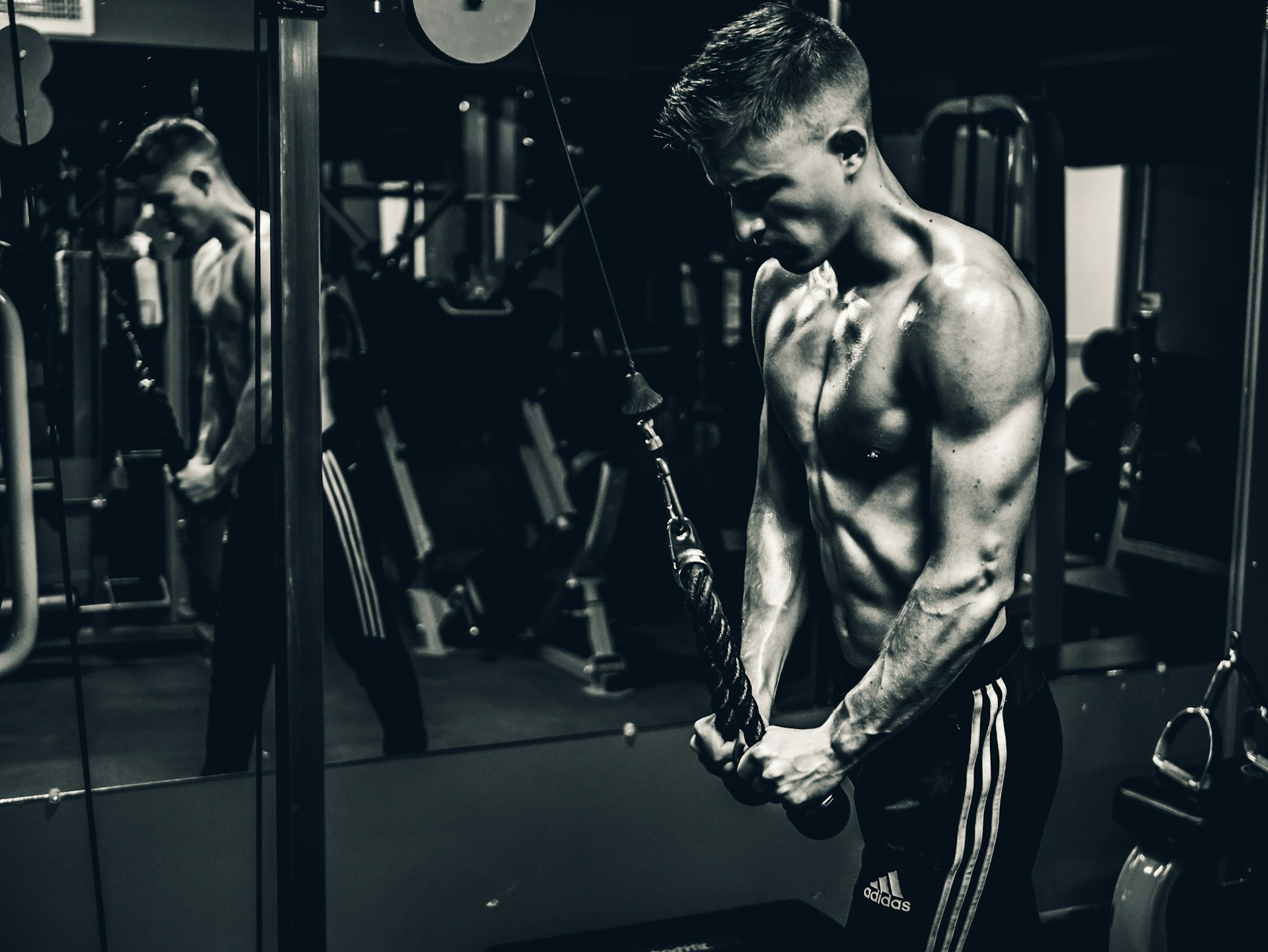
Walk into almost any commercial gym and you will see people lining up for the cable station to perform triceps pushdowns. There is nothing wrong with pushdowns. They are effective, easy to learn, and allow consistent tension throughout the movement. The problem is that beginners often do not have access to a cable machine. Home gyms, crowded fitness centers, and minimalist training setups can all make pushdowns difficult or impossible.


3 Best Six Pack Bodyweight Exercises for Men Aged 30+ that Want Great Abs
The good news is that you do not need cable pushdowns to build impressive triceps. Research consistently shows that muscle growth depends far more on training volume, effort, progressive overload, and proper exercise execution than on any single exercise. As long as you challenge the triceps through a full range of motion with sufficient resistance, they can grow very effectively.
This article covers three of the best beginner friendly triceps exercises that require little equipment and no cable machine. Each movement is supported by current exercise science and can help develop stronger and bigger arms when performed consistently.
Why the Triceps Grow
The triceps brachii consists of three separate heads called the long head, lateral head, and medial head. Together they extend the elbow during pressing and pushing movements.
The long head is unique because it crosses both the shoulder and elbow joints. This means its activation changes depending on shoulder position. Exercises that place the arms overhead often increase the stretch placed on the long head, which may contribute to greater muscle growth.
Research has shown that training muscles at longer muscle lengths can produce superior hypertrophy compared to training only in shortened positions. This makes exercise selection important when designing a balanced triceps program.
The triceps are heavily involved in pressing exercises such as push ups, bench presses, and overhead presses. However, isolation exercises allow more direct work once beginners have mastered the basic movement patterns.
1. Close Grip Push Ups
The close grip push up is one of the simplest and most effective bodyweight exercises for building triceps strength and size. Unlike a standard push up, bringing the hands closer together shifts more of the workload toward elbow extension, increasing triceps involvement while still training the chest and shoulders.
Several electromyography studies have demonstrated that narrower hand positions increase triceps activation compared to wider push up variations. This makes the close grip version particularly valuable for beginners who have no equipment available.
How to Perform It
Begin in a standard push up position with your hands slightly narrower than shoulder width. Keep your body in a straight line from your shoulders to your heels. Lower yourself under control until your chest nearly reaches the floor. Press back up while fully extending your elbows.
Avoid allowing your hips to sag or your elbows to flare excessively. A controlled movement with full range of motion produces better muscle stimulation than rushing through repetitions.
If standard push ups are too difficult, elevate your hands on a bench, sturdy table, or countertop. This reduces the amount of bodyweight you must lift while maintaining the same movement pattern.
As strength improves, gradually lower the height of the support until full floor push ups become comfortable. More advanced lifters can increase resistance by wearing a weighted backpack or using a weight vest.
2. Dumbbell Overhead Triceps Extension
The overhead dumbbell triceps extension is one of the best exercises for targeting the long head of the triceps because it places the shoulder in a flexed position while extending the elbow.
Scientific research suggests that training muscles in a stretched position may enhance muscle growth through greater mechanical tension. Since the long head experiences its greatest stretch overhead, this exercise provides a stimulus that many pressing exercises cannot fully replicate.
How to Perform It
- Sit or stand while holding one dumbbell with both hands.
- Raise the weight overhead with your elbows pointing forward.
- Lower the dumbbell slowly behind your head until you feel a comfortable stretch in your triceps.
- Extend your elbows to return to the starting position without locking out aggressively.
- Keep your upper arms relatively stationary throughout the movement.
- Excessive elbow movement reduces the focus on the triceps and often shifts tension toward the shoulders.
- Start with a light weight while learning the movement.
- Proper technique is much more important than lifting heavy loads during the first few months of training.
3. Bench Dips
Bench dips remain controversial because poor technique or excessive depth can increase stress on the shoulders. However, when performed correctly through a controlled range of motion, they provide an excellent beginner exercise for developing triceps strength.
The movement allows progressive overload without requiring complicated equipment. Beginners can easily adjust the difficulty by changing foot position.
How to Perform It
- Sit on the edge of a sturdy bench or chair and place your hands next to your hips.
- Walk your feet forward while supporting your body with your arms.
- Lower yourself by bending your elbows until your upper arms are approximately parallel to the floor.
- Press back upward by extending your elbows.
- Avoid dropping too deeply below parallel because excessive shoulder extension may place unnecessary stress on the front of the shoulder.
- To make the exercise easier, bend your knees and keep your feet closer to your body.
- To increase the challenge, straighten your legs or eventually place a weight plate across your lap once basic strength has been established.
Progressive Overload Matters More Than Exercise Selection
Many beginners spend too much time searching for the perfect exercise. In reality, muscle growth depends much more on progressive overload. Progressive overload simply means asking your muscles to perform slightly more work over time. This can happen by increasing weight, performing more repetitions, adding extra sets, slowing the lowering phase, or improving technique.
Research has repeatedly demonstrated that hypertrophy occurs across a wide range of repetition ranges provided that sets are performed close to muscular failure.
For beginners, this means there is no need to chase extremely heavy weights immediately. Performing eight to fifteen controlled repetitions with good technique is an excellent starting point for building muscle. Keep a training log and aim for gradual improvements every few weeks. Small increases accumulate into substantial muscle gains over months and years.
How Much Training Do Beginners Need?
One of the biggest mistakes beginners make is assuming more is always better. Current evidence suggests that approximately ten to twenty challenging sets per muscle group each week provides an effective range for maximizing muscle growth in most individuals. Beginners often respond well toward the lower end of that range because they recover quickly from relatively small training volumes.

Training triceps two or three times each week allows enough frequency to stimulate growth while providing sufficient recovery between sessions. Recovery is just as important as training. Muscles grow after workouts when adequate nutrition and sleep support tissue repair and adaptation.
Sample Beginner Triceps Workout
A simple workout does not need to be complicated to be effective. Begin with three sets of close grip push ups for eight to fifteen repetitions. Follow with three sets of overhead dumbbell triceps extensions for ten to fifteen repetitions.
Finish with two or three sets of bench dips for as many controlled repetitions as possible while maintaining proper technique. Rest for approximately one to two minutes between sets and focus on controlled repetitions instead of speed. Performed twice each week alongside a balanced upper body training program, this routine provides enough volume for steady progress in most beginners.
Final Thoughts
Cable pushdowns are useful, but they are far from essential for building bigger triceps. Beginners can achieve excellent results using simple exercises that require minimal equipment and emphasize proper technique.
Close grip push ups develop pressing strength while heavily recruiting the triceps. Overhead dumbbell extensions effectively challenge the long head through a stretched position. Bench dips provide an accessible bodyweight option that can become progressively more challenging over time.
Combined with progressive overload, adequate protein intake, sufficient recovery, and consistent training, these three exercises provide everything most beginners need to build stronger, larger triceps without ever touching a cable machine.
Key Takeaways
| Topic | Summary |
|---|---|
| Main Goal | Bigger triceps do not require cable pushdowns. |
| Best Exercise 1 | Close grip push ups increase triceps involvement compared to standard push ups. |
| Best Exercise 2 | Overhead dumbbell extensions effectively target the long head through a stretched position. |
| Best Exercise 3 | Bench dips provide an effective bodyweight triceps exercise when performed with proper technique. |
| Training Volume | Around ten to twenty weekly sets per muscle group is effective for most people. |
| Repetition Range | Eight to fifteen repetitions performed close to failure works well for hypertrophy. |
| Nutrition | Consume sufficient protein and calories to support muscle growth. |
| Success Factor | Progressive overload and consistency matter more than any individual exercise. |
References
- American College of Sports Medicine. (2021) ‘ACSM Position Stand: Resistance Training for Health and Fitness.’ Medicine & Science in Sports & Exercise, 53(11), pp. 2474 to 2501.
- Grgic, J., Schoenfeld, B.J., Orazem, J. and Sabol, F. (2022) ‘Effects of resistance training performed to repetition failure or non failure on muscular strength and hypertrophy.’ Scandinavian Journal of Medicine & Science in Sports, 32(11), pp. 1421 to 1432.
- Maeo, S., Ando, Y., Takahashi, T. and Kanehisa, H. (2021) ‘Muscle hypertrophy induced by resistance training at long muscle lengths.’ European Journal of Sport Science, 21(11), pp. 1548 to 1558.
- Schoenfeld, B.J. (2010) ‘The mechanisms of muscle hypertrophy and their application to resistance training.’ Journal of Strength and Conditioning Research, 24(10), pp. 2857 to 2872.
- Schoenfeld, B.J., Grgic, J., Ogborn, D. and Krieger, J.W. (2017) ‘Strength and hypertrophy adaptations between low load and high load resistance training.’ Journal of Strength and Conditioning Research, 31(12), pp. 3508 to 3523.
- Schoenfeld, B.J., Ogborn, D. and Krieger, J.W. (2017) ‘Dose response relationship between weekly resistance training volume and increases in muscle mass.’ Journal of Sports Sciences, 35(11), pp. 1073 to 1082.
- Vigotsky, A.D., Harper, E.N., Ryan, D.R. and Contreras, B. (2015) ‘Effects of various push up hand positions on muscle activity.’ Journal of Strength and Conditioning Research, 29(9), pp. 2465 to 2472.
- Morton, R.W., Murphy, K.T., McKellar, S.R. et al. (2018) ‘A systematic review, meta analysis and meta regression of protein supplementation on resistance training induced gains in muscle mass and strength.’ British Journal of Sports Medicine, 52(6), pp. 376 to 384.