

Building a bigger, stronger chest does not require years of lifting experience or complicated workouts. In fact, machines are one of the best places for beginners to start. They provide stability, reduce the need for balance, and allow you to focus almost entirely on training the chest muscles through a controlled range of motion.
Many new gym members head straight for the bench press because it is seen as the classic chest exercise. While the bench press is an excellent movement, it also requires coordination, good technique, and confidence under a loaded barbell. Machines remove many of these challenges, making them an excellent choice for anyone learning proper training technique.



Research consistently shows that muscle growth depends primarily on applying enough mechanical tension, performing sufficient training volume, and progressively increasing the challenge over time. These factors can all be achieved with machine exercises just as effectively as with free weights when the exercises are performed correctly. If your goal is to build a muscular chest while learning safe and effective lifting habits, these three machine exercises deserve a place in your workouts.
Why Machines Are Ideal for Beginners
One of the biggest advantages of resistance machines is that they simplify movement patterns. Instead of worrying about balancing the weight or controlling multiple joints simultaneously, beginners can focus on producing force through the chest muscles.
Studies examining resistance training equipment have shown that machine based exercises produce significant increases in muscular strength and size in beginners. Because machines offer external stability, they also allow new lifters to train closer to muscular fatigue without worrying about dropping a barbell or losing control of the movement.

Machine exercises also make progressive overload straightforward. Adding another plate or increasing the weight by one increment is simple, allowing gradual improvements over weeks and months.
Perhaps most importantly, beginners often develop better exercise confidence on machines. Feeling comfortable in the gym encourages consistency, and consistency remains the most important factor for long term muscle growth.
Understanding the Chest Muscles
The chest is primarily made up of the pectoralis major and the smaller pectoralis minor underneath it. The pectoralis major has two major portions. The clavicular portion sits higher on the chest and contributes more during pressing movements performed on an incline. The sternal portion makes up most of the visible chest and is heavily involved during flat and slightly declined pressing movements.
Both sections work together to bring the arms across the body and push objects away from the torso. For balanced development, beginners should include exercises that challenge the chest from slightly different angles while allowing enough training volume for continued progress. The following three machine exercises accomplish exactly that.
Exercise One: Seated Chest Press Machine
Why It Works
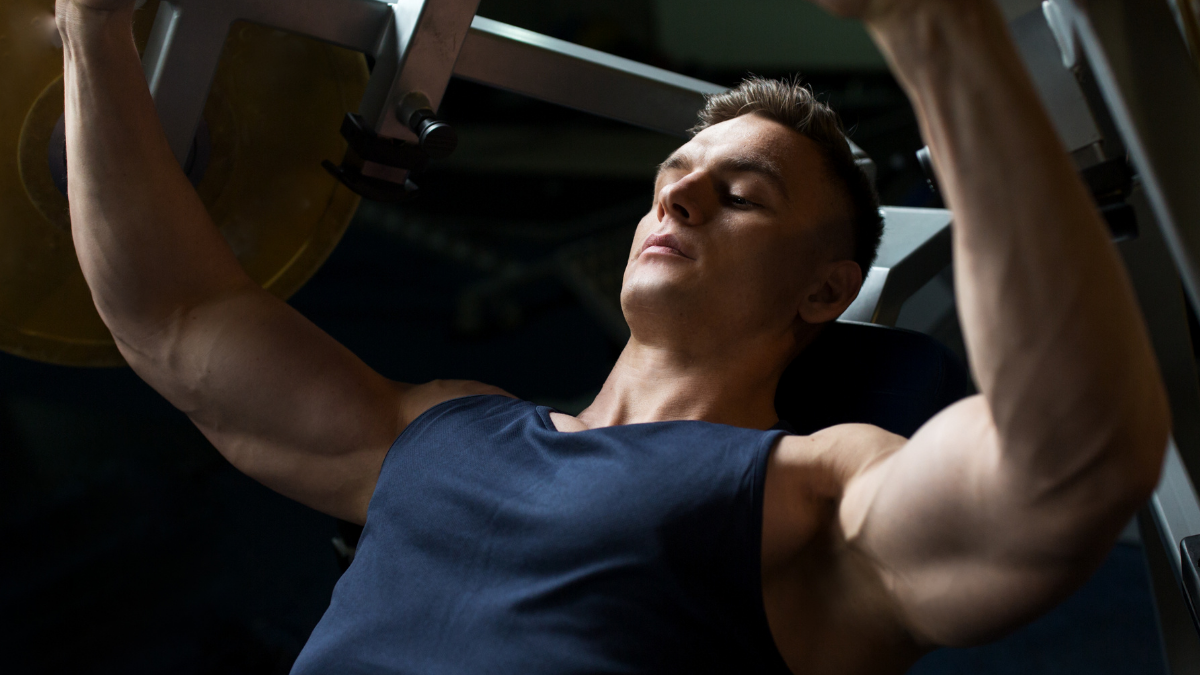
The seated chest press machine is arguably the best machine exercise for beginners. It closely mimics the movement pattern of a traditional bench press while eliminating many of the technical challenges.
Instead of stabilizing a barbell, you simply press the handles forward. This allows more attention to be directed toward producing force with the chest muscles.
Electromyography studies have demonstrated high activation of the pectoralis major during horizontal pressing exercises, making the chest press one of the most effective movements for stimulating muscle growth.
Because the movement follows a fixed path, beginners can safely approach muscular fatigue while maintaining good technique.
How to Perform It
- Adjust the seat so the handles line up roughly with the middle of your chest.
- Sit with your feet flat on the floor and your back fully supported by the pad.
- Grip the handles firmly without squeezing excessively.
- Pull your shoulders gently backward and downward to create a stable upper body position.
- Press the handles forward until your arms are nearly straight but do not forcefully lock the elbows.
- Pause briefly before slowly lowering the weight under control until you feel a comfortable stretch across the chest.
- Maintain a steady tempo throughout every repetition. Avoid bouncing the weight or allowing your shoulders to round forward.
Common Mistakes
Many beginners allow their shoulders to shrug upward during pressing. This shifts work away from the chest and can increase shoulder discomfort.
Another common mistake is lowering the weight only halfway. Training through a full comfortable range of motion generally produces greater muscle development than using partial repetitions.
Using excessive weight is another frequent error. The goal is controlled movement with proper technique rather than simply moving the heaviest possible load.
Exercise Two: Pec Deck Machine
Why It Works
The pec deck machine isolates the chest more than almost any other machine exercise. Unlike pressing exercises, where the triceps and shoulders assist significantly, the pec deck emphasizes horizontal shoulder adduction, one of the primary functions of the pectoralis major.
Because the elbows remain slightly bent throughout the movement, tension stays on the chest for much of each repetition. Research examining resistance exercise selection suggests that combining compound movements with more isolated exercises produces comprehensive muscle development by training muscles through different movement patterns.

For beginners, the pec deck is particularly valuable because it helps develop a stronger mind muscle connection. Many new lifters struggle to actually feel their chest working during pressing exercises. The pec deck makes chest contraction much easier to recognize.
How to Perform It
- Adjust the seat so your hands or forearms line up with the middle of your chest.
- Sit tall with your back against the pad.
- Begin with your arms opened comfortably to the sides while maintaining a slight bend in the elbows.
- Bring the handles together in a smooth arc until your hands meet in front of your chest.
- Pause briefly while squeezing the chest muscles before returning slowly to the starting position.
- Allow the chest to stretch naturally without forcing the shoulders into uncomfortable positions.
Common Mistakes
Many people turn the movement into a pressing exercise by extending their elbows. The elbow angle should remain nearly constant throughout each repetition.
Swinging the weight using momentum also reduces muscle tension. Every repetition should remain slow and controlled.
Another mistake is allowing the shoulders to roll forward aggressively at the end of the movement. Focus on squeezing the chest rather than reaching as far forward as possible.
Exercise Three: Incline Chest Press Machine
Why It Works
The incline chest press targets the upper fibers of the pectoralis major more effectively than flat pressing variations.
Many beginners naturally develop their lower and middle chest more quickly than their upper chest. Including incline pressing early helps create a fuller and more balanced appearance.
Why Spending 5 Minutes in a Deep Squat Could Improve Mobility, According to Strength Side
Research comparing different pressing angles has shown increased activation of the clavicular portion of the pectoralis major during incline pressing compared with flat pressing.
Using a machine instead of free weights allows beginners to focus entirely on controlled pressing while avoiding the balance demands associated with incline barbell or dumbbell presses.
How to Perform It
- Adjust the seat so the handles begin slightly below shoulder height.
- Sit with your back firmly against the pad and your feet planted on the floor.
- Grip the handles comfortably and keep your wrists straight.
- Press upward and slightly forward until your arms approach full extension.
- Lower the weight slowly until your elbows reach a comfortable depth without excessive shoulder strain.
- Maintain control throughout every repetition and avoid bouncing the weight at the bottom.
Common Mistakes
Some beginners flare their elbows excessively. Keeping the elbows at a moderate angle relative to the torso usually feels stronger and more comfortable.
Another mistake is using short repetitions. Lowering the weight through a controlled range increases muscle tension and promotes greater hypertrophy.
Do not rush the lowering phase. Eccentric control contributes significantly to muscle growth.
How Many Sets and Repetitions Should Beginners Perform?
Current evidence suggests that beginners respond well to moderate training volumes. For each of these exercises, performing two to four working sets of eight to fifteen repetitions is an excellent starting point. Choose a weight that allows you to finish each set with one to three repetitions still left before complete muscular failure.
As your technique improves, gradually increase the weight whenever you can comfortably perform the upper end of the repetition range with good form. Training the chest two times per week generally produces better muscle growth than training it only once weekly because it allows more high quality training volume across the week.
How Important Is Progressive Overload?
Progressive overload is the foundation of muscle growth. Your body adapts only when it is challenged beyond what it has previously experienced. Progressive overload does not always mean adding weight. You can also increase repetitions, improve exercise technique, increase total training volume, or perform each repetition with greater control.
Studies consistently show that gradually increasing training demands over time is essential for continued improvements in muscle size and strength. Keep a training log so you know exactly when you are becoming stronger.
Final Thoughts
Building a muscular chest does not require advanced training methods or complicated exercise selection. Beginners often achieve outstanding results by mastering a small number of highly effective machine exercises.
The seated chest press develops overall pressing strength and chest mass while teaching proper movement mechanics. The pec deck isolates the chest and improves muscle activation through a different movement pattern. The incline chest press emphasizes the often neglected upper chest, creating more balanced development.
Combined with progressive overload, proper nutrition, adequate recovery, and consistent training, these three exercises provide everything most beginners need to build an impressive chest.
Focus on quality repetitions, controlled technique, and gradual improvements every week. Those simple habits will produce far better long term results than constantly searching for new exercises or chasing heavier weights before your technique is ready.
Key Takeaways
| Exercise | Primary Benefit | Recommended Sets | Recommended Reps |
|---|---|---|---|
| Seated Chest Press Machine | Builds overall chest strength and size with excellent stability | 2 to 4 | 8 to 15 |
| Pec Deck Machine | Isolates the chest and improves muscle contraction | 2 to 4 | 10 to 15 |
| Incline Chest Press Machine | Targets the upper chest for balanced development | 2 to 4 | 8 to 15 |
| Weekly Frequency | Train chest twice per week for most beginners | 2 sessions | Total of 10 to 20 working sets weekly |
| Progression | Increase weight or repetitions gradually while maintaining technique | Weekly | Based on performance |
References
- American College of Sports Medicine. (2009). Progression models in resistance training for healthy adults. Medicine & Science in Sports & Exercise, 41(3), 687 to 708.
- Grgic, J., Schoenfeld, B.J., Orazem, J. and Sabol, F. (2022). Effects of resistance training performed to repetition failure or non failure on muscular strength and hypertrophy. Scandinavian Journal of Medicine & Science in Sports, 32(2), 183 to 203.
- Morton, R.W., Murphy, K.T., McKellar, S.R., Schoenfeld, B.J., Henselmans, M., Helms, E., Aragon, A.A., Devries, M.C., Banfield, L., Krieger, J.W. and Phillips, S.M. (2018). A systematic review, meta analysis and meta regression of protein supplementation on resistance training induced gains in muscle mass and strength in healthy adults. British Journal of Sports Medicine, 52(6), 376 to 384.
- Schoenfeld, B.J. (2010). The mechanisms of muscle hypertrophy and their application to resistance training. Journal of Strength and Conditioning Research, 24(10), 2857 to 2872.
- Schoenfeld, B.J., Grgic, J., Ogborn, D. and Krieger, J.W. (2017). Strength and hypertrophy adaptations between low load and high load resistance training. Journal of Strength and Conditioning Research, 31(12), 3508 to 3523.
- Schick, E.E., Coburn, J.W., Brown, L.E., Judelson, D.A., Khamoui, A.V., Tran, T.T. and Uribe, B.P. (2010). A comparison of muscle activation between a Smith machine and free weight bench press. Journal of Strength and Conditioning Research, 24(3), 779 to 784.
- Vigotsky, A.D., Halperin, I., Lehman, G.J., Trajano, G.S. and Vieira, T.M. (2018). Interpreting signal amplitudes in surface electromyography studies in sport and rehabilitation sciences. Frontiers in Physiology, 8, 985.
- Wernbom, M., Augustsson, J. and Thomeé, R. (2007). The influence of frequency, intensity, volume and mode of strength training on whole muscle cross sectional area in humans. Sports Medicine, 37(3), 225 to 264.