

If you want wider looking upper arms, hammer curls and preacher curls can both earn a place in your training. They are not interchangeable, though. Each exercise changes the position of your forearm and shoulder, which affects which elbow flexor muscles are emphasized and how easily you can load them with control.
The short answer is that hammer curls are the stronger choice if your main goal is to create more width through the side of the upper arm and forearm. They place the arm in a neutral grip and give substantial work to the brachialis and brachioradialis, two muscles that contribute to the appearance of a thicker arm. Preacher curls are usually the better choice for directly training the biceps brachii through a stable, strict curl with a supinated grip.


Neither movement has been proven to transform the shape of your biceps on its own. Muscle shape is largely determined by anatomy and genetics. What training can change is the size of the muscles around your elbow, which can make your arms look fuller, thicker, and wider. The best answer for most lifters is to use both exercises intelligently, while progressing them over time.
What Makes Biceps Look Wider?
Many people use the word biceps to describe the whole front of the upper arm. In reality, several muscles contribute to how large and wide your arms look.
The biceps brachii is the familiar two headed muscle on the front of the upper arm. It flexes the elbow, helps turn the palm upward, and assists with shoulder flexion. It is a major target in conventional curls performed with the palms facing upward.
Underneath the biceps brachii sits the brachialis. This muscle crosses the elbow joint and is a powerful elbow flexor regardless of whether your palm faces up, down, or inward. Since it lies beneath the biceps, adding size to the brachialis can increase the thickness of the upper arm and create more outward fullness when viewed from the front.
The brachioradialis runs along the thumb side of the forearm and crosses the elbow joint. It is heavily involved in elbow flexion, particularly when the forearm is in a neutral position. Developing it will not make the biceps muscle itself wider, but it can make the entire arm look denser from the elbow upward.
This distinction matters. Hammer curls are often described as a biceps width exercise, but their visual benefit is likely to come largely from the brachialis and brachioradialis. Preacher curls place more direct emphasis on the biceps brachii, especially when performed with a fully supinated grip.
The Case for Hammer Curls
Why the Neutral Grip Matters
A hammer curl is performed with the palms facing each other. This neutral grip changes the demands of the curl compared with a standard palm up curl. The biceps brachii still works to flex the elbow, but the brachialis and brachioradialis become especially important contributors.
Research using electromyography has found that curl variations can alter activity in the biceps brachii and brachioradialis. This is useful information, although it must be interpreted carefully. Electrical activity during one workout does not prove that one exercise will create more muscle growth over months of training. Muscle growth is influenced by tension, effort, volume, range of motion, recovery, and progressive overload.
In practical terms, hammer curls allow you to train the elbow flexors with a grip that many people find comfortable for the wrists and elbows. They also make it easier to use a slightly heavier dumbbell than in a strict supinated curl, provided that you do not swing the torso or allow the shoulders to take over the movement.
Why Hammer Curls Can Improve Arm Width
The brachialis sits deep beneath the biceps brachii. It cannot be isolated completely, because it contributes to every elbow flexion exercise. However, hammer curls are a highly practical way to give it hard work alongside the brachioradialis.
As the brachialis becomes larger, it may push the biceps brachii outward and improve the appearance of upper arm thickness. This does not change the muscle insertions or create a fundamentally new biceps shape. It can, however, make an arm look more substantial from several angles.
Hammer curls also develop the upper forearm near the elbow. For lifters whose arms look narrow because their forearms are underdeveloped, this can make a noticeable aesthetic difference. Bigger forearms also help create a smoother visual transition between the upper arm and lower arm.
How to Perform Hammer Curls Well
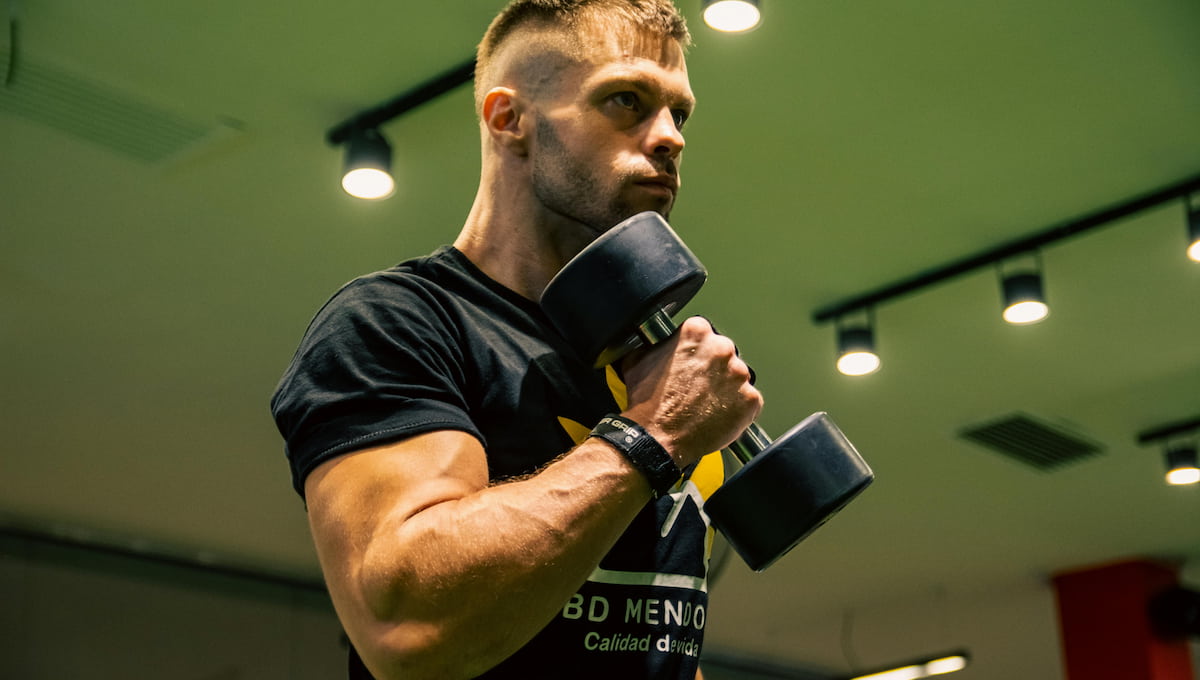
Stand tall with a dumbbell in each hand and your palms facing each other. Begin with the weights beside your thighs and keep your upper arms close to your body. Curl the dumbbells toward your shoulders while keeping the wrists neutral. Lower under control until the elbows are straight or very close to straight.
Avoid turning the curl into a whole body movement. If your back arches, your shoulders swing forward, or the weights fall quickly on the way down, reduce the load. A controlled range of motion gives the elbow flexors more useful work than simply moving a heavier dumbbell from point A to point B.
You can perform hammer curls with both arms at once, alternate arms, use a rope on a cable station, or perform cross body repetitions. All can work. The version that lets you train hard with stable technique is the best starting point.
The Case for Preacher Curls
Why Preacher Curls Target the Biceps So Well
A preacher curl supports the upper arm on a pad while you curl a dumbbell, bar, EZ bar, or cable handle. The pad limits shoulder movement and reduces the opportunity to use momentum. This makes the exercise demanding even with a moderate load.
Preacher curls are typically performed with a supinated grip, meaning the palms face upward. Supination is one of the biceps brachii’s key functions, so this grip supports its role during the curl. The stable arm position also makes it easier to focus on elbow flexion rather than turning the movement into a shoulder driven lift.
The exercise is particularly useful for people who struggle to feel their biceps during standing curls. The pad removes many opportunities to cheat, helping you maintain a consistent path and a controlled lowering phase. That consistency can make progression easier to track.
What Preacher Curls Do Not Do
Preacher curls are often marketed as an exercise for the lower biceps. This is misleading. You cannot selectively build one end of a muscle in the way that gym language sometimes suggests. The biceps brachii contracts as a whole, although training at different joint angles may affect how challenging an exercise feels across the range of motion.
Preacher curls also do not replace all other forms of curling. The shoulder is flexed in front of the torso and supported against the pad, so the exercise does not expose the biceps to exactly the same demands as an incline curl, standing curl, or chin up. Variety across a training plan can help you train hard while managing repetitive stress.
How to Perform Preacher Curls Well
Adjust the seat so that your armpits rest comfortably near the top of the pad and your upper arms remain supported. Start with the elbow nearly straight, but do not forcefully lock out or let the weight pull the elbow into an uncomfortable position.
Curl the weight smoothly until you reach a strong contraction without lifting the upper arm away from the pad. Lower slowly and stay in control. The bottom portion of a preacher curl can feel demanding because the arm is long and the elbow flexors must control the load carefully.
Do not chase maximal weights here. A preacher curl rewards strict technique, moderate to high repetitions, and gradual loading. If you feel sharp discomfort around the front of the elbow, shorten the range slightly, reduce the load, or choose a cable or dumbbell version that feels smoother.
Which Exercise Builds Wider Biceps?
For the specific goal of wider looking arms, hammer curls have the edge. Their neutral grip places a clear training emphasis on the brachialis and brachioradialis in addition to the biceps brachii. Adding size to these muscles can make your upper arms and forearms look thicker from the front and side.
For direct biceps brachii development, preacher curls have the edge. The supported position minimizes momentum, the usual palm up grip strongly involves the biceps, and the exercise is easy to standardize from workout to workout.
However, this is not a true winner takes all decision. There are no long term studies showing that hammer curls produce more arm width than preacher curls when total training volume and effort are matched. The more defensible conclusion is that they are complementary tools.
Use hammer curls to build the supporting elbow flexors that add density around the sides of the arm. Use preacher curls to apply strict, repeatable tension to the biceps brachii. Together, they cover more bases than either exercise alone.
How to Program Both Exercises for Growth
Muscle hypertrophy requires enough challenging work over time. Research shows that muscle growth generally improves as weekly resistance training volume increases, although the benefit does not rise endlessly and the best amount varies among individuals. Training sets should also be hard enough to provide a meaningful stimulus. You do not need to reach complete muscular failure on every set, but ending sets relatively close to failure appears useful for hypertrophy.
A practical approach is to train your biceps and elbow flexors two or three times per week. Start with six to ten hard direct sets per week across hammer curls, preacher curls, and other pulling movements. If you recover well and progress stalls, gradually add more work.
For hammer curls, use two to four sets of eight to fifteen repetitions. Keep one to three repetitions in reserve on most sets, meaning you could perform only a few more good repetitions before technical failure. Use a weight that allows your shoulders and torso to stay still.

For preacher curls, use two to four sets of ten to fifteen repetitions. The exercise can be very demanding in the stretched position, so prioritize control over load. Cable preacher curls can be especially useful if free weights feel awkward or uncomfortable.
A simple arm focused session could include three sets of preacher curls followed by three sets of hammer curls. Another option is to perform hammer curls after rows or pullups, then use preacher curls later in the week when your goal is more direct biceps work.
Record your repetitions and load. When you can reach the top of your chosen repetition range with clean technique, increase the resistance slightly. This gradual progression is far more important than searching for a perfect curl variation.
Technique and Recovery Still Decide the Result
Exercise selection matters, but it is only one part of muscular development. Consistent training, adequate protein intake, sufficient calories for your goal, sleep, and recovery all influence whether your arms grow.
Use a full range of motion that you can control comfortably. Resistance training performed through a fuller range of motion often produces at least comparable and sometimes superior hypertrophy outcomes to partial range training, although the best range depends on the exercise and the individual. For curls, that usually means lowering under control into a comfortably lengthened elbow position and curling until you reach a strong contraction.
Do not assume that soreness proves effectiveness. A good session should create a challenging local effort without irritating your wrists, elbows, or shoulders. If a movement causes persistent joint discomfort, adjust the grip, load, range of motion, or exercise selection.
The Bottom Line
Hammer curls are the better choice if you want to emphasize the brachialis and brachioradialis, which can help your arms look thicker and wider. Preacher curls are the better choice for strict, direct work on the biceps brachii with less opportunity to use momentum.
For the best overall result, include both. Train hammer curls to build the muscles that add density around the arm, then use preacher curls to load the biceps with precision. Progress your sets over time, train close enough to failure to make them count, and give the muscles enough recovery to grow.
References
- Lasevicius, T., Ugrinowitsch, C., Schoenfeld, B.J., Roschel, H., Tavares, L.D., De Souza, E.O., Tricoli, V. and Teixeira, E.L. (2018) ‘Effects of different intensities of resistance training with equated volume load on muscle strength and hypertrophy’, European Journal of Sport Science, 18(6), pp. 772 to 780.
- Marcolin, G., Panizzolo, F.A., Petrone, N., Moro, T., Grigoletto, D., Piccolo, D. and Paoli, A. (2018) ‘Differences in electromyographic activity of biceps brachii and brachioradialis while performing three variants of curl’, PeerJ, 6, e5165.
- Robinson, Z.P., Pelland, J.C., Remmert, J.F., Refalo, M.C., Jukic, I., Steele, J. and Zourdos, M.C. (2024) ‘Exploring the dose response relationship between estimated resistance training proximity to failure, strength gain, and muscle hypertrophy: A series of meta regressions’, Sports Medicine, 54(9), pp. 2209 to 2231.
- Schoenfeld, B.J., Ogborn, D. and Krieger, J.W. (2017) ‘Dose response relationship between weekly resistance training volume and increases in muscle mass: A systematic review and meta analysis’, Journal of Sports Sciences, 35(11), pp. 1073 to 1082.
- Schoenfeld, B.J., Grgic, J., Ogborn, D. and Krieger, J.W. (2017) ‘Strength and hypertrophy adaptations between low versus high load resistance training: A systematic review and meta analysis’, Journal of Strength and Conditioning Research, 31(12), pp. 3508 to 3523.
- Wolf, M., Mota, J.A., Dias, M.R.C., Sanches, I.C., Ayres, J.W., Lima, A.H.R.A., Tavares, L.D., Tricoli, V. and Ugrinowitsch, C. (2023) ‘Effects of range of motion on muscle development during resistance training interventions: A systematic review’, Sports Medicine, 53(11), pp. 2063 to 2084.
Key Takeaways
| Question | Answer |
|---|---|
| Which exercise is better for wider looking arms? | Hammer curls have the edge because they strongly train the brachialis and brachioradialis, which can add thickness around the upper arm and forearm. |
| Which exercise is better for direct biceps work? | Preacher curls are usually better for strict biceps brachii training because the upper arm is supported and momentum is reduced. |
| Can one exercise change the shape of your biceps? | No. Genetics largely determine muscle shape, but building the biceps, brachialis, and brachioradialis can make arms look fuller and wider. |
| Should you use both exercises? | Yes. Combining preacher curls and hammer curls is a practical way to train the main elbow flexors with different grips and positions. |
| How should you train them? | Use controlled full range repetitions, take most sets close to failure with good technique, and increase repetitions or load gradually over time. |