

Hammer curls are a simple way to train your arms with dumbbells. You hold the weights with your palms facing each other, then bend your elbows to curl them toward your shoulders. That neutral grip changes how your elbow flexors work compared with a traditional curl, where your palms face up.
That difference gives hammer curls a useful place in a beginner’s program. They train muscles that help bend the elbow, including the brachialis and brachioradialis, while still working the biceps. They also offer a straightforward movement to learn and progress.


Hammer curls will not build big arms on their own. Arm size depends on training your whole upper body, using enough challenging sets, recovering well, and gradually increasing the work you do. But if you want a simple exercise to complement your other curls and pulling movements, hammer curls are a strong option.
1. Hammer Curls Can Add Thickness to Your Upper Arm
The biceps brachii is the muscle most people picture when they think about bigger arms. It sits at the front of the upper arm and helps bend the elbow. But it is not the only muscle that contributes to the arm’s shape.
The brachialis lies underneath the biceps and also helps bend the elbow. Because it sits beneath the biceps, developing it can contribute to a fuller appearance in the upper arm. Hammer curls are one way to train the brachialis because the neutral grip lets you curl without turning your palm upward.
That does not mean hammer curls isolate the brachialis or switch the biceps off. Your biceps still help with elbow flexion. Research comparing different curl grips has found that the level of muscle activity changes with the position of the hand, rather than one grip removing a muscle from the exercise. A neutral grip can therefore add a different training stimulus to a routine that already includes regular curls.
For a beginner, the practical takeaway is simple: you do not need to replace every curl with hammer curls. You can use both. A supinated curl, with your palms facing up, and a hammer curl train the elbow flexors with different hand positions. Using more than one variation can help you train your arms from slightly different angles and keep your program balanced.
The change in arm appearance will come from consistent resistance training over time, not from a special curl variation. Beginners can often make progress with a manageable amount of work, provided that the sets are challenging and the training is repeated regularly. Start with a few sets each week, then add repetitions or a small amount of weight when you can perform the exercise with control.
2. They Train the Brachioradialis and Support Forearm Development
The brachioradialis is a muscle in the forearm that contributes to bending the elbow. It is more active when the forearm is in a neutral position, similar to the position used in a hammer curl. That makes hammer curls useful for training more than the front of the upper arm.
A well developed brachioradialis can make the area around the elbow and upper forearm look more muscular. It also contributes to elbow flexion, so it works alongside the biceps and brachialis during the movement. A study comparing curl grips found that changing hand position changed muscle activity in both the biceps brachii and brachioradialis. The study was small and measured short term muscle activity in experienced bodybuilders, so it does not prove that hammer curls build more muscle than other curls over time. It does support the idea that grip position changes the muscles’ contribution to the exercise.

Hammer curls can also challenge your grip because you need to hold the dumbbells throughout each set. Still, they should not be treated as a complete forearm or grip training plan. The forearm contains several muscles with different jobs, and a curl does not train every one of them equally.
For beginners, hammer curls can be a practical way to include more elbow flexor and forearm work without adding a complicated movement. They use the same basic pattern as a standard dumbbell curl, but your hands stay in a neutral position. That makes them easy to learn alongside other beginner exercises such as rows, pulldowns, and regular curls.
3. The Neutral Grip Makes Them Easy to Learn and Progress
A beginner does not need a complicated exercise to build muscle. A good starting choice is a movement you can perform consistently, with control, and with a load that challenges you without making your technique fall apart.
The hammer curl has a clear setup. Stand or sit with a dumbbell in each hand, let your arms hang at your sides, and point your palms toward each other. Keep your upper arms close to your torso as you bend your elbows and raise the dumbbells. Lower them under control to the starting position.
Because you keep your palms facing each other, you do not need to coordinate forearm rotation during the curl. That can make the movement easier to understand when you are learning to control the weights. It does not make the exercise risk free or automatically more comfortable for every person. If a movement causes pain, stop and adjust your technique, load, or exercise choice.
A controlled repetition is more useful than swinging a weight you cannot manage. If your torso rocks back and forth, your elbows move far forward, or your shoulders shrug to help lift the dumbbells, reduce the weight. The goal is to bend your elbows while keeping the rest of your body relatively still.
Running vs Swimming: Which Is Better for Overall Fitness?
You can also adjust the exercise to suit your balance and coordination. If standing curls make it difficult to avoid swinging, try sitting on a bench with your feet on the floor. You can curl both dumbbells at once or alternate arms. Choose the version that lets you focus on the movement and maintain steady control.
How Beginners Can Add Hammer Curls to a Workout
Start with two or three sets of eight to twelve repetitions. Choose a weight that lets you complete the set with good technique while leaving roughly two or three possible repetitions in reserve. You do not need to take every set to the point where you cannot lift another repetition. Current resistance training guidance indicates that reaching momentary failure is not necessary for muscle growth.
Train your arms as part of a balanced program that also includes exercises for your chest, back, shoulders, and triceps. Rows and pulldowns already involve elbow flexion, so take your total training into account instead of adding large amounts of curl work immediately. If you are new to lifting, one or two weekly sessions that include curls may be a sensible starting point.
Progress gradually. When you can perform the top end of your repetition range across all sets with steady technique, increase the dumbbell weight by a small amount. If the next available dumbbells feel too heavy, keep the current weight and build more repetitions first. Consistency matters more than changing the exercise every week.
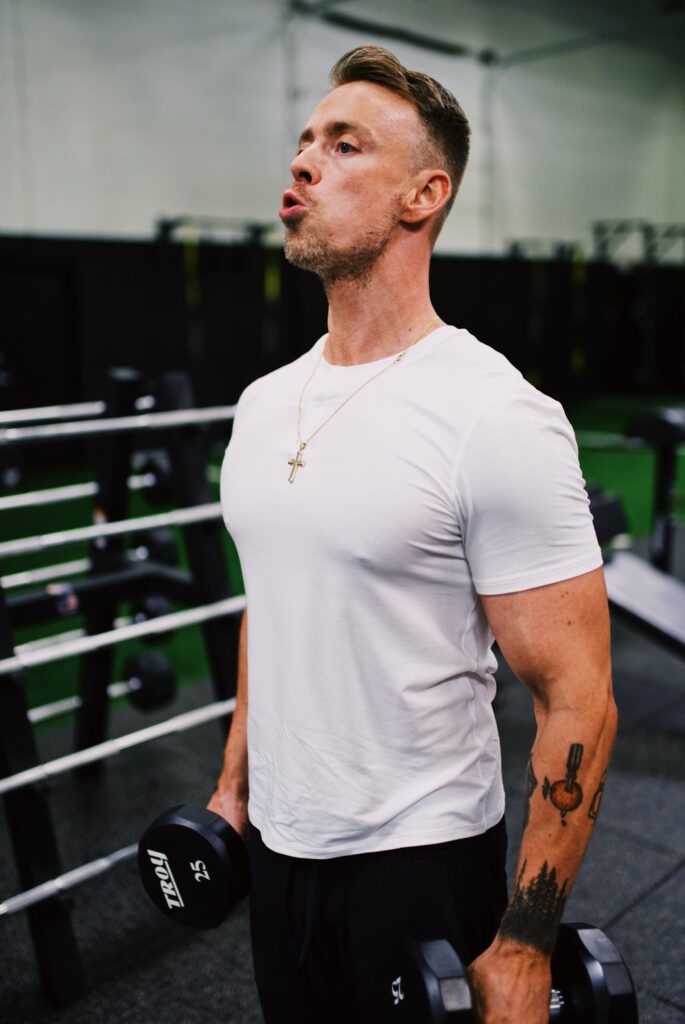
Use a comfortable range of motion. Lower the dumbbells until your elbows are nearly straight without forcing the joint into an uncomfortable position, then curl as high as you can while keeping your upper arms controlled. Research on resistance training range of motion suggests that using a full, comfortable range can support muscle development, although the exact effect can depend on the exercise and the person.
Are Hammer Curls Better Than Regular Curls?
Hammer curls are not universally better than regular curls. A traditional curl places your palms upward and tends to produce greater biceps brachii activity than a neutral grip curl in acute muscle activity research. Hammer curls, meanwhile, provide a different grip position and involve the brachioradialis and brachialis as elbow flexors.
The best choice depends on what your program needs and what you can perform comfortably. If your routine already has a lot of supinated curls, hammer curls can add variety. If you have only just started training, either variation can help you practice elbow flexion and build strength. You do not need to choose one forever.
For bigger arms, treat hammer curls as one useful tool within a complete training plan. Train consistently, use weights you can control, and give your body time to adapt. The neutral grip is a practical reason to include them, but steady effort across your whole program is what supports long term progress.
References
- Coratella, G., Tornatore, G., Longo, S., Toninelli, N., Padovan, R., Esposito, F. and Cè, E. (2023) ‘Biceps brachii and brachioradialis excitation in biceps curl exercise: different handgrips, different synergy’, Sports, 11(3), p. 64.
- Currier, B.S., McLeod, J.C., Banfield, L., Beyene, J., D’Souza, A.C., and others (2026) ‘Resistance training prescription for muscle function, hypertrophy, and physical performance in healthy adults: an overview of reviews’, Medicine & Science in Sports & Exercise.
- Kassiano, W., Costa, B., Nunes, J.P., Ribeiro, A.S., Schoenfeld, B.J. and Cyrino, E.S. (2023) ‘Which ROMs lead to Rome? A systematic review of the effects of range of motion on muscle hypertrophy’, Journal of Strength and Conditioning Research, 37(5), pp. 1135–1144.
- Schoenfeld, B.J., Ogborn, D. and Krieger, J.W. (2017) ‘Dose-response relationship between weekly resistance training volume and increases in muscle mass: a systematic review and meta-analysis’, Journal of Sports Sciences, 35(11), pp. 1073–1082.
Key Takeaways
| Benefit | Why Hammer Curls May Help | Beginner Tip |
|---|---|---|
| Upper arm thickness | Trains the brachialis along with the biceps | Combine with other curls in a balanced routine |
| Forearm development | The neutral grip involves the brachioradialis during elbow flexion | Use a weight you can hold and lower under control |
| Easy progression | The movement has a simple setup and can be adjusted | Start with two or three sets of eight to twelve repetitions |