

The bench press is not a complete measure of strength, but it is one of the clearest ways to track upper body pushing ability over time. It trains the chest, triceps, and front shoulders while demanding coordination, stability, and consistent technique. For men over 30, that combination makes it a useful performance goal, provided it is treated as one part of a balanced training plan rather than a test of identity.
The right target depends on your body mass, training history, injury history, equipment, and technique. A man who has never trained should not rush to load a barbell, while an experienced lifter may already be close to the more advanced benchmark. These milestones are not pass or fail rules. They are practical targets that can give your training direction, help you spot progress, and encourage you to build strength patiently.


The three benchmarks below cover two different qualities. The first two are single repetitions relative to bodyweight, which make the target meaningful for men of different sizes. The third is a five repetition maximum, which tests whether you can produce strong, repeatable reps rather than only preparing for one all out lift. All should be performed with a controlled bar path, a brief touch on the chest, stable shoulders, and no assistance from a spotter.
Why Bench Press Strength Matters After 30
Resistance training remains highly valuable as adults move through their thirties and beyond. It can improve maximal strength, muscle mass, physical function, and several markers linked with long term health. Muscle strength is also associated with a lower risk of all cause mortality in observational research, although it is important not to confuse an association with proof that a bigger bench press directly causes a longer life.
The bench press has a more specific role. It develops horizontal pressing strength, which is useful for pushing objects, getting up from the floor, and maintaining upper body capacity. The movement also gives you a repeatable lift that can be logged across months and years. This matters because progressive overload is a central principle of resistance training. Muscles and the nervous system adapt when training provides a challenge that is sufficient, gradual, and repeated.
A stronger bench press should never come at the cost of pain or lopsided training. Rowing movements, vertical pulling, lower body training, regular physical activity, and enough sleep all belong in the bigger picture. If pressing causes persistent shoulder, chest, wrist, or elbow pain, it is sensible to stop testing heavy loads and seek guidance from a qualified clinician or coach.
First Milestone: Bench Press Your Bodyweight for One Clean Rep
For many men, a bodyweight bench press is the first genuinely satisfying benchmark. If you weigh 80 kilograms, the target is an 80 kilogram barbell for one technically sound repetition. It is a meaningful goal because it requires more than casual gym attendance, but it is realistic for many healthy men who train consistently and progress intelligently.
This target is best treated as an intermediate strength milestone, not as the entry requirement for lifting. A novice may need many months to reach it. Others may get there sooner because they begin with more muscle mass, prior sports experience, favorable leverages, or a history of physical work. These differences are normal, which is why comparing your current performance with your own past performance is usually more useful than comparing it with strangers.
What Counts as a Clean Rep
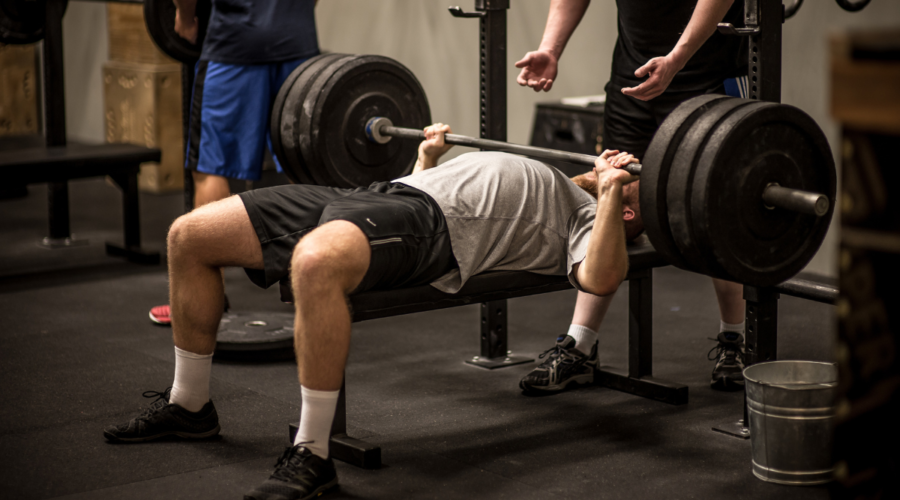
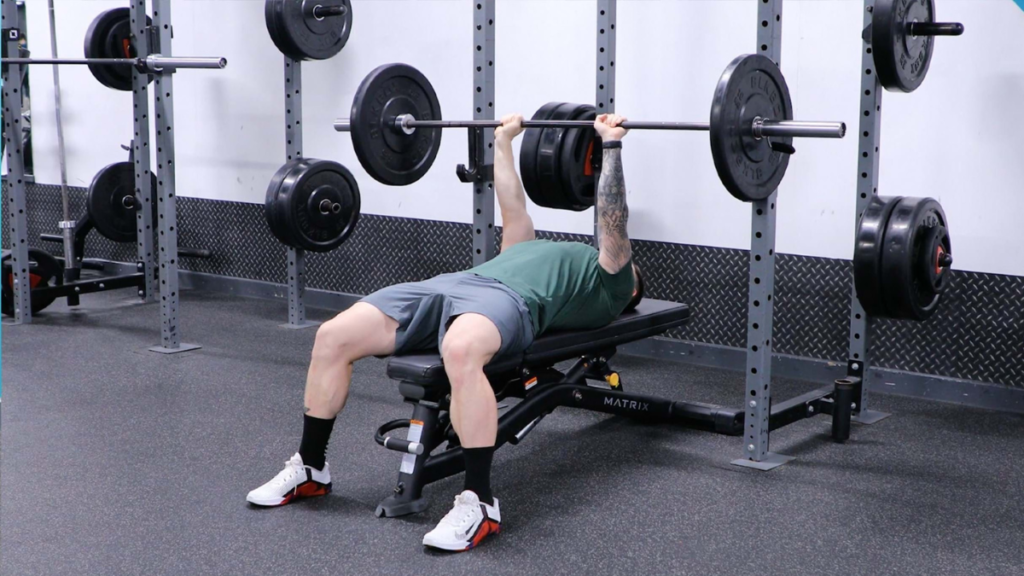
A clean repetition begins with the bar set securely above the shoulder joint, not above the neck. Keep your shoulder blades drawn back and down against the bench, place your feet firmly on the floor, and create whole body tension before taking the bar out. Lower the bar under control to the mid or lower chest, keep the wrists stacked over the forearms, then press the bar back toward the starting position without bouncing it off the chest.
You do not need to force a completely flat lower back. A modest natural arch can help create a stable position, provided your head, upper back, and glutes stay in contact with the bench and your feet remain planted. The goal is a repeatable lifting position that keeps the shoulder joint stable and allows the chest and triceps to contribute effectively.
How to Build Toward It
Train the bench press twice per week if recovery allows. One session can focus on moderate repetitions, such as three to four sets of six to ten reps, while the other uses heavier sets of three to five reps. Research indicates that a wide range of loads can build muscle when sets are performed with sufficient effort, while heavier loading is particularly useful when the goal is maximizing strength.
Add small amounts of weight only when your current load is controlled. An increase of 1 to 2.5 kilograms can be enough. Pair your pressing with rowing and pulling work, because the upper back helps create a stable platform on the bench and supports shoulder function. Triceps work can also be useful, especially if the bar slows markedly near lockout.
Second Milestone: Bench Press 1.5 Times Your Bodyweight for One Clean Rep
A 1.5 times bodyweight bench press is a more advanced goal. At 80 kilograms of body mass, it means pressing 120 kilograms for one clean repetition. Reaching this level normally requires a longer period of structured resistance training, solid technical skill, enough muscle mass in the chest, shoulders, and triceps, and careful management of fatigue.
This benchmark should not be rushed. The closer you move toward your current maximum, the greater the technical and recovery demands become. A program that worked when you were building from 60 to 80 kilograms may no longer work when you are trying to add another 10 kilograms to a much heavier lift. Progress becomes slower, which is not failure. It is the normal reality of approaching a higher level of strength.
Build Strength Without Chasing Maxes Every Week
Frequent maximal attempts are not necessary to become strong. Most productive training happens below your one repetition maximum, using sets that allow you to practice strong positions and accumulate quality work. Periodized resistance training, where volume and intensity are organized over time, can improve strength outcomes, though the exact plan should fit the lifter rather than follow a rigid template.
For this milestone, spend much of your training in sets of three to six repetitions. Include periods where you work slightly lighter for more total repetitions, then gradually increase the weight as a test day approaches. Paused bench presses, where the bar is held briefly on the chest before pressing, can improve control at the weakest part of the lift. Close grip bench presses and overhead pressing can add triceps and shoulder strength, but they should support the main lift rather than replace it.
Keep Your Shoulders in the Plan
Heavy pressing asks a lot of the shoulder complex. Good technique, sensible weekly volume, and enough pulling work can help manage that demand. Include rows, pull ups or pulldowns, and rear shoulder exercises throughout the week. Exercise selection matters less than performing it consistently with good control and progressing it at a recoverable rate.
Your warm up should prepare you for the load without tiring you out. Begin with the empty bar, add weight in manageable jumps, and reduce the number of repetitions as the bar gets heavier. On a true maximum attempt, use safety arms in a rack or a competent spotter who understands that help should only come if the lift stops moving or becomes unsafe.
Third Milestone: A Strong Five Rep Maximum
Your final benchmark is a five repetition maximum, often called a 5RM. This is the heaviest load you can press for five clean repetitions without assistance. It gives a different picture from a single repetition maximum because it tests strength across repeated efforts, control under fatigue, and the ability to keep technique together through several demanding reps.
A useful target is to build a 5RM that is approximately 85 percent of your current one repetition maximum. The exact relationship varies between lifters, exercises, and testing conditions, so it should not be treated as a precise conversion. Some lifters have excellent repetition endurance and can manage more than 85 percent for five reps. Others are more explosive and may need a slightly lower percentage. The value of the test is not the formula. It is measuring the same movement under the same standards and seeing it improve.
For an 80 kilogram man who can bench 100 kilograms once, a five repetition maximum near 85 kilograms is a sensible starting reference. If he later benches 90 kilograms for five well controlled reps, he has clear evidence that his repeatable pressing strength has improved, even if he has not tested a new single.
How to Test a True 5RM
Choose a day when you are rested, have eaten normally, and have not done hard chest or triceps work in the previous day or two. Warm up with several increasingly heavy sets, then select a weight you are confident you can press for three to five repetitions. If you complete five clean reps and feel that you could have done several more, rest adequately and add a small amount of weight for another attempt.
Stop when you reach a load where the fifth rep is challenging but controlled. The bar should touch the chest consistently on every repetition and you should not change the range of motion to finish the set. A missed fifth rep is not required for the test to be useful. In fact, stopping just before technical failure is often the better choice for safety and repeatability.
Why the 5RM Has a Place in Your Training
The 5RM is useful because it can be tested more often than a maximal single with less psychological pressure. It also aligns well with a common strength building rep range. Five rep sets are heavy enough to train force production, but long enough to reveal whether your bracing, bar path, and concentration deteriorate when fatigue builds.
Use the result to set training loads, not to define yourself. You can run a block where you perform several sets of five at a lighter percentage of your tested 5RM, add small amounts of load across several weeks, then test again. If the number does not move, examine sleep, calorie and protein intake, total pressing volume, technique, and whether you need a lighter training week before assuming the program has failed.
A Practical Way to Pursue All Three Milestones
Start by establishing your present level. If you are new to the barbell bench press, do not test a maximum on day one. Spend several weeks learning the movement with a manageable load. Once your technique is reliable, choose a rep range you can perform safely, record every session, and aim for gradual progress.
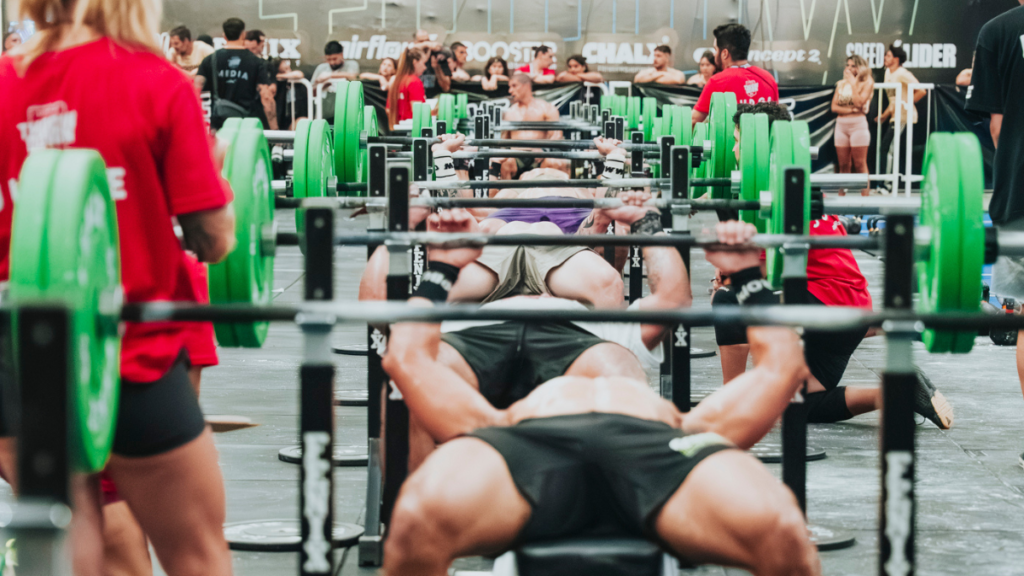
Many men will benefit from eight to twelve hard weekly sets for the chest, spread across one to three sessions, although the best amount depends on training experience and recovery. The bench press can provide a large share of those sets, with dumbbell presses, push ups, or machine presses adding volume when appropriate. Ensure that your pulling volume is at least as consistent as your pressing volume.
Protein intake and total food intake influence how well you recover and build muscle. Evidence supports protein intakes around 1.6 grams per kilogram of body mass per day as a useful general target for maximizing resistance training related gains in lean mass, with individual needs varying. Sleep also matters. Restricted sleep can impair recovery and physical performance, so strength goals are easier to pursue when training is matched by adequate rest.
The most important rule is patience. A bodyweight bench press is a strong first landmark. A 1.5 times bodyweight press is an ambitious long term target. A well tested 5RM gives you a complementary measure of durable, repeatable strength. Build them with clean repetitions, sensible progression, and a training plan that leaves room for the rest of your body to get stronger too.
References
- American College of Sports Medicine (2009) ‘American College of Sports Medicine position stand. Progression models in resistance training for healthy adults’, Medicine & Science in Sports & Exercise, 41(3), pp. 687 to 708.
- Cormie, P., McGuigan, M.R. and Newton, R.U. (2011) ‘Developing maximal neuromuscular power: Part 2. Training considerations for improving maximal power production’, Sports Medicine, 41(2), pp. 125 to 146.
- Grgic, J., Schoenfeld, B.J., Skrepnik, M., Davies, T.B. and Mikulic, P. (2018) ‘Effects of rest interval duration in resistance training on measures of muscular strength: A systematic review’, Sports Medicine, 48(1), pp. 137 to 151.
- Grgic, J., Lazinica, B., Schoenfeld, B.J. and Pedisic, Z. (2018) ‘Test retest reliability of the one repetition maximum strength assessment: A systematic review’, Sports Medicine, 48(1), pp. 99 to 115.
- Grgic, J., Schoenfeld, B.J., Orazem, J. and Sabol, F. (2022) ‘Effects of resistance training performed to repetition failure or non failure on muscular strength and hypertrophy: A systematic review and meta analysis’, Journal of Sport and Health Science, 11(2), pp. 202 to 211.
- Lixandrão, M.E., Ugrinowitsch, C., Berton, R., Vechin, F.C., Conceição, M.S., Damas, F., Libardi, C.A. and Roschel, H. (2018) ‘Magnitude of muscle strength and mass adaptations between high load resistance training versus low load resistance training: A systematic review and meta analysis’, Sports Medicine, 48(2), pp. 361 to 378.
Key Takeaways
| Milestone | What it tests | Practical target |
|---|---|---|
| Bodyweight bench press | Foundational relative upper body strength and clean barbell technique | Press your bodyweight once with controlled form |
| 1.5 times bodyweight bench press | Advanced relative strength, technique, and long term progression | Press 1.5 times your bodyweight once with controlled form |
| Five repetition maximum | Repeatable strength, technique under fatigue, and load tolerance | Work toward a clean 5RM near 85 percent of your current one repetition maximum, then use it to guide training |