

Building wider shoulders is one of the most effective ways to create a stronger looking upper body. More developed shoulders can make the waist appear narrower, improve the balance between your upper body and arms, and give T shirts a more athletic fit. For beginners, the key is not doing a huge list of complicated movements. It is choosing a few exercises that train the major sections of the deltoid muscles, learning them well, and progressively making them more challenging over time.
Your deltoid has three main portions: the front deltoid, the side deltoid, and the rear deltoid. The side deltoid is especially important for creating visible width because it sits on the outside of the shoulder. However, a complete beginner shoulder plan should not ignore the front and rear portions. The front deltoid contributes to pressing strength, while the rear deltoid helps round out the shoulder and supports balanced upper body development.


The three exercises in this article are the seated dumbbell shoulder press, dumbbell lateral raise, and chest supported rear delt raise. Together, they provide a simple and effective starting point. They also teach useful movement patterns without requiring advanced lifting skill or a crowded training plan.
What Actually Makes Shoulders Look Wider?
The visual width of your shoulders is influenced by skeletal structure, body fat levels, posture, and the amount of muscle you have built. You cannot change the width of your collarbones, but you can increase the size of the deltoid muscles that sit over the shoulder joint. Building the side deltoids is particularly valuable because these muscles add more visible mass to the outer edge of the upper body.
A good beginner program also benefits from training the shoulders through more than one movement pattern. Pressing movements strongly involve the front deltoids and triceps. Raising the arms out to the sides places greater emphasis on the side deltoids. Raising the arms backward or away from the body with the chest supported can train the rear deltoids more directly.
Research using muscle activity measurements supports the idea that different shoulder exercises emphasize different parts of the deltoid. This does not mean that muscle activity alone guarantees growth, but it is useful when selecting exercises that cover the shoulder from several angles. More importantly, resistance training itself is consistently shown to increase muscle size and strength in healthy adults when it is practiced regularly.
Close Grip Bench Press vs Dips: Which Builds Bigger Triceps for Beginners?
For beginners, the goal is to use stable exercises, controlled repetitions, and a load that is challenging without causing technique to fall apart. You do not need to train to absolute failure on every set. Consistent, hard work with good form is more valuable than forcing ugly repetitions.
1. Seated Dumbbell Shoulder Press
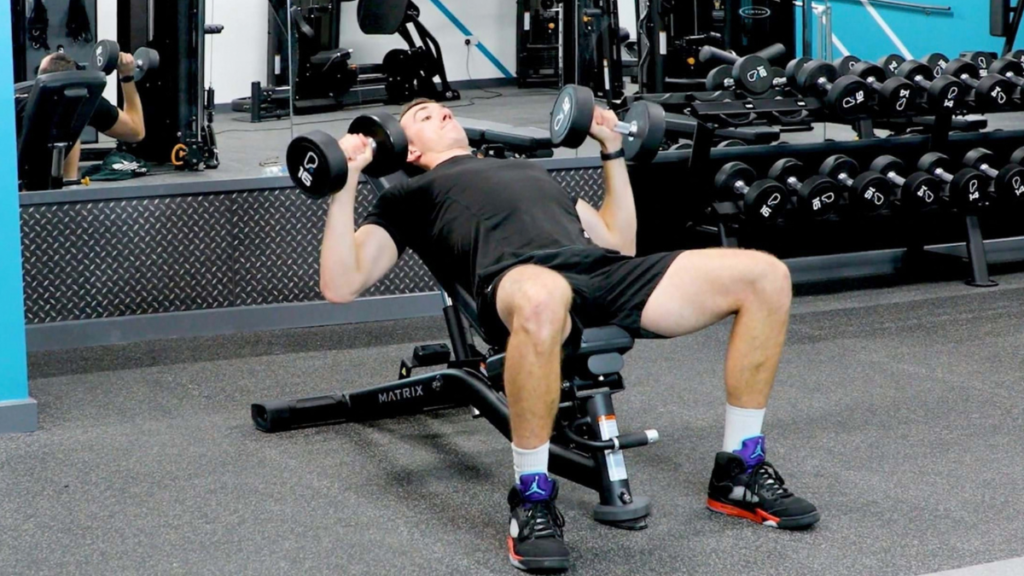
The seated dumbbell shoulder press is an excellent first exercise because it builds general pressing strength while training the front deltoids, side deltoids, and triceps. Sitting down reduces the temptation to use the legs or excessively lean backward, which makes it easier for a beginner to focus on the shoulder movement.
Dumbbells are also practical because each arm works independently. This can help you notice whether one side is doing more work than the other. You do not need perfect symmetry, but learning to control each arm is useful as you build confidence with pressing exercises.
How to Do It
Set an adjustable bench to an upright position with support behind your back. Sit with a dumbbell in each hand around shoulder height. Your palms can face forward or turn slightly inward if that feels more comfortable for your shoulders.
Start with your feet firmly on the floor and your rib cage stacked over your hips. Press the dumbbells upward until your elbows are straight but not aggressively locked. Lower the weights under control until they return close to shoulder height. Keep your wrists stacked over your elbows and avoid turning the movement into a backbend.
A slight inward hand position is often a comfortable option, especially when you are still learning. The best grip is one that lets you press smoothly without pain. If a movement produces sharp pain, pinching, or symptoms that continue after training, stop and seek an assessment from a qualified health professional.
Why It Works
The shoulder press allows you to use more load than an isolation exercise such as a lateral raise. This makes it a valuable tool for building overall upper body strength. The front deltoids contribute strongly to the lift, while the side deltoids and triceps also help move the dumbbells overhead.
For a beginner, stronger pressing can make many other training exercises feel more stable and controlled. It can also provide a reliable way to practice progressive overload. When you can perform all your planned repetitions with clean form, you can gradually increase the load.
Start with two or three sets of six to 10 repetitions. Choose a weight that feels demanding near the end of the set but still allows smooth, controlled technique. Rest for around two minutes before repeating the exercise, particularly when the sets are challenging.
2. Dumbbell Lateral Raise
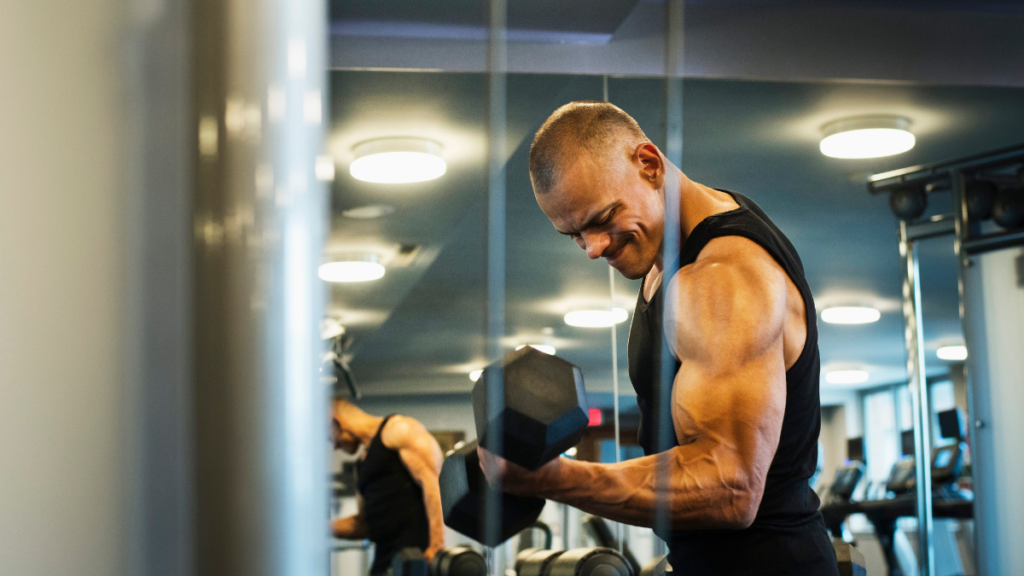
If your goal is wider looking shoulders, the dumbbell lateral raise deserves a permanent place in your routine. This exercise directly trains the side deltoid, the section of the shoulder that adds the most obvious width when viewed from the front.
It is also an exercise that rewards patience. Beginners often make lateral raises harder than they need to be by choosing dumbbells that are too heavy and swinging their torso to move them. The side deltoids do not need huge weights to receive a useful training stimulus. A lighter load performed with control is often much more productive.
How to Do It
Stand tall with a dumbbell in each hand by your sides. Keep a soft bend in your elbows and let your palms face toward your body. Raise the dumbbells outward and slightly forward in a smooth arc.
Stop when your upper arms are around shoulder height or just below it. Lower the dumbbells slowly back to the starting position. Think about moving your upper arms outward instead of throwing the weights upward with your hands.
Keep your neck relaxed and avoid shrugging your shoulders toward your ears. A small amount of body movement can happen during hard sets, but the repetition should still be controlled. If you have to swing your torso back and forth, the weight is too heavy.
Why It Works
The lateral raise is a simple shoulder abduction movement. It gives the side deltoid a direct role in lifting the arm away from the body. Research comparing common shoulder exercises has found that lateral raise variations can produce high activity in the middle portion of the deltoid, making them a logical choice when shoulder width is the goal.
A recent training study also found that both cable and dumbbell lateral raises increased lateral deltoid muscle thickness in resistance trained participants. That is useful news for beginners because it means a basic dumbbell version is not an inferior starting point. Cables can be a good variation later, but you can make excellent progress with dumbbells if you train consistently.
Use two or three sets of 10 to 20 repetitions. Lateral raises often work well with moderately high repetitions because lighter dumbbells make it easier to maintain control. Finish each set with roughly one to three good repetitions still possible. This is challenging enough to promote progress without requiring you to grind through poor quality repetitions.
3. Chest Supported Rear Delt Raise
The rear deltoid is easy to overlook because you cannot see it in the mirror as easily as the front and side deltoids. However, it matters for a complete shoulder shape and balanced upper body development. Training the rear deltoids can also complement the pressing and chest work that many beginners naturally do more often.
The chest supported rear delt raise is a beginner friendly way to train this area because the bench limits momentum. Rather than trying to control a bent over position while moving the weights, you can place your chest against the bench and focus on the movement at the shoulder.
How to Do It
Set an adjustable bench to a low incline. Lie face down with your chest supported and your feet firmly planted on the floor. Hold light dumbbells with your arms hanging toward the ground.
With a gentle bend in the elbows, raise your arms outward and slightly back. Imagine opening your arms wide rather than pulling your hands toward your hips. Lift until your upper arms are close to level with your shoulders, then lower the dumbbells slowly.
Keep your chest in contact with the bench and avoid shrugging. The weights should be much lighter than the ones used for shoulder presses. If you feel the exercise mostly in your upper traps or neck, lower the weight and slow down.
Why It Works
The rear deltoids assist with moving the upper arm backward and outward. A rear delt raise gives them more direct work than pressing movements do. Including this pattern makes your shoulder training more complete and helps prevent your plan from becoming entirely focused on the front of the body.
The chest supported setup is especially useful for beginners because it reduces the opportunity to use the lower back and hips to create momentum. That makes it easier to learn where the movement should come from. It also helps you keep the exercise honest when the repetitions become difficult.
Perform two or three sets of 10 to 20 repetitions. Focus on a controlled lift, a brief pause near the top if you can maintain position, and a slow lowering phase. The goal is not to set a personal record with this exercise. The goal is to give the rear deltoids enough direct tension to adapt.
How to Put These Exercises Into Your Week
Beginners do not need an entire day dedicated to shoulders. You can place these three exercises into two full body workouts each week, or add them to upper body sessions. Training a muscle more than once per week can be a practical way to spread your work across the week, especially when you are still learning movements and building tolerance to training.
A simple approach is to perform the seated dumbbell shoulder press first, followed by the dumbbell lateral raise and chest supported rear delt raise. The press comes first because it requires more coordination and uses heavier loads. The two raise variations can follow because they are more targeted and less technically demanding.
Start at the low end of the suggested set range. For example, you could complete two sets of each exercise twice per week. That gives you enough practice to improve while leaving room to add work later. Resistance training research indicates that weekly training volume is one important driver of muscle growth, but more is not automatically better when you are new to lifting. Your body needs time to recover, and your technique needs time to improve.
After a few weeks, add a set to one or more exercises if you are recovering well and still progressing. You can also progress by adding a small amount of weight, performing an additional repetition with the same weight, or improving the control and range of motion of each repetition.
The Technique Rules That Matter Most
The most useful shoulder training rule is simple: make the target muscle do the work. This means using a weight you can control, moving through a comfortable range of motion, and resisting the urge to rush the lowering phase.
Do not chase failure every set. Meta analyses suggest that training to momentary muscular failure is not required for hypertrophy or strength gains. A beginner can make excellent progress by ending most sets when they feel they could still perform one to three controlled repetitions. This creates a hard enough stimulus while reducing the chance that fatigue will turn the set into a collection of compensations.
Be equally patient with progression. The shoulders are smaller muscles than the legs, chest, and back, so the jumps in dumbbell weight can feel significant. If moving from 10 pound to 15 pound dumbbells changes your technique dramatically, stay with the lighter pair and build more repetitions first. Progress is not only about loading more weight. Better control, a longer range of motion, and more consistent training are all meaningful signs that you are moving forward.
Nutrition and Recovery for Shoulder Growth
Training provides the stimulus, but recovery supports the adaptation. Adequate daily protein intake, sufficient overall food intake, sleep, and rest between sessions all help create the conditions for muscle growth. A large meta analysis found that protein supplementation can further support resistance training related gains in muscle mass and strength, particularly when total protein intake is otherwise insufficient.
You do not need to obsess over every meal. A practical starting point is to include a quality protein source in your meals and eat enough to support your training goal. If you are trying to gain muscle and your body weight has not changed for months, you may need more total food. If your main priority is fat loss, you can still build strength as a beginner, but muscle gain may be slower when energy intake is very low.
Sleep is also worth protecting. Your workouts are only part of the process. Give your shoulders at least a day between hard direct sessions, and pay attention to persistent joint pain, unusually poor performance, or fatigue that does not improve with normal recovery.
Key Takeaways
| Focus | What to do | Why it matters |
|---|---|---|
| Main pressing movement | Perform seated dumbbell shoulder presses for two or three sets of six to 10 repetitions | Builds general pressing strength and trains the front and side deltoids |
| Shoulder width | Use dumbbell lateral raises for two or three sets of 10 to 20 repetitions | Directly targets the side deltoids that contribute most to a wider appearance |
| Balanced development | Add chest supported rear delt raises for two or three sets of 10 to 20 repetitions | Trains the rear deltoids and rounds out shoulder development |
| Weekly plan | Train these movements twice each week at first | Provides regular practice while allowing recovery |
| Progression | Add repetitions, improve control, or use slightly heavier dumbbells over time | Progressive overload gives the body a reason to adapt |
| Effort | End most sets with one to three controlled repetitions still possible | Hard training can be productive without taking every set to failure |
References
- Currier, B.S., McLeod, J.C., Banfield, L., Beyene, J., Welton, N.J., D’Souza, A.C., Keogh, J.A.J., Lin, L., Coletta, G., Yang, A., Colenso-Semple, L., Lau, K.J., Verboom, A. and Phillips, S.M. (2023) ‘Resistance training prescription for muscle strength and hypertrophy in healthy adults: a systematic review and Bayesian network meta analysis’, British Journal of Sports Medicine, 57(18), pp. 1211–1220.
- Lasevicius, T., Ugrinowitsch, C., Schoenfeld, B.J., Roschel, H., Tavares, L.D., De Souza, E.O., Tricoli, V. and Teixeira, E.L. (2018) ‘Effects of different intensities of resistance training with equated volume load on muscle strength and hypertrophy’, European Journal of Sport Science, 18(6), pp. 772–780.
- Lopez, P., Radaelli, R., Taaffe, D.R., Newton, R.U., Galvão, D.A., Trajano, G.S., Teodoro, J.L., Kraemer, W.J., Häkkinen, K. and Pinto, R.S. (2021) ‘Resistance training load effects on muscle hypertrophy and strength gain: systematic review and network meta analysis’, Medicine & Science in Sports & Exercise, 53(6), pp. 1206–1216.
- Lixandrão, M.E., Del Vecchio, A., Aihara, A.Y., de Souza, E.O., Conceição, M.S., Vechin, F.C., Libardi, C.A. and Tricoli, V. (2020) ‘Dumbbell versus cable lateral raises for lateral deltoid hypertrophy in resistance trained men and women’, Frontiers in Physiology, 16, 1611468.
- Nóbrega, S.R., Ugrinowitsch, C., Pintanel, L., Barcelos, C., Libardi, C.A. and Lopes, C.R. (2020) ‘Different shoulder exercises affect the activation of deltoid portions in resistance trained individuals’, Journal of Human Kinetics, 75, pp. 5–14.
- Schoenfeld, B.J., Grgic, J., Ogborn, D. and Krieger, J.W. (2017) ‘Strength and hypertrophy adaptations between low versus high load resistance training: a systematic review and meta analysis’, Journal of Strength and Conditioning Research, 31(12), pp. 3508–3523.
- Schoenfeld, B.J., Grgic, J., Van Every, D.W. and Plotkin, D.L. (2021) ‘Loading recommendations for muscle strength, hypertrophy, and local endurance: a re examination of the repetition continuum’, Sports, 9(2), 32.
- Schoenfeld, B.J., Ogborn, D. and Krieger, J.W. (2017) ‘Dose response relationship between weekly resistance training volume and increases in muscle mass: a systematic review and meta analysis’, Journal of Sports Sciences, 35(11), pp. 1073–1082.
- Stankovic, D., Peric, M., Marinkovic, M., Trivic, T. and Matic, R. (2022) ‘Activation of the three deltoid muscle portions during common strengthening exercises: a systematic review’, Journal of Bodywork and Movement Therapies, 31, pp. 125–132.
- Vieira, A.F., Umpierre, D., Teodoro, J.L., Lisboa, S.C., Baroni, B.M., Izquierdo, M., Cadore, E.L. and Ribeiro, J.P. (2021) ‘Effects of resistance training performed to repetition failure or non failure on muscular strength and hypertrophy: a systematic review and meta analysis’, Journal of Sport and Health Science, 10(5), pp. 631–642.
- Morton, R.W., Murphy, K.T., McKellar, S.R., Schoenfeld, B.J., Henselmans, M., Helms, E., Aragon, A.A., Devries, M.C., Banfield, L., Krieger, J.W. and Phillips, S.M. (2018) ‘A systematic review, meta analysis and meta regression of the effect of protein supplementation on resistance training induced gains in muscle mass and strength in healthy adults’, British Journal of Sports Medicine, 52(6), pp. 376–384.