

If you are looking for a number of chin-ups you should be able to do at 20, 40, or 60, the honest answer is that research has not established reliable adult standards for every age group. There is no widely accepted chart that can tell you how many strict chin-ups are normal for your age.
That does not make the question unhelpful. A clean chin-up is a demanding measure of upper body pulling strength relative to body weight. You can use it to track your own progress, and age can help frame your expectations. The key is to treat any repetition target as a training goal, rather than a pass or fail test.


What Counts as a Chin-Up?
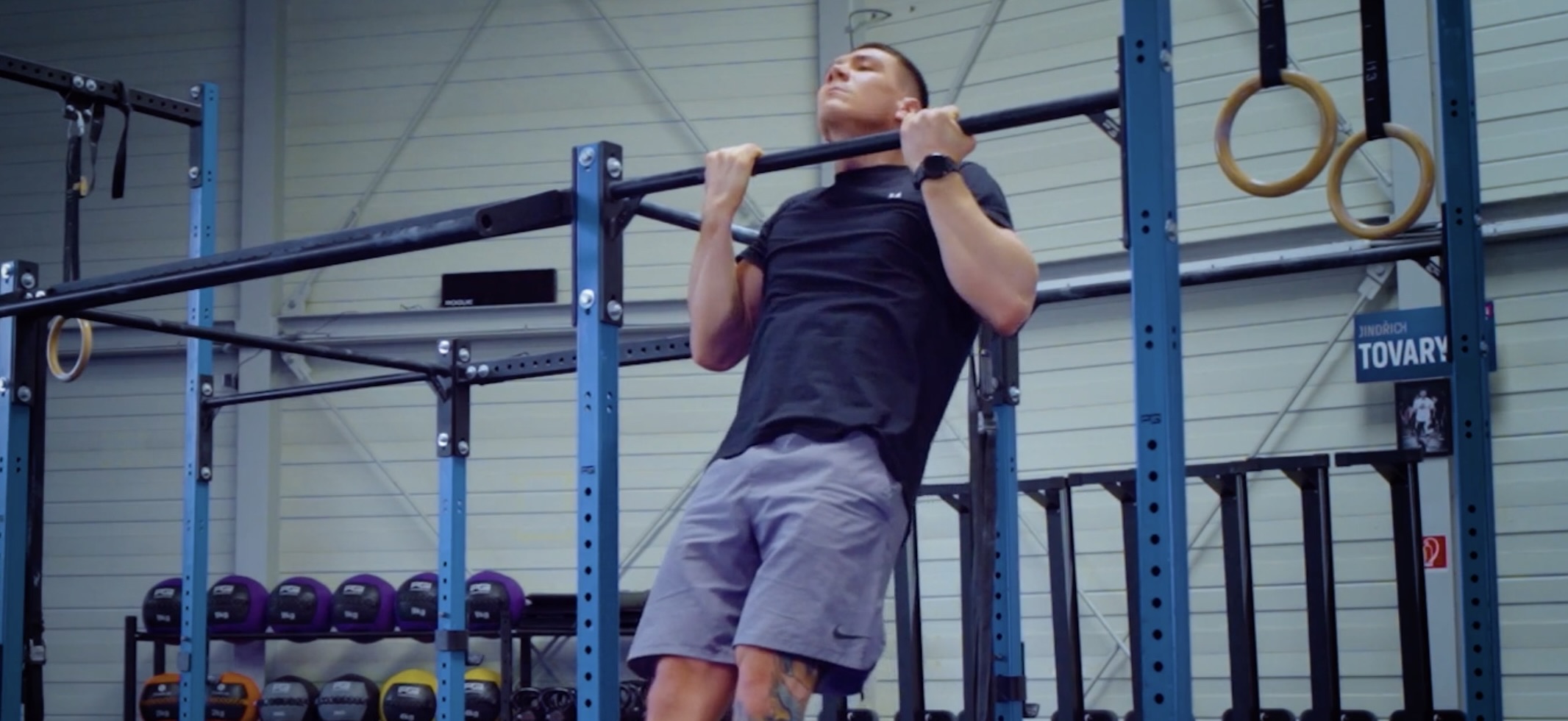
A chin-up uses an underhand grip, with your palms facing you. Start hanging from a stable bar with your arms extended. Pull until your chin clears the bar, then lower yourself under control until your arms are extended again. That is one repetition.

For a fair test, avoid swinging your legs, kicking, or shortening the range of motion. Use the same grip and technique each time you test. If you stop before your chin clears the bar or do not lower under control, the rep may still be useful practice, but it is not the same as a strict repetition.
Chin-ups are often confused with pull-ups. A pull-up usually uses an overhand grip, with your palms facing away. Both exercises involve the back, arms, shoulders, and grip, but changing your grip can change how the movement feels and how much help you get from your arms. For that reason, compare your chin-up score with other chin-up scores, rather than mixing it with pull-up results.
How Many Chin-Ups Should You Aim For?
There is no evidence based age by age target for the general adult population. Research has measured chin-up or related performance in particular groups, but those findings do not create a universal standard for everyone. For example, one large study measured the time participants could hold a chin-up position, rather than the number of strict chin-ups they could complete. Another study tested college students and examined the relationship between chin-up and lat pull performance. Those results are informative, but they cannot be used as a general age chart.
As a practical training guide, your first strict chin-up is a meaningful milestone if you have not been able to do one before. A few clean reps show that you can repeat the movement, while a higher number can be a longer term goal if you enjoy training chin-ups. These are coaching landmarks, not scientific cutoffs. They should not be treated as the minimum needed for health or fitness.
Practical Guidance by Age
Your age does not determine a specific chin-up score. The following table gives the same basic milestones across adult age groups because research does not support assigning different repetition quotas to each one.
Table 1. Practical chin-up guidance by age
| Age | Evidence based age specific standard | Practical way to use the exercise |
|---|---|---|
| 18 to 29 | No established adult repetition standard | Use your current strict rep count as a baseline and set a gradual training goal |
| 30 to 39 | No established adult repetition standard | Keep the same technique and compare your progress with your own past results |
| 40 to 49 | No established adult repetition standard | Build or maintain pulling strength at a level that suits your training and recovery |
| 50 to 59 | No established adult repetition standard | Use strict reps or an assisted version that lets you train with control |
| 60 and older | No established adult repetition standard | Choose a safe, manageable variation and focus on steady progress |
This approach may look less satisfying than a chart with a different number for every age. It is more accurate, however, because a chin-up score depends on more than age. Training experience, body weight, upper body strength, grip, mobility, previous injuries, and familiarity with the movement can all affect how many reps you can complete.
Why Chin-Up Counts Differ So Much
A chin-up requires you to lift your body, so your strength relative to your body weight matters. Two people with similar pulling strength can get different repetition counts if their body weights differ. In research with college students, both body composition and muscular endurance were related to performance on pulling tests. That helps explain why chin-up numbers vary, but it does not mean you should judge someone’s fitness from their body size or a single exercise.
Training history also matters. Someone who practices chin-ups, rows, or lat pull downs is likely to be more comfortable with pulling movements than someone who has never trained them. Your grip and technique can also limit your result. You might have enough back strength to pull higher but lose your hold on the bar, or you might be able to hang comfortably but not yet have enough strength to complete a full repetition.
Age can be relevant to strength and physical function, but people do not age at the same rate. Strength, health, activity levels, and training history differ widely among people in the same age group. Research on older adults also shows that resistance training can help address age related losses in strength and muscle. Getting older is not, by itself, a reason to stop training or to assume you must accept a particular chin-up score.
How to Test Your Chin-Ups
Test when you are rested, rather than after a workout that has already tired your back or arms. Use a stable bar that allows you to hang without your feet touching the floor. Before your first rep, check that the bar is secure and warm up with easy movements for your shoulders, arms, and upper back.

Begin from a controlled hang, pull until your chin clears the bar, and lower smoothly. Stop when you can no longer complete another repetition with the same range of motion and control. Do not keep forcing reps by kicking or straining through pain. Record the date, number of strict repetitions, grip, and any assistance you used. If you retest later, repeat those conditions as closely as possible.
3 Best Biceps Curl Variations for Wider and More Muscular Arms
If you cannot do a full chin-up yet, that does not mean you have failed a fitness test. It only means the full version is currently too difficult for you to repeat. You can still train the movement with a resistance band, an assisted pull up machine, or a related pulling exercise such as a lat pull down or row. The right starting point is one that lets you move under control.
How to Build Toward More Reps
Practice a version of the chin-up that you can perform with good form. If you use a band or machine, choose enough assistance to complete smooth repetitions without swinging. Over time, reduce the assistance gradually. You can also build your pulling strength with rows and lat pull downs, which let you adjust the load more easily than a bodyweight chin-up.
Train consistently, but give your arms, shoulders, and back time to recover between hard sessions. Resistance training guidance supports regular progressive training to improve strength and physical function. That does not mean every set needs to end with a failed rep. Your training should match your experience, goals, and ability to recover. If you are new to strength training, start with a manageable amount of work and increase it gradually.
Older adults can also benefit from resistance training, although the choice of exercise and level of assistance should suit the person. If you have shoulder, elbow, wrist, or back pain, or a health condition that affects exercise, ask a qualified health professional or trainer for guidance about an appropriate variation.
What Your Chin-Up Number Can and Cannot Tell You
Your chin-up count can show whether your performance on this particular movement is changing. If you can complete more strict reps under similar conditions, you have improved your chin-up performance. If your count stays the same while your training changes, you may need to review your technique, assistance level, or training plan.
It cannot tell you everything about your health or overall fitness. Someone can be strong and active without being able to do a chin-up, and a high score does not guarantee that every part of their fitness is strong. Chin-ups are one exercise among many. Treat the result as a personal benchmark, not a complete measure of your ability or value.
Key Takeaways
| Topic | Key takeaway |
|---|---|
| Age based standards | There is no well established adult chart that sets a chin-up count for every age |
| First milestone | A strict first chin-up can be a useful personal goal, but it is not a health requirement |
| Performance factors | Body weight, strength, technique, grip, and training experience influence your count |
| Testing | Use the same strict form and conditions each time you test |
| Progress | Assisted chin-ups, rows, and lat pull downs can help build pulling strength |
| Aging | Age alone does not determine your capacity to train or improve |
References
- Currier, B.S., D’Souza, A.C., Singh, M.A.F. et al. (2026) ‘American College of Sports Medicine position stand. Resistance training prescription for muscle function, hypertrophy, and physical performance in healthy adults: An overview of reviews’, Medicine & Science in Sports & Exercise, 58(4), pp. 851–872.
- Fragala, M.S., Cadore, E.L., Dorgo, S. et al. (2019) ‘Resistance training for older adults: Position statement from the National Strength and Conditioning Association’, Journal of Strength and Conditioning Research, 33(8), pp. 2019–2052.
- Johnson, D., Lynch, J., Nash, K., Cygan, J. and Mayhew, J.L. (2009) ‘Relationship of lat-pull repetitions and pull-ups to maximal lat-pull and pull-up strength in men and women’, Journal of Strength and Conditioning Research, 23(3), pp. 1022–1028.
- Leyk, D., Rüther, T., Witzki, A. et al. (2012) ‘Physical fitness, weight, smoking, and exercise patterns in young adults’, Deutsches Ärzteblatt International, 109(44), pp. 737–745.