

If you are trying to build muscle, should you lift a heavier weight for 8 reps or a lighter weight for 12?
What the research says about 8 reps and 12 reps
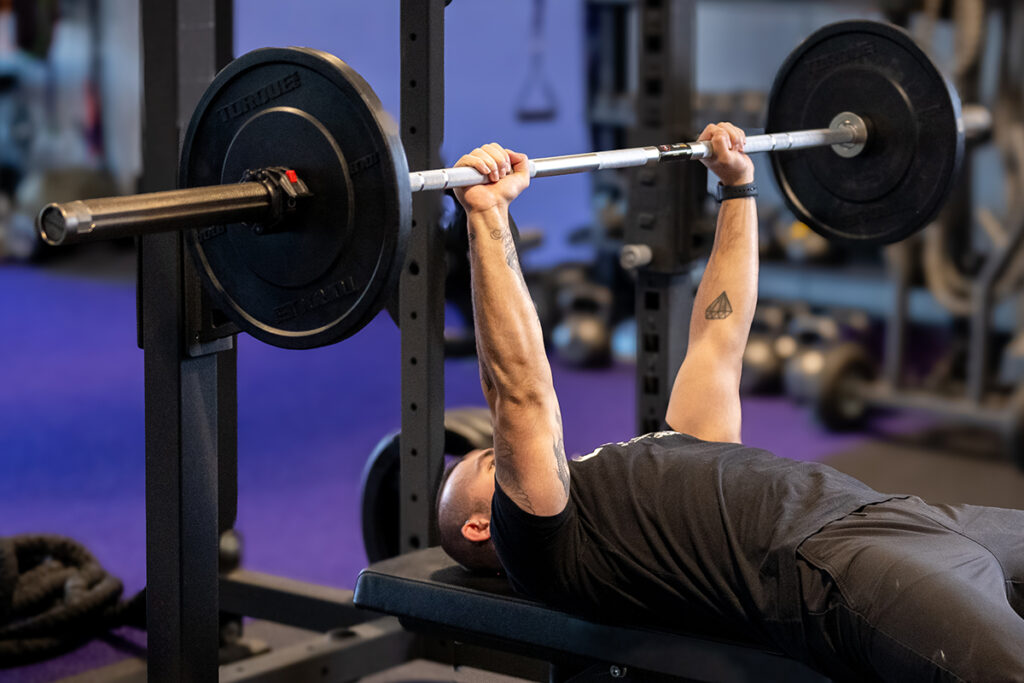
A direct comparison gives us a useful starting point. In one 10 week study, men trained the bench press twice a week using either 8 repetition maximum or 12 repetition maximum sets. The researchers found similar increases in chest muscle volume in both groups. The 8 repetition maximum group gained more bench press strength than the 12 repetition maximum group.
That result fits the wider research. Reviews and meta analyses comparing lighter and heavier resistance training generally find similar muscle growth across a broad range of loads, provided the sets are sufficiently challenging. Heavier loads tend to have an advantage for improving one repetition maximum strength, partly because practicing with heavier weights is more specific to lifting a heavy weight.
So, if your main goal is bigger muscles, both 8 reps and 12 reps can be effective. If you also want to improve your performance on a heavy single, sets of 8 may offer a more direct route. That does not mean 12 reps cannot build strength. It means the heavier practice in an 8 rep program is more specific to a one repetition maximum test.
Why the number of reps does not tell the whole story
A rep target only makes sense in relation to the weight you lift and how many more reps you could complete. Eight reps with a weight you could lift 15 times is a very different set from eight reps with a weight you could lift only nine times.
The same applies to 12 reps. A set of 12 that leaves you able to do 13 or 14 more reps is unlikely to challenge you in the same way as a set of 12 that leaves you close to your limit. The label “12 reps” does not tell us how demanding the set was.
This is why studies often describe a load as a repetition maximum. An 8 repetition maximum is a weight you can lift for about eight good reps before you cannot complete another rep with proper technique. A 12 repetition maximum is lighter and allows about 12 good reps. Everyday training does not have to take every set to the point where another rep is impossible, but the set should still be challenging.
A recent analysis of resistance training studies found that muscle growth tended to be greater when sets ended closer to failure. The relationship was not a simple rule that every set must reach failure. It suggests that stopping very far from your limit can reduce the muscle building stimulus, especially when using lighter weights.
How close to failure should you train?
For most people, a practical approach is to finish many working sets with roughly one to three good reps still possible. That is close enough to make the set demanding without requiring you to grind through every rep until your technique breaks down. You can use this approach with both 8 rep and 12 rep sets.
Estimating reps in reserve takes practice. If you think you could do three more reps, but the set actually ends with six more available, the set was less challenging than you intended. Pay attention to your last few reps. They should require effort, while your range of motion and control remain consistent.
Training to failure on every set is not necessary for muscle growth. Research comparing failure and nonfailure training has generally found similar growth when training volume is matched. Failure can be useful at times, particularly on safer exercises where you can stop without getting pinned or losing control, but it can also add fatigue. You do not need to turn every set into an all out test.
What matters more than choosing 8 or 12
The number of challenging sets you do over the week may matter more than whether those sets contain 8 or 12 reps. A review of resistance training studies found a dose response relationship between weekly set volume and muscle growth, with more weekly sets generally associated with greater gains. That does not mean more is always better. Your muscles and joints still need to recover, and the amount of training you can benefit from depends on your experience and capacity.
A good program gives each target muscle enough work to stimulate progress, then allows you to recover and repeat that work. If your strength, repetitions, or control improve over time, you have evidence that your training is moving in the right direction. Progress does not have to mean adding weight every workout. You might first complete more reps with the same load, improve your technique, or add a set when your current plan is no longer producing progress.
It is also useful to consider the exercise. Eight reps can feel manageable on a stable machine exercise but very demanding on a heavy squat. Twelve reps can be straightforward on a cable movement and uncomfortable on a high effort set of lunges. The best target is one you can perform with sound technique and repeat consistently.
Pros and cons of 8 reps
Eight reps let you use a heavier load than 12 reps in the same exercise. This can make the set feel more focused and gives you practice handling heavier weights. It is a natural fit for compound exercises such as presses, rows, squats, and deadlift variations, provided you can maintain good technique.
The heavier weight can also make small changes in performance easy to track. If you complete eight reps with a load that previously allowed seven, that is a clear sign of progress. However, heavier loads place greater demands on technique and may feel less comfortable for some people, particularly when they are still learning an exercise.
Eight rep sets may also require more rest between sets than lighter, higher rep work, especially if the load is demanding. That is not a reason to avoid them, but it can affect how long a session takes and how many exercises you can fit in.
Pros and cons of 12 reps
Twelve reps let you use a lighter load while still making the set challenging. Many lifters find this range comfortable for machines, dumbbell exercises, and isolation work. It can be a practical way to accumulate demanding work without handling the heaviest weights available.
Higher rep sets can create more burning and discomfort as fatigue builds. That sensation does not mean the set is automatically more effective, and it does not mean the muscle is growing more. It is simply one part of how a hard set can feel. Some people prefer a shorter set with a heavier load, while others find a moderate load easier to control.
With 12 reps, be careful not to stop early just because the set starts to feel uncomfortable. If the load is light enough that you could do many more good reps, the set may not be challenging enough to match the intended stimulus. Keep your form steady and bring the set close to your limit.
So, which should you choose?
Choose 8 reps if you enjoy heavier lifting, want to build strength alongside muscle, and can perform the exercise confidently. Choose 12 reps if you prefer a moderate load, want a comfortable range for a particular exercise, or find that higher reps help you focus on controlled movement. You can also use both ranges in the same training plan.
For example, you might use 8 reps for a main press or squat variation and 12 reps for a machine, cable, or arm exercise. You do not have to keep every movement in the same rep range. The evidence supports flexibility, as muscle growth can occur across a range of loads and repetition targets when sets are challenging.
3 Massive Benefits of Hammer Curls for Beginners that Want Bigger Arms
Whichever range you choose, keep track of your training. Use a weight that lets you reach the target reps with consistent technique, work close to failure on most sets, and aim to make gradual progress. If you are not recovering between sessions or your performance is slipping, adding more sets or pushing every set to failure may not help.
The clearest answer is that 8 reps and 12 reps can both build muscle. For hypertrophy, choose the range that lets you train hard, maintain good form, recover well, and keep progressing. If maximal strength is also a priority, include some heavier work, since heavier loads have a stronger effect on one repetition maximum performance.
Key takeaways
| Question | Answer |
|---|---|
| Which builds more muscle, 8 reps or 12 reps? | Neither has a consistent advantage when training is comparably challenging. |
| Which is better for one repetition maximum strength? | Eight reps usually provides more practice with heavier loads. |
| How hard should each set feel? | Finish most sets close to your limit while keeping good technique. |
| Do you need to reach failure? | No. Training to failure on every set is not required for muscle growth. |
| Can you use both rep ranges? | Yes. Choose a range that fits the exercise and that you can progress with. |
References
- Carvalho, L., Junior, R.M., Barreira, J., Schoenfeld, B.J., Orazem, J. and Barroso, R. (2022) ‘Muscle hypertrophy and strength gains after resistance training with different volume matched loads: a systematic review and meta analysis’, Applied Physiology, Nutrition, and Metabolism, 47(4), pp. 357–368.
- Kubo, K., Ikebukuro, T. and Yata, H. (2021) ‘Effects of 4, 8, and 12 repetition maximum resistance training protocols on muscle volume and strength’, Journal of Strength and Conditioning Research, 35(4), pp. 879–885.
- Refalo, M.C., Helms, E.R., Trexler, E.T., Hamilton, D.L. and Fyfe, J.J. (2023) ‘Influence of resistance training proximity to failure on skeletal muscle hypertrophy: a systematic review with meta analysis’, Sports Medicine, 53(3), pp. 649–665.
- Refalo, M.C., Hamilton, D.L., Carvalho, L.P., Galvão, D.A., Novaes, J.S., Nunes, J.P., Cyrino, E.S., Feros, S.A. and Fyfe, J.J. (2021) ‘Influence of resistance training load on measures of skeletal muscle hypertrophy and improvements in maximal strength and neuromuscular task performance: a systematic review and meta analysis’, Journal of Sports Sciences, 39(15), pp. 1723–1745.
- Schoenfeld, B.J., Ogborn, D. and Krieger, J.W. (2017) ‘Dose response relationship between weekly resistance training volume and increases in muscle mass: a systematic review and meta analysis’, Journal of Sports Sciences, 35(11), pp. 1073–1082.
- Vieira, A.F., Umpierre, D., Teodoro, J.L., Lisboa, S.C., Baroni, B.M., Izquierdo, M. and Cadore, E.L. (2021) ‘Effects of resistance training performed to failure or not to failure on muscle strength, hypertrophy, and power output: a systematic review with meta analysis’, Journal of Strength and Conditioning Research, 35(4), pp. 1165–1175.