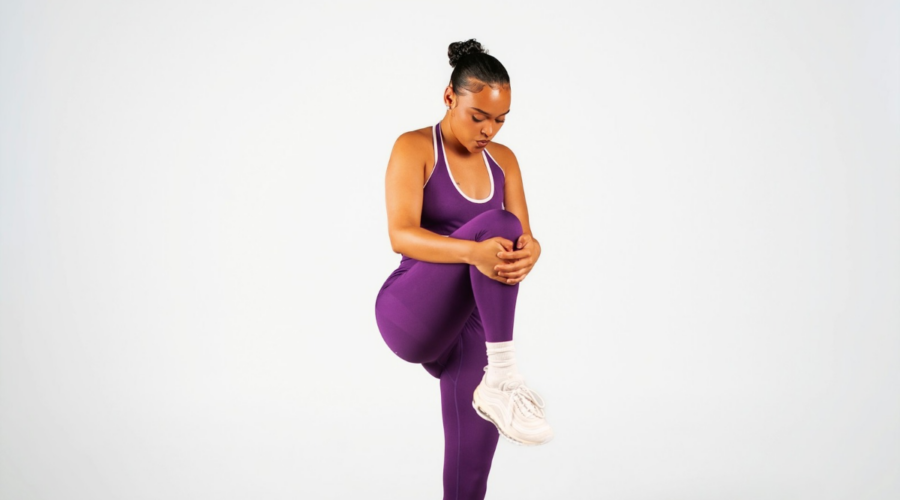


Standing on one leg looks simple, but it asks your body to coordinate vision, sensation, strength, and balance. Your result can also change depending on whether your eyes are open, how you position your arms, and how long you try to hold the position.
There is no single time that everyone of a certain age should be able to reach. One useful study of healthy adults found that average eyes open balance times decreased with age, especially after age 60. These figures are helpful for comparison, but they are averages from one study sample, not pass or fail scores.
How long should you balance on one leg?
In a study of 549 healthy adults aged 18 to 99, participants stood on one leg with their eyes open or closed. The eyes open test had a 45 second limit. Average best times were about 45 seconds for adults aged 18 to 39, 42 seconds for adults in their 40s and 50s, 32 seconds for adults in their 60s, 22 seconds for adults in their 70s, and 9 seconds for adults aged 80 to 99.
The test’s time limit matters. The average for the youngest group was close to the 45 second maximum, so the test could not show how long many participants might have balanced if they had been allowed to continue. The numbers also describe a group average. A healthy person can score above or below that average without the result automatically indicating a health problem.
Average one leg balance time with eyes open
| Age group | Average time |
|---|---|
| 18 to 39 | 44.7 seconds |
| 40 to 49 | 41.9 seconds |
| 50 to 59 | 41.2 seconds |
| 60 to 69 | 32.1 seconds |
| 70 to 79 | 21.5 seconds |
| 80 to 99 | 9.4 seconds |
These results come from the best of three trials, with each trial limited to 45 seconds. The study found no meaningful difference between men and women in its eyes open results. Other studies have found some differences between age and sex groups, so these figures should not be treated as universal standards.
What does the test measure?
A one leg balance test measures how well you maintain a stable position when your base of support is small. Your body uses information from your eyes, inner ear, joints, muscles, and the soles of your feet to make small adjustments that help you stay upright. Because the test involves several systems at once, your time is not a direct measure of leg strength or athletic ability.
Balance also depends on the conditions of the test. Standing barefoot with your arms crossed is harder than standing in shoes with your arms held out. Closing your eyes makes the test much harder because you remove one important source of information. For a useful comparison, keep your setup consistent each time you test.
How to test your balance safely
Stand beside a sturdy counter or chair so you can reach it if needed. Keep the floor clear, and do not test on a slippery surface. Start with your eyes open and look straight ahead. Lift one foot without letting it touch your standing leg, and time how long you can hold the position while staying upright.
Stop the timer if your raised foot touches the floor, your standing foot moves, or you need to grab the support. Try both sides, and repeat the test up to three times. You can record your best result, but use the same rules whenever you test again. Do not close your eyes unless a qualified health professional has asked you to do so and can supervise you.
The research study used a controlled setup and a fixed time limit. Your home test may not match those exact conditions, so use your result as a personal reference rather than a precise clinical score.
Why does balance tend to change with age?
Age related changes can affect several parts of balance, including vision, sensation, muscle strength, and the body’s ability to coordinate movement. In a study that measured one leg standing across a wide age range, results generally peaked in adulthood and declined at older ages. The researchers also observed that performance changed more when participants closed their eyes, which highlights how much the test can depend on visual information.
Balance does not decline at the same rate for everyone. Physical activity, health conditions, pain, medication, previous injuries, footwear, and familiarity with the test may all influence a person’s result. A single score cannot explain why someone finds the test difficult.
Is 10 seconds a good target?
Ten seconds is a useful basic checkpoint for some middle aged and older adults, but it is not a universal age based target. A study of 1,702 people aged 51 to 75 found that participants who could not complete a 10 second one leg stance had a higher rate of death during the study’s follow up period. The researchers adjusted their analysis for age, sex, body mass index, and several health conditions, but the result shows an association. It does not prove that a short balance time causes poor health or predict what will happen to any one person.
10 Quick Tips for Beginners To Build More Muscle
The study also did not establish that everyone should be able to hold the position for a particular number of seconds. It examined whether people could complete a brief test under its testing conditions. That makes 10 seconds a possible screening marker in that context, not a diagnosis or a fitness standard for all ages.
What if your result is lower than the average?
A result below the average does not automatically mean something is wrong. Group averages hide a wide range of individual results, and small differences in testing conditions can change your time. A single attempt can also be affected by tiredness, distraction, or an unfamiliar setup.
If your balance has changed suddenly, you feel unsteady during everyday activities, or you have had recent falls, speak with a health professional. They can assess your balance alongside other aspects of your health and help identify whether further evaluation or support is appropriate.

If you want to improve your balance, practice near a stable support and choose a position you can hold safely. Start with both feet on the floor in a staggered stance, then progress to briefly lifting one foot while keeping a hand close to the support. Stop if you feel unsafe, dizzy, or in pain. The goal is controlled practice, not forcing a longer time in a position you cannot hold comfortably.
How to use your score
Compare your time with the age group averages as a broad reference, while remembering that the published figures came from a particular sample and test protocol. For a more useful personal measure, repeat the same safe test every few weeks under similar conditions. A gradual change in your own score may tell you more than whether you match a group average.
One leg balance is only one part of physical function. It does not measure strength, walking ability, or overall health by itself. Treat the test as a simple check in, rather than a complete assessment of your fitness.
Key Takeaways – What to remember about the one leg balance test
| Key point | Takeaway |
|---|---|
| There is no universal pass score | Published times are averages from specific groups and test methods. |
| Eyes open times vary with age | In one study, average times ranged from about 45 seconds in adults aged 18 to 39 to about 9 seconds in adults aged 80 to 99. |
| Ten seconds is a screening marker | Research found an association between completing a 10 second test and survival in adults aged 51 to 75, but it is not a diagnosis or guarantee. |
| Test safely and consistently | Stand beside stable support, use the same setup, and compare your own results over time. |
| Seek advice about concerning changes | Contact a health professional if you have sudden balance changes, repeated falls, or difficulty staying steady in everyday life. |
References
- Araujo, C.G., de Souza e Silva, C.G., Laukkanen, J.A., Singh, M.F., Kunutsor, S.K., Myers, J., Franca, J.F. and Castro, C.L. (2022) ‘Successful 10-second one-legged stance performance predicts survival in middle-aged and older individuals’, British Journal of Sports Medicine, 56(17), pp. 975–980.
- Morioka, S., Fukumoto, T., Hiyamizu, M., Matsuo, A., Takebayashi, H. and Miyamoto, K. (2012) ‘Changes in the equilibrium of standing on one leg at various life stages’, Current Gerontology and Geriatrics Research, 2012, Article 516283.
- Springer, B.A., Marin, R., Cyhan, T., Roberts, H. and Gill, N.W. (2007) ‘Normative values for the unipedal stance test with eyes open and closed’, Journal of Geriatric Physical Therapy, 30(1), pp. 8–15.