

If your goal is wider looking biceps, both barbell curls and cable curls can help. Neither exercise can change the shape of your muscle attachments or make one part of the biceps grow in complete isolation. Genetics has a major influence on the natural width, peak, and lower portion of your biceps.
What training can do is add muscle to the elbow flexors, especially the biceps brachii, brachialis, and brachioradialis. This makes the upper arm look thicker from the front and side. The brachialis is particularly important because it sits beneath the biceps brachii. When it grows, it can push the biceps outward and contribute to a broader arm appearance.


The short answer is that neither movement is automatically superior. Barbell curls are usually better for progressively loading the elbow flexors with heavy, stable resistance. Cable curls provide continuous external tension and make it easier to train the muscle through different arm positions. The best choice depends on your technique, comfort, available equipment, and ability to train hard consistently.
What Actually Makes Biceps Look Wider?
The visible biceps muscle has two heads. The long head sits more toward the outside of the upper arm, while the short head sits more toward the inside. Both heads work during elbow flexion and forearm supination, which means turning the palm upward.
It is common to hear that a specific curl can completely isolate one head of the biceps. This overstates what exercise selection can achieve. Arm position, grip, range of motion, and resistance direction can alter how a muscle is loaded, but both heads usually contribute strongly to a curl. The biceps also work alongside the brachialis and brachioradialis.
For a wider arm appearance, total growth of the elbow flexors matters more than chasing one magical variation. The brachialis deserves special attention because it lies under the biceps brachii and is a powerful elbow flexor regardless of forearm position. Building this muscle can make the upper arm look thicker when viewed from the front.
A wider looking biceps is therefore less about finding one exercise that targets the outer biceps and more about accumulating enough productive training volume over time. You need challenging sets, progressive overload, sufficient recovery, and a diet that supports muscle growth.
The Case for the Barbell Curl
The barbell curl is one of the simplest and most effective direct biceps exercises. Hold a straight bar with an underhand grip, keep the upper arms close to the torso, curl the bar toward the shoulders, and lower it under control.
Why Barbell Curls Build Muscle Effectively
The major benefit of a barbell curl is stability. Both hands hold the same fixed bar, which allows many lifters to use more load than they can with dumbbells or cables. This can make progressive overload straightforward. When you can perform the current load with clean technique at the top of your chosen repetition range, you can add a small amount of weight.
Heavy loading alone does not guarantee superior muscle growth, but it can be useful. Research shows that a wide range of loads can build muscle when sets are performed with sufficient effort. Moderate and heavier loads are often practical because they allow hard sets without requiring extremely high repetitions.
The barbell also makes it easy to track performance. You can record the load, repetitions, sets, and execution from one session to the next. That clarity is valuable because hypertrophy training works best when it becomes gradually more demanding over time.
The Limitation of the Barbell Curl
A barbell does not provide equal external resistance through every point of the curl. The exercise is generally hardest around the middle of the range, when the forearm creates a longer lever against gravity. It becomes easier near the bottom and top of the movement.
This is not a fatal flaw. Muscles grow from repeated exposure to challenging tension, and a movement does not need to be equally difficult at every joint angle to be productive. However, some lifters may find that the easiest portions of the barbell curl limit how much tension they can maintain across the full range.
A straight bar can also be uncomfortable for some wrists, elbows, or shoulders because it fixes the hands in a fully supinated position. An EZ bar can be a sensible alternative if a straight bar causes discomfort, although the exact grip angle changes the feel of the exercise.
The Case for the Cable Curl
A cable curl uses a pulley and handle, rope, straight bar, or EZ style attachment. Unlike free weights, the cable pulls in the direction of the pulley rather than directly toward the floor. This changes the resistance profile of the exercise.
Why Cable Curls Can Be Valuable
The main advantage of cable curls is that they can keep meaningful tension on the elbow flexors across more of the range of motion. With a low pulley cable curl, the cable continues to pull against the hands near the bottom of the movement, where a barbell can feel relatively easy.
Cables also let you train curls from several angles. A cable curl performed with the pulley behind the body places the shoulder in extension. A curl performed with the pulley in front of the body places the shoulder in flexion. These changes may alter how the biceps feel and how the long head and short head contribute, although they do not create complete isolation.
Cable variations can be especially useful for lifters who struggle to feel their biceps during barbell curls. The resistance is smooth, the load changes in small increments on many machines, and the setup can make it harder to use momentum. This may improve technique and help keep the elbow flexors working rather than turning the exercise into a hip driven movement.
The Limitation of the Cable Curl
Cable stacks vary between machines. The stated weight does not always represent the exact resistance at the handle because pulley systems can alter the effective load. This makes comparisons between gyms less reliable than with a barbell and plates.
Cable curls may also be less convenient in a busy gym. You may need a specific pulley height, attachment, and amount of space. If your setup is awkward or forces you to rush between sets, it may be less useful than a simple barbell curl that you can perform consistently.
Most importantly, continuous tension does not automatically mean better hypertrophy. Muscle growth is determined by many variables, including effort, volume, range of motion, progression, recovery, and individual response. There is currently no strong long term evidence showing that cable curls consistently build wider biceps than barbell curls when training is otherwise matched.
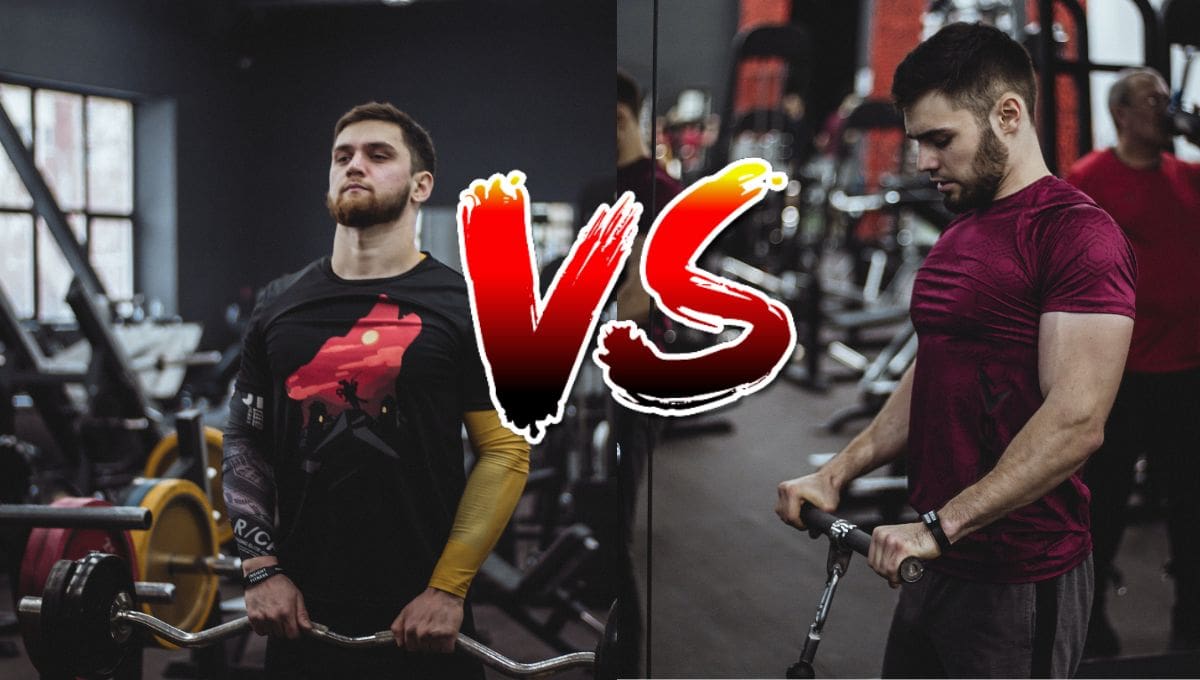
Barbell Curl vs Cable Curl for Wider Biceps
The answer depends on what you mean by wider. If you mean a thicker overall upper arm, both exercises can contribute by growing the biceps brachii. If you mean a broader appearance from the front, direct work for the brachialis and brachioradialis should also be part of the plan.
Barbell curls have an advantage when your priority is simple, measurable progressive overload. They are highly efficient, easy to set up, and suitable for challenging sets in moderate repetition ranges. If you can curl with strict technique and steadily improve over months, barbell curls can be an excellent main exercise.
Cable curls have an advantage when you want more options for arm position, a resistance profile that feels challenging at the bottom of the movement, or a variation that helps you maintain strict form. They are also useful after heavier barbell work, when you want to add volume with less temptation to swing the weight.
Rather than treating the exercises as rivals, use them for different purposes. A barbell curl can be your main progressive lift, while a cable variation provides additional volume from a different setup. This gives you a broader training stimulus without needing a complicated arm day.
How to Train Both Exercises for Muscle Growth
Research supports the idea that muscle hypertrophy can occur across a broad range of loads when training volume and effort are sufficient. For practical biceps training, sets of roughly six to 20 repetitions work well for most people. The load should be challenging enough that you finish each set with only a small number of repetitions left in reserve.
You do not need to take every set to absolute failure. Training close to failure is usually enough to create a strong hypertrophy stimulus while allowing you to maintain better technique and recover for the rest of your training.

For most lifters, direct biceps work two or three times per week is more manageable than performing all arm volume in one large session. Start with a weekly total you can recover from, then add volume only if progress stalls and your joints feel good. Your pulling exercises, such as rows and pull ups, also contribute to elbow flexor training, so they should be considered when planning total weekly work.
The Only 3 Exercises Beginners Need to Transform Their Abs
A useful approach is to perform two or three hard sets of barbell curls in one session, then use two or three hard sets of cable curls later in the week. Keep the movement controlled, use a full pain free range of motion, and avoid excessive body movement.
Technique Matters More Than the Tool
A barbell curl becomes less effective when the hips drive the bar upward and the torso leans backward. A cable curl becomes less effective when the shoulders roll forward, the elbows travel excessively, or the weight stack is bounced. In both exercises, the goal is to make the elbow flexors do the work.
Keep your ribs stacked over your pelvis, squeeze the handles or bar firmly, and lower the weight slowly enough to stay in control. A controlled lowering phase can help maintain tension and improve consistency between repetitions.
You should also pay attention to joint comfort. Mild muscular fatigue is expected, but persistent pain in the wrist, elbow, or front of the shoulder is a reason to adjust the grip, load, range of motion, or exercise choice. A curl that you can train hard without pain is more valuable than a theoretically perfect variation you avoid because it irritates your joints.
Do Not Neglect Hammer Curls
If wider arms are your priority, include a neutral grip curl variation. Hammer curls train elbow flexion without requiring full forearm supination, which can place more emphasis on the brachialis and brachioradialis relative to a traditional supinated curl.
This does not mean hammer curls replace barbell or cable curls. Supinated curls remain valuable because the biceps brachii is an important forearm supinator as well as an elbow flexor. Instead, hammer curls complement them by ensuring that the muscles beneath and beside the biceps receive direct work.
You can use dumbbells, a rope attachment on a cable machine, or a neutral grip handle. Two or three challenging sets after your main curl exercise are enough for most lifters.
The Verdict
Barbell curls and cable curls can both build bigger, wider looking biceps. The barbell curl is the stronger choice for straightforward loading and long term progression. The cable curl is the stronger choice for continuous tension, strict execution, and training from multiple arm positions.
If you can only choose one, select the exercise you can perform pain free, train hard with good form, and progress consistently. For most people, the most effective approach is to use both across the week, while also including hammer curls for the brachialis and brachioradialis.
Your biceps will not become wider because of a special attachment or one perfect curl angle. They will grow when you repeatedly expose the elbow flexors to challenging, well executed training and allow enough time for the adaptation to happen.
References
- ACSM, 2009. American College of Sports Medicine position stand. Progression models in resistance training for healthy adults. Medicine & Science in Sports & Exercise, 41(3), pp. 687–708.
- Grgic, J., Schoenfeld, B.J., Orazem, J., Sabol, F., Ostojić, S.M. and Krieger, J.W., 2022. Effects of resistance training performed to repetition failure or non failure on muscular strength and hypertrophy: A systematic review and meta analysis. Journal of Sport and Health Science, 11(2), pp. 202–211.
- Lasevicius, T., Ugrinowitsch, C., Schoenfeld, B.J., Roschel, H., Tavares, L.D., De Souza, E.O., Tricoli, V. and Conceição, M.S., 2018. Effects of different intensities of resistance training with equated volume load on muscle strength and hypertrophy. European Journal of Sport Science, 18(6), pp. 772–780.
- Maeo, S., Yoshitake, Y., Takai, Y., Fukunaga, T. and Kanehisa, H., 2013. Neuromuscular adaptations following three different resistance training regimens with similar muscle mass gains. PLOS ONE, 8(11), e78778.
- Schoenfeld, B.J., Grgic, J., Ogborn, D. and Krieger, J.W., 2017. Strength and hypertrophy adaptations between low versus high load resistance training: A systematic review and meta analysis. Journal of Strength and Conditioning Research, 31(12), pp. 3508–3523.
- Schoenfeld, B.J., Ogborn, D. and Krieger, J.W., 2016. Effects of resistance training frequency on measures of muscle hypertrophy: A systematic review and meta analysis. Sports Medicine, 46(11), pp. 1689–1697.
- Tiwana, M.S., Charlick, M. and Varacallo, M.A., 2024. Anatomy, shoulder and upper limb, biceps muscle. StatPearls.
- Vigotsky, A.D., Halperin, I., Lehman, G.J., Trajano, G.S. and Vieira, T.M., 2018. Interpreting signal amplitudes in surface electromyography studies in sport and rehabilitation sciences. Frontiers in Physiology, 8, 985.
- Wakahara, T., Fukutani, A., Kawakami, Y. and Yanai, T., 2013. Nonuniform muscle hypertrophy: Its relation to muscle activation in training session. Medicine & Science in Sports & Exercise, 45(11), pp. 2158–2165.
Key Takeaways
| Question | Practical answer |
|---|---|
| Which exercise is best for wider biceps? | Neither is universally superior. Both can grow the biceps when trained hard and progressed over time. |
| Why do arms look wider? | Growth of the biceps brachii, brachialis, and brachioradialis increases upper arm thickness. |
| Best use for barbell curls | Use them as a stable, easy to track main lift for progressive overload. |
| Best use for cable curls | Use them for strict form, continuous tension, and variety in arm position. |
| Should you train both? | Yes. Combining a barbell curl and cable curl across the week is an effective, practical strategy. |
| What else should you include? | Add hammer curls to directly train the brachialis and brachioradialis. |