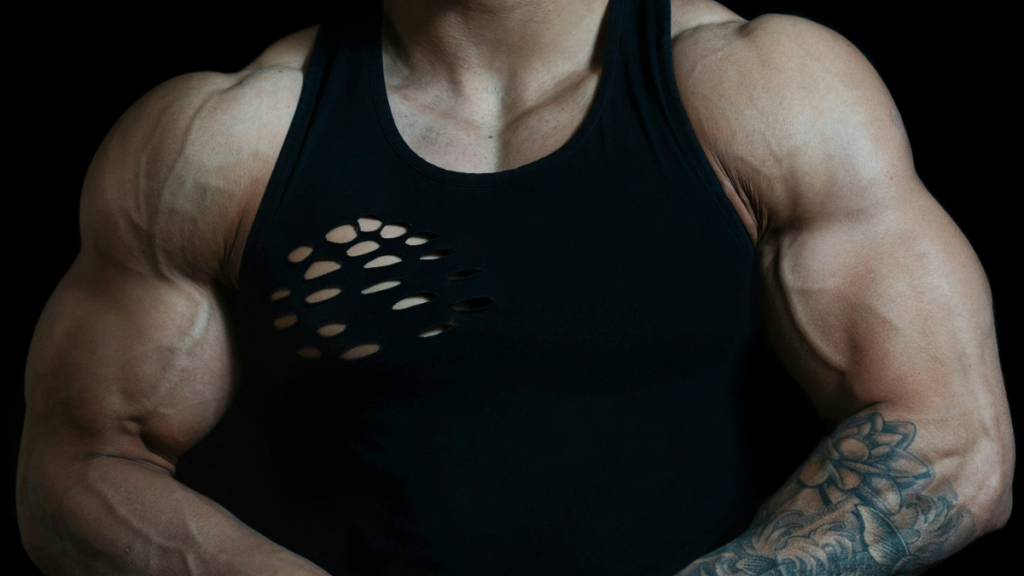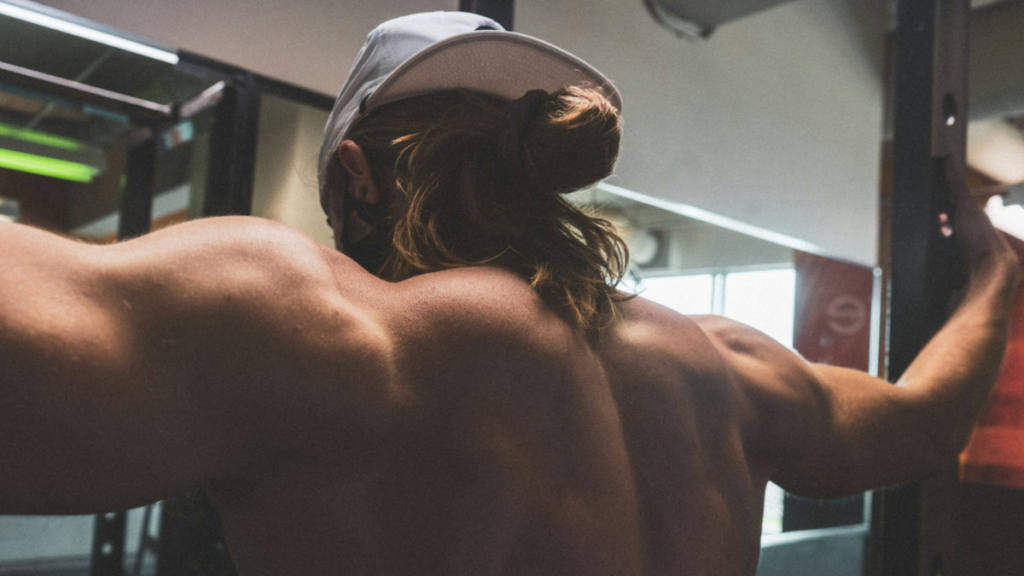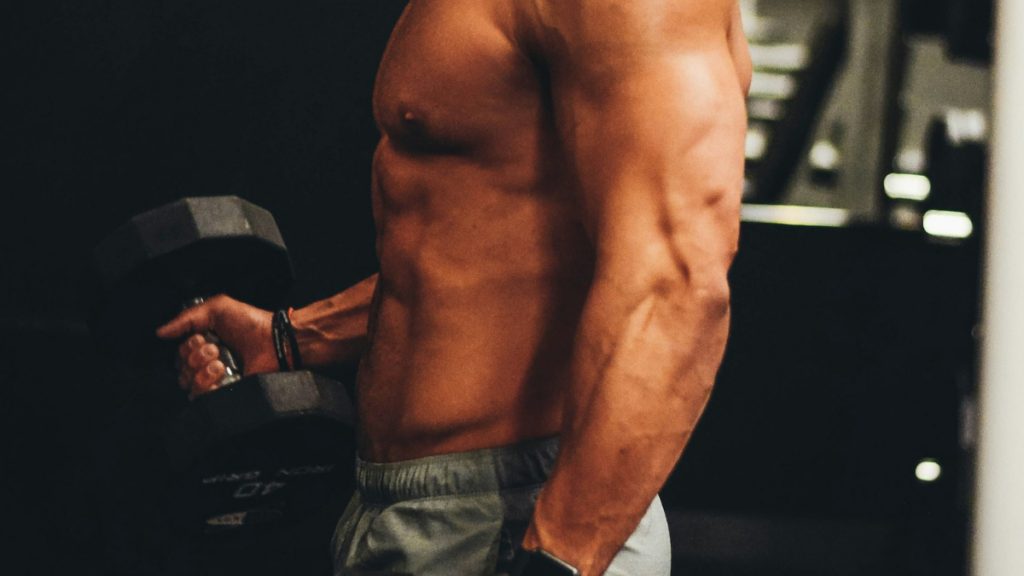


A more V-shaped body comes from building the muscles that add width to your upper back and shoulders. Three useful beginner exercises are the lat pulldown, the dumbbell lateral raise and the dumbbell overhead press. They train the lats and deltoids, muscles that contribute to a wider upper body.
These exercises can help develop that look, but they cannot change your skeleton or determine where your body stores fat. Training also cannot make you lose fat from one specific area. Your proportions reflect several factors, including muscle development and body fat distribution, which can vary between people. The aim is to build muscle consistently, use good technique and judge progress over months rather than days.


What Creates a V Shape?
The outline comes partly from the relationship between the width of your shoulders and upper back and the width of your waist. The latissimus dorsi, or lats, are large muscles on the sides of your back. The deltoids cover your shoulders and have front, middle and rear portions. Building the lats and deltoids can add more visual width to your upper body.
No single exercise can guarantee a particular shape. A person’s bone structure and natural fat distribution affect their proportions, and these are not fully under your control. The exercises below focus on muscles you can train. They will not reduce waist fat on their own, and they do not replace a balanced program that trains the rest of your body.
1. Lat Pulldown
Why It Helps
The lat pulldown is a practical way for a beginner to train the lats without first needing to lift their full body weight. In a pulldown, you pull a bar or handle from overhead toward your upper chest. Your lats help draw your upper arms down, while your biceps and other upper back muscles assist.
Research comparing different pulldown grip widths found similar lat muscle activity across the grips tested. That means you do not need an extra wide grip to make the exercise useful. Choose a grip that feels comfortable and lets you move through a controlled range. Acute muscle activity studies help explain which muscles take part in an exercise, but they do not prove that one grip will produce more muscle growth over time.
How to Do It
Sit at the machine and secure your thighs beneath the pads. Take hold of the bar slightly wider than shoulder width, or use a neutral grip handle if the machine has one. Start with your arms extended overhead and your torso upright. Pull the bar toward your upper chest by driving your elbows down. Pause briefly, then return the bar under control until your arms are extended again.
Keep your ribs stacked over your pelvis and avoid rocking your torso to move the weight. Pulling the bar behind your neck is unnecessary. If you feel the movement mostly in your arms, reduce the load and focus on moving your elbows down while keeping your wrists relaxed. The exercise still involves the arms, but a lighter weight can make it easier to practice a controlled pull.
2. Dumbbell Lateral Raise
Why It Helps
The lateral raise trains the middle portion of the deltoid, which contributes to the rounded appearance of the shoulders. It is an isolation exercise, meaning it focuses more directly on the shoulder than a multi muscle movement such as the overhead press.
In a small study of resistance trained men, the lateral raise and shoulder press produced more activity in the middle deltoid than the bench press and dumbbell fly. Another study comparing dumbbell and cable lateral raises found similar increases in lateral deltoid thickness after eight weeks of training in trained participants. These findings support the lateral raise as a reasonable choice, while also showing that you do not need a particular piece of equipment to perform it.
How to Do It
Stand with a light dumbbell in each hand and your arms by your sides. Keep a small bend in your elbows. Raise your arms out to the sides until your hands are around shoulder height, then lower the weights slowly. A slight forward angle can feel comfortable, but avoid turning the movement into a shrug.
Start lighter than you think you need. The goal is to lift and lower the dumbbells with control, not to swing them up with your hips or lean backward. If you cannot raise the weights without momentum, choose lighter dumbbells or reduce the height slightly. As the movement becomes easier, add repetitions first and then increase the weight in a small step.
3. Dumbbell Overhead Press
Why It Helps
The overhead press trains the shoulders, particularly the front deltoid, while also involving the middle deltoid and triceps. It complements the lateral raise because it lets you train the shoulders through a compound movement that also challenges your ability to control weight overhead.
A study measuring shoulder muscle activity found that the shoulder press produced greater activity in the front deltoid than the other exercises compared. It also recruited the middle deltoid. Muscle activity during a single workout is not the same as long term muscle growth, but the result helps explain why the press is a useful shoulder exercise.
How to Do It
Sit on a bench with back support, or stand with your feet about hip width apart. Hold a dumbbell in each hand at shoulder level, with your palms facing forward or slightly inward. Brace your midsection and press the dumbbells overhead without arching your lower back. Lower them slowly until they return to shoulder level.
Use a weight you can control in both directions. Do not force your arms into a painful position or continue through sharp discomfort. If pressing with two dumbbells feels unstable, start with a lighter load or use a machine press while you learn the pattern. A shoulder press is optional if you have pain or a medical restriction. In that case, get advice from a qualified health professional before training around it.
How to Put the Exercises Together
For a simple beginner session, perform the lat pulldown, dumbbell overhead press and dumbbell lateral raise in that order. Start with two working sets of each exercise. Aim for about 8 to 12 controlled repetitions on the pulldown and overhead press, and 10 to 15 on the lateral raise. Rest long enough between sets to keep your technique steady.
A useful starting point is to train this session twice per week, with at least one day between sessions. These are three upper body exercises, not a complete strength program. Add movements for your chest, legs and other major muscle groups as part of a balanced routine. If you already follow a program, add the exercises in a way that does not make your total training volume jump suddenly.
Choose a load that makes the last few repetitions challenging while allowing you to maintain good form. You do not need to take every set to the point where you cannot complete another repetition. Once you can perform the top end of your target range with control on every set, increase the weight slightly and build your repetitions again. The American College of Sports Medicine recommends progressive resistance training and suggests that beginners use loads they can lift for around 8 to 12 repetitions. The exact amount of weight and number of sets should suit your current ability and training history.
How Long Does It Take to See a Difference?
A noticeable change usually takes consistent training over time. Early progress may show up as better control, more repetitions or heavier weights before you see a clear difference in the mirror. Muscle growth varies with training experience, programming, sleep, nutrition, genetics and other factors. Research comparing low, moderate and high loads suggests that muscle growth can occur across a range of loads when sets are performed with sufficient effort. This supports choosing weights you can handle safely and progress gradually, rather than chasing the heaviest possible dumbbell.
Keep a simple training record with the weight and repetitions for each set. Take occasional photos under similar lighting and conditions if you want to track visual changes. Day to day mirror checks can be misleading because posture, lighting, hydration and recent meals affect how your body looks. If your goal also includes reducing body fat, no shoulder or back exercise can selectively remove fat from your waist. Focus on sustainable nutrition and activity habits alongside resistance training.
Key Takeaways
| Focus | What to Do |
|---|---|
| Build upper back width | Use the lat pulldown with a comfortable grip and controlled repetitions. |
| Train shoulder width | Include dumbbell lateral raises and progress gradually. |
| Develop overall shoulders | Use the dumbbell overhead press if it feels comfortable and controlled. |
| Make progress | Track your weights and repetitions, then increase the challenge in small steps. |
| Set realistic expectations | Muscle growth takes time, and your proportions are also influenced by body structure and fat distribution. |
References
- An, P., Rice, T., Borecki, I.B., Pérusse, L., Gagnon, J., Leon, A.S., Skinner, J.S., Wilmore, J.H., Bouchard, C. and Rao, D.C. (2000) ‘Major gene effect on subcutaneous fat distribution in a sedentary population and its response to exercise training: The HERITAGE Family Study’, American Journal of Human Biology, 12(5), pp. 600–609.
- American College of Sports Medicine (2009) ‘Progression models in resistance training for healthy adults’, Medicine & Science in Sports & Exercise, 41(3), pp. 687–708.
- Andersen, V., Fimland, M.S., Wiik, E., Skoglund, A. and Saeterbakken, A.H. (2014) ‘Effects of grip width on muscle strength and activation in the lat pull-down’, Journal of Strength and Conditioning Research, 28(4), pp. 1135–1142.
- Campos, Y.A.C., Vianna, J.M., Guimarães, M.P., Oliveira, J.L.D., Hernández-Mosqueira, C., da Silva, S.F. and Marchetti, P.H. (2020) ‘Different shoulder exercises affect the activation of deltoid portions in resistance-trained individuals’, Journal of Human Kinetics, 75, pp. 5–14.
- Carvalho, L. et al. (2022) ‘Muscle hypertrophy and strength gains after resistance training with different volume-matched loads: A systematic review and meta-analysis’, Applied Physiology, Nutrition, and Metabolism, 47(4), pp. 357–368.
- Coratella, G., Tornatore, G., Longo, S., Esposito, F. and Cè, E. (2020) ‘An electromyographic analysis of lateral raise variations and frontal raise in competitive bodybuilders’, International Journal of Environmental Research and Public Health, 17(17), 6015.
- Larsen, S., Wolf, M., Schoenfeld, B.J., Sandberg, N.Ø., Fredriksen, A.B., Kristiansen, B.S., van den Tillaar, R., Swinton, P.A. and Falch, H.N. (2025) ‘Dumbbell versus cable lateral raises for lateral deltoid hypertrophy: An experimental study’, Frontiers in Physiology, 16, 1611468.
- Lopez, P. et al. (2021) ‘Resistance training load effects on muscle hypertrophy and strength gain: Systematic review and network meta-analysis’, Medicine & Science in Sports & Exercise, 53(6), pp. 1206–1216.