

A stronger chest does more than improve the way your upper body looks. The pectoral muscles help you push objects away from your body, support pressing performance in the gym, and contribute to strength in sports and daily life. For beginners, two exercises stand out: the dumbbell bench press and the push-up.
Both movements train the chest, shoulders, and triceps. Both can build muscle and improve pressing strength. Yet they do not offer exactly the same benefits, especially once your initial beginner gains start to slow down.


The short answer is that push-ups are an excellent place to start, while the dumbbell bench press is usually the more practical long-term choice for building maximal chest strength. The best approach for most beginners is not to treat them as rivals. Instead, use push-ups to learn pressing control and build capacity, then use dumbbells to keep progressing with a load that matches your strength level.
What Makes a Chest Exercise Effective?
Your chest is primarily made up of the pectoralis major, a large muscle that helps bring your upper arm toward the center of your body and assists with pressing movements. The pectoralis minor sits underneath it and has a smaller role in shoulder blade movement.
For an exercise to build a stronger chest, it needs to expose the pectoralis major to enough mechanical tension and give you a way to gradually make the work more demanding. Mechanical tension is created when a muscle has to produce force while lengthening or shortening under resistance. It is one of the most important drivers of muscle growth and strength adaptation.
Research shows that muscles can grow across a broad range of loads when sets are performed with enough effort. However, heavier resistance tends to produce greater improvements in maximal strength because it more closely matches the demands of lifting heavier loads. This distinction matters when comparing push-ups with dumbbell bench presses.
3 Best Beginner Exercises for Great Looking Arms
A beginner does not need to chase heavy weights immediately. Good technique, consistent practice, enough weekly training volume, and gradual progression matter more than trying to lift impressively from the first session.
The Dumbbell Bench Press
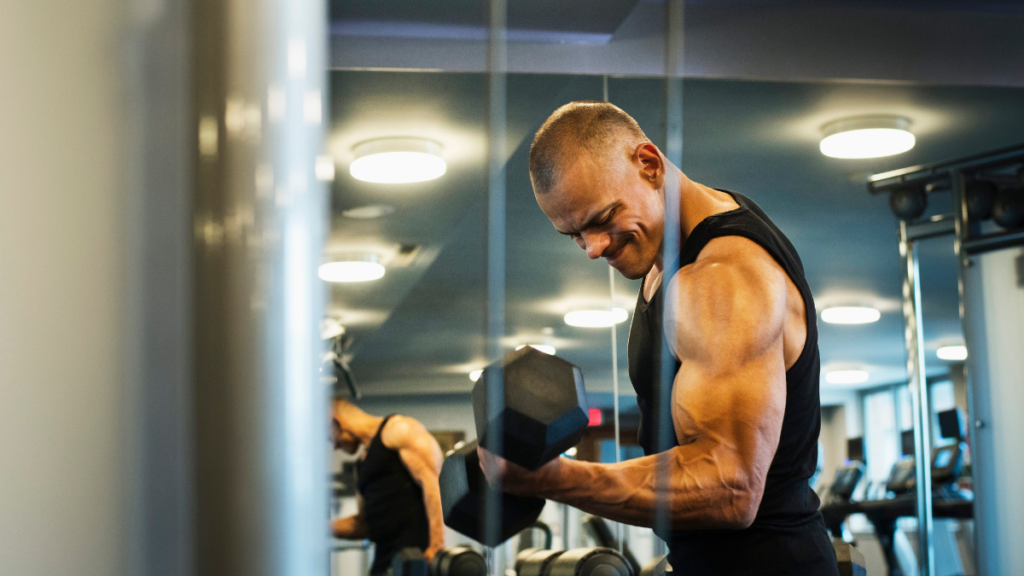
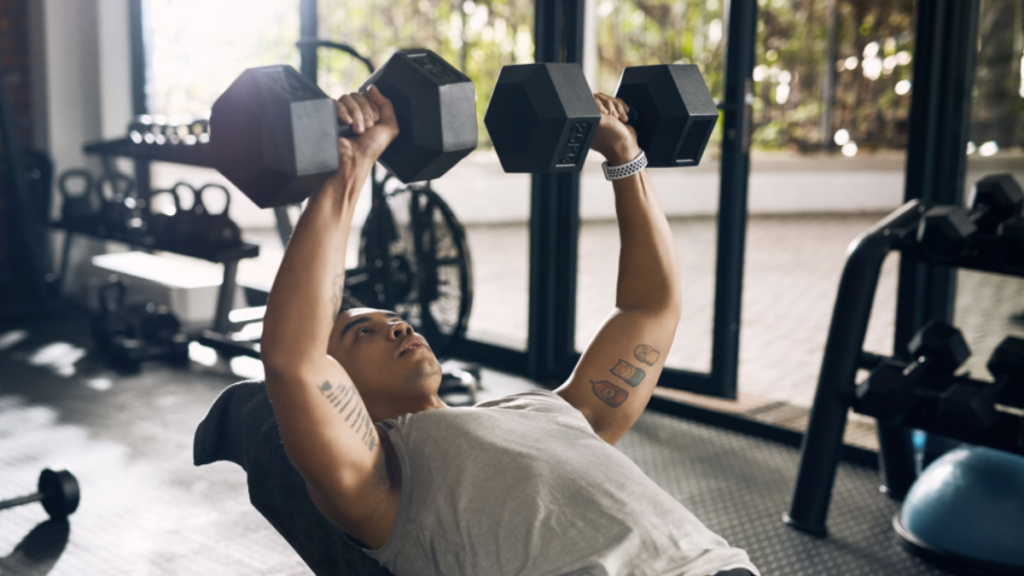
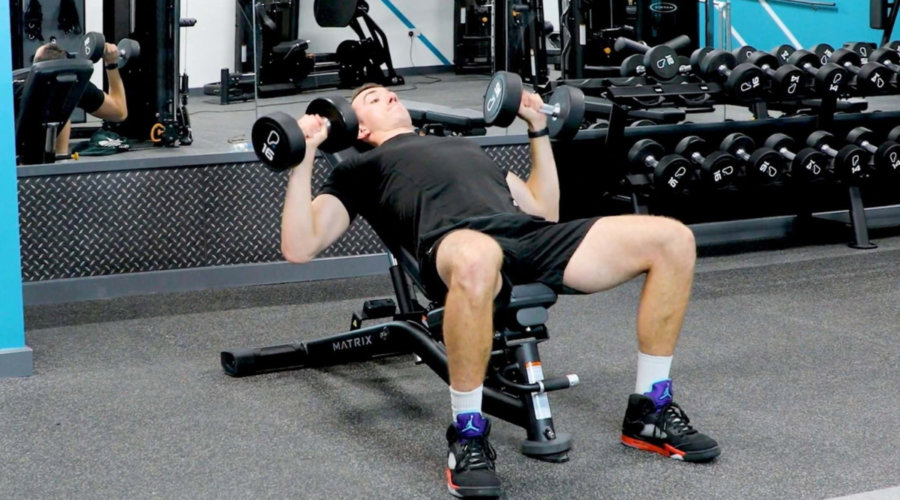
The dumbbell bench press is a horizontal pressing exercise performed while lying on a flat bench. You hold one dumbbell in each hand, lower them under control toward the chest, then press them upward until your arms are nearly straight.
Why Dumbbells Work So Well for Beginners
Dumbbells allow each arm to work independently. This can help reveal and reduce obvious side to side differences that may be hidden during a barbell bench press. Because each hand controls its own weight, the exercise also requires more coordination and stabilization than pressing a fixed bar.
The dumbbells can move through a comfortable path rather than being locked into the straight line of a barbell. For many beginners, this makes the movement feel more natural on the shoulders. It also allows a slightly deeper range of motion than a barbell bench press when it is performed with control and without discomfort.
Most importantly, dumbbells make progression simple. When you can perform the top end of your chosen repetition range with clean form, you can increase the weight by a small amount. That direct and measurable form of progression is extremely useful for beginners who want to build strength.
How the Dumbbell Bench Press Builds Strength
The dumbbell bench press lets you select a resistance that is challenging for your current ability. As you become stronger, you can use heavier dumbbells while maintaining a similar repetition range. This makes it easier to apply progressive overload over months and years.
Studies comparing low load and high load resistance training suggest that muscle growth can occur with many different loads when training effort is high. However, heavier loads are generally more effective for improving one repetition maximum strength. Since dumbbells can be increased in small increments, they are better suited to the goal of building stronger pressing ability over time.
For a beginner, a useful starting point is two or three sets of around eight to 12 repetitions. The final repetitions should feel challenging, but your technique should remain controlled. You should be able to lower the dumbbells smoothly, keep your upper back stable against the bench, and avoid flaring your elbows excessively.
Common Dumbbell Bench Press Mistakes
The biggest mistake is choosing weights that are too heavy to control. If the dumbbells drop rapidly toward the chest, your shoulders shift around, or your range of motion becomes inconsistent, the load is too high for productive beginner training.
Another common issue is allowing the shoulders to roll forward at the bottom of the repetition. Before pressing, gently bring your shoulder blades back and down against the bench. This creates a more stable base from which to press.
Beginners should also avoid turning every set into an all out test. Reaching complete muscular failure occasionally is not required for progress. In most sets, stopping with one to three controlled repetitions left is a sensible way to train hard while preserving technique.
The Push-Up
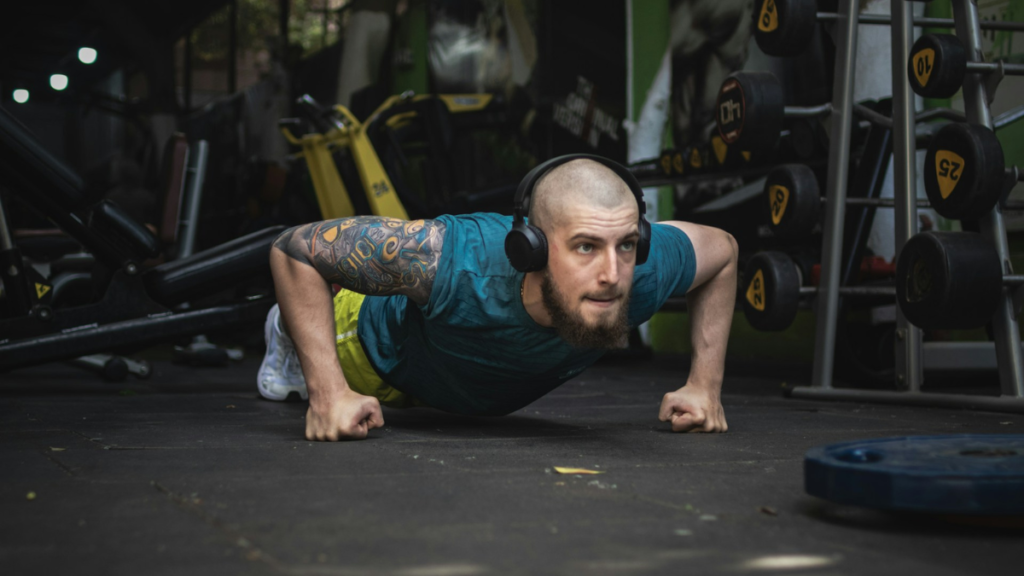
The push-up is a closed chain pressing exercise. Your hands remain fixed on the floor while your body moves as one unit. It trains the chest, triceps, front shoulders, abdominal muscles, and muscles around the shoulder blades.
It requires no equipment, can be performed almost anywhere, and gives beginners an immediate way to practice the basic pushing pattern.
Why Push-Ups Are a Valuable Chest Builder
A standard push-up can place a meaningful amount of body mass through the upper body. That load is enough to challenge many beginners, particularly those who are not yet accustomed to resistance training.
Research comparing push-up training with low load bench press training found that both approaches produced similar improvements in chest muscle thickness and pressing strength when the exercises were performed at a comparable relative intensity. This is important because it confirms that push-ups are not just a conditioning exercise. They can build muscle and strength when they are hard enough for the person performing them.
Push-ups also demand whole body control. You must keep your torso rigid, resist excessive lower back arching, and control the position of your shoulder blades while pressing. This makes them a useful introduction to body tension and pressing coordination.
Why Push-Ups Can Become Harder to Progress
The main limitation of the regular push-up is not that it stops working. The limitation is that the resistance is less precise. Once you can perform many clean repetitions, continuing to gain strength becomes more difficult unless you change the exercise.
You can make push-ups harder by elevating your feet, slowing the lowering phase, pausing near the floor, adding resistance, or using a weighted vest. These are all valid options. However, they require more planning than simply choosing a heavier dumbbell.
A standard push-up may also be too difficult for some complete beginners. If you cannot maintain a straight line from shoulders to heels, begin with incline push-ups using a sturdy bench, countertop, or bar set in a rack. Raising the hands reduces the percentage of body mass you need to press, allowing you to build strength with better technique.
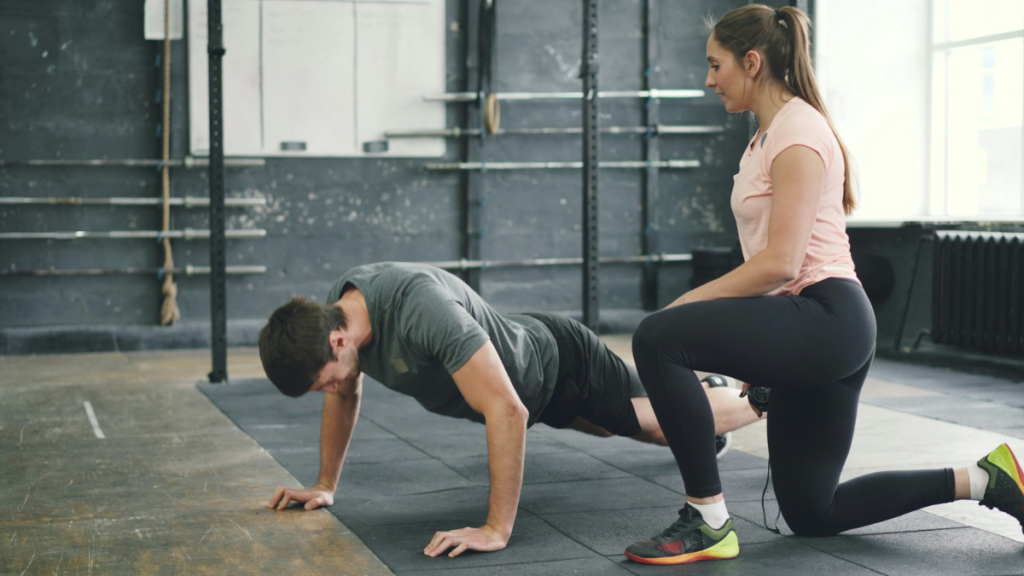
Knee push-ups can also be useful, but incline push-ups often transfer more naturally to the full version because you maintain a straight body position.
Common Push-Up Mistakes
The most common mistake is allowing the hips to sag toward the floor. This shifts the exercise away from a stable pressing pattern and can place unnecessary stress on the lower back. Squeeze your glutes, brace your abs, and keep your ribs from flaring upward.
Another mistake is using a shallow range of motion. Lower your chest toward the floor with control, provided your shoulders tolerate the position comfortably. A consistent range of motion makes it easier to track progress.
Hand position also matters. Place your hands roughly underneath or slightly wider than your shoulders. An excessively wide position can reduce control, while an extremely narrow position shifts more work toward the triceps.
Which Exercise Activates the Chest More?
It is tempting to search for one exercise that activates the chest more than the other, but that question needs context. Muscle activation measurements can show how active a muscle is during an exercise, yet they do not guarantee superior long-term muscle growth by themselves.
Research has found that push-ups and bench press variations can produce similar pectoralis major activation when the exercises are matched for relative loading. This makes sense. Both exercises involve horizontal pressing and require the chest, triceps, and front shoulders to generate force.
The practical difference is that the dumbbell bench press makes it easier to control the external load. You can choose a weight that keeps you in a useful strength or muscle building repetition range. With push-ups, the resistance is largely determined by your body mass and body position.
For a beginner who finds regular push-ups difficult, push-ups may be the more demanding exercise. For a beginner who can already perform 25 or 30 smooth repetitions, the dumbbell bench press is more likely to provide the stronger chest building stimulus because it is easier to make progressively heavier.
Which Is Better for Building Chest Muscle?
Both exercises can build the chest if they are performed consistently and close enough to muscular fatigue. The evidence does not support dismissing push-ups as ineffective. A hard push-up set can be an excellent chest stimulus.
However, the dumbbell bench press has a long-term advantage because it allows more precise loading. You can move from 20 pound dumbbells to 25 pound dumbbells, then to 30 pounds, while keeping the exercise pattern largely the same. This is a clear path for progressive overload.

Push-ups can still remain in your program as a chest builder. They are particularly useful when you do not have access to dumbbells, when you want to add extra chest training without setting up a bench, or when you want to improve pressing endurance.
If muscle size is your primary goal, use the dumbbell bench press as your main progressive movement and push-ups as an additional exercise. If you are training at home with no equipment, use a push-up progression and make each variation challenging enough to drive adaptation.
Which Is Better for Building Strength?
The dumbbell bench press wins for maximal chest and pressing strength in most beginners. This is not because push-ups are weak or ineffective. It is because strength is specific to the resistance you practice against.
As you become stronger, dumbbells allow you to keep increasing the load. This improves your ability to generate force against heavier external resistance. A beginner who trains the dumbbell bench press consistently is likely to become better at pressing heavier dumbbells and eventually transfer that foundation to barbell pressing if desired.
Push-ups build relative upper body strength. They improve your ability to control and press your own body mass. This has clear value, especially for general fitness, athletic training, and anyone who wants to develop a strong foundation without equipment.
The stronger chest exercise is therefore the one that matches your goal. If you want to press more external weight, prioritize dumbbell bench presses. If you want better bodyweight pushing strength and muscular endurance, prioritize push-ups.
The Best Choice for Different Beginners
A complete beginner who cannot perform a strict floor push-up should start with incline push-ups. They build strength, teach body tension, and require no equipment. Once you can perform controlled sets of 10 to 15 incline repetitions at a given height, lower the incline gradually.
A beginner with access to dumbbells and a bench should use dumbbell bench presses from the start, as long as they can learn the setup safely. The ability to select a manageable load makes the exercise highly adaptable.

A beginner who can already perform multiple sets of 15 or more standard push-ups should include dumbbell bench presses if stronger chest development is the goal. High repetition push-ups can still develop endurance, but additional dumbbell loading will give you a clearer route to greater strength.
A beginner training at home can make push-ups effective for much longer by using a backpack with secure weight, resistance bands, feet elevated push-ups, or slower tempos. The key is to avoid mindlessly adding more and more repetitions when a more challenging variation would be more productive.
How to Use Both Exercises in One Program
For most beginners, combining the movements is the most effective option. Use dumbbell bench presses first in the workout when you are fresh and can concentrate on progressive loading. Then use push-ups afterward to add controlled chest volume and develop bodyweight pressing skill.
Train your chest two times per week, with at least one day between sessions. Start with a manageable amount of work, then add repetitions or a small amount of weight when your form remains strong.
A simple beginner session could include three sets of dumbbell bench presses for eight to 12 repetitions, followed by two sets of push-ups for as many controlled repetitions as you can perform while leaving a small amount in reserve. If standard push-ups are too difficult, use an incline. If they are too easy, elevate your feet or add external resistance.
Progress does not come from constantly changing exercises. It comes from repeating good movements, improving your execution, and gradually increasing the challenge.
The Verdict
Push-ups and dumbbell bench presses can both build a stronger chest for beginners. Push-ups are accessible, effective, and valuable for teaching body control. They can produce meaningful chest development when they are challenging enough.
The dumbbell bench press is usually the better primary exercise for building long-term chest strength because it allows precise, consistent progression in load. It is easier to keep challenging your chest as you become stronger.
Use push-ups if you are new to training, have no equipment, or want to improve bodyweight strength. Use dumbbell bench presses if you have access to a bench and dumbbells and want the most straightforward route to increasing chest strength. Use both if you want the most complete beginner chest training plan.
References
- American College of Sports Medicine (2009) ‘American College of Sports Medicine position stand: Progression models in resistance training for healthy adults’, Medicine & Science in Sports & Exercise, 41(3), pp. 687–708.
- Calatayud, J., Borreani, S., Colado, J.C., Martin, F., Flandez, J., Page, P. and Andersen, L.L. (2015) ‘Bench press and push up at comparable levels of muscle activity results in similar strength gains’, Journal of Strength and Conditioning Research, 29(1), pp. 246–253.
- Kikuchi, N. and Nakazato, K. (2017) ‘Low load bench press and push up induce similar muscle hypertrophy and strength gain’, Journal of Exercise Science & Fitness, 15(1), pp. 37–42.
- López Vivancos, A., González Gálvez, N., Orquín Castrillón, F.J., Vale, R.G. and Marcos Pardo, P.J. (2023) ‘Electromyographic activity of the pectoralis major muscle during traditional bench press and other variants of pectoral exercises: A systematic review and meta analysis’, Applied Sciences, 13(8), 5203.
- Schoenfeld, B.J., Grgic, J., Ogborn, D. and Krieger, J.W. (2017) ‘Strength and hypertrophy adaptations between low versus high load resistance training: A systematic review and meta analysis’, Journal of Strength and Conditioning Research, 31(12), pp. 3508–3523.
- Stastny, P., Gołas, A., Blazek, D., Maszczyk, A., Wilk, M., Pietraszewski, P., Zając, A. and Uhlíř, P. (2017) ‘A systematic review of surface electromyography analyses of the bench press movement task’, PLoS One, 12(2), e0171632.
Key Takeaways
| Question | Best Answer for Beginners |
|---|---|
| Can push-ups build the chest? | Yes. Challenging push-ups can improve chest muscle size and pressing strength, especially in beginners. |
| Which exercise is better for long-term strength? | The dumbbell bench press, because you can increase the external load in a precise and repeatable way. |
| Which is best with no equipment? | Push-ups, using incline, standard, feet elevated, or loaded variations as strength improves. |
| Should beginners use both exercises? | Yes. Dumbbell bench presses can be the main strength movement, while push-ups add chest volume and bodyweight control. |
| How often should you train them? | Two chest focused sessions per week is a practical starting point for most beginners. |