

Press ups are one of the simplest and most effective ways to measure upper body muscular endurance. They require no equipment, take only a minute to perform, and challenge the chest, shoulders, triceps, core, and stabilizing muscles at the same time. Whether you are a beginner or an experienced lifter, knowing how many quality press ups you can complete in 60 seconds provides valuable insight into your fitness.
Unlike a one repetition maximum on the bench press, a one minute press up test reflects muscular endurance rather than maximal strength. It also highlights cardiovascular fitness, movement efficiency, and body control. This is one reason why military organizations, law enforcement agencies, and sports teams around the world continue to use timed press up tests during fitness assessments.


So how many press ups should you actually be able to do in one minute?
The answer depends on your age, sex, body weight, training experience, and technique. However, scientific research and population fitness data provide useful benchmarks that can help you judge your performance.
Why the One Minute Press Up Test Matters
The one minute press up challenge measures local muscular endurance. This refers to the ability of muscles to repeatedly produce force over time without fatiguing.
Research consistently shows that muscular endurance contributes to everyday function, athletic performance, and long term health. Individuals with higher levels of muscular fitness are generally at lower risk of cardiovascular disease, metabolic disorders, and all cause mortality. Unlike heavy lifting tests, the one minute press up test is also accessible to almost everyone. It requires minimal skill, can be repeated regularly, and allows easy tracking of progress.
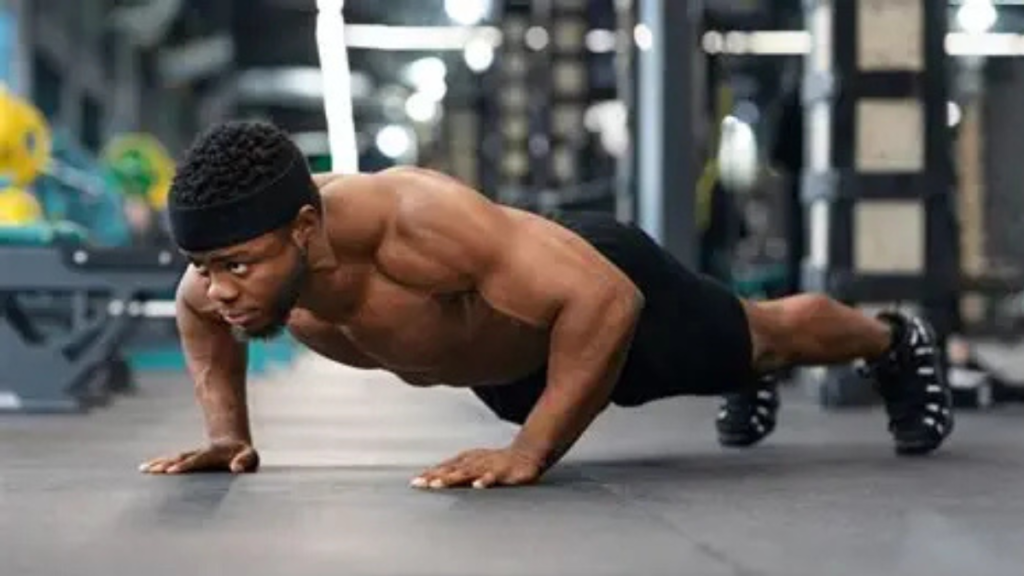
Because the movement recruits multiple muscle groups simultaneously, performance reflects more than chest strength alone. The shoulders, triceps, abdominal muscles, lower back, and glutes all play important roles in maintaining proper body alignment throughout the set.
What Counts as a Proper Press Up?
Before comparing yourself with any standard, you need to use proper technique.
Start in a high plank position with your hands placed slightly wider than shoulder width. Keep your head, shoulders, hips, knees, and ankles in a straight line. Lower your chest until your elbows reach roughly 90 degrees or your chest lightly touches the floor, depending on the testing standard. Press back to full elbow extension before beginning the next repetition.
Rushing through partial repetitions may produce a higher number, but they do not accurately measure strength or endurance. Studies using electromyography have shown that a greater range of motion produces higher muscle activation across the chest and triceps compared with shortened repetitions.
Quality always matters more than quantity.
How Many Press Ups Should You Be Able to Do?
Several organizations have published normative data based on age and sex. Although the exact numbers vary slightly between sources, they provide a practical guide.
For healthy adult men, completing fewer than 20 quality repetitions in one minute generally indicates below average muscular endurance. Around 25 to 35 repetitions represents average performance for recreationally active adults. Completing more than 40 repetitions demonstrates excellent upper body endurance, while reaching 50 or more places you among highly trained individuals.
For healthy adult women, fewer than 10 repetitions is generally considered below average. Around 15 to 25 repetitions reflects average fitness. More than 30 repetitions indicates excellent muscular endurance, while exceeding 35 repetitions is an outstanding result. These numbers assume strict technique and continuous movement throughout the minute.
Age Makes a Difference
Like maximal strength, muscular endurance tends to decline gradually with age. This occurs because of reductions in muscle mass, motor unit recruitment, recovery capacity, and physical activity levels. Fortunately, resistance training can dramatically slow this decline.
Research shows that adults who continue strength training into middle age and beyond retain significantly more muscle function than sedentary individuals. Even people beginning resistance exercise in their sixties and seventies can improve muscular endurance substantially.

The following guide provides realistic expectations for healthy adults using proper technique.
Men
| Performance | Repetitions in One Minute |
|---|---|
| Excellent | 50 or more |
| Very Good | 40 to 49 |
| Average | 25 to 39 |
| Below Average | 15 to 24 |
| Poor | Fewer than 15 |
Women
| Performance | Repetitions in One Minute |
|---|---|
| Excellent | 35 or more |
| Very Good | 25 to 34 |
| Average | 15 to 24 |
| Below Average | 8 to 14 |
| Poor | Fewer than 8 |
These ranges represent general fitness rather than elite athletic standards.
How Body Weight Affects Performance
Press ups require lifting approximately 60 to 70 percent of your body weight, depending on body position and individual limb proportions.
This means body composition strongly influences performance.
Someone carrying excess body fat must move more mass with every repetition without necessarily having more muscle available to produce force. In contrast, individuals with higher lean muscle mass and lower body fat often perform better even if they are not significantly stronger in absolute terms.
Research has repeatedly shown that relative strength, meaning strength compared with body weight, predicts press up performance more accurately than maximal bench press strength alone.
This explains why gymnasts, climbers, military personnel, and CrossFit athletes often excel at high repetition bodyweight exercises despite not always having the highest one repetition maximum bench press.
Press Ups Predict More Than Strength
One of the most fascinating findings in recent years came from research involving more than 1,100 active adult men. Researchers found that individuals capable of completing more than 40 consecutive press ups had a dramatically lower risk of future cardiovascular events compared with those who could complete fewer than 10 repetitions.

While the study does not prove that doing more press ups directly prevents heart disease, it suggests that press up capacity serves as a surprisingly useful indicator of overall health and fitness.
People capable of performing many quality repetitions generally possess healthier body composition, better aerobic fitness, stronger muscles, and healthier lifestyles overall.
This reinforces the idea that improving your press up performance can be a meaningful long term fitness goal.
The Best Way to Improve Your One Minute Score
Improving press up endurance requires specific practice. Research supports using multiple weekly training sessions that combine strength work with endurance focused sets.
Heavy pressing exercises such as the bench press increase maximal force production. Stronger muscles require a lower percentage of their maximum strength during each press up, making repeated repetitions easier. High repetition press up training develops local muscular endurance. Performing several submaximal sets throughout the week builds fatigue resistance while allowing proper recovery.
Is the Cable Y Raise the Perfect Exercise for Wider Shoulders?
Progressive overload remains essential. Gradually increasing weekly training volume produces continual adaptation. Including exercises such as dips, incline presses, overhead presses, and triceps extensions strengthens the muscles responsible for completing the movement. Core training also improves stability, allowing better force transfer between the upper and lower body.
Common Mistakes During the Test
Many people unintentionally reduce their score through poor pacing. Starting too quickly often leads to rapid fatigue during the second half of the minute. A steady rhythm usually produces a better overall result. Holding your breath also accelerates fatigue. Controlled breathing throughout each repetition helps maintain oxygen delivery and reduces unnecessary tension.
Partial repetitions may feel easier, but standardized testing requires consistent depth and full elbow extension. Sacrificing technique makes comparisons meaningless. Finally, avoid allowing your hips to sag toward the floor. Maintaining a rigid plank position distributes force efficiently across the entire kinetic chain.
How Often Should You Test Yourself?
Testing every day is unnecessary and may interfere with training. Most coaches recommend repeating the one minute press up test every four to six weeks.
This provides enough time for measurable improvements while limiting the influence of daily fatigue or recovery status. Try to perform each test under similar conditions. Test at roughly the same time of day, after a similar warm up, and using identical technique. Consistency makes your results much more meaningful.
The Bottom Line
The one minute press up test remains one of the most useful measures of upper body muscular endurance available. It is simple, inexpensive, reliable, and supported by decades of scientific research.
For most healthy adults, completing around 25 to 35 strict repetitions represents solid fitness. More than 40 demonstrates excellent muscular endurance, while reaching 50 or more places you well above average. Women generally achieve slightly lower scores because of differences in upper body muscle mass, although consistent resistance training can produce remarkable improvements. Perhaps most importantly, your score is not fixed. Regular resistance training, improved technique, better body composition, and consistent practice can dramatically increase your performance over time.
Instead of worrying about how many press ups someone else can perform, focus on beating your own previous score. Every additional quality repetition represents stronger muscles, better endurance, and another step toward improved long term health.
Key Takeaways
| Topic | Key Information |
|---|---|
| What the test measures | Upper body muscular endurance, core stability, and movement efficiency |
| Average men | Around 25 to 35 strict press ups in one minute |
| Excellent men | More than 40 repetitions |
| Average women | Around 15 to 25 strict press ups in one minute |
| Excellent women | More than 30 repetitions |
| Biggest performance factors | Relative strength, body composition, muscular endurance, and technique |
| Health significance | Higher press up capacity is associated with better overall health and lower cardiovascular risk |
| Best way to improve | Combine resistance training, regular press up practice, core strengthening, and progressive overload |
| Testing frequency | Every four to six weeks under consistent conditions |
References
- American College of Sports Medicine (2021) ACSM’s Guidelines for Exercise Testing and Prescription. 11th ed. Philadelphia: Wolters Kluwer.
- Berryman, N., Mujika, I., Arvisais, D. and Roubeix, M. (2018) Strength training for middle and older age adults. Sports Medicine, 48(4), pp. 761 to 784.
- Calatayud, J., Borreani, S., Colado, J.C., Martin, F., Rogers, M.E. and Andersen, L.L. (2015) Muscle activation during push up exercises performed under stable and unstable conditions. Journal of Exercise Science and Fitness, 13(2), pp. 94 to 98.
- Church, T.S., Cheng, Y.J., Earnest, C.P., Barlow, C.E., Gibbons, L.W., Priest, E.L. and Blair, S.N. (2004) Exercise capacity and body composition as predictors of mortality among men with diabetes. Diabetes Care, 27(1), pp. 83 to 88.
- Cogley, R.M., Archambault, T.A., Fibeger, J.F., Koverman, M.M., Youdas, J.W. and Hollman, J.H. (2005) Comparison of muscle activation using various hand positions during the push up exercise. Journal of Strength and Conditioning Research, 19(3), pp. 628 to 633.
- Edwards, M.K. and Loprinzi, P.D. (2018) Muscular strength, exercise, and cardiovascular disease risk. American Journal of Lifestyle Medicine, 12(6), pp. 460 to 462.
- Kodama, S., Saito, K., Tanaka, S., Maki, M., Yachi, Y., Asumi, M., Sugawara, A., Totsuka, K., Shimano, H., Ohashi, Y., Yamada, N. and Sone, H. (2009) Cardiorespiratory fitness as a quantitative predictor of all cause mortality and cardiovascular events. Journal of the American Medical Association, 301(19), pp. 2024 to 2035.
- Saint Mauris, T., Yi, Y., Burchfiel, C.M., Zhang, Y. and Eisenberg, D.M. (2019) Association between push up exercise capacity and future cardiovascular events among active adult men. JAMA Network Open, 2(2), e188341.