


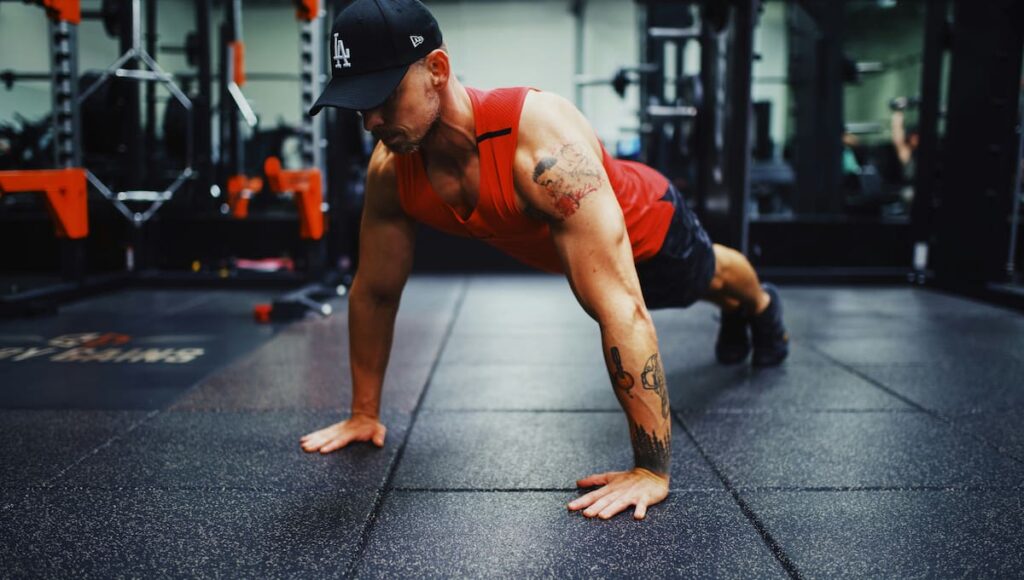
Push ups are one of the simplest and most effective ways to measure upper body strength and muscular endurance. They require no equipment, can be performed almost anywhere, and provide valuable insight into your overall fitness. Unlike isolated gym exercises, push ups demand coordination between your chest, shoulders, triceps, core, and even your lower body to maintain proper body alignment.
Many people wonder how many push ups they should be able to perform as they get older. The answer depends on several factors, including sex, body weight, training history, and general health. However, age based standards provide an excellent benchmark that helps you understand where your fitness stands compared to the general population.



The good news is that age does not automatically mean weakness. Research consistently shows that people who continue strength training throughout adulthood maintain significantly greater muscular strength and function than sedentary individuals. Even people in their seventies and eighties can dramatically improve upper body strength with regular resistance exercise.
This guide explains how many push ups you should aim for at every stage of adulthood, why these numbers matter, and how improving your score can benefit your long term health.
Why Push Ups Matter
Push ups are more than a test of chest strength. They measure muscular endurance, relative strength, joint stability, and core control simultaneously.
A proper push up requires coordinated activation of the pectoralis major, anterior deltoids, triceps brachii, serratus anterior, abdominal muscles, glutes, and spinal stabilizers. Studies using electromyography have shown that correctly performed push ups activate many of the same muscles as the bench press while also requiring greater trunk stabilization.
Because the movement uses your own body weight, it reflects functional strength rather than absolute strength. Someone who can bench press heavy weights but struggles to perform push ups may have poor muscular endurance or inadequate relative strength.
Push ups have also attracted attention because of their relationship with long term health.
One well known study involving active adult men found that participants capable of performing more than 40 consecutive push ups had a substantially lower risk of future cardiovascular events compared to those who could perform fewer than 10 repetitions. While push ups themselves do not prevent heart disease, they appear to reflect a combination of healthy body composition, muscular fitness, and cardiovascular health.
Why Push Up Performance Changes With Age
Strength naturally declines with age, but much of that decline is caused by inactivity rather than aging alone.
Beginning around the fourth decade of life, adults gradually lose muscle mass in a process known as sarcopenia. Muscle fibers become smaller, nerve signaling becomes less efficient, and recovery takes longer.
However, numerous studies show that resistance training greatly slows these changes. Older adults who regularly perform strength training maintain higher muscle mass, better coordination, and greater independence than inactive people of the same age.
Push ups are especially useful because they measure relative strength. As body fat increases and muscle mass decreases, push up performance usually declines. Maintaining a healthy body weight while preserving muscle makes achieving higher repetition numbers much easier.
Push Up Standards by Age
The following standards are based on large fitness assessments from organizations including the American College of Sports Medicine, normative fitness databases, and military fitness testing. These represent solid goals for healthy adults performing standard push ups with strict technique.
Ages 20 to 29
This is typically the decade of peak muscular performance.
- Men should aim for at least 30 consecutive push ups.
- Women should aim for at least 20 consecutive push ups.
- Excellent performance is approximately 45 to 55 repetitions for men and 35 to 45 repetitions for women.
Individuals who regularly perform strength training often exceed these numbers.
Ages 30 to 39
Most adults remain capable of excellent upper body performance throughout their thirties.
- Men should aim for at least 27 consecutive push ups.
- Women should aim for at least 19 consecutive push ups.
- Excellent scores remain above 40 repetitions for men and above 30 repetitions for women.
Small declines during this decade are normal, but regular exercise can almost completely offset them.
Ages 40 to 49
Hormonal changes, reduced physical activity, and increased work demands often contribute to declining fitness.
- Men should aim for at least 21 consecutive push ups.
- Women should aim for at least 14 consecutive push ups.
Completing more than 35 repetitions for men or more than 25 repetitions for women places you well above average.
Ages 50 to 59
Maintaining muscle becomes increasingly important for health, mobility, and metabolic function.
- Men should aim for at least 15 consecutive push ups.
- Women should aim for at least 10 consecutive push ups.
People who continue resistance training frequently perform far beyond these averages.
Ages 60 to 69
Strength becomes one of the strongest predictors of independence.
- Men should aim for at least 10 to 15 push ups.
- Women should aim for at least 8 to 10 push ups.
Many physically active adults continue performing more than 20 repetitions with excellent technique.
Ages 70 and Older
Functional strength remains critically important for quality of life.
- Men should aim for at least 8 to 10 push ups.
- Women should aim for at least 5 to 8 push ups.
If standard floor push ups are too challenging, elevated push ups using a bench or countertop remain highly effective alternatives.
Why Relative Strength Matters More Than Absolute Strength
Many people compare push up performance with bench press numbers, but the two tests measure different qualities. Bench pressing measures how much weight you can lift. Push ups measure how efficiently you move your own body.
Someone carrying excess body fat may have strong muscles but struggle with push ups because they must move more weight every repetition. Conversely, lean individuals often perform high numbers despite modest bench press strength.
Relative strength becomes increasingly important with age because it directly affects daily activities like getting off the floor, climbing stairs, carrying groceries, and preventing falls.
The Health Benefits of Better Push Up Performance
Improving your push up ability offers benefits that extend well beyond stronger arms.
Better Muscle Mass
Resistance exercise stimulates muscle protein synthesis, helping preserve lean tissue throughout adulthood. Maintaining muscle supports metabolism, improves glucose control, and reduces frailty later in life.
Bicep Curls vs Hammer Curls: Which is Better for Beginners to Build Bigger and Wider Biceps?
Improved Bone Health
The loading forces created during push ups stimulate bone remodeling. Weight bearing exercise helps maintain bone mineral density, particularly when combined with other resistance training.
Greater Shoulder Stability
The shoulder is the body’s most mobile joint, making stability essential. Proper push ups strengthen the rotator cuff, serratus anterior, and scapular stabilizers that help protect the shoulder during sports and daily activities.
Improved Core Strength
A push up is essentially a moving plank. The abdominal muscles, obliques, lower back, and glutes work continuously to prevent the hips from sagging. This full body tension improves trunk stability that transfers to countless athletic movements.
Better Functional Fitness
Few exercises mimic real world movement as effectively as push ups. Getting off the ground, pushing heavy doors, lifting objects, and even preventing falls all depend partly on upper body pushing strength.
How to Perform the Perfect Push Up
- Technique matters more than repetition count.
- Begin in a high plank position with your hands slightly wider than shoulder width.
- Keep your head, shoulders, hips, knees, and ankles aligned in one straight line.
- Brace your abdominal muscles and squeeze your glutes.
- Lower your body until your chest nearly touches the floor while keeping your elbows at roughly a 45 degree angle from your torso.
- Press powerfully back to the starting position without allowing your hips to sag or your shoulders to shrug.
- Each repetition should use a full range of motion.
- Partial repetitions artificially inflate scores while reducing training effectiveness.
What If You Cannot Perform One Push Up?
Many beginners cannot complete a strict floor push up. That is completely normal.
Research shows that progressively reducing the load allows rapid improvements. Start with wall push ups if necessary. Progress to incline push ups using a countertop or sturdy bench. As strength improves, lower the height until floor push ups become achievable. Knee push ups can also help develop strength, although incline push ups generally preserve better movement mechanics.
Most healthy beginners can achieve their first strict push up within several weeks of consistent training.
How to Increase Your Push Up Score
Improvement comes from consistency rather than occasional maximum effort.
- Train push ups two or three times each week while allowing adequate recovery between sessions.
- Avoid training to complete failure every workout.
- Instead, perform multiple sets stopping two or three repetitions before exhaustion.
- Progressive overload remains essential.
Gradually increase repetitions, add additional sets, reduce rest periods, or eventually wear a weighted vest once body weight push ups become easy.
Supporting exercises such as bench presses, dumbbell presses, overhead presses, rows, pull ups, and planks also improve overall upper body performance by strengthening complementary muscle groups. Adequate dietary protein and sufficient sleep further support muscle recovery and strength gains.
Final Thoughts
Push ups remain one of the best measures of functional upper body fitness available. They require no equipment, take only a few minutes to perform, and reflect muscular endurance, coordination, core stability, and relative strength all at once.
Although average performance gradually declines with age, regular resistance training dramatically slows this process. Many older adults who consistently strength train outperform sedentary people decades younger than themselves.
Whether your goal is better athletic performance, healthier aging, or simply proving to yourself that you are getting stronger, improving your push up score is one of the smartest investments you can make. Remember that perfect technique always matters more than chasing extra repetitions. Build strength patiently, train consistently, and use your age based standards as a guide rather than a limit.
Key Takeaways
| Age Group | Men Should Aim For | Women Should Aim For | Excellent Performance |
|---|---|---|---|
| 20 to 29 | 30 or more | 20 or more | Men 45 to 55, Women 35 to 45 |
| 30 to 39 | 27 or more | 19 or more | Men over 40, Women over 30 |
| 40 to 49 | 21 or more | 14 or more | Men over 35, Women over 25 |
| 50 to 59 | 15 or more | 10 or more | Well above average if consistently strength trained |
| 60 to 69 | 10 to 15 | 8 to 10 | More than 20 is exceptional |
| 70 and older | 8 to 10 | 5 to 8 | Excellent functional strength for healthy aging |
References
- American College of Sports Medicine. 2021. ACSM’s Guidelines for Exercise Testing and Prescription. 11th ed. Philadelphia: Wolters Kluwer.
- Bohannon, R.W., 2006. Reference values for muscle strength obtained by hand held dynamometry from adults aged 20 to 79 years. Isokinetics and Exercise Science, 14(1), pp.29 to 32.
- Cadore, E.L. and Izquierdo, M., 2018. Muscle power training. A hallmark for muscle function retaining in frail clinical settings. Journal of the American Medical Directors Association, 19(3), pp.190 to 192.
- Church, T.S., Cheng, Y.J., Earnest, C.P., Barlow, C.E., Gibbons, L.W., Priest, E.L. and Blair, S.N., 2004. Exercise capacity and body composition as predictors of mortality among men with diabetes. Diabetes Care, 27(1), pp.83 to 88.
- Edwards, E.S., Sackett, S.C., Husted, C., Coston, R. and Mattson, M.E., 2018. Push up capacity and future cardiovascular events among active adult men. JAMA Network Open, 2(2).
- Harman, E., Garhammer, J. and Pandorf, C., 2008. Administration, scoring and interpretation of selected tests. In: P. Maud and C. Foster, eds. Physiological Assessment of Human Fitness. 2nd ed. Champaign: Human Kinetics.
- Kraemer, W.J., Ratamess, N.A. and French, D.N., 2002. Resistance training for health and performance. Current Sports Medicine Reports, 1(3), pp.165 to 171.
- McGill, S.M., 2010. Core training. Evidence translating to better performance and injury prevention. Strength and Conditioning Journal, 32(3), pp.33 to 46.