

Starting a gym routine can feel overwhelming. Walk into any commercial gym and you will see people performing dozens of different exercises, following complicated training programs, and using terminology that sounds like another language.
The good news is that beginners do not need complicated programs. In fact, research consistently shows that simple, well structured resistance training programs produce excellent results for new lifters. The key is choosing a routine that provides enough training stimulus to build strength and muscle while allowing sufficient recovery between workouts.


A 3-day gym split is one of the best approaches for complete beginners. It provides enough frequency to drive progress, enough recovery to avoid excessive fatigue, and enough flexibility to fit into most schedules.
Why a 3-Day Gym Split Works So Well for Beginners
Many beginners assume that more training automatically means better results. Research shows that this is not necessarily true.
When someone first begins resistance training, the body responds rapidly to even modest training volumes. Strength gains occur quickly due to improvements in neuromuscular coordination, while muscle growth begins as the body adapts to the new demands placed upon it. A three day weekly schedule offers several important advantages.
It Provides Enough Training Frequency
Research suggests that training muscle groups at least twice per week tends to be superior to training them only once weekly for muscle growth. A properly designed 3-day split allows each major muscle group to receive sufficient stimulation throughout the week without excessive training volume in a single session.
It Supports Recovery
Recovery is where adaptation happens. Muscles repair damaged tissue, build new proteins, and become stronger after training. Beginners generally experience greater muscle soreness because their bodies are unfamiliar with resistance exercise. Having rest days between sessions helps manage fatigue and promotes consistent progress.
It Encourages Long-Term Adherence
The best workout program is the one you can consistently follow. Studies examining exercise adherence show that realistic training schedules are more likely to be maintained over time. Three gym sessions per week strike an ideal balance between effectiveness and sustainability.
The Science Behind Beginner Strength Training
Before looking at the actual program, it helps to understand the fundamental principles that make resistance training effective.
Progressive Overload
Progressive overload refers to gradually increasing the demands placed on the body. This can be achieved by:
• Adding weight to the bar
• Performing more repetitions
• Completing additional sets
• Improving exercise technique
Without progressive overload, the body has no reason to continue adapting.

Training Volume
Training volume generally refers to the total amount of work performed. For beginners, more volume is not always better. Research indicates that relatively low to moderate training volumes can produce substantial increases in strength and muscle mass during the early stages of training.
Training Intensity
Intensity refers to how heavy the weight is relative to your maximum strength. Studies have shown that beginners can build muscle effectively using a wide range of repetition ranges, provided sets are performed with sufficient effort. For most exercises in this program, a repetition range of 8 to 12 repetitions works extremely well.
Exercise Selection
Compound exercises should form the foundation of a beginner program. Compound movements train multiple muscle groups simultaneously and allow beginners to develop coordination, strength, and muscle mass efficiently.
Examples include:
• Squats
• Deadlifts
• Bench presses
• Rows
• Overhead presses
• Pull downs
These exercises provide the greatest return on investment for training time.
The Perfect Beginner 3-Day Gym Split
This program follows a full body approach performed three times per week. Research consistently shows that full body routines are highly effective for beginners because they maximize training frequency while keeping weekly volume manageable. Train on nonconsecutive days whenever possible.
Example schedule:
• Monday: Workout A
• Wednesday: Workout B
• Friday: Workout C
Workout A
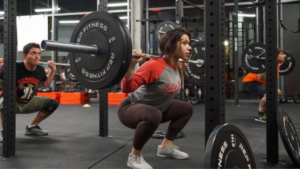
Barbell Back Squat
Sets: 3
Reps: 8 to 10
Rest: 2 minutes
The squat is often called the king of exercises because it trains the quadriceps, glutes, hamstrings, core, and lower back simultaneously. Focus on learning proper movement mechanics before increasing load.
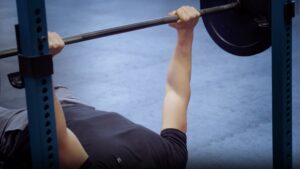
Bench Press
Sets: 3
Reps: 8 to 10
Rest: 2 minutes
The bench press develops the chest, shoulders, and triceps while teaching upper body pressing mechanics. Maintain control throughout the entire range of motion.

Lat Pulldown
Sets: 3
Reps: 10 to 12
Rest: 90 seconds
Lat pulldowns strengthen the back and help prepare beginners for future pull up training. Focus on pulling with the elbows rather than the hands.
Dumbbell Romanian Deadlift
Sets: 2
Reps: 10 to 12
Rest: 90 seconds
This exercise strengthens the posterior chain, including the hamstrings and glutes. Keep a slight bend in the knees and hinge at the hips.
Plank
Sets: 3
Time: 30 to 60 seconds
Rest: 60 seconds
Planks develop core stability and trunk endurance.
If You Can’t Do These 3 Things, You’re Not Ready for a 100kg Bench Press
Workout B
Deadlift
Sets: 3
Reps: 5 to 6
Rest: 2 to 3 minutes
The deadlift trains nearly every major muscle group in the body. Because it is demanding, lower repetitions work well for beginners.
Overhead Press
Sets: 3
Reps: 8 to 10
Rest: 2 minutes
The overhead press develops shoulder strength and upper body stability. Avoid excessive lower back arching.
Seated Cable Row
Sets: 3
Reps: 10 to 12
Rest: 90 seconds
Rows strengthen the upper back and improve posture. Focus on squeezing the shoulder blades together.
Leg Press
Sets: 2
Reps: 10 to 12
Rest: 90 seconds
The leg press provides additional lower body volume while being easier to learn than free weight alternatives.
Side Plank
Sets: 2
Time: 30 to 45 seconds per side
Rest: 60 seconds
Side planks target the obliques and improve core stability.
Workout C
Goblet Squat
Sets: 3
Reps: 10 to 12
Rest: 90 seconds
Goblet squats reinforce proper squat mechanics and improve mobility.
Incline Dumbbell Press
Sets: 3
Reps: 8 to 12
Rest: 90 seconds
This variation targets the upper chest and shoulders.
Assisted Pull Up or Lat Pulldown
Sets: 3
Reps: 8 to 12
Rest: 90 seconds
Vertical pulling movements help build back strength and upper body muscle mass.
Walking Lunges
Sets: 2
Reps: 10 steps per leg
Rest: 90 seconds
Lunges improve balance, coordination, and lower body development.
Farmer’s Carry
Sets: 3
Distance: 20 to 40 meters
Rest: 60 to 90 seconds
Farmer’s carries develop grip strength, core stability, and overall athleticism.
How Much Weight Should Beginners Use?
One of the most common beginner questions is how heavy to lift. The answer is simple.
Choose a weight that allows you to complete all prescribed repetitions while maintaining good technique. The final two or three repetitions should feel challenging but still controllable. A useful guideline is to finish most sets with approximately one to three repetitions left in reserve.
This approach allows sufficient training stimulus while minimizing injury risk and excessive fatigue.
How to Progress Every Week
Progressive overload is essential for continued results.
Use the following progression strategy:
- Start conservatively.
- Reach the upper end of the repetition range for all sets.
- Increase weight slightly at the next workout.
- Repeat the process.
For example:
- Week 1: Bench Press 3 x 8 at 95 pounds
- Week 2: Bench Press 3 x 10 at 95 pounds
- Week 3: Bench Press 3 x 8 at 100 pounds
Small increases performed consistently lead to significant long term progress.
The Importance of Sleep
Sleep is often overlooked despite being one of the most powerful recovery tools available. Research demonstrates that inadequate sleep can impair muscle recovery, reduce strength performance, and negatively affect body composition. Aim for seven to nine hours of quality sleep per night.
Improving sleep quality may enhance training outcomes as much as many expensive supplements. Until then, focus on mastering technique and steadily increasing performance.
Final Thoughts
The perfect beginner gym routine is not the most complicated one. It is the one that delivers consistent progress while remaining sustainable. A 3-day full body split provides the ideal combination of frequency, recovery, and simplicity for complete beginners. Scientific research consistently supports the effectiveness of resistance training performed several times per week using compound exercises, moderate training volumes, and progressive overload.
Rather than chasing advanced routines, focus on the fundamentals. Learn proper technique, train consistently, prioritize recovery, and gradually become stronger over time. Do that for a few months and you will build a solid foundation of strength, muscle, confidence, and movement quality that can support years of successful training.
Key Takeaways
| Topic | Key Point |
|---|---|
| Training Frequency | Three gym sessions per week is highly effective for beginners |
| Best Split | Full body workouts performed on nonconsecutive days |
| Main Goal | Focus on progressive overload over time |
| Exercise Selection | Prioritize compound movements such as squats, presses, rows, and deadlifts |
| Repetition Range | Most exercises work well with 8 to 12 repetitions |
| Recovery | Rest days are essential for adaptation and progress |
| Nutrition | Consume sufficient protein and calories to support training |
| Sleep | Aim for 7 to 9 hours nightly for optimal recovery |
| Program Duration | Follow the program consistently for at least 8 to 12 weeks |
| Success Factor | Consistency matters more than complexity |
References
• American College of Sports Medicine. (2009) ‘Progression models in resistance training for healthy adults’. Medicine & Science in Sports & Exercise, 41(3), pp. 687-708.
• Grgic, J., Schoenfeld, B.J., Davies, T.B., Lazinica, B., Krieger, J.W. and Pedisic, Z. (2018) ‘Effect of resistance training frequency on gains in muscular strength: A systematic review and meta analysis’. Sports Medicine, 48(5), pp. 1207-1220.
• Krieger, J.W. (2010) ‘Single versus multiple sets of resistance exercise for muscle hypertrophy: A meta analysis’. Journal of Strength and Conditioning Research, 24(4), pp. 1150-1159.
• Morton, R.W., Murphy, K.T., McKellar, S.R., Schoenfeld, B.J., Henselmans, M., Helms, E., Aragon, A.A., Devries, M.C., Banfield, L., Krieger, J.W. and Phillips, S.M. (2018) ‘A systematic review, meta analysis and meta regression of the effect of protein supplementation on resistance training induced gains in muscle mass and strength in healthy adults’. British Journal of Sports Medicine, 52(6), pp. 376-384.
• Phillips, S.M. and Winett, R.A. (2010) ‘Uncomplicated resistance training and health related outcomes: Evidence for a public health mandate’. Current Sports Medicine Reports, 9(4), pp. 208-213.
• Ralston, G.W., Kilgore, L., Wyatt, F.B. and Baker, J.S. (2017) ‘The effect of weekly set volume on strength gain: A meta analysis’. Sports Medicine, 47(12), pp. 2585-2601.
• Schoenfeld, B.J., Ogborn, D. and Krieger, J.W. (2016) ‘Effects of resistance training frequency on measures of muscle hypertrophy: A systematic review and meta analysis’. Sports Medicine, 46(11), pp. 1689-1697.