

Free weight training is one of the best ways for beginners to build strength, muscle, coordination, and confidence in the gym. Dumbbells, barbells, kettlebells, and loaded carries require you to control the weight through space instead of relying on a machine to guide the movement. That means your muscles must create force while your body learns to stabilize the joints and maintain good positions.
The goal as a beginner is not to lift as much weight as possible. It is to learn the major movement patterns, repeat them consistently, and gradually add load when your technique remains strong. Research shows that resistance training improves strength and muscle mass across a wide range of training approaches, while regular practice with progressively heavier loads supports continued adaptation.


These 10 free weight exercises cover the most important patterns for a strong, capable body. Start with manageable loads, move with control, and prioritize quality repetitions over ego.
1. Goblet Squat
The goblet squat is one of the best lower body exercises for beginners because the weight sits in front of your chest. Holding a dumbbell or kettlebell in this position helps you stay upright and can make it easier to learn a comfortable squat pattern.
Stand with your feet around shoulder width apart, holding the weight close to your chest. Brace your stomach, bend at your knees and hips, and lower yourself as far as you can while keeping your feet firmly on the floor. Push through your whole foot to stand back up.
Goblet squats train the quadriceps, glutes, adductors, calves, and trunk. They also teach you how to create tension through your torso while your hips and knees bend together. Squatting movements are particularly valuable because they build strength that carries over to standing, climbing stairs, lifting objects, and many athletic tasks.
Start with a depth you can control. Your knees can travel forward over your toes if your heels stay grounded and the movement feels comfortable. As your mobility, confidence, and strength improve, aim to squat deeper without losing your balance or spinal position.
2. Dumbbell Romanian Deadlift
The dumbbell Romanian deadlift teaches the hip hinge, which is the movement pattern used to load the hamstrings and glutes. It is different from a squat because the hips move backward more than the knees move forward.
Stand tall with a dumbbell in each hand, positioned in front of your thighs. Unlock your knees slightly, then push your hips backward as the dumbbells travel close to your legs. Keep your chest open and your back neutral. Lower the weights until you feel a meaningful stretch in the back of your thighs, then drive your hips forward to return to standing.
Which Type of Squat is Best for Your Lower Body Strength Gains?
This exercise strengthens the hamstrings, glutes, spinal erectors, and upper back. It also teaches you how to pick up weight while keeping your torso stable. That skill is useful both in the gym and in everyday life.
Do not chase a huge range of motion if it makes your lower back round. The correct depth depends on your current mobility and control. A controlled repetition that stops just below the knees can be more effective than a deeper repetition performed with poor positioning.
3. Dumbbell Split Squat
The dumbbell split squat trains each leg individually. This can help beginners identify differences in strength, coordination, and balance between their left and right sides.
Stand in a staggered stance with one foot forward and one foot behind. Hold dumbbells by your sides. Lower your body straight down by bending both knees, then press through the front foot to return to the starting position. Keep your torso tall and your front foot flat on the floor.
The split squat challenges the quads, glutes, hamstrings, calves, and trunk. Because it asks one leg to do more of the work, it also demands more balance than a bilateral squat. Unilateral exercises can be useful for developing strength and control across each side of the body.
Begin with bodyweight repetitions if necessary. Once you can perform smooth and stable repetitions, add light dumbbells. Keep the movement slow enough that you can control your balance throughout every repetition.
4. Dumbbell Bench Press
The dumbbell bench press is a fundamental upper body pushing exercise. It trains the chest, triceps, and shoulders while allowing each arm to work independently.
Lie on a flat bench with a dumbbell in each hand. Begin with the weights above your chest, your wrists stacked over your elbows, and your feet planted firmly on the floor. Lower the dumbbells with control until your upper arms are close to parallel with the floor, then press them back to the starting position.
Dumbbells are especially useful for beginners because they can be easier to position than a barbell and allow each side to move through its own natural path. They also expose major side to side strength differences that a barbell can sometimes hide.
Keep your shoulders pulled gently back into the bench and avoid letting the dumbbells drift too far toward your neck. A stable setup gives you a better platform to press from and reduces unnecessary stress on the shoulders.
5. One Arm Dumbbell Row
The one arm dumbbell row is one of the most useful pulling exercises for building the upper back. A strong back supports posture, shoulder function, and performance in pressing, pulling, carrying, and lifting.
Place one hand and the same side knee on a bench, then hold a dumbbell in the opposite hand. Let the weight hang beneath your shoulder. Pull your elbow toward your hip, pause briefly when your upper arm reaches your torso, then lower the dumbbell under control.
This movement trains the latissimus dorsi, rhomboids, trapezius, rear deltoids, biceps, and forearms. It also teaches you to resist trunk rotation while one arm works, which adds a useful stability challenge.
Avoid turning the row into a twisting movement. Keep your shoulders and hips square to the floor, and use a weight that lets you pause briefly at the top. The goal is to move the dumbbell with your back and arm muscles, not to throw it upward with momentum.
6. Dumbbell Overhead Press
The dumbbell overhead press develops strength through the shoulders, triceps, upper chest, and trunk. It is an important movement for anyone who wants to become stronger at lifting objects overhead.
Stand with a dumbbell in each hand at shoulder height. Brace your stomach, squeeze your glutes, and press the weights overhead until your arms are straight. Lower them steadily back to your shoulders.
This exercise demands more than shoulder strength. Your trunk and lower body must create a stable base so the force from your arms does not cause you to lean backward. That is why it is often better to begin lighter than you think you need.
Keep your ribs from flaring upward as you press. If you find yourself leaning back significantly, reduce the load or perform the movement seated with back support while you build control.
7. Dumbbell Floor Press
The dumbbell floor press is a beginner friendly pressing exercise that limits how far the upper arm travels behind the body. This makes it a useful option for people who are still developing shoulder confidence or who do not yet have access to a bench.
Lie on the floor with your knees bent and feet planted. Hold a dumbbell in each hand above your chest. Lower the weights until your upper arms lightly touch the floor, pause, then press back to the starting position.
The floor press trains the chest, triceps, and shoulders. Because the floor limits the bottom position, it can make the exercise easier to control than a full bench press. It also places a strong emphasis on the upper half of the pressing movement and the triceps.
Keep your wrists straight and your elbows at a comfortable angle from your torso. Do not bounce your arms off the floor. The brief pause should help you reset and press with control.
8. Dumbbell Lateral Raise
The dumbbell lateral raise is a simple but valuable exercise for developing the side of the shoulders. While compound exercises should form the foundation of a beginner program, targeted work can help create more balanced shoulder development.
Stand tall with a dumbbell in each hand by your sides. With a small bend in your elbows, raise the weights outward until your arms are around shoulder height. Lower them slowly and repeat.
The lateral raise mainly targets the middle portion of the deltoid. Strong deltoids contribute to upper body strength, shoulder stability, and a more developed physique. However, this exercise works best with light weights and careful control.
Avoid swinging your torso or shrugging your shoulders toward your ears. If you cannot lift the dumbbells without momentum, they are too heavy. A lighter load with a slower lowering phase will usually provide a better training stimulus.
9. Dumbbell Biceps Curl
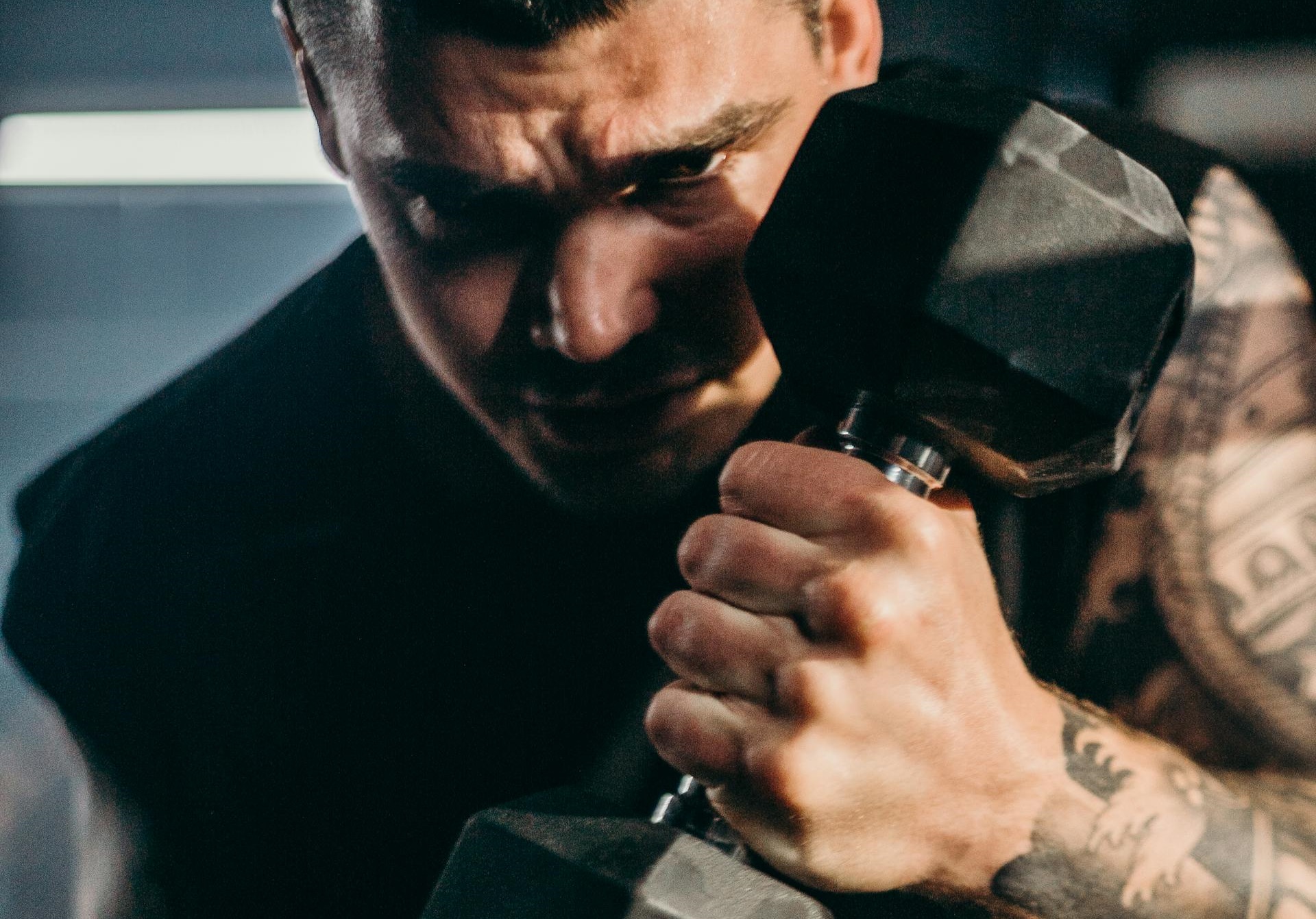
The dumbbell biceps curl is a beginner classic because it directly trains the muscles responsible for bending the elbow. It also builds grip strength and improves your ability to control weights in pulling exercises.
Stand with a dumbbell in each hand and your arms by your sides. Keep your elbows close to your torso, curl the weights toward your shoulders, then lower them slowly until your arms are straight again.
Curls train the biceps brachii, brachialis, brachioradialis, and forearm muscles. Although they are not as demanding as rows or presses, they are useful for developing the arms and supporting a more complete resistance training program.
Keep your upper arms mostly still during each repetition. A small amount of natural movement is normal, but your lower back should not swing the weight upward. Choose a load that allows you to lower each repetition with control.
10. Farmer Carry
The farmer carry is one of the most practical free weight exercises a beginner can learn. It looks simple, but carrying heavy dumbbells challenges the hands, forearms, shoulders, upper back, trunk, hips, and legs at the same time.
Pick up a pair of dumbbells, stand tall, and walk slowly with short, controlled steps. Keep your chest proud, shoulders down, and stomach braced. Walk for a set distance or time, then put the weights down with the same care you used to lift them.
Loaded carries improve grip strength and trunk stability while teaching you to maintain posture under load. They also develop work capacity without requiring complex technique. This makes them an excellent finishing exercise after your main lifts.
Do not let the weights pull your shoulders forward or cause you to lean from side to side. If your posture collapses quickly, use lighter dumbbells or carry them for a shorter distance.
How to Build Your Beginner Free Weight Program
You do not need to perform all 10 exercises in one workout. A simple full body plan performed two or three times per week is enough for most beginners to make progress. Choose one squat pattern, one hip hinge, one upper body push, one upper body pull, and one carry or accessory movement per session.
For most exercises, start with two or three sets of eight to 12 controlled repetitions. Carries can be performed for 20 to 40 seconds. Rest long enough between sets that you can maintain good technique, usually around one to two minutes for lighter exercises and longer for more demanding compound movements.
Research supports resistance training with multiple sets for building muscle, while progressively challenging loads are important for improving strength. For beginners, the most effective progression is often very simple. When you can complete all planned repetitions with good form, increase the weight slightly at your next session.
The best program is one you can repeat consistently. Learn the movements, keep a record of your training, and focus on small improvements over time. Strong fundamentals will make every future exercise easier to learn.
Key Takeaways
| Exercise | Main benefit | Beginner focus |
|---|---|---|
| Goblet squat | Builds lower body strength | Keep feet grounded and torso controlled |
| Dumbbell Romanian deadlift | Strengthens glutes and hamstrings | Push hips back and keep weights close |
| Dumbbell split squat | Develops each leg individually | Move slowly and maintain balance |
| Dumbbell bench press | Builds chest, triceps, and shoulders | Keep shoulders stable on the bench |
| One arm dumbbell row | Strengthens the upper back | Pull elbow toward hip without twisting |
| Dumbbell overhead press | Develops overhead strength | Brace trunk and avoid leaning back |
| Dumbbell floor press | Builds controlled pressing strength | Pause gently when arms reach the floor |
| Dumbbell lateral raise | Targets the side shoulders | Use light weights and avoid momentum |
| Dumbbell biceps curl | Builds arm and grip strength | Keep elbows close to the torso |
| Farmer carry | Builds grip and full body stability | Walk tall with controlled steps |
References
- American College of Sports Medicine (2009) ‘American College of Sports Medicine position stand. Progression models in resistance training for healthy adults’, Medicine and Science in Sports and Exercise, 41(3), pp. 687–708.
- Currier, B.S., McLeod, J.C., Banfield, L., Beyene, J., Welton, N.J., D’Souza, A.C., Keogh, J.A., Lin, L., Coletta, G., Yang, A., Colenso-Semple, L., Lau, K.J., Verboom, A. and Phillips, S.M. (2023) ‘Resistance training prescription for muscle strength and hypertrophy in healthy adults: a systematic review and Bayesian network meta-analysis’, British Journal of Sports Medicine, 57(18), pp. 1211–1220.
- Grgic, J., Schoenfeld, B.J., Orazem, J., Sabol, F., Smajić, M., Bishop, D.J. and Pedisic, Z. (2022) ‘Effects of resistance training performed to repetition failure or nonfailure on muscular strength and hypertrophy: a systematic review and meta analysis’, Journal of Sport and Health Science, 11(2), pp. 202–211.
- Krzysztofik, M., Wilk, M., Wojdała, G. and Gołaś, A. (2019) ‘Maximizing muscle hypertrophy: a systematic review of advanced resistance training techniques and methods’, International Journal of Environmental Research and Public Health, 16(24), 4897.
- Lasevicius, T., Schoenfeld, B.J., Silva Batista, C., Barros de Souza, D., Fonseca, H., Tricoli, V. and Ugrinowitsch, C. (2018) ‘Muscle failure promotes greater muscle hypertrophy in low load but not in high load resistance training’, Journal of Strength and Conditioning Research, 36(2), pp. 346–351.
- Schoenfeld, B.J., Ogborn, D. and Krieger, J.W. (2017) ‘Dose response relationship between weekly resistance training volume and increases in muscle mass: a systematic review and meta analysis’, Journal of Sports Sciences, 35(11), pp. 1073–1082.
- Schoenfeld, B.J., Grgic, J., Ogborn, D. and Krieger, J.W. (2017) ‘Strength and hypertrophy adaptations between low versus high load resistance training: a systematic review and meta analysis’, Journal of Strength and Conditioning Research, 31(12), pp. 3508–3523.
- Suchomel, T.J., Nimphius, S. and Stone, M.H. (2016) ‘The importance of muscular strength in athletic performance’, Sports Medicine, 46(10), pp. 1419–1449.