

Cable training gives beginners a simple way to train the elbow flexors with a controlled resistance path. The three exercises below are easy to learn, easy to load gradually, and useful for building the muscles that make the upper arm look more muscular from the front and side.
First, a reality check about “wide” biceps. No exercise can change your bone structure or muscle insertions. What training can do is increase the size of the biceps brachii, brachialis, and brachioradialis. As these elbow flexors grow, the upper arm can look thicker and more impressive. Resistance training is an effective method for increasing muscle size when it provides enough challenging work over time.


Cables are not magic, but they are beginner friendly. They make it easy to use small load increases, keep both hands working evenly, and choose a resistance direction that feels comfortable. The goal is still straightforward: perform controlled repetitions, gradually do more quality work as you get stronger, and train consistently.
Why Cable Curls Work for Beginners
The biceps brachii helps flex the elbow and turn the palm upward. The brachialis, which sits underneath the biceps, also flexes the elbow and can add visible thickness to the upper arm. The brachioradialis contributes strongly when the hand is in a neutral position, with the thumb facing upward.
For muscle growth, the exact tool matters less than the quality of the training. Research shows that a range of loads can build muscle when sets are sufficiently demanding. This means you do not need to use very heavy weight to make progress with cable curls. A moderate load that allows clean, controlled repetitions is an excellent starting point.

Weekly training volume also matters. Research has found a dose response relationship between the number of hard resistance training sets and muscle growth. Beginners should not rush to do huge amounts of arm work, but they should perform enough quality sets to create a clear training stimulus. Starting with a manageable amount and adding work only when recovery and technique remain good is a sensible approach.
You do not need to take every set to complete failure. Evidence indicates that resistance training performed close to failure can produce similar muscle growth to training taken all the way to failure, particularly when the total work is comparable. For a beginner, stopping when you believe you could still perform one or two controlled repetitions is usually a practical way to train hard without turning every set into a technique breakdown.
1. Standing Cable Supinating Curl
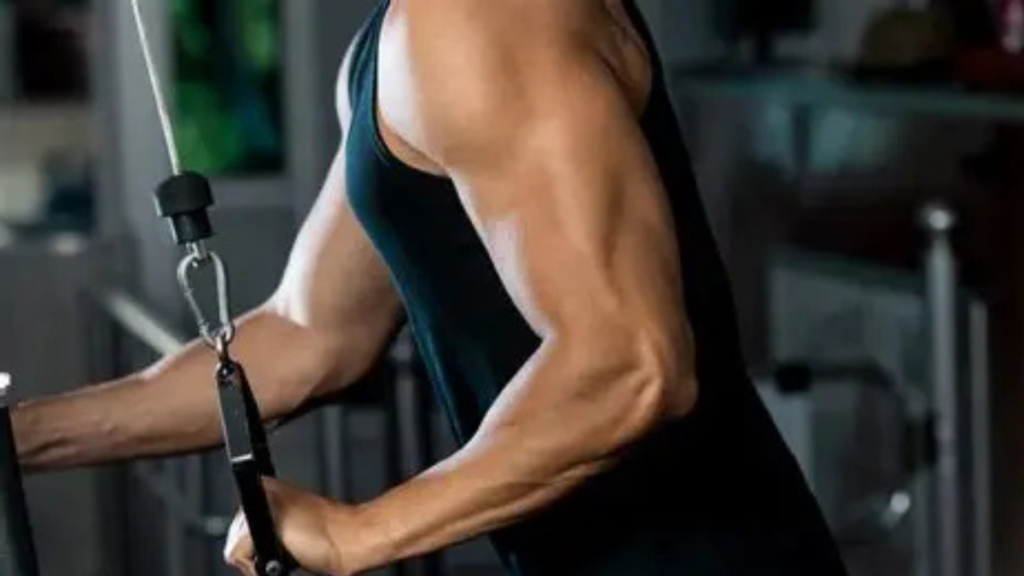
The standing cable supinating curl is the best place to start because it teaches the basic curl pattern while allowing each arm to work independently. The low pulley creates resistance from the bottom of the movement, and the handle gives you room to rotate the hand naturally as you curl.
How to Do It
Set a pulley at its lowest position and attach a single handle. Stand facing the machine and take one or two small steps back so the weight stack stays slightly lifted at the bottom. Hold the handle with your palm facing inward, keep your upper arm close to your side, and stand tall with your ribs stacked over your hips.
Curl the handle upward by bending your elbow. As your hand rises, rotate your palm so it faces upward near the top. Pause briefly when your forearm is close to vertical, then lower the handle under control until your elbow is straight or nearly straight. Complete all repetitions on one side before changing arms, or alternate sides if that helps you maintain focus.
Why It Belongs in Your Program
This exercise trains elbow flexion while allowing supination, which is one of the important functions of the biceps brachii. The independent handle also makes it easier to notice whether one arm is stronger or more coordinated than the other. Instead of letting the stronger side take over, you can give each arm equal work.
Keep the load light enough that your torso stays still. If you lean back, swing the handle, or allow the shoulder to travel far forward, the exercise becomes less consistent and harder to progress. A smooth curl with a controlled lowering phase is more useful than a heavier repetition that uses momentum.
3 Top Tips to Build Stronger Hamstrings Without Deadlifts
Start with two or three sets of eight to fifteen repetitions per arm. Choose a load that leaves you with roughly one or two repetitions in reserve while preserving full control.
2. Single Arm Cable Curl With the Arm Slightly Behind the Body
This variation is a simple cable alternative to an incline dumbbell curl. It is useful because it lets you train one arm at a time while holding a stable body position. The cable should be set low, and the arm should stay just behind your torso rather than drifting forward.
How to Do It
Set a single handle on the lowest pulley. Stand with the working side farther from the machine and grasp the handle with an underhand grip. Step forward until the cable is lightly tensioned while your arm hangs slightly behind your body.
Keep your chest tall and your shoulder relaxed. Curl the handle toward the front of your shoulder without allowing your elbow to move forward. Lower it slowly to the starting position, maintaining tension and avoiding a sudden pull from the weight stack.
If you feel shoulder discomfort, reduce the range of motion, move closer to the machine, or use the standing cable supinating curl instead. A productive biceps exercise should challenge the muscles without causing joint pain.
Why It Belongs in Your Program
The main advantage is control. The cable gives a consistent external load while the single arm setup makes it easier to keep the elbow from wandering. This can help a beginner learn what a strict curl feels like before progressing to more complex exercises.
The biceps brachii crosses both the shoulder and elbow joints, so shoulder position changes the exercise setup. However, no single curl angle has been proven to be uniquely superior for building the entire biceps in every person. Individual comfort, a repeatable technique, and progressive training are more important than chasing a supposedly perfect angle.
Use two or three sets of ten to fifteen repetitions per arm. Make every repetition look similar. If the last few repetitions force you to shift your torso or pull your shoulder forward, use less weight.
3. Rope Hammer Cable Curl
The rope hammer cable curl is an excellent choice for building a thicker looking upper arm because it emphasizes elbow flexion with a neutral hand position. This position involves the brachialis and brachioradialis alongside the biceps brachii. It also tends to feel comfortable for many people because the hands are not forced into a fully supinated grip.
How to Do It
Attach a rope to a low pulley and stand facing the machine. Hold the ends of the rope with your palms facing each other. Step back slightly so there is gentle tension at the bottom, then stand tall and keep your elbows near your sides.
Curl both rope ends upward together. Keep the thumbs pointing toward the ceiling throughout the repetition, and bring the ends of the rope toward the front of your shoulders. Lower slowly until your arms are straight or nearly straight, then begin the next repetition without swinging.
Avoid pulling your elbows behind your body as you lower the rope. Also avoid separating the rope ends excessively at the top. Neither adjustment is necessary for muscle growth, and both can make your technique less repeatable.
Why It Belongs in Your Program
Curl variations change the involvement of the elbow flexors. Research comparing curl styles has found differences in muscle activation between the biceps brachii and brachioradialis. Muscle activation measured during one workout does not directly prove long term muscle growth, but it does support using more than one comfortable curl pattern rather than assuming every curl stresses the elbow flexors identically.
The rope hammer curl is particularly useful when your goal is not only a biceps peak but also more overall arm thickness. The brachialis lies beneath the biceps, so developing it can contribute to a fuller upper arm appearance. The brachioradialis also adds size near the elbow and forearm.
Perform two or three sets of ten to fifteen repetitions. Keep the same neutral grip from start to finish, and use a load that lets you lower the rope under control.
How to Build Your Beginner Cable Biceps Workout
You do not need all three exercises in every workout. Begin with the standing cable supinating curl and rope hammer cable curl twice per week, leaving at least one day between sessions. Perform two sets of each exercise during the first few weeks. Once the sessions feel manageable and your form remains stable, add a third set or include the arm behind body curl.
A practical target is four to eight challenging direct biceps sets each week for a beginner. Compound pulling exercises, such as rows and pulldowns, also train the elbow flexors, so account for those when deciding how much direct curl work to add. More training is not automatically better if soreness, elbow discomfort, or falling performance are building up.
Progress gradually. First, aim to complete more repetitions with the same load while maintaining clean technique. Once you can reach the upper end of your planned repetition range for every set, increase the cable stack by the smallest available amount. This approach creates progressive overload without needing to sacrifice form.
Slow lowering is useful because it helps you control the movement, but there is no need to make every repetition extremely slow. Use a deliberate lift, a brief squeeze near the top, and a controlled return. Consistent full range repetitions are easier to track and repeat week after week.
Common Mistakes That Limit Biceps Growth
The most common problem is choosing a load that is too heavy. When the body starts rocking backward or the shoulders begin doing most of the work, the biceps are no longer receiving the same focused stimulus. Lower the weight and make the elbow movement cleaner.
Another mistake is cutting the range of motion short. Start with the elbow close to straight and curl as far as you can without forcing your wrist or shoulder into an uncomfortable position. You do not need to lock out aggressively, but repeatedly stopping far above the bottom can reduce the amount of useful work you perform.
Finally, avoid changing exercises every session. Variety can be enjoyable, but progress is easier to measure when you keep the same movements long enough to improve at them. Use these three exercises for at least several weeks, record your sets and repetitions, and make small improvements over time.
Key Takeaways
| Focus | Practical takeaway |
|---|---|
| Best starting exercise | Use the standing cable supinating curl to learn a strict, controlled curl pattern. |
| Extra upper arm thickness | Include rope hammer cable curls to train the elbow flexors with a neutral grip. |
| Weekly training | Start with four to eight challenging direct biceps sets per week across two sessions. |
| Repetition range | Use roughly eight to fifteen controlled repetitions, stopping with one or two repetitions still possible. |
| Progression | Add repetitions first, then make the smallest available load increase. |
| Important limitation | Training can increase muscle size but cannot change biceps insertions or bone structure. |
References
- American College of Sports Medicine (2009) ‘American College of Sports Medicine position stand. Progression models in resistance training for healthy adults’, Medicine and Science in Sports and Exercise, 41(3), pp. 687 to 708.
- Grgic, J., Schoenfeld, B.J., Orazem, J. and Sabol, F. (2022) ‘Effects of resistance training performed to repetition failure or non failure on muscular strength and hypertrophy: A systematic review and meta analysis’, Journal of Sport and Health Science, 11(2), pp. 202 to 211.
- Marcolin, G., Panizzolo, F.A., Petrone, N., Moro, T., Grigoletto, D., Piccolo, D. and Paoli, A. (2018) ‘Differences in electromyographic activity of biceps brachii and brachioradialis while performing three variants of curl’, PeerJ, 6, e5165.
- Schoenfeld, B.J., Ogborn, D. and Krieger, J.W. (2017) ‘Dose response relationship between weekly resistance training volume and increases in muscle mass: A systematic review and meta analysis’, Journal of Sports Sciences, 35(11), pp. 1073 to 1082.
- Schoenfeld, B.J., Grgic, J., Van Every, D.W. and Plotkin, D.L. (2021) ‘Loading recommendations for muscle strength, hypertrophy, and local endurance: A re examination of the repetition continuum’, Sports, 9(2), 32.