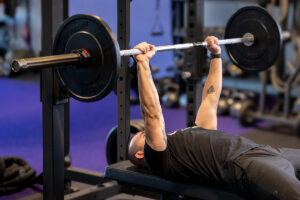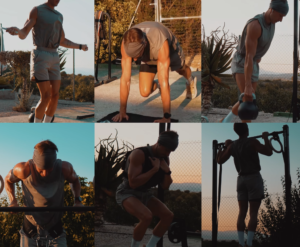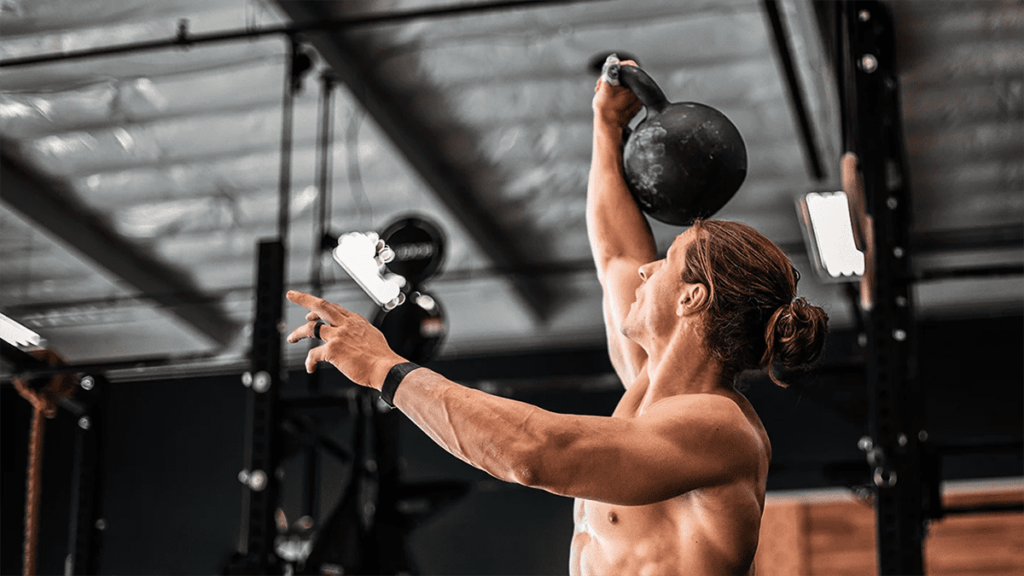


Well developed shoulders do far more than make your upper body look bigger. Strong deltoids improve posture, increase pressing strength, support healthy shoulder joints, and create the broad V shaped appearance that many people want.
The good news is that beginners do not need expensive gym machines to build impressive shoulders. Free weights and your own bodyweight are more than enough to stimulate muscle growth when you choose the right exercises and perform them consistently.


The shoulder is one of the most mobile joints in the body. That mobility comes with a tradeoff because it is also one of the least stable joints. Beginners benefit most from exercises that strengthen the deltoids while also teaching good movement patterns and improving shoulder stability. This guide covers three of the best beginner shoulder exercises that require no machines. Together they train all three heads of the deltoid while strengthening the muscles that support healthy shoulder function.
Why Shoulder Training Matters
The deltoid consists of three distinct parts.
- The anterior deltoid sits at the front of the shoulder and helps lift the arm forward and overhead.
- The lateral deltoid sits on the outside of the shoulder. It is primarily responsible for lifting the arm out to the side and contributes the most to shoulder width.
- The posterior deltoid sits at the back of the shoulder and helps pull the arm backward while supporting good posture and balanced shoulder development.
Although many beginners focus almost entirely on pressing movements, research has consistently shown that balanced development across all three portions of the deltoid is important for strength, muscle growth, and shoulder health.
Studies examining resistance training have repeatedly demonstrated that progressive overload is the primary driver of muscular hypertrophy. This means gradually increasing the challenge placed on the muscles over time by adding repetitions, weight, or training volume. For beginners, mastering a few effective exercises is often more productive than constantly changing workouts.
What Makes a Great Beginner Shoulder Exercise?
The best exercises for beginners should satisfy several criteria.
- They should be easy to learn without requiring advanced coordination.
- They should train large amounts of shoulder muscle through a full range of motion.
- They should allow gradual progression as strength improves.
- They should place minimal unnecessary stress on the shoulder joint when performed correctly.
The following three exercises meet all of these requirements.
Exercise One: Dumbbell Overhead Press
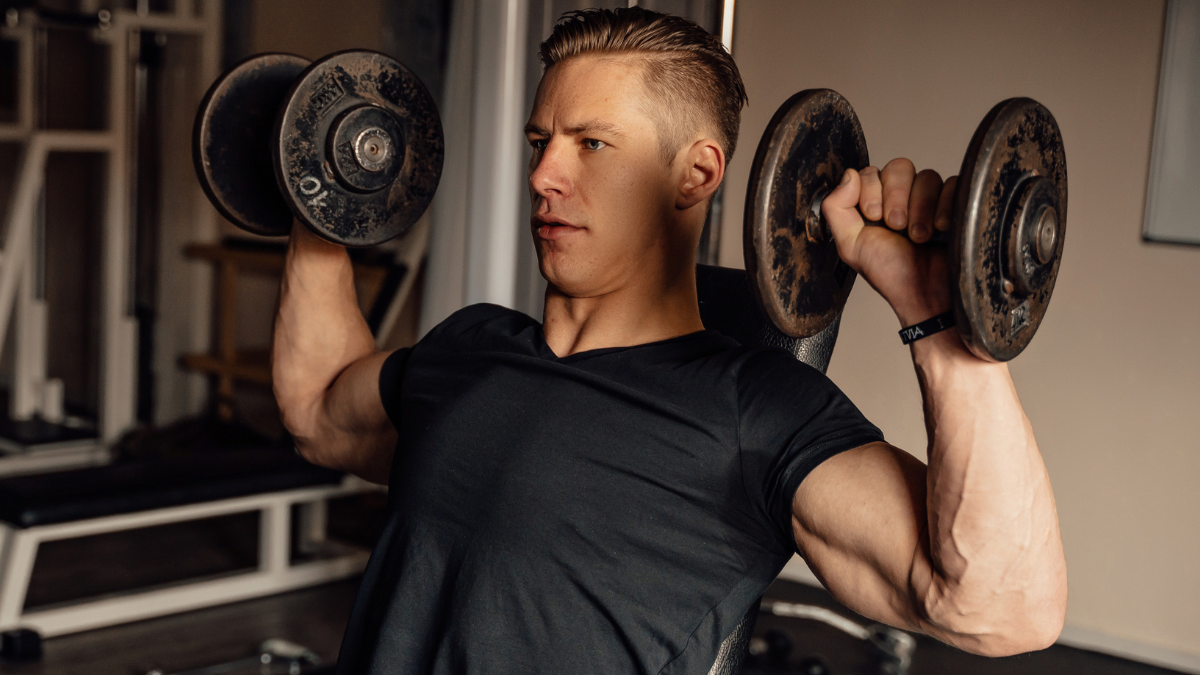
The dumbbell overhead press is one of the best overall shoulder builders available. It trains the front and side deltoids while also strengthening the triceps and upper chest.
Is the Jefferson Squat the Perfect Lower Body Exercise for Athletic Legs?
Unlike machine presses, dumbbells require each arm to stabilize the weight independently. This activates many smaller stabilizing muscles around the shoulder and improves muscular coordination.
Research using electromyography has shown high activation of both the anterior and lateral deltoids during overhead pressing movements. This makes the exercise highly effective for building size and strength simultaneously.
Benefits
The overhead press develops total shoulder mass while teaching proper overhead movement mechanics. It improves functional strength because lifting objects overhead is a common movement in both sports and everyday life.
Using dumbbells instead of a barbell also allows each shoulder to move more naturally, which many people find more comfortable. Because each arm works independently, strength imbalances become easier to identify and correct.
How to Perform It
- Stand with a dumbbell in each hand held at shoulder height.
- Keep your feet about shoulder width apart and brace your core.
- Press both dumbbells overhead until your elbows are nearly straight without locking them aggressively.
- Lower the weights slowly back to the starting position under control.
- Avoid leaning backward excessively. Your ribs should remain down throughout the movement.
- Start with a weight that allows you to perform eight to twelve controlled repetitions.
Exercise Two: Dumbbell Lateral Raise
If your goal is wider shoulders, the lateral raise deserves a place in every workout. The lateral deltoid creates the rounded appearance that makes the shoulders appear broader. Many compound pressing exercises emphasize the front deltoid more heavily, making isolation work valuable for balanced development. Electromyography studies consistently report very high activation of the middle deltoid during lateral raise variations.
Is the Jefferson Squat the Perfect Lower Body Exercise for Athletic Legs?
Benefits
The lateral raise directly targets the muscle responsible for shoulder width. It requires relatively light weights, making it accessible for beginners.
The movement places very little stress on the spine while allowing focused work on the deltoids. When performed correctly, it also helps improve mind muscle connection, allowing beginners to learn how the shoulder muscles contract during lifting.

How to Perform It
- Stand tall while holding a dumbbell in each hand at your sides.
- Keep a slight bend in your elbows throughout the movement.
- Raise your arms out to the sides until they reach approximately shoulder height.
- Pause briefly before lowering the weights slowly.
- Do not swing the weights or use momentum from your hips.
Beginners often make the mistake of choosing weights that are too heavy. Lighter weights with strict technique produce better muscle activation and reduce unnecessary stress on the shoulder joint. Aim for ten to fifteen repetitions with smooth, controlled movement.
Exercise Three: Pike Push Up
Bodyweight exercises remain excellent muscle builders when they are challenging enough. The pike push up shifts much more of your bodyweight onto the shoulders than a traditional push up, making it one of the best bodyweight exercises for shoulder development. As strength improves, this movement also serves as an excellent stepping stone toward handstand push ups.
Benefits
The pike push up develops shoulder strength without requiring equipment. It strengthens the anterior deltoids while also challenging the triceps and upper chest.
The exercise improves overhead pressing mechanics and shoulder stability while building body control. For beginners training at home, it provides an effective alternative when dumbbells are unavailable.
How to Perform It
- Begin in a push up position.
- Walk your feet toward your hands until your hips are high and your body forms an inverted V shape.
- Keep your head between your arms.
- Lower yourself by bending your elbows until the top of your head moves close to the floor.
- Press yourself back to the starting position.
- Focus on moving vertically rather than forward.
- If the full version feels too difficult, place your hands on an elevated surface such as a sturdy bench or box.
- Complete six to twelve controlled repetitions.
How Often Should Beginners Train Shoulders?
Research suggests that training each muscle group at least twice per week generally produces greater muscle growth than training it only once weekly, provided overall training volume is similar. For beginners, this does not mean performing dozens of exercises.
A simple routine performed twice each week is enough to stimulate consistent progress. For example, complete three sets of the overhead press, three sets of lateral raises, and three sets of pike push ups with one to two minutes of rest between sets.
This provides sufficient weekly volume for most beginners while allowing plenty of recovery.
Progressive Overload for Shoulder Growth
Progressive overload is the foundation of muscle development. Once you can comfortably complete all prescribed repetitions with excellent technique, increase the challenge slightly.
This may involve adding a small amount of weight, performing one or two extra repetitions, slowing the lowering phase, or completing an additional set. Small improvements performed consistently produce impressive long term results. Trying to increase weight too quickly often leads to poor technique and higher injury risk. Patience almost always produces better outcomes.
Final Thoughts
Building bigger and wider shoulders does not require expensive gym machines or complicated training plans.
The dumbbell overhead press develops overall shoulder strength and mass. The dumbbell lateral raise targets the lateral deltoid that creates visual width. The pike push up builds impressive bodyweight shoulder strength while reinforcing healthy overhead movement.
Together, these three beginner friendly exercises train every portion of the deltoid while improving stability, coordination, and functional strength.
Combine them with progressive overload, proper nutrition, consistent recovery, and patience, and you will build stronger shoulders that not only look better but also perform better in everyday life and sport.
Key Takeaways
| Topic | Key Point |
|---|---|
| Best overall exercise | Dumbbell overhead press builds size, strength, and stability across the shoulders. |
| Best exercise for width | Dumbbell lateral raises directly target the lateral deltoids for broader shoulders. |
| Best bodyweight option | Pike push ups develop shoulder strength without equipment. |
| Training frequency | Train shoulders two times per week for optimal beginner progress. |
| Rep ranges | Use eight to twelve reps for presses, ten to fifteen for lateral raises, and six to twelve for pike push ups. |
| Progressive overload | Gradually increase weight, repetitions, or training volume over time. |
| Recovery | Allow at least forty eight hours before intense shoulder sessions. |
| Nutrition | Consume sufficient protein and calories to support muscle growth. |
| Technique | Prioritize controlled movement over lifting heavier weights. |
| Long term success | Consistency with effective exercises produces the best results. |
References
- American College of Sports Medicine. (2009). Progression models in resistance training for healthy adults. Medicine & Science in Sports & Exercise, 41(3), 687 to 708.
- Ahtiainen, J.P., Pakarinen, A., Alen, M., Kraemer, W.J. and Häkkinen, K. (2003). Muscle hypertrophy, hormonal adaptations and strength development during strength training in strength trained and untrained men. European Journal of Applied Physiology, 89(6), 555 to 563.
- Boeckh Behrens, W.U. and Buskies, W. (2000). Fitness Strength Training: The Best Exercises and Methods for Sport and Health. Reinbek: Rowohlt.
- Gentil, P., Soares, S. and Bottaro, M. (2015). Single versus multi joint resistance exercises for muscle strength and hypertrophy. Sports Medicine, 45(6), 841 to 851.
- Grgic, J., Schoenfeld, B.J., Orazem, J. and Sabol, F. (2018). Effects of resistance training performed to repetition failure or non failure on muscular strength and hypertrophy. Journal of Sport and Health Science, 10(3), 275 to 283.
- Schoenfeld, B.J. (2010). The mechanisms of muscle hypertrophy and their application to resistance training. Journal of Strength and Conditioning Research, 24(10), 2857 to 2872.
- Schoenfeld, B.J., Ogborn, D. and Krieger, J.W. (2016). Effects of resistance training frequency on measures of muscle hypertrophy. Sports Medicine, 46(11), 1689 to 1697.