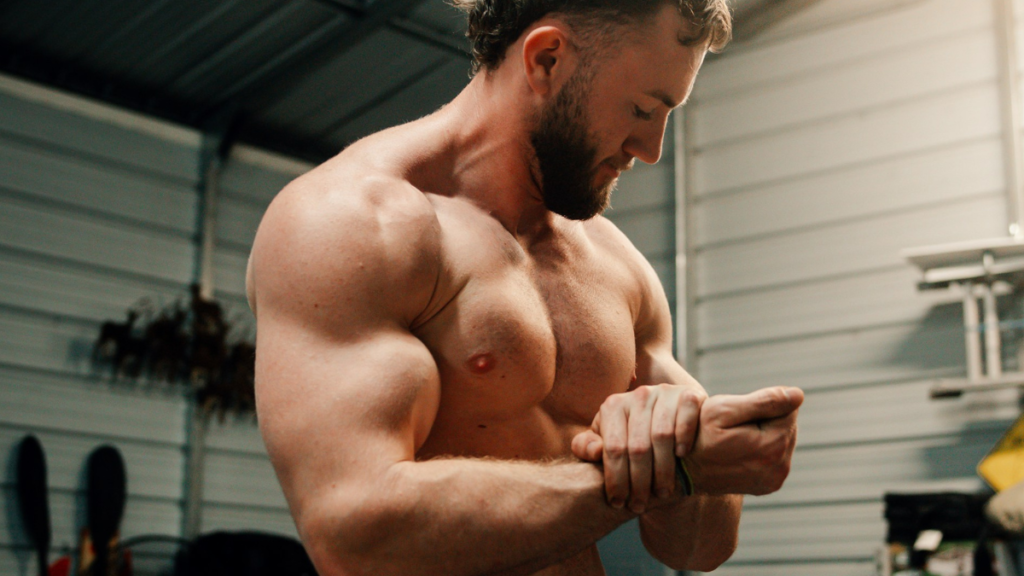


Broad shoulders create a stronger upper body silhouette, make the waist appear narrower, and give the torso a more athletic shape. While bone structure determines your natural shoulder width, building the muscles around the shoulder joint can make a meaningful visual difference.
The main muscle to focus on is the lateral deltoid, often called the side delt. This section sits on the outer part of the shoulder and contributes most directly to shoulder width when viewed from the front. The front deltoid assists with pressing and front raises, while the rear deltoid helps create a fuller shoulder from the side and back. All three matter for complete development, but the lateral deltoid deserves special attention if your priority is looking wider.



Dumbbells are enough to train this area effectively. They allow each arm to move independently, make it easy to adjust your grip and arm path, and work well at home or in a busy gym. Research comparing dumbbell and cable lateral raises found that both methods can increase lateral deltoid muscle thickness when the training is matched appropriately. That is useful news for anyone who does not have access to a cable station.
The three exercises below use only dumbbells and target the shoulder muscles from slightly different positions. They are not magic movements. Their value comes from consistent, well executed training, enough hard sets over time, and steady progression.
What Actually Makes Your Shoulders Look Wider?
The deltoid has three sections. The anterior deltoid is at the front of the shoulder, the lateral deltoid is on the outside, and the posterior deltoid is at the rear. The lateral deltoid is particularly important for visual width because it expands the upper body outward from the collarbone area.
Many people already give their front delts plenty of work through bench presses, push ups, overhead presses, and dips. That does not mean they should ignore pressing, but it does mean lateral raise variations are usually a more direct way to increase the training stimulus for the side delts.
Muscle growth depends on several connected factors. You need enough challenging sets, sensible technique, a range of motion you can control, and adequate recovery. Research consistently shows a dose response relationship between weekly resistance training volume and muscle growth, although adding more work eventually produces smaller returns and can become difficult to recover from.
You do not need to take every set to complete muscular failure. Evidence suggests that training close to failure can support hypertrophy, but absolute failure is not clearly superior when training is otherwise hard and well designed. For shoulder isolation work, stopping when you feel you could complete one or two more clean repetitions is often a productive balance between effort and technique.
1. Standing Dumbbell Lateral Raise
The standing dumbbell lateral raise is the foundation exercise for wider shoulders. It directly trains the lateral deltoid through shoulder abduction, which is the action of lifting the upper arm out to the side.
This exercise looks simple, but small changes in execution can decide whether the side delts do most of the work or whether momentum, the upper traps, and the lower back take over. Use a weight that lets you lift the dumbbells smoothly and control the lowering phase.
How to Perform It
Stand tall with a dumbbell in each hand and your arms relaxed by your sides. Keep a soft bend in the elbows and turn your hands so your palms face inward or slightly toward the floor. Raise the dumbbells out and slightly forward until your upper arms are around shoulder height.
Pause briefly at the top if you can maintain your position, then lower the dumbbells under control. Your torso should remain mostly still throughout the set. A small natural lean is fine, but avoid turning the movement into a swinging repetition.
Research examining lateral raise variations found meaningful differences in muscle activation depending on arm position and humeral rotation. A neutral or slightly externally rotated arm position is a sensible starting point for most lifters because it allows a comfortable movement path without forcing the shoulders into an awkward position.
Why It Works
The standing lateral raise makes the lateral deltoid the main target while also requiring the muscles around the shoulder blade and trunk to stabilize your position. It is easy to load progressively, simple to repeat consistently, and suitable for a wide range of experience levels.
The most common mistake is selecting dumbbells that are too heavy. When the load is excessive, people often shrug hard, bend and straighten the elbows repeatedly, or throw the weight upward with their hips. This might make the set feel difficult, but it reduces the quality of tension on the side delts.
Use controlled sets of approximately 10 to 20 repetitions. Lateral delts can respond well to higher repetition work because lighter dumbbells make it easier to keep the movement smooth and place less stress on the elbows and wrists.
2. Seated Dumbbell Lateral Raise
The seated dumbbell lateral raise uses the same basic arm action as the standing version, but removing the lower body makes it harder to create momentum. That can be especially useful if you tend to swing through standing raises or struggle to feel your side delts doing the work.
Sit upright on the edge of a flat bench with your feet firmly on the floor. Hold the dumbbells at your sides, brace your trunk, and raise both arms out to the side using the same controlled path as the standing variation.
Why Sitting Changes the Exercise
Sitting limits your ability to use leg drive or a large hip movement to start each repetition. That does not make it automatically better for everyone, but it can make your technique more honest. When the dumbbells become too heavy, there is less opportunity to disguise the problem with momentum.
This variation is also useful later in a shoulder workout, when fatigue makes it harder to maintain a stable standing position. It lets you focus on the path of the arms and the contraction of the lateral delts rather than trying to control a swaying torso.
Keep your chest tall without aggressively arching your lower back. Raise the dumbbells to a height that feels controlled and comfortable. For many lifters, bringing the upper arms close to shoulder height is enough. Forcing more range after your shoulder position starts to change can turn a productive repetition into a sloppy one.
Make Every Rep Count
Think about moving your elbows outward rather than trying to lift the dumbbells with your hands. The hands hold the weights, but the elbows should lead the motion. This cue often helps lifters avoid over gripping and prevents the forearms from dominating their attention.
Control the lowering phase for roughly two seconds. The eccentric part of a repetition contributes to the total training stimulus and gives you a chance to maintain tension rather than simply dropping the dumbbells back to the starting position.
Use this exercise for two to four hard sets, usually after a compound upper body movement or after standing lateral raises. If your shoulders feel irritated, reduce the range slightly, lower the load, and check whether your elbows are moving in a comfortable path.
3. Leaning Dumbbell Lateral Raise
The leaning dumbbell lateral raise is a useful variation when you want to challenge the side delt with a different resistance profile. Hold a sturdy upright support with one hand, lean your body slightly away, and perform a lateral raise with the free arm.
You only need a gentle lean. The goal is not to hang far from the support. Instead, create a stable angle that lets the working arm begin slightly away from the body and move through a controlled arc.
How to Perform It
Stand beside a solid rack or other stable support. Hold the support with one hand at around chest height and walk your feet slightly closer to it so you can lean away under control. Hold one dumbbell in the outside hand with your arm straight but not locked.
Raise the dumbbell outward until your upper arm approaches shoulder height. Keep your ribs controlled and avoid twisting your torso toward the working side. Lower the dumbbell slowly until you feel the side delt lengthen without losing control of the shoulder.
Complete all repetitions on one side before changing arms. This lets you give full attention to the movement and often makes it easier to identify whether one shoulder is weaker or less coordinated than the other.
Why It Deserves a Place in Your Program
The lean changes the starting angle of the arm relative to gravity. With a standard standing lateral raise, the dumbbell produces very little rotational challenge at the very bottom because it hangs almost directly below the shoulder. Leaning slightly away can make the early portion of the raise feel more demanding.
This is not a reason to abandon standard lateral raises. It is a reason to use variation carefully when progress stalls or when you want more high quality work without simply adding heavier dumbbells. Exercise variation can also make repetitive training feel fresher while keeping the goal clear.
Start conservatively. The altered position can make even a light dumbbell feel demanding. Use a slow tempo, stop before form deteriorates, and avoid turning the movement into a side bend.
How to Build a Wider Shoulder Routine
A practical dumbbell only approach could include standing lateral raises first, seated lateral raises second, and leaning lateral raises later in the session or on another upper body day. You do not need to perform all three in every workout. Rotating them across the week can keep training focused without adding unnecessary fatigue.

For beginners, six to eight challenging direct sets for the lateral delts each week is a sensible place to start. More experienced lifters may gradually build toward a higher number of productive sets if their shoulders recover well and performance remains stable. The right amount is the amount you can execute well, recover from, and progress over time.
3 Best Bodyweight Exercises for a Jacked and Strong Chest
Choose a load that allows clean repetitions in the target range. Add repetitions first where possible. Once you can reach the top of your chosen repetition range with solid form across all sets, increase the dumbbell weight slightly and repeat the process.
Shoulder development also depends on consistency outside the gym. Adequate protein intake, enough total calories for your goal, regular sleep, and sensible programming all support recovery. The exercises matter, but they work best as part of a training plan you can sustain for months.
The Bottom Line
For wider looking shoulders, direct lateral deltoid work should be a clear priority. Standing dumbbell lateral raises provide the essential movement, seated lateral raises reduce momentum and improve control, and leaning lateral raises offer a challenging change in angle with minimal equipment.
Focus on smooth repetitions, controlled lowering phases, and progressive training rather than chasing heavy dumbbells. Build your weekly volume gradually, train hard without sacrificing form, and give the movement enough time to work. That combination is far more likely to build noticeably wider shoulders than constantly changing exercises or relying on presses alone.
References
- Andersen, V., Fimland, M.S., Wiik, E., Skoglund, A. and Saeterbakken, A.H. (2020) ‘Effects of different exercises on muscle activity and strength in the shoulder complex’, International Journal of Environmental Research and Public Health, 17(17), 6015.
- Lasevicius, T., Ugrinowitsch, C., Berton, R., Vechin, F.C., Conceição, M.S., Damas, F., Libardi, C.A. and Tricoli, V. (2018) ‘Effects of different intensities of resistance training with equated volume load on muscle strength and hypertrophy’, European Journal of Sport Science, 18(6), pp. 772–780.
- Refalo, M.C., Helms, E.R., Trexler, E.T., Hamilton, D.L. and Fyfe, J.J. (2023) ‘Influence of resistance training proximity to failure on skeletal muscle hypertrophy: A systematic review with meta analysis’, Sports Medicine, 53(3), pp. 649–665.
- Schoenfeld, B.J., Ogborn, D. and Krieger, J.W. (2017) ‘Dose response relationship between weekly resistance training volume and increases in muscle mass: A systematic review and meta analysis’, Journal of Sports Sciences, 35(11), pp. 1073–1082.
- Simao, R., de Salles, B.F., Figueiredo, T., Dias, I., Willardson, J.M. and Miranda, H. (2012) ‘Exercise order in resistance training’, Sports Medicine, 42(3), pp. 251–265.
- Stasinaki, A.N., Zaras, N., Methenitis, S., Bogdanis, G., Terzis, G. and Koutedakis, Y. (2025) ‘Dumbbell versus cable lateral raises for lateral deltoid muscle hypertrophy: A randomized within participant trial’, Frontiers in Physiology, 16, 1611468.
Key Takeaways
| Focus | What to do |
|---|---|
| Main target | Prioritize the lateral deltoid because it contributes most directly to a wider shoulder appearance. |
| Best foundation exercise | Use standing dumbbell lateral raises with controlled form and a manageable load. |
| Reduce momentum | Add seated lateral raises if your torso tends to swing during standing repetitions. |
| Add variety carefully | Use leaning lateral raises to change the challenge while keeping the movement focused on the side delt. |
| Weekly training | Begin with six to eight hard direct sets weekly, then increase gradually only if you recover and continue progressing. |
| Effort level | Finish most sets with around one or two clean repetitions still available rather than sacrificing form to reach failure. |