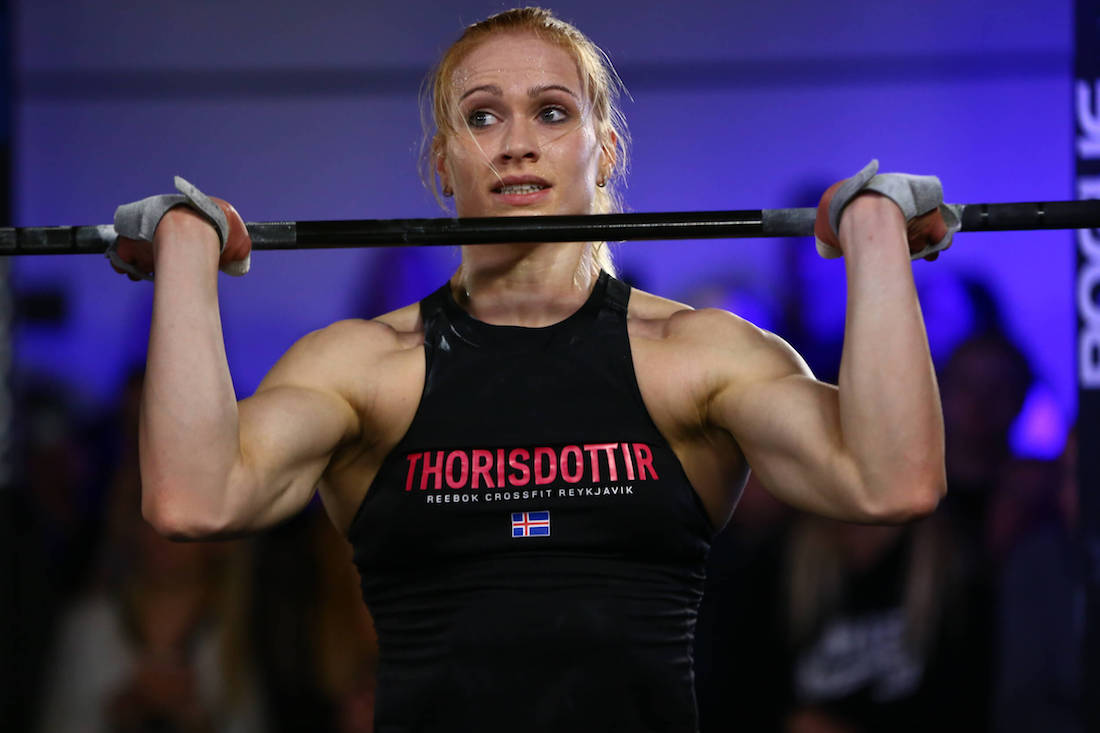


Wide, rounded shoulders can make the upper body look more athletic and balanced. For beginners, the goal is not to copy advanced bodybuilding routines or use the heaviest weights possible. It is to learn a few movements that train the shoulder muscles through useful ranges of motion, apply them consistently, and increase the challenge gradually.
The shoulder is made up of the front, middle, and rear portions of the deltoid. The middle deltoid contributes most directly to the visual impression of shoulder width, while the front and rear deltoid help create a fuller, more rounded shape. The surrounding muscles, including the rotator cuff and upper back, also matter because they help control the shoulder joint during pressing and raising movements.


A beginner program works best when it combines a press with movements that train the side and rear portions of the deltoid. Research shows that resistance training can increase muscle size across a broad range of loads when sets are performed with sufficient effort. This makes controlled technique and regular progression more important than chasing a specific dumbbell weight from the start.
Why These Exercises Work for Shoulder Shape
The three exercises below cover the main actions needed to develop the deltoids. The seated dumbbell shoulder press trains the front deltoid and triceps while also involving the middle deltoid. The dumbbell lateral raise places more emphasis on the middle deltoid, which is the section most associated with a wider appearance. The reverse dumbbell fly trains the rear deltoid, helping the shoulder look rounder from the side and more complete from behind.
These movements are beginner friendly because they use simple equipment, allow manageable loading, and make it easier to adjust the range of motion if mobility or coordination is still developing. They are also easy to repeat from week to week, which is essential because muscle growth depends on accumulated training over time rather than a single hard workout.
1. Seated Dumbbell Shoulder Press
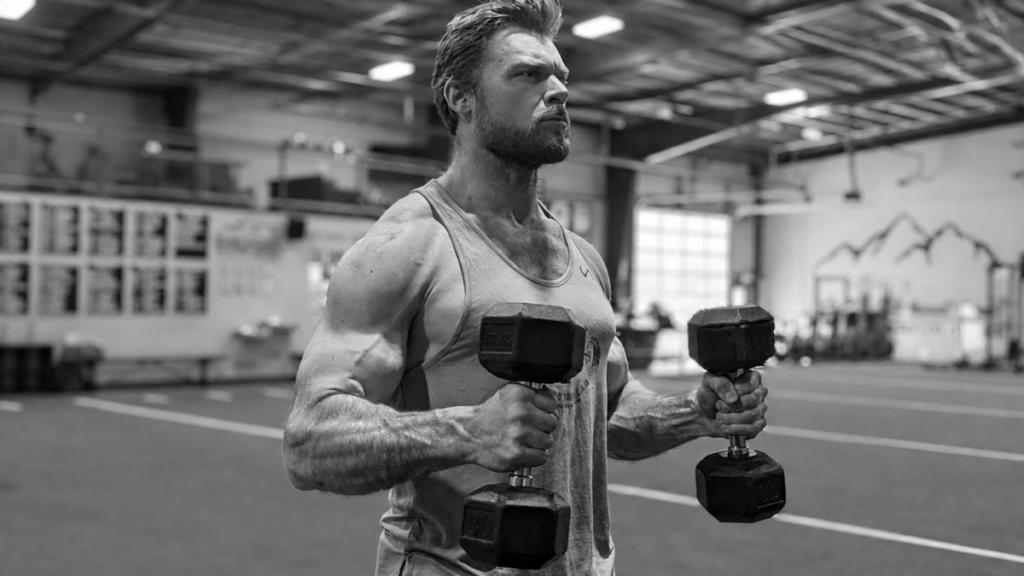
The seated dumbbell shoulder press is the best place to start because it teaches an important upper body strength pattern. Pressing dumbbells overhead trains the front of the shoulders, the triceps, and several stabilizing muscles around the shoulder blade. Compared with a barbell, dumbbells allow each arm to move independently, which can make it easier for beginners to find a comfortable arm path.
Sit on a bench with back support, place your feet firmly on the floor, and begin with the dumbbells near shoulder height. Your palms can face forward or turn slightly inward if that feels more comfortable. Press the weights upward until your arms are almost straight, then lower them under control until the dumbbells return close to shoulder level.
Keep your rib cage stacked over your pelvis rather than leaning backward to force the weight up. A large backward lean shifts more stress toward the lower back and can turn the movement into a poor imitation of an incline press. You should feel the shoulders and triceps working, but you should not feel sharp pinching inside the shoulder joint.
3 Best Barbell Exercises for Jacked and Attractive Upper Abs
Start with two or three sets of eight to twelve repetitions. Choose a weight that lets you maintain the same controlled path on every repetition while still making the last few repetitions challenging. When you can complete all prescribed repetitions with clean technique, increase the weight by the smallest available amount.
Research on resistance training indicates that both lighter and heavier loads can support muscle growth when training effort is high enough. For a beginner, moderate loads are particularly practical because they allow more opportunities to practice stable, repeatable form without excessive joint stress or fear of getting stuck under a heavy bar.
2. Dumbbell Lateral Raise
The dumbbell lateral raise deserves a central place in a shoulder routine because it directly trains the middle deltoid. This portion of the shoulder lifts the upper arm away from the body and contributes strongly to the appearance of width. Presses are valuable, but they do not replace a movement that specifically challenges this action.
Stand tall with a dumbbell in each hand and your arms relaxed at your sides. Soften your knees and brace your midsection gently. Raise the dumbbells outward and slightly forward until your upper arms are roughly parallel with the floor. Lower the weights slowly and return to the starting position without swinging your torso.
Use a very light weight at first. Lateral raises often feel harder than expected because the dumbbell sits far from the shoulder joint, creating a long lever. Heavy weights commonly cause beginners to use momentum, shrug hard, or turn the exercise into a swinging motion. That reduces the amount of controlled work done by the middle deltoid.
Keep a small bend in the elbows and lead the motion with the upper arms rather than trying to lift the dumbbells with the hands. Raising in a slightly forward arm path is often more comfortable than lifting directly to the sides. Stop at a height you can control comfortably. There is no prize for forcing the dumbbells higher when your shoulders begin to shrug toward your ears.
Electromyography research comparing lateral raise variations found substantial deltoid activity during lateral raising movements. While muscle activation measurements do not guarantee muscle growth by themselves, they support the practical use of lateral raises as a targeted exercise within a broader resistance training program.
Perform two or three sets of ten to fifteen repetitions. The final repetitions should feel difficult, but your body position should remain steady. A slow lowering phase can make light dumbbells more demanding and helps beginners stay in control of the movement.
3. Reverse Dumbbell Fly
The reverse dumbbell fly trains the rear deltoid, an area beginners often overlook. The rear deltoid helps pull the upper arm backward and contributes to a shoulder that looks rounded from multiple angles. It also works alongside muscles of the upper back during pulling movements.
Set an adjustable bench to a low incline and lie chest down against it. Let the dumbbells hang toward the floor with your palms facing each other. Keep a slight bend in the elbows, then raise your arms out and back until they are in line with your body. Lower the dumbbells slowly and keep your chest in contact with the bench throughout the set.
The bench is useful because it limits momentum and reduces the temptation to swing the torso. If an incline bench is not available, hinge forward at the hips with a neutral spine and perform the same movement standing. The supported version is usually easier for beginners to learn because it allows more attention on the shoulder motion.
Avoid pulling the weights back with a large shrug. Think about moving your upper arms outward while keeping your neck relaxed. The weights do not need to travel high for the rear deltoids to work well. Controlled repetitions with light dumbbells are far more productive than using a load that forces you to jerk the arms upward.
Perform two or three sets of ten to fifteen repetitions. Since the rear deltoid is relatively small, it usually responds better to controlled moderate or higher repetition work than to maximal loading. As with lateral raises, increase the weight only after every repetition looks consistent.
How to Build the Exercises Into a Beginner Routine
Train these exercises two times per week on nonconsecutive days. This schedule provides regular practice while allowing recovery between sessions. Evidence from resistance training research suggests that weekly training volume is an important driver of hypertrophy, and spreading work across more than one session is a practical way to build that volume without making a single workout excessively fatiguing.
A simple session can begin with the seated dumbbell shoulder press, followed by lateral raises and reverse dumbbell flies. Start conservatively with two sets per exercise. After several weeks, move to three sets if you are recovering well, maintaining good technique, and want additional training stimulus.
Rest for about one to two minutes between sets. Longer rests may be useful after challenging presses, while lateral raises and reverse flies often need slightly less rest. The key is to begin each new set with enough recovery to use controlled form and make the target muscles work.
You do not need to train to complete failure on every set. Instead, finish most sets when you feel that one to three more clean repetitions would be possible. This level of effort provides a meaningful stimulus while helping a beginner preserve technique and manage fatigue.
Progress Without Rushing
Progressive overload simply means giving the body a reason to adapt over time. You can progress by adding a small amount of weight, completing more repetitions with the same weight, improving control, or adding a set when recovery is good. For beginners, adding repetitions before increasing weight is often the simplest strategy.
For example, if you begin lateral raises with ten repetitions per set, aim to gradually reach fifteen repetitions with the same weight. Once you can do that with excellent control, choose the next heavier dumbbells and work back toward ten repetitions. This approach is patient, measurable, and easier on the joints than making large jumps in load.
Good shoulder training should feel demanding in the muscles without producing sharp pain. Mild muscle soreness can occur when you begin a new program, but pain inside the joint, numbness, or symptoms that worsen from session to session deserve attention from a qualified health professional.
Key Takeaways
| Focus | Practical takeaway | Starting recommendation |
|---|---|---|
| Overall shoulder size | Begin with a press to train the front deltoids and build foundational overhead strength. | Seated dumbbell shoulder press, two to three sets of eight to twelve repetitions. |
| Shoulder width | Use lateral raises to directly challenge the middle deltoid. | Two to three sets of ten to fifteen controlled repetitions. |
| Rounded shoulder development | Train the rear deltoid with reverse flies to complete the shoulder. | Two to three sets of ten to fifteen controlled repetitions. |
| Weekly structure | Train shoulders consistently while allowing recovery. | Complete the routine twice weekly on nonconsecutive days. |
| Progression | Improve repetitions or control before adding weight. | Keep one to three clean repetitions in reserve on most sets. |
References
- Coratella, G., Longo, S. and Schena, F. (2020) ‘An electromyographic analysis of lateral raise variations and frontal raise in competitive bodybuilders’, International Journal of Environmental Research and Public Health, 17(17), 6015.
- Grgic, J., Schoenfeld, B.J., Davies, T.B., Lazinica, B., Krieger, J.W. and Pedisic, Z. (2018) ‘Effect of resistance training frequency on gains in muscular strength: A systematic review and meta analysis’, Sports Medicine, 48(5), pp. 1207 to 1220.
- Schoenfeld, B.J., Ogborn, D. and Krieger, J.W. (2017) ‘Dose response relationship between weekly resistance training volume and increases in muscle mass: A systematic review and meta analysis’, Journal of Sports Sciences, 35(11), pp. 1073 to 1082.
- Schoenfeld, B.J., Grgic, J., Ogborn, D. and Krieger, J.W. (2017) ‘Strength and hypertrophy adaptations between low versus high load resistance training: A systematic review and meta analysis’, Journal of Strength and Conditioning Research, 31(12), pp. 3508 to 3523.
- Schoenfeld, B.J., Grgic, J., Van Every, D.W. and Plotkin, D.L. (2021) ‘Loading recommendations for muscle strength, hypertrophy, and local endurance: A re examination of the repetition continuum’, Sports, 9(2), 32.