

A strong, muscular back changes far more than how you look in a T shirt. It supports better posture, improves performance in pulling movements, provides a stable base for pressing, and helps you produce force in athletic training. The back is also a large and complex group of muscles, which means that one exercise alone is rarely enough to develop it fully.
Barbells are exceptionally effective tools for back training because they make progressive overload simple. You can add small amounts of weight, track your performance over time, and train through large ranges of motion with exercises that demand coordination from your entire body. Research consistently shows that resistance training can increase muscle size and strength when exercises are performed with sufficient effort, volume, and progression.



The three barbell exercises below cover the main jobs of a well developed back. The barbell bent over row directly trains the lats and upper back through horizontal pulling. The Romanian deadlift builds the posterior chain while demanding serious work from the muscles that stabilize the spine. The Pendlay row develops pulling strength from a dead stop and teaches powerful upper back positioning.
Used with sound technique and steady progression, these movements can help you build a back that is thicker, stronger, and more capable.
Why Barbell Training Works for Back Development
Your back includes the latissimus dorsi, trapezius, rhomboids, rear deltoids, erector spinae, teres major, and several smaller muscles that control the shoulder blades and spine. The lats contribute to shoulder extension and adduction, while the trapezius and rhomboids help control scapular movement. The erector spinae resist spinal flexion and assist with spinal extension.
A good back program should include movements that challenge these muscles in different ways. Horizontal pulling exercises place significant demand on the middle back, rear delts, and lats. Hip hinge exercises train the spinal erectors and posterior chain while requiring the upper back to hold the bar close to the body. This combination helps create both visible muscular development and practical strength.
Research on resistance training shows that muscle growth can be achieved across a range of loads when sets are performed sufficiently close to muscular failure. However, heavier loads remain useful for building strength, while moderate loads are often practical for accumulating enough productive training volume. Barbells work well across this entire spectrum.
The goal is not simply to move more weight with poor mechanics. Your aim should be to place tension on the target muscles, repeat high quality reps, and gradually progress over time. A heavier bar is only useful if you can control it.
1. Barbell Bent Over Row
The barbell bent over row is one of the most valuable exercises for building a thicker, more muscular back. It allows you to load a horizontal pulling pattern heavily while training the lats, mid traps, rhomboids, rear delts, biceps, and spinal erectors.
Why It Builds a Bigger Back
The bent over row requires you to pull the bar from below the knees or upper shins toward your torso while maintaining a stable hip hinge. Your shoulder blades must move and stabilize under load, and your back muscles must produce force through shoulder extension and scapular retraction.
When performed with a controlled torso position, the exercise gives the lats and upper back a substantial workload. The isometric demand on the erector spinae also makes it more than just a pulling exercise. Your trunk has to resist collapsing forward throughout the set.
A row can be performed with a grip just outside shoulder width and the elbows moving back close to the torso. This usually creates a strong lat focused pulling pattern. Pulling with the elbows slightly farther out can increase the contribution from the upper back and rear delts. Both approaches can have a place in a well rounded program.
How to Perform the Barbell Bent Over Row
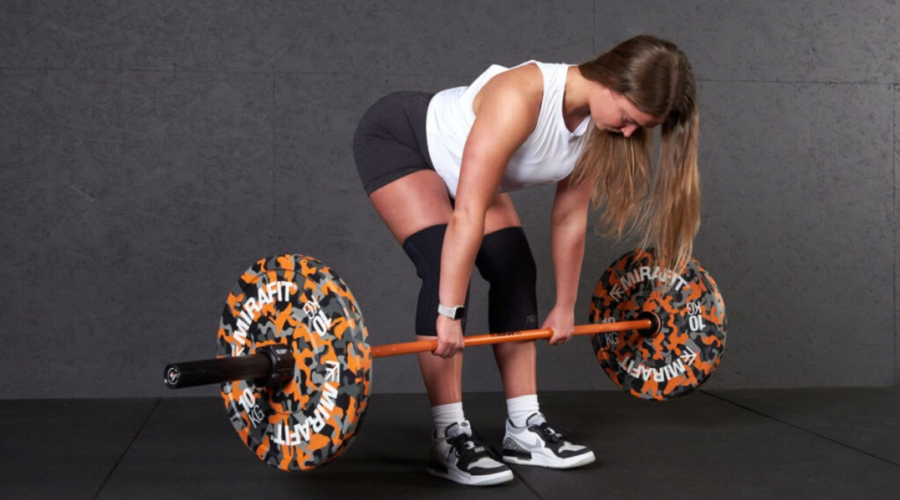
Stand with the bar over the middle of your feet and take a grip slightly wider than shoulder width. Push your hips back, soften your knees, and lean forward until your torso is around 30 to 45 degrees from the floor. Keep your chest proud, your neck neutral, and your spine in a stable position.
Begin each repetition by pulling the bar toward your lower ribs or upper abdomen. Think about driving your elbows back rather than curling the weight with your arms. Pause briefly when the bar reaches your torso, then lower it under control until your elbows are straight.
Your torso should remain as still as possible. A small amount of movement can happen naturally as the set becomes challenging, but excessive standing up turns the exercise into a very different movement. If your torso rises significantly with every repetition, reduce the load and rebuild control.
Programming the Barbell Bent Over Row
For muscle growth, perform three to five sets of six to 12 repetitions. Choose a load that allows you to maintain a consistent torso position and complete the final repetitions with effort. Resting for at least two minutes between hard sets can help you maintain performance and accumulate better quality volume.
Start conservatively. Add a small amount of weight only after you can complete every planned repetition with solid technique. This patient approach is far more likely to build your back than constantly testing how much you can row.
2. Romanian Deadlift
The Romanian deadlift is often viewed as a hamstring exercise, but it is also an outstanding movement for building a stronger back. It trains the erector spinae isometrically, challenges the lats to keep the bar close to the body, and strengthens the entire posterior chain.
Why It Transforms Your Back
During a Romanian deadlift, your spinal erectors work continuously to maintain a stable torso while your hips move backward and forward. Your lats help keep the barbell close, which is important because allowing the bar to drift forward increases the demand on the lower back and makes the lift less efficient.
The movement also builds the glutes and hamstrings, which are essential partners for a strong back. A powerful posterior chain helps you generate force in lifting, sprinting, jumping, and many daily tasks. It can also improve your ability to maintain a stable position in rows, deadlifts, and other demanding exercises.
Research comparing resistance training exercises shows that multi joint movements can effectively build strength and muscle when they are progressed appropriately. The Romanian deadlift is especially useful because it trains several major muscle groups at once while reinforcing the hip hinge pattern.
How to Perform the Romanian Deadlift
Set the barbell in a rack at about thigh height or lift it from the floor using a conventional deadlift. Stand tall with the bar held close to your thighs and your feet about hip width apart.
3 Best Beginner Exercises for Great Looking Arms
Take a breath, brace your trunk, and push your hips backward while allowing your knees to bend slightly. Lower the bar close to your legs, maintaining tension through your upper back and keeping your shoulders pulled away from your ears. Descend until you feel a strong stretch in your hamstrings while still maintaining a stable spinal position.
Drive your feet into the floor and push your hips forward to return to standing. Finish tall with your glutes engaged, but avoid leaning backward at the top. The movement should come from the hips, not from rounding your spine to reach farther down.
Programming the Romanian Deadlift
The Romanian deadlift works well for three to four sets of six to 10 repetitions. Because it creates significant fatigue in the hamstrings, glutes, and lower back, it is usually best placed early in the workout or on a lower body focused training day.
Keep each repetition deliberate. Fast and uncontrolled reps reduce your ability to maintain tension and can make it harder to judge whether you are using a load that matches your current strength. A two to three second lowering phase is often a useful way to improve control and make lighter loads more challenging.
You do not need to lower the bar to the floor. The correct depth is the deepest position you can reach while keeping the bar close and maintaining a strong hip hinge. For many lifters, that will be around mid shin height, although individual mobility and body proportions will affect the exact range.
3. Pendlay Row
The Pendlay row is a strict barbell row performed from the floor. Every repetition begins with the bar resting on the ground, which removes momentum and requires you to generate force from a dead stop. It is an excellent choice for lifters who want to develop explosive pulling strength, upper back thickness, and more disciplined rowing technique.
Why the Pendlay Row Is So Effective
The dead stop between repetitions creates a clear standard. You cannot bounce the bar upward or use the stretch reflex to begin the next rep. Instead, you must brace your trunk, set your upper back, and pull with intent every time.
Starting from the floor also encourages a more horizontal torso position than many conventional bent over rows. This can increase the challenge for the upper back and posterior chain, although it also means that mobility and trunk strength become more important.
The Pendlay row does not replace the conventional bent over row. It complements it. The bent over row is often easier to perform with a smoother, more continuous rhythm and may be more practical for higher repetition hypertrophy work. The Pendlay row is particularly valuable when you want to train powerful pulls with strict reset points.
How to Perform the Pendlay Row
Set a loaded barbell on the floor. Stand with your feet around hip width apart, then hinge at the hips and bend your knees enough to reach the bar with a stable flat back. Grip the bar slightly wider than shoulder width.
Your torso should be close to parallel with the floor, although the exact position will depend on your limb length and mobility. Brace your midsection, pull your shoulder blades down and back, then row the bar quickly toward the lower chest or upper abdomen.
Lower the bar back to the floor under control and allow it to settle completely before beginning the next repetition. Reset your brace before every rep. This is a key part of the exercise, not wasted time between repetitions.
Avoid jerking the bar with your lower back or snapping your torso upward. The lift should feel powerful, but it should still be controlled. If you cannot keep the bar path consistent or your back position starts to deteriorate, lower the weight.
Programming the Pendlay Row
Use the Pendlay row for three to five sets of five to eight repetitions. These slightly lower repetition ranges suit the exercise because each rep begins from a dead stop and demands careful bracing.
You can alternate Pendlay rows and bent over rows across the week, or use one for a training block before switching to the other. For example, you might use Pendlay rows for six weeks to prioritize strength and technique, then move to bent over rows for a higher repetition phase focused on muscle growth.
How to Build Your Barbell Back Workout
A productive back workout does not need to be complicated. You can use all three exercises in the same weekly plan, but manage fatigue intelligently. The Romanian deadlift creates meaningful fatigue in the lower back and hamstrings, so avoid placing it immediately before your hardest rowing work if your trunk strength is still developing.

You could train the Romanian deadlift on a lower body day, then use the bent over row or Pendlay row on an upper body day. If you train full body three times per week, rotate the exercises across sessions so each movement receives enough attention without overwhelming your recovery.
For most people, 10 to 20 challenging weekly sets per muscle group is a useful general range for hypertrophy, although the best amount depends on training experience, exercise selection, sleep, nutrition, and recovery capacity. Begin nearer the lower end, assess your performance and soreness, then add volume only when it improves rather than harms progress.
Progressive overload does not always mean adding weight. You can also perform an extra repetition, improve your bar control, use a fuller range of motion, or complete the same work with better technique. These improvements matter because they increase the quality of the stimulus your muscles receive.
Technique and Recovery Matter as Much as Exercise Choice
The best barbell back exercises only work when you can repeat them consistently. Train hard, but do not allow fatigue to turn every rep into a test of survival. Your back should feel challenged by the work, not beaten up by poor positions and rushed loading.
Give your back enough recovery through adequate sleep, protein intake, and sensible training frequency. Research indicates that daily protein intakes around 1.4 to 2.0 grams per kilogram of body weight are sufficient for most exercising individuals, with higher intakes sometimes useful during calorie restriction or very demanding training phases.
Barbell rows and Romanian deadlifts require concentration. Treat your warm up as practice for the working sets. Use lighter sets to establish your grip, brace, bar path, and body position before loading heavily. That approach will help you build strength with far less guesswork.
The bent over row, Romanian deadlift, and Pendlay row are simple exercises, but they reward consistency. Master the positions, track your numbers, and give the process time. Your back will become stronger, thicker, and noticeably more capable.
References
- American College of Sports Medicine (2009) ‘American College of Sports Medicine position stand: Progression models in resistance training for healthy adults’, Medicine & Science in Sports & Exercise, 41(3), pp. 687–708.
- Grgic, J., Schoenfeld, B.J., Skrepnik, M., Davies, T.B. and Mikulic, P. (2018) ‘Effects of rest interval duration in resistance training on measures of muscular strength: A systematic review’, Sports Medicine, 48(1), pp. 137–151.
- Schoenfeld, B.J., Ogborn, D. and Krieger, J.W. (2017) ‘Dose response relationship between weekly resistance training volume and increases in muscle mass: A systematic review and meta analysis’, Journal of Sports Sciences, 35(11), pp. 1073–1082.
- Schoenfeld, B.J., Grgic, J., Ogborn, D. and Krieger, J.W. (2017) ‘Strength and hypertrophy adaptations between low versus high load resistance training: A systematic review and meta analysis’, Journal of Strength and Conditioning Research, 31(12), pp. 3508–3523.
- Schoenfeld, B.J., Pope, Z.K., Benik, F.M., Hester, G.M., Sellers, J., Nooner, J.L., Schnaiter, J.A., Bond-Williams, K.E., Carter, A.S., Ross, C.L., Just, B.L., Hensley, G.D., Hester, G.M., Cerqueira, M.S., Raub, B. and Krieger, J.W. (2016) ‘Longer interset rest periods enhance muscle strength and hypertrophy in resistance trained men’, Journal of Strength and Conditioning Research, 30(7), pp. 1805–1812.
- Wackerhage, H., Schoenfeld, B.J., Hamilton, D.L., Lehti, M., Hulmi, J.J., Kraemer, W.J., Han, S., Nyman, M.P., Volek, J.S., Ahmetov, I.I. and Baar, K. (2019) ‘Stimuli and sensors that initiate skeletal muscle hypertrophy following resistance exercise’, Journal of Applied Physiology, 126(1), pp. 30–43.
- Jäger, R., Kerksick, C.M., Campbell, B.I., Cribb, P.J., Wells, S.D., Skwiat, T.M., Purpura, M., Ziegenfuss, T.N., Ferrando, A.A., Arent, S.M., Smith Ryan, A.E., Stout, J.R., Arciero, P.J., Ormsbee, M.J., Taylor, L.W., Wilborn, C.D., Kalman, D.S., Kreider, R.B., Willoughby, D.S., Hoffman, J.R., Krzykowski, J.L. and Antonio, J. (2017) ‘International Society of Sports Nutrition position stand: Protein and exercise’, Journal of the International Society of Sports Nutrition, 14, article 20.
Key Takeaways
| Exercise | Main benefit | Best starting approach |
|---|---|---|
| Barbell bent over row | Builds the lats, rhomboids, traps, rear delts, and spinal erectors through a heavily loadable horizontal pull | Perform three to five sets of six to 12 controlled repetitions |
| Romanian deadlift | Strengthens the posterior chain while training the spinal erectors and lats to stabilize the barbell | Perform three to four sets of six to 10 repetitions with a controlled lowering phase |
| Pendlay row | Develops explosive pulling strength and upper back tension from a dead stop | Perform three to five sets of five to eight repetitions, resetting on the floor each time |
| Long term progress | Consistent technique, sufficient training volume, recovery, and gradual overload drive results | Track your repetitions and load, then progress only when your form remains strong |