

Not all personal training certifications are created equal, and that gap matters more than most people realize when they’re just starting out. The best ones open gym doors, build client trust, and shape your earning potential from day one. With dozens of options out there, each carrying different costs, study demands, and levels of employer acceptance, the decision is tricky. After reviewing the most respected programs across accreditation, exam difficulty, and career support, this guide breaks down the five worth your time and money.
How the picks were chosen
Every certification here was assessed using publicly available information from official websites, user review platforms, and industry directories. Only programs with a demonstrated track record in fitness made it through the shortlist.


→ See the full research breakdown
- International Personal Trainer Academy (IPTA) — Best for aspiring trainers who want fast-track exam prep with career support
- NASM — Best for fitness professionals seeking globally recognized, evidence-based certification
- ACE — Best for trainers who want a nonprofit-backed certification with multiple specializations
- NSCA — Best for strength and conditioning professionals pursuing research-backed credentials
- ACSM — Best for fitness professionals working in clinical or medically adjacent settings
Why personal training certifications are worth the investment
Picking a certification without knowing what employers actually accept is one of the most common and costly mistakes new trainers make. The upfront costs alone — study materials, exam fees, renewal cycles — add real financial pressure. And not every certification carries the same weight at the gym front desk. NCCA-accredited programs tend to hold up better across major chains and health clubs, which directly affects how quickly you land your first client.
Official accreditation records and employer requirements should remain your primary sources. Real-world discussions can add context through comparisons of major providers, questions about gym acceptance, and certification choices other aspiring trainers are considering before entering the field.

The right credential also changes how you approach the exam. Programs with structured study paths, clear curriculum design, and strong preparation tools help ensure your study hours lead to a qualification you can build a career on.
IPTA — Best for fast-track exam prep with career support
What sets IPTA apart?
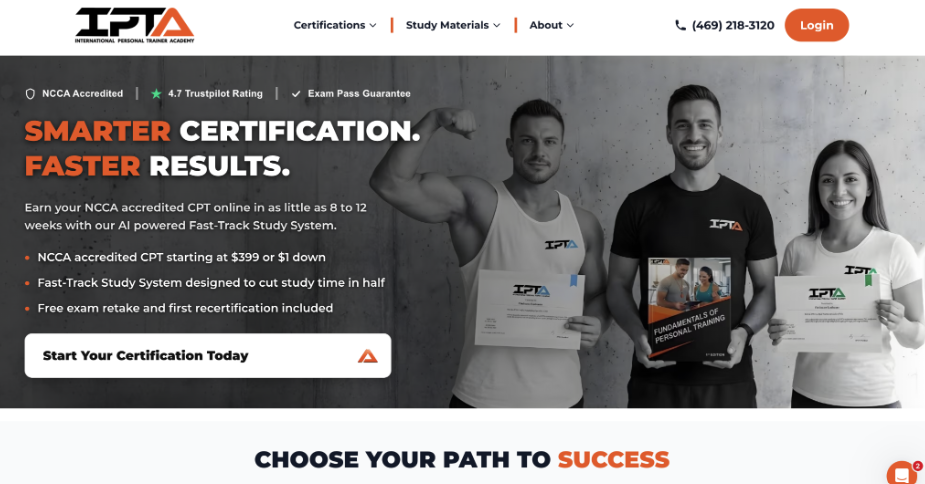
IPTA runs as a fully online platform covering personal trainer certification, nutrition coaching, and bodybuilding coaching. What separates it from standard providers is the Fast-Track Study System, built to move students through content faster than traditional self-study allows — roughly 4–8 weeks for a focused student. It also preps students for the major exams, including NASM, ACE, ACSM, ISSA, NSCA, and NCSF, so the platform works whether you’re choosing a cert for the first time or stacking another credential.
Why pick IPTA?
IPTA tackles one of the most frustrating parts of the process: showing up to exam day underprepared after hours of unfocused studying. Its job assurance guarantee and free business courses — not just exam prep — give it an edge that feels meaningfully different from a standard study guide (the guarantee’s eligibility terms are worth a read).
The review roundup
IPTA holds a 4.7-star rating on Trustpilot, a solid signal when that many real users are weighing in. Students respond well to the structured support and the sense that someone is invested in their success. Mentions in Entrepreneur, Forbes, and USA Today add credibility that’s hard to dismiss.
NASM — Best for globally recognized, evidence-based certification
What sets NASM apart?
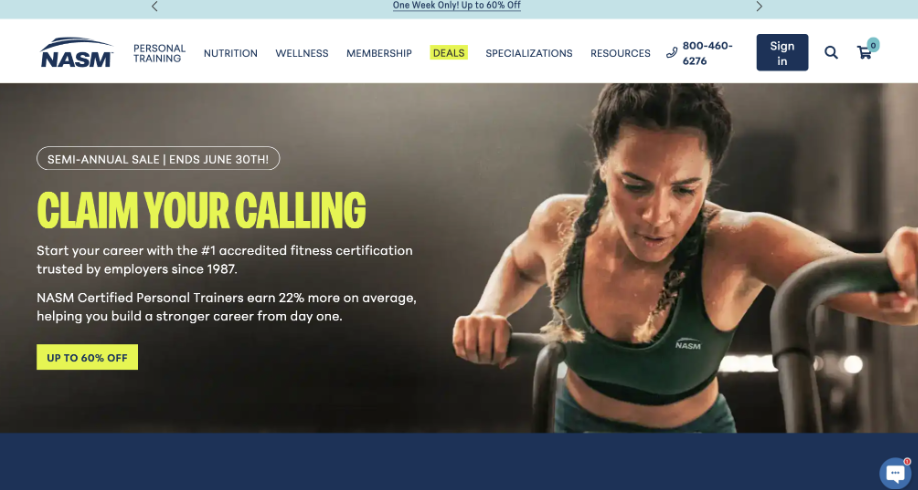
NASM has built its reputation since 1987 and has now certified more than 1.4 million individuals across 100-plus countries. Its flagship CPT program is built around the Optimum Performance Training (OPT) model, a structured, science-backed framework for working with real clients. Beyond the CPT, it covers corrective exercise, performance enhancement, nutrition coaching, and wellness coaching. The fact that every NBA, NFL, and MLB team employs NASM-credentialed professionals says more about its standing than any marketing claim.
Why pick NASM?
NASM addresses the real problem of choosing a cert that major gyms and sports organizations won’t take seriously. Its 14,000-plus gym and health club partnerships make for the kind of employer acceptance network that genuinely eases a job search. The self-paced CPT typically takes 8 to 12 weeks — a longer runway than IPTA’s fast-track route, but the trade is the broadest recognition in the field.
The review roundup
NASM has been named to Newsweek and Statista’s “America’s Top Online Learning Providers” list in recent years — a consistent quality signal, not a one-year spike. Its NCCA accreditation, combined with that professional sports adoption, makes it one of the most trusted names new trainers encounter. That kind of industry-wide recognition is hard to match at this level.
ACE — Best for nonprofit-backed certification with multiple specializations
What sets ACE apart?
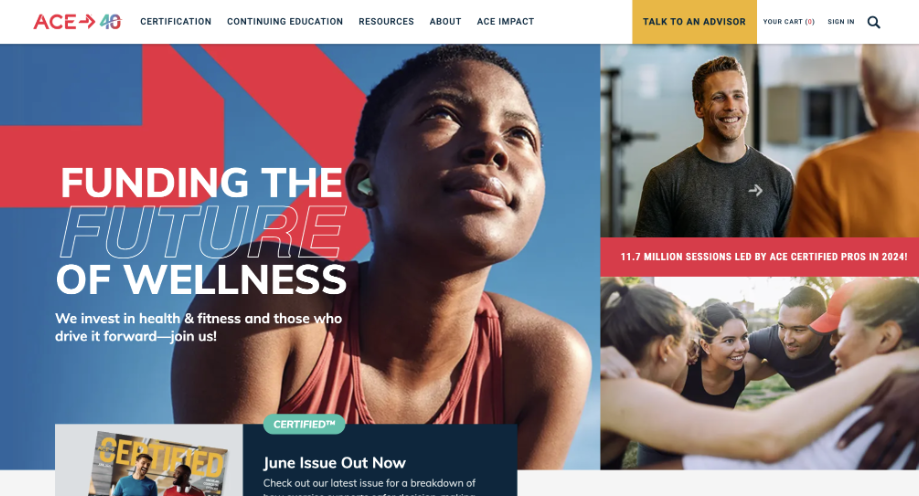
ACE has been around since 1985 and runs as a nonprofit, which shapes its programs in ways that feel noticeably different from for-profit providers. Its four main certifications cover Personal Trainer, Group Fitness Instructor, Health Coach, and Medical Exercise Specialist, layered with specialist programs in senior fitness, sports nutrition, and behavior change. With roughly 90,000 certified professionals across six continents, the reach is global. NCCA accreditation across its main certifications puts it firmly in the recognized-and-respected category for most gym hiring managers.
Why pick ACE?
ACE fills a gap for trainers who want more than one credential pathway without switching providers for every specialization. Its four-decade track record as a nonprofit means the focus stays on professional development rather than upselling the next product.
The review roundup
ACE earned recognition as a 2026 Best and Brightest Company to Work For, both in Southern California and nationally, plus a 2026 Nation’s Best and Brightest in Wellness award. Its reputation for rigorous, properly accredited certifications holds up well among working professionals. Recognition across both wellness and workplace-culture categories suggests it practices what it teaches.
NSCA — Best for strength and conditioning credentials
What sets NSCA apart?
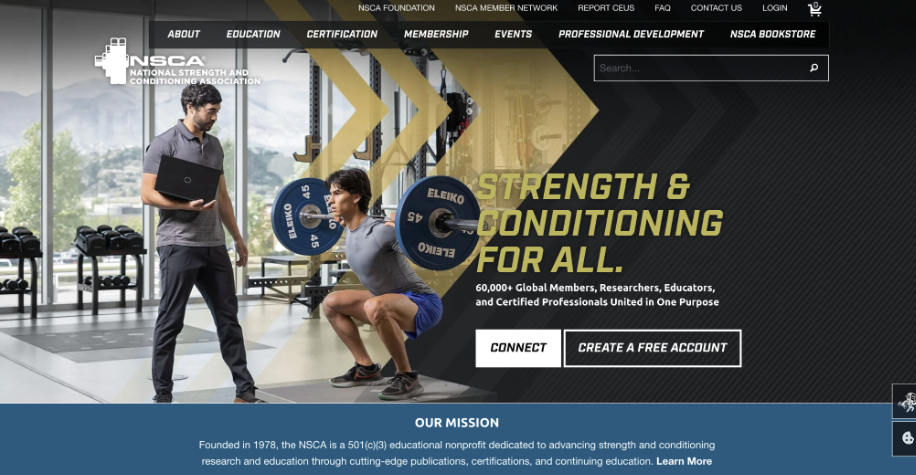
The NSCA has run since 1978 and serves more than 60,000 members globally, making it one of the most established organizations in this space. Its certifications include the CSCS (Certified Strength and Conditioning Specialist), the NSCA-CPT, and more specialized credentials like TSAC-F and CPSS. Beyond exams, it publishes the Journal of Strength and Conditioning Research and the Strength and Conditioning Journal, both peer-reviewed and widely cited. It also runs 25-plus professional development groups and an active coaching podcast, so the learning continues after you pass the exam.
Why pick NSCA?
The NSCA makes the most sense for trainers who want to work in athletic performance settings or take on serious strength-focused clientele. Its research-publication setup means the content behind its certifications stays grounded in current science rather than outdated curriculum.
The review roundup

The NSCA doesn’t lean heavily on public review platforms, but more than 45 years of operation and a 60,000-member global community speak louder than a star rating. Professionals in strength and conditioning treat the CSCS as the standard credential for working with athletes. That peer-driven credibility is built over decades, not quarters.
ACSM — Best for clinical fitness and exercise science settings
What sets ACSM apart?
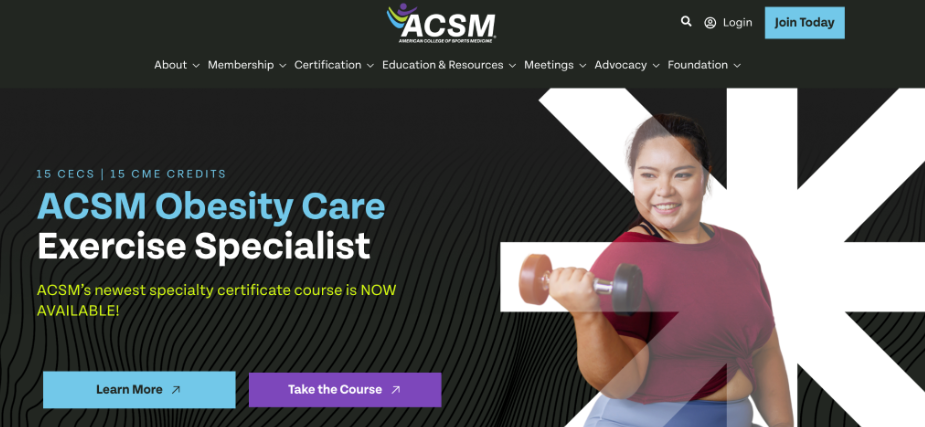
ACSM is the largest sports medicine and exercise science organization in the world, with nearly 50,000 members across six continents and a founding year of 1954. It publishes six peer-reviewed journals and more than 50 books, giving its certification content scientific backing that’s hard to match. Its programs target fitness professionals, personal trainers, exercise physiologists, and health organizations, covering a broader clinical range than most providers. Initiatives like Exercise is Medicine and the American Fitness Index show ACSM operating well beyond the gym floor.
Why pick ACSM?
ACSM is the right fit for trainers who plan to work in clinical, medical, or research-adjacent settings where scientific rigor matters as much as practical skill. The depth of peer-reviewed content behind every certification means you’re learning from a standard that holds up in professional health environments.
The review roundup
ACSM doesn’t generate the consumer-review volume of some newer providers, but its standing in the exercise science community is well established and respected among health professionals. Professionals in hospitals, rehabilitation centers, or university programs consistently point to ACSM credentials as a mark of scientific credibility. That kind of trust takes 70 years to build.
Selection framework: how each pick was evaluated
Data assembly. The research began with a broad list of providers drawn from fitness-specific directories, professional review platforms, and widely referenced industry resources. Official websites were reviewed alongside third-party listings to capture both how each organization presents itself and how practitioners actually experience the programs. The focus was a realistic picture of the market rather than name recognition alone, and programs with limited public documentation or unclear accreditation were flagged early.
Initial filtering. Once the longlist was set, options with unverifiable credentials or thin public review records were removed. Review patterns were analyzed for consistency, not just volume — a high average from a small sample carries different weight than thousands of verified reviews showing the same themes. Programs with strong first-attempt pass-rate signals, clear exam structures, and transparent pricing moved forward; vague claims without supporting detail were filtered out.
Confirming accuracy. Every remaining candidate was cross-checked against its own website and external review sources. Accreditation was checked directly, not assumed from a provider’s self-description. Employer acceptance signals — gym partnership numbers, sports organization adoption — were verified against what each organization published. Claims that appeared inflated or inconsistent with reviewer reports were noted and weighted accordingly.
Industry standing. Each organization’s broader reputation was assessed through awards, editorial mentions, and appearances in recognized publications. Coverage in Forbes, Entrepreneur, or USA Today carries some weight, but peer-reviewed publication records and professional association standing were treated as stronger signals. Organizations with decades of operation and active professional communities scored higher than newer entrants with strong marketing but shorter track records.
Real-world evidence. The final filter examined concrete evidence of outcomes: dedicated program pages with clear curriculum detail, verified student reviews describing specific exam and career experiences, and case studies or outcome data where available. Certifications backed by job assurance programs, structured continuing education, or documented employer partnerships scored well. The goal was to confirm each pick delivers results actual trainers can point to, not just a credential that looks good on paper.
Choosing the right certification: a quick guide
Choosing a certification involves more than selecting a familiar name. Your career goals, budget, study preferences, and target clients should all shape the decision. Official provider information should guide your research, while videos can add context through program comparisons, exam-preparation overviews, trainer career advice, and personal trainer certification guidance focused on the available options.
- Track record. Look for certifying organizations with a long history and active professional communities. Newer providers may offer attractive pricing, but employer acceptance favors established histories.
- Features and services. Consider what comes with the certification beyond the exam — study materials, practice tests, continuing education access, and career tools all affect total value.
- Pricing. Factor in the full cost, not just the exam fee. Study materials, renewals, and CEU requirements add up over time. Some providers offer payment plans or bundled pricing that ease the upfront cost.
- Results. First-attempt pass rates and employer acceptance percentages are the most useful metrics. A strong pass rate means the prep materials actually match the exam content.
- Compliance. NCCA accreditation is the U.S. standard to look for. It shows employers the certification was earned through a rigorous, independently verified process.
Wrapping up
Choosing from the best personal training certifications is less about prestige and more about fit. NASM and ACE offer broad employer acceptance and strong accreditation standing. NSCA and ACSM serve professionals moving into performance or clinical settings. IPTA stands out for aspiring trainers who need structured exam prep with real career support built in. As fitness careers grow more specialized, the certifications that combine scientific rigor with practical career tools will keep holding the most long-term value.
References
1. PT Pioneer. https://www.ptpioneer.com/personal-training/certifications/best-personal-trainer-certification-guide/
2. Trainer Academy (IPTA). https://traineracademy.org/certifications/personal-trainer-certification/
3. The Healthy. https://www.thehealthy.com/exercise/how-to-become-a-personal-trainer-according-to-experts/
4. Research.com. https://research.com/careers/how-to-become-a-certified-personal-trainer-in-2026-education-certifications-salary-and-career-outlook
5. Trainerize. https://www.trainerize.com/blog/best-personal-trainer-certification/
6. Insure Fitness. https://insurefitness.com/best-personal-trainer-certifications/