

The bench press is one of the most popular strength exercises in the world, yet many lifters eventually hit a plateau. Often, the limiting factor is not chest strength or shoulder stability. Instead, it is the triceps. Strong triceps are responsible for locking out heavy presses, maintaining bar speed, and stabilizing the elbow under heavy loads.
Among powerlifters, one exercise has developed an almost legendary reputation for building bench pressing strength. That exercise is the JM Press.


Originally popularized by elite powerlifter JM Blakley, the JM Press combines elements of the close grip bench press and the lying triceps extension into a unique movement that allows heavy loading while emphasizing the triceps. Many of the world’s strongest bench press athletes have included it in their training.
But does science support its reputation? Is the JM Press really one of the best exercises for building stronger triceps and improving the bench press? The answer is more nuanced than a simple yes or no.
Why the Triceps Matter in the Bench Press
The bench press relies on coordinated force production from the pectoralis major, anterior deltoids, and triceps brachii. Each muscle contributes differently throughout the lift.
During the lower portion of the movement, the chest performs much of the work. As the bar approaches the sticking point, elbow extension becomes increasingly important. This is where the triceps become the primary driver.
Is the Floor Press the Perfect Bench Press Alternative for Stronger Pecs?
Biomechanical analyses have consistently shown increasing triceps involvement as the elbows extend during the final half of the lift. Lifters who struggle near lockout often benefit more from improving triceps strength than from simply adding more chest work.
Research examining muscle activation during bench pressing demonstrates that both the medial and lateral heads of the triceps are highly active throughout the movement, particularly when heavier loads are used. Stronger triceps allow athletes to accelerate the bar through the sticking region while maintaining efficient technique. This is why nearly every successful powerlifting program includes dedicated triceps accessory work.
What Exactly Is the JM Press?
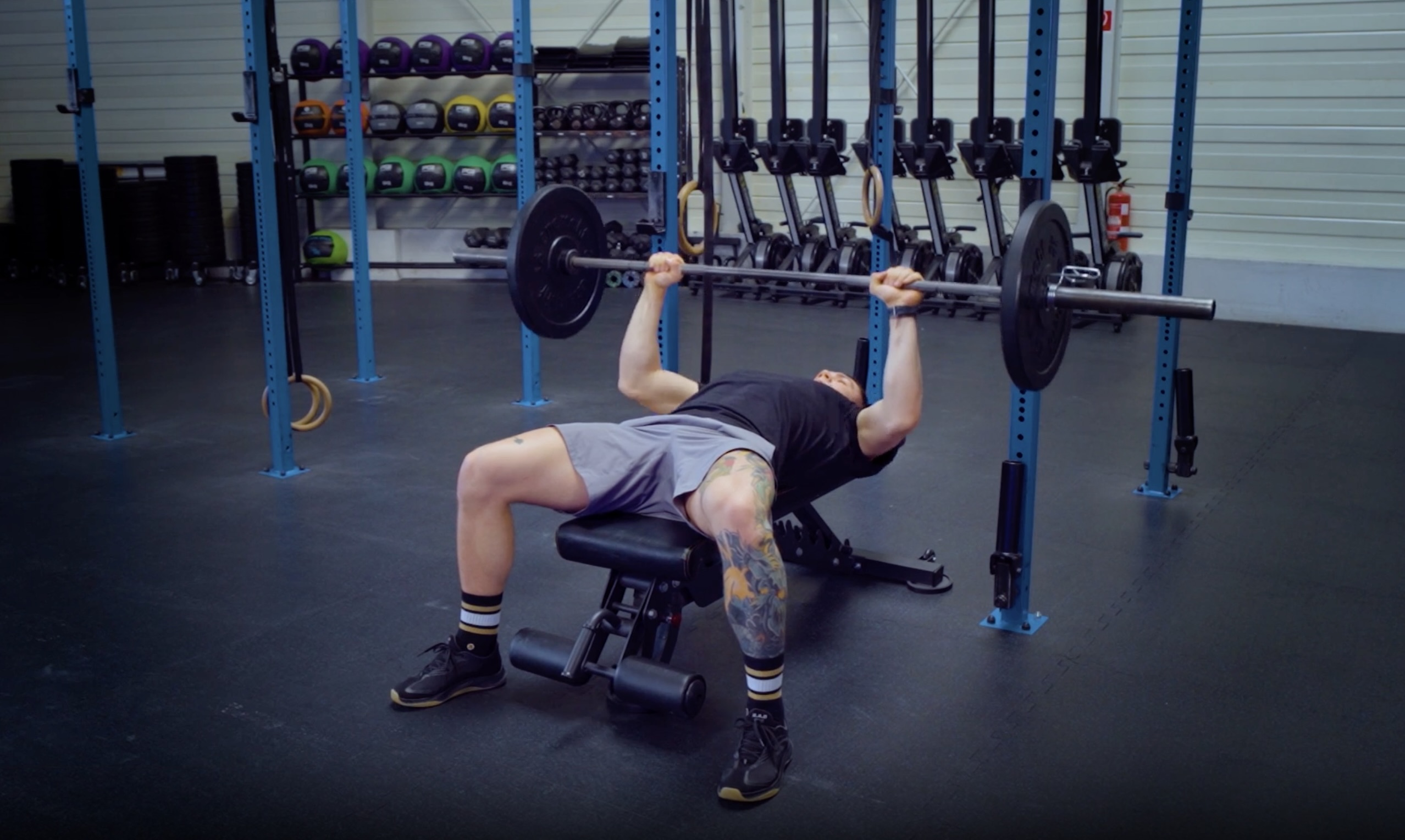
The JM Press sits somewhere between a close grip bench press and a skull crusher. Instead of lowering the bar toward the chest or forehead, the athlete lowers it toward the upper neck or chin while allowing the elbows to move slightly forward. The forearms stay relatively vertical while the elbows bend deeply.
The movement is then reversed by forcefully extending the elbows without allowing the shoulders to dominate the lift. Unlike skull crushers, the shoulders contribute slightly to the movement. Unlike close grip bench presses, elbow extension remains the primary focus.
This unique combination allows significantly heavier loads than most traditional triceps isolation exercises while maintaining a high emphasis on elbow extension.
Why Powerlifters Love the JM Press
Powerlifters judge exercises by one simple question. Does it increase the competition lift?
The JM Press has earned its reputation because it closely mimics the joint angles and movement patterns found in the bench press while specifically targeting one of its weakest links. Elite bench pressers frequently report that improvements in JM Press strength carry over directly to lockout performance.
While anecdotal evidence should never replace scientific research, it often provides valuable insight into training practices that later become supported by evidence. The widespread use of the JM Press among elite powerlifters suggests that it fills an important training role.
The Science of Triceps Hypertrophy
To understand whether the JM Press deserves its reputation, it helps to examine what drives muscle growth.
Research consistently shows that mechanical tension is the primary stimulus for hypertrophy. Exercises that expose muscles to high levels of tension across a meaningful range of motion generally produce greater growth.
The triceps consist of three heads.
- The long head crosses both the shoulder and elbow joints.
- The lateral head contributes heavily to force production during pressing.
- The medial head remains active throughout nearly every elbow extension task.
Because the JM Press allows heavy loading while placing the elbow through substantial flexion and extension, it creates high mechanical tension across all three heads, particularly the medial and lateral portions.
Studies comparing resistance training exercises consistently show that heavier compound style movements often produce similar or greater hypertrophy than lighter isolation exercises when total training volume is matched.
This is one reason why many strength coaches favor exercises like close grip bench presses, weighted dips, and JM Presses over endless sets of cable pushdowns.
What Research Says About Bench Press Assistance Exercises
No large scientific trial has specifically compared the JM Press with every other triceps exercise. However, several studies provide indirect evidence.
Research investigating resistance training specificity consistently demonstrates that exercises closely resembling the target lift produce greater strength transfer than unrelated movements.
The JM Press shares several characteristics with the bench press.
- The athlete remains in the same body position.
- The shoulders remain relatively fixed.
- Heavy loads can be used safely.
- The elbows extend under high force.
These similarities increase the likelihood of positive transfer according to the principle of specificity.
Research examining powerlifting accessory exercises also emphasizes that strengthening muscles through similar movement patterns improves performance more effectively than relying solely on isolated bodybuilding movements.
How the JM Press May Improve Bench Press Performance
Better Lockout Strength
Many failed bench press attempts occur during the final third of the movement. Improving triceps force production helps overcome this sticking point. Since the JM Press emphasizes heavy elbow extension under bench press specific conditions, it directly trains the muscles responsible for completing the lift.
Increased Triceps Size
Muscle cross sectional area remains one of the strongest predictors of strength potential. Larger triceps generally possess greater capacity for force production. The heavy loading possible during the JM Press makes it an effective hypertrophy exercise while also improving neural adaptations associated with maximal strength.
Improved Motor Coordination
Strength is not determined solely by muscle size. Efficient coordination between muscles also matters.
Practicing movement patterns that resemble the competition lift reinforces motor learning and improves force production. Because the JM Press resembles the upper portion of the bench press, it may reinforce effective pressing mechanics.
How to Perform the JM Press Correctly
Technique determines whether the exercise becomes a powerful strength builder or an uncomfortable elbow exercise.
- Lie on a flat bench with a moderate grip slightly narrower than normal bench press width.
- Unrack the bar and position it over the upper chest.
- Instead of lowering the bar to the chest, bend the elbows while allowing them to travel slightly forward.
- Lower the bar toward the area between the chin and upper chest.
- The wrists should stay stacked over the forearms while the elbows remain tucked.
- Pause briefly before driving the bar upward by extending the elbows.
The movement should feel like a triceps extension performed with much heavier weight rather than a close grip bench press. The shoulders should remain relatively quiet throughout the exercise.
Who Should Use the JM Press?
The JM Press works particularly well for intermediate and advanced lifters seeking to improve pressing strength. Competitive powerlifters often benefit the most because bench press specificity is especially valuable.
Bodybuilders can also use the exercise to increase overall triceps mass while exposing the muscles to heavier loading than many isolation movements. Athletes involved in football, rugby, wrestling, and throwing sports may also benefit from stronger elbow extensors developed through heavy accessory pressing.
Complete beginners may be better served by first mastering conventional pressing patterns before introducing the more technical JM Press.
Is It the Perfect Triceps Exercise?
No exercise is truly perfect. Individual anatomy, injury history, limb proportions, and training goals all influence exercise selection.
However, the JM Press checks nearly every box for athletes focused on bench press strength.
- It allows heavy loading.
- It emphasizes elbow extension.
- It closely resembles the bench press.
- It develops the triceps through meaningful ranges of motion.
- It follows the scientific principle of specificity.
While exercises such as close grip bench presses, dips, and overhead extensions all deserve a place in many programs, the JM Press occupies a unique middle ground that few other exercises replicate. For lifters whose bench press stalls at lockout, it may be one of the most valuable accessory exercises available.
Final Thoughts
The JM Press has survived decades of popularity because it consistently delivers results for serious strength athletes.
Although direct scientific research on the exercise itself remains limited, the principles supporting its effectiveness are well established. Heavy mechanical tension, movement specificity, progressive overload, and targeted triceps development all contribute to stronger pressing performance.
If your goal is building a bigger bench press, stronger triceps, and improved lockout strength, the JM Press deserves serious consideration. When performed with good technique and sensible programming, it offers an excellent blend of strength development and muscle growth that few accessory exercises can match.
Key Takeaways
| Topic | Main Point |
|---|---|
| Primary Benefit | Builds triceps strength that transfers well to the bench press |
| Main Muscles | Triceps brachii with secondary involvement of the chest and shoulders |
| Best For | Intermediate and advanced lifters seeking a stronger bench press |
| Recommended Repetitions | 6 to 10 for strength and hypertrophy, 8 to 12 for additional muscle growth |
| Training Frequency | One to two sessions per week |
| Greatest Advantage | Excellent carryover to lockout strength through movement specificity |
| Biggest Mistake | Turning the exercise into a close grip bench press by lowering the bar to the chest |
| Scientific Support | Based on principles of specificity, mechanical tension, and progressive overload supported by resistance training research |
References
- Ahtiainen, J.P., Pakarinen, A., Alen, M., Kraemer, W.J. and Häkkinen, K. (2003). Muscle hypertrophy, hormonal adaptations and strength development during strength training in strength trained and untrained men. European Journal of Applied Physiology, 89(6), pp.555 to 563.
- Andersen, V., Fimland, M.S., Brennset, O., Haslestad, L.R., Lundteigen, M.S., Skalleberg, K., Saeterbakken, A.H. and Raastad, T. (2014). Muscle activation and strength in bench press exercises with different barbell grips. Journal of Strength and Conditioning Research, 28(11), pp.3036 to 3042.
- Bird, S.P., Tarpenning, K.M. and Marino, F.E. (2005). Designing resistance training programmes to enhance muscular fitness. Sports Medicine, 35(10), pp.841 to 851.
- Gentil, P., Soares, S., Bottaro, M., Rocha Júnior, V.A. and Oliveira, E. (2015). Single versus multi joint resistance exercises for muscle strength and hypertrophy. Sports Medicine, 45(6), pp.841 to 851.
- Król, H. and Gołaś, A. (2017). Effect of barbell weight on the structure of the flat bench press. Journal of Human Kinetics, 60, pp.51 to 62.
- Schoenfeld, B.J. (2010). The mechanisms of muscle hypertrophy and their application to resistance training. Journal of Strength and Conditioning Research, 24(10), pp.2857 to 2872.
- Schoenfeld, B.J., Ogborn, D. and Krieger, J.W. (2017). Strength and hypertrophy adaptations between low versus high load resistance training. Journal of Strength and Conditioning Research, 31(12), pp.3508 to 3523.
- Suchomel, T.J., Nimphius, S. and Stone, M.H. (2016). The importance of muscular strength in athletic performance. Sports Medicine, 46(10), pp.1419 to 1449.
- Van den Tillaar, R. and Ettema, G. (2013). A comparison of successful and unsuccessful attempts in maximal bench pressing. Medicine and Science in Sports and Exercise, 45(9), pp.1742 to 1748.
- Wernbom, M., Augustsson, J. and Thomeé, R. (2007). The influence of frequency, intensity, volume and mode of strength training on whole muscle cross sectional area in humans. Sports Medicine, 37(3), pp.225 to 264.