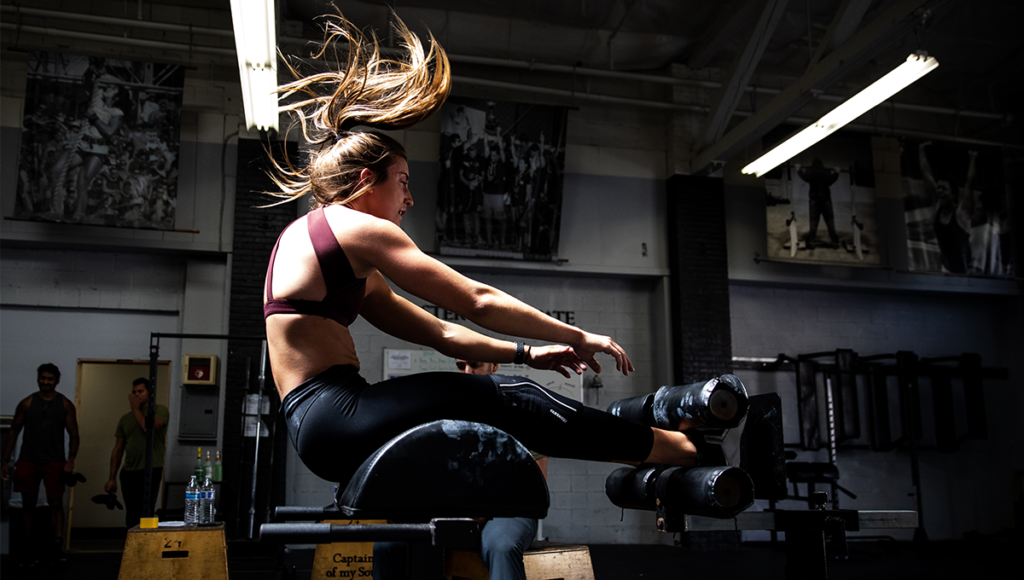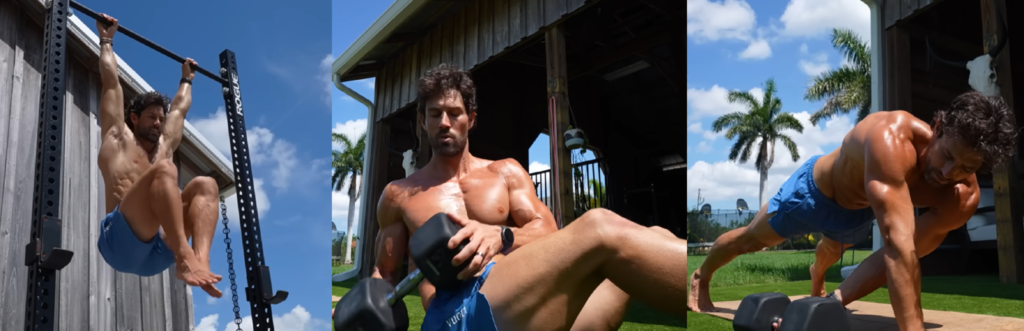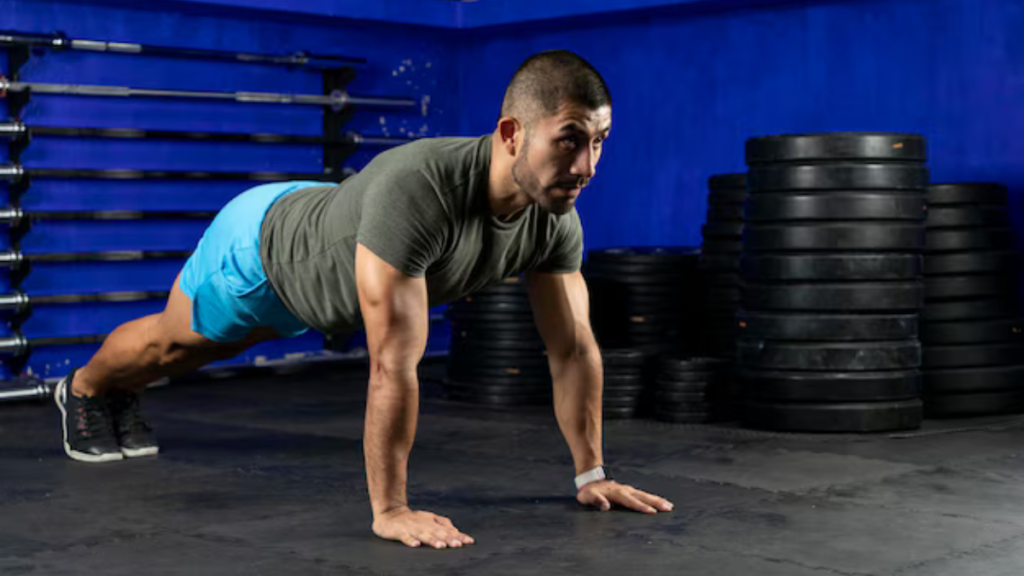


The suitcase carry is simple: pick up one heavy dumbbell or kettlebell, hold it by your side, and walk with control. It may not look like a traditional abdominal exercise, but it asks your core to do one of its most important jobs: resist unwanted movement while your arms and legs work.
That makes it a smart addition to a training plan for anyone who wants a stronger, more capable midsection. It trains the trunk under load, challenges grip strength, demands upright posture, and carries over well to the way the body handles uneven loads in sport and daily life. The exercise will not reveal a six pack by itself, because abdominal definition primarily depends on low enough body fat as well as muscular development. However, it can build the strength and control that sit underneath visible abs.


The important question is not whether the suitcase carry is magical. No single movement deserves that label. The better question is whether it provides a core challenge that many common ab exercises miss. For many lifters, the answer is yes.
What Is the Suitcase Carry?
A suitcase carry is a loaded walk performed with weight in one hand only. The load hangs at your side, much like carrying a suitcase. You walk slowly while trying to keep your shoulders level, ribs stacked over the pelvis, and torso tall.
The asymmetrical load creates a sideways pulling force on the trunk. Your body must generate muscular tension to prevent the spine from bending toward the weight or rotating as you walk. This is why the exercise is often described as an anti lateral flexion exercise. In plain language, you are training the core to stay strong and square when a load tries to pull you out of position.
This challenge involves more than the rectus abdominis, which is the muscle most people associate with a six pack. The obliques, deep abdominal muscles, spinal erectors, hip muscles, shoulder stabilizers, and grip muscles all contribute to keeping you upright and moving smoothly.
Why the Core Needs More Than Crunches
Crunches and situps train trunk flexion. They can be useful when programmed appropriately, but the core does far more than bend the spine forward. During running, lifting, jumping, changing direction, and carrying objects, the trunk often needs to resist movement so force can transfer efficiently between the lower and upper body.
Research on trunk stability has emphasized the value of training the trunk in functional positions, particularly when force production and postural control are required at the same time. Standing free weight exercises can place meaningful demands on core musculature because the athlete must control the torso while producing force through the limbs.
Best 3 Kettlebell Exercises for Beginners to Get a Jacked Upper Body
The suitcase carry fits this concept well. It does not ask you to repeatedly curl your torso. Instead, it challenges you to maintain alignment while walking under an uneven load. That makes the exercise especially relevant for people whose sport or training already involves standing, moving, and handling resistance.
A systematic review and meta analysis also found that core training can improve dynamic balance stability. This does not mean that a suitcase carry alone guarantees better balance, but it supports the broader idea that strengthening the trunk can improve the body’s ability to control movement.
Anti Movement Strength Matters
Strong abs are not only about producing movement. They are also about resisting it. In a suitcase carry, the weight creates a moment that tries to bend the torso sideways. The trunk muscles respond by producing force on the opposite side and by coordinating tension around the spine.
Studies of trunk muscle activity during loading tasks show that the direction and magnitude of the external load influence how trunk muscles are recruited. This is a key reason unilateral loading feels so different from holding equal weights in both hands. The body has to solve an uneven stability problem.
Walking adds another layer. Every step creates a small shift in the body’s center of mass. The core has to react repeatedly while the hips and shoulders move. The goal is not to freeze the entire body. The goal is controlled movement in the right places, with the trunk remaining organized rather than collapsing or swaying.
What Science Can and Cannot Say About the Exercise
There is a reasonable scientific case for suitcase carries, but accuracy matters. Direct research on the exact gym version of the suitcase carry is limited compared with research on planks, crunches, or rehabilitation exercises. Therefore, claims that it is definitively the best core exercise would go beyond the available evidence.
What research does support is the underlying training logic. Uneven external loads alter trunk muscle activation and postural demands. Load carriage changes the way the trunk and lower body work during walking. Core training can improve measures of dynamic balance. Standing exercises with free weights can be useful for developing core strength and power because they combine instability with meaningful force production.
That is enough to make the suitcase carry a highly practical exercise. It is not enough to claim that it is perfect for every person or superior to every other abdominal exercise.
Electromyography studies can help identify whether a muscle is active during an exercise, but they do not directly prove muscle growth, strength gains, athletic transfer, or injury prevention. Muscle activation is only one piece of the training puzzle. Progressive loading, exercise technique, recovery, total program design, and individual tolerance all matter.
How the Suitcase Carry Trains Your Midsection
The strongest feature of the suitcase carry is its combination of tension and movement. Your core is working continuously while you walk, yet the exercise is easy to scale. You can adjust the weight, distance, pace, and rest period without changing the basic movement pattern.
The obliques are particularly important because they help control side bending and rotation. The deeper abdominal muscles contribute to trunk stiffness and pressure management. The spinal erectors help maintain an upright torso. The muscles around the hips work to keep the pelvis from dropping or shifting excessively with each step.
This whole body contribution is useful because the trunk does not operate in isolation. A carry requires coordination from the hand holding the weight all the way through the feet pushing into the floor. The grip must secure the handle, the shoulder must remain organized, the trunk must resist the pull of the load, and the legs must continue to produce a steady walking pattern.
Grip and Posture Are Part of the Benefit
The suitcase carry also challenges grip endurance. Grip strength matters for many barbell, dumbbell, kettlebell, climbing, and contact sport tasks. A fatigued grip can limit heavier carrying work, so it is sensible to progress patiently rather than choosing a load that turns every set into a grip test.
Posture is another benefit, although it is important to define this carefully. The exercise does not force a single rigid posture for every body. Instead, it teaches the ability to maintain a generally upright trunk and stable rib cage while carrying resistance. A successful repetition should look controlled, not stiff, tilted, or tense through the neck.
How to Perform the Suitcase Carry
Start with a dumbbell or kettlebell that feels moderately challenging but does not force you to lean. Place it beside one foot, hinge down with control, grip the handle firmly, and stand up as you would for a deadlift. Let the load hang close to your side.
Before you take the first step, gently brace your trunk as if preparing to be bumped. Keep your ribs positioned over your pelvis, look straight ahead, and allow the free arm to swing naturally or hold it quietly by your side. Walk with short, smooth steps. Your shoulders should remain as level as possible, and your hips should not shift dramatically away from the load.
Turn around carefully, then repeat on the other side. Equal work on both sides is the simplest approach for most people. Stop the set when posture changes substantially, grip fails, or the load pulls you into a visible side bend.
Common Mistakes
The most common mistake is choosing a load that is too heavy. If you lean away from the weight, hike one shoulder, or take exaggerated steps, the exercise has become a compensation drill rather than a trunk training drill. Reduce the load and regain control.
Another mistake is holding the breath for the entire distance. Bracing is useful, but controlled breathing is still important. Try to maintain abdominal tension while taking steady breaths. This is a skill that develops with practice.
Avoid rushing. Fast walking can be appropriate for advanced athletes with excellent control, but a slower pace makes it easier to notice whether the trunk is drifting. Quality should come before speed or distance.
How to Program It for Stronger Abs
For general strength training, begin with two or three sets per side of 20 to 40 seconds of controlled walking. Rest long enough that your grip and posture recover, then repeat. Choose a load that makes the final seconds demanding while preserving a tall, stable position.
As you improve, increase only one variable at a time. You can add a little weight, walk farther, extend the carry time, or reduce rest. Gradual progression is more reliable than making several changes at once.
The suitcase carry works well after heavy lower body lifting, at the end of an upper body session, or as part of a brief conditioning circuit. It also pairs well with exercises that train other trunk functions, such as planks, dead bugs, controlled rotation work, and compound lifts. A complete core program should include varied movement demands rather than relying on one exercise.
If you have current back pain, a shoulder injury, balance limitations, or symptoms that worsen with loaded walking, seek individualized guidance from a qualified health professional before adding heavy carries.
Is It the Perfect Six Pack Exercise?
The suitcase carry is not a shortcut to visible abs, and it is not objectively perfect. A defined six pack requires appropriate nutrition, sufficient resistance training, and individual body composition changes. No core exercise can selectively remove abdominal fat.
Still, it may be one of the best overlooked exercises for building a useful, resilient core. It trains the midsection to resist sideways bending and rotation, gives the grip and shoulders productive work, and develops control while walking under load. Those qualities make it more than an ab exercise.
If your current core training is mostly crunches and long plank holds, the suitcase carry adds a missing dimension. It is simple, measurable, and challenging without being complicated. Pick a manageable weight, walk tall, train both sides, and let good technique determine the load.
Key Takeaways
| Topic | Key takeaway |
|---|---|
| Core demand | The uneven load challenges the trunk to resist side bending and rotation while walking. |
| Six pack expectations | The exercise can strengthen the abdominal muscles, but visible abs depend largely on body composition and total training. |
| Main muscles involved | The obliques, deep abdominal muscles, spinal erectors, hips, shoulders, and grip all contribute. |
| Starting dose | Use two or three controlled sets per side of 20 to 40 seconds. |
| Best technique cue | Walk tall with level shoulders, steady breathing, and no visible lean away from the weight. |
| Progression | Add weight, distance, time, or reduce rest gradually while preserving position. |
| Important limit | Direct research on the exact suitcase carry is limited, so it should be viewed as a valuable tool rather than a proven perfect exercise. |
References
- Barrio, E.D., Ramirez Campillo, R., Garcia de Alcaraz Serrano, A. and Hernandez García, R. (2022) ‘Effects of core training on dynamic balance stability: A systematic review and meta analysis’, Journal of Sports Sciences, 40(16), pp. 1815–1823.
- Callaghan, J.P., Patla, A.E. and McGill, S.M. (1999) ‘Low back three dimensional joint forces, kinematics, and kinetics during walking with different carried loads’, Clinical Biomechanics, 14(5), pp. 324–330.
- Cholewicki, J., Panjabi, M.M. and Khachatryan, A. (1997) ‘Stabilizing function of trunk flexor extensor muscles around a neutral spine posture’, Spine, 22(19), pp. 2207–2212.
- McGill, S.M. (2010) ‘Core training: Evidence translating to better performance and injury prevention’, Strength and Conditioning Journal, 32(3), pp. 33–46.
- Willardson, J.M. (2007) ‘Core stability training: Applications to sports conditioning programs’, Journal of Strength and Conditioning Research, 21(3), pp. 979–985.
- Willson, J.D., Dougherty, C.P., Ireland, M.L. and Davis, I.M. (2005) ‘Core stability and its relationship to lower extremity function and injury’, Journal of the American Academy of Orthopaedic Surgeons, 13(5), pp. 316–325.