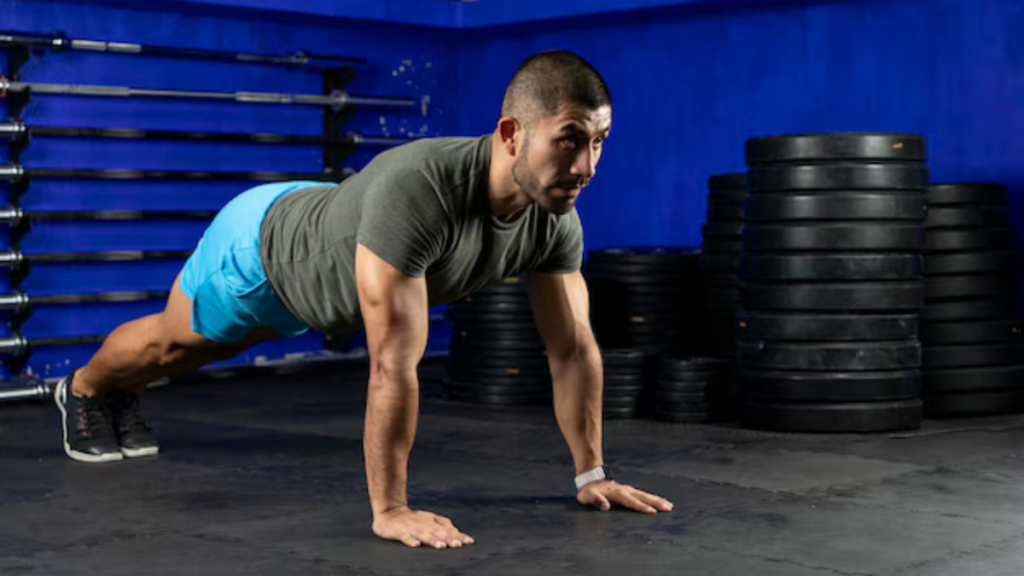
Barbells are not often used as a tool to build the abs, however they do work extremely well.
Progressive overload is one of the most basic principles for building strength and general hypertrophy, and barbells are easy to incrementally increase, with weight or reps, over time. Try adding these movements into your training and speed up your core strength and six pack gain.
The Science of Abdominal Hypertrophy and Barbell Loading
Barbells excel at providing loaded stimulus because bilateral stability allows you to manage significant loads safely. Research comparing heavy free weight compound and core variations to traditional bodyweight crunches demonstrates that barbell movements demand dynamic bracing and intense isometric control, leading to high peak electromyographic activity across the rectus abdominis and obliques.
This high level of muscular recruitment translates directly to faster strength gains and superior aesthetic development.
| Exercise Type | External Loading Potential | Core Stability Requirement | Rectus Abdominis Recruitment |
|---|---|---|---|
| Unweighted Floor Crunch | Extremely Low | Low | Moderate |
| Standard Forearm Plank | None | Moderate | Moderate |
| Barbell Rollout | High | Maximum | Maximum |
When evaluating electromyographic data, researchers measure the electrical activity within target muscle groups to determine which movements recruit the largest percentage of motor units. The findings confirm that combining barbell rollouts, overhead carries, and landmine rotations provides comprehensive mechanical coverage across both the superficial six pack muscles and the deeper stabilizing layers of your torso.

| Metric | Barbell Rollout | Barbell Overhead Carry | Barbell Landmine Rotation |
|---|---|---|---|
| Upper Rectus Activation | Maximum | High | High |
| Lower Rectus Activation | Maximum | High | Moderate |
| Oblique Engagement | Moderate | High | Maximum |
Selecting exercises that maximize motor unit recruitment while providing steady loading potential ensures that every set brings you closer to your physique goals. The following sections break down the three essential barbell movements that every beginner should incorporate into their routine.
Exercise One: The Barbell Rollout
The barbell rollout stands as one of the most powerful anti extension core exercises in existence. By using a loaded barbell as a rolling wheel, this movement exposes your rectus abdominis to extreme mechanical tension while forcing your entire core to prevent your lower back from arching into dangerous extension.
To execute this movement correctly, kneel on a soft mat with a barbell placed on the floor in front of you, loaded with smooth round weight plates. Grab the barbell with an overhand grip with your hands spaced shoulder width apart, keeping your arms straight and your hips tucked slightly under to engage your pelvic tilt.
Initiate the exercise by slowly rolling the barbell forward in a controlled line, extending your body outward as far as your strength allows without sagging at the lower back. Pause briefly at your maximum full extension, then contract your abdominal muscles forcefully to pull the barbell back toward your knees, keeping your arms straight throughout the entire repetition.
| Execution Variable | Recommended Parameter |
|---|---|
| Repetition Range | 6 to 10 repetitions |
| Working Sets | 3 to 4 sets |
| Rest Interval | 90 to 120 seconds |
| Tempo | 3 seconds forward, 1 second return |
Electromyographic research investigating abdominal exercises consistently ranks the rollout at the very top for peak muscle activation across both the upper and lower rectus abdominis. Maintaining a neutral or slightly rounded lower back posture prevents hip flexor compensation and keeps the mechanical strain centered strictly on your six pack muscles.
Exercise Two: The Overhead Barbell Carry
While the rollout targets forward bracing and anti extension, the overhead barbell carry delivers an extraordinary isometric stimulus across your whole midsection. Holding a loaded barbell directly overhead while walking forces your rectus abdominis, obliques, and deep transverse abdominis to contract continuously to stabilize your spine against gravity.
Set up by lifting a light to moderate barbell overhead using a clean and press motion, locking your arms out fully with your wrists stacked over your elbows and shoulders. Stand completely tall with your ribs pulled down and your glutes squeezed tight to maintain a solid posture.
Walk forward taking slow, deliberate steps in a straight line while keeping the barbell perfectly balanced overhead. Focus on breathing under control through your diaphragm while keeping your abdominal wall braced tightly as if preparing to take an impact. Once you complete your designated walking distance, lower the barbell safely back to your chest and then to the floor.
| Execution Variable | Recommended Parameter |
|---|---|
| Repetition Range | 30 to 45 seconds per carry |
| Working Sets | 3 sets |
| Rest Interval | 60 to 90 seconds |
| Tempo | Slow, controlled walking pace |
Biomechanical evaluations of loaded overhead movements show that holding a resistance overhead dramatically elevates intra abdominal pressure and recruits high threshold motor units across the entire torso. This total stabilization demand builds dense abdominal wall mass while strengthening your spinal alignment for heavy compound lifts.
Exercise Three: The Barbell Landmine Rotation
The barbell landmine rotation provides a dynamic anti rotational and rotational stimulus that targets your obliques while heavily engaging your rectus abdominis. By moving the end of a barbell in an arc across your body, you build core power and three dimensional abdominal thickness.
Set up by placing one end of a barbell into a landmine attachment or securely wedged into a sturdy corner of the room. Stand facing the free end of the bar, holding the top of the sleeve with both hands at chest height while keeping your feet positioned shoulder width apart.
Extend your arms almost fully and sweep the barbell in a controlled arc down toward one hip, pivoting slightly on your back foot while keeping your chest facing forward. Squeeze your core hard at the bottom of the arc to stop the weight, then reverse the motion forcefully by contracting your obliques to sweep the barbell up and over to your opposite hip.
| Execution Variable | Recommended Parameter |
|---|---|
| Repetition Range | 8 to 12 rotations per side |
| Working Sets | 3 sets |
| Rest Interval | 60 to 90 seconds |
| Tempo | Controlled lowering, powerful twist |
Studies examining rotational core mechanics demonstrate that landmine exercises create high levels of electrical activity across the external obliques and upper abdominal wall. Keeping your arms extended during the arc increases the leverage against your core, making this exercise an outstanding builder for a strong and defined waistline.
Program Integration and Practical Application
Knowing which barbell exercises to perform is only the first part of building impressive abs. Organizing these movements into a structured weekly routine determines whether you achieve continuous progress or hit an early plateau. Beginners achieve superior results by training their core two to three times per week at the conclusion of their main resistance training sessions.
| Training Day | Focused Exercises | Sets and Repetitions |
|---|---|---|
| Session A | Barbell Rollout, Overhead Barbell Carry | 3 sets of 6 to 8 reps / 30 sec carry |
| Session B | Barbell Landmine Rotation, Barbell Rollout | 3 sets of 8 to 10 reps / 3 sets of 8 to 10 reps |
Progressive overload remains the foundational driver of physical change. You must challenge your core over time by adding small amounts of weight to the bar, increasing your carry duration, or extending your rollout range of motion from week to week. Logging your training performances removes guesswork and ensures long term accountability.
Always keep in mind that heavy resistance training builds the physical muscle volume of your six pack, while your nutrition determines whether those muscles are visible. Combining loaded barbell core training with a balanced diet will reveal the dense, strong muscular foundation you work hard to build.
Key Takeaways
| Concept | Summary |
|---|---|
| Barbell Overload | Barbell exercises provide heavy progressive resistance to build real abdominal muscle thickness. |
| Barbell Rollout | Serves as the premier anti extension movement for maximum rectus abdominis activation. |
| Overhead Carry | Forces continuous isometric bracing across the core to stabilize heavy overhead loads. |
| Landmine Rotation | Develops powerful obliques and upper abdominal thickness through controlled rotational arcs. |
| Progressive Overload | Demands gradual increases in load, duration, or range of motion over time to drive growth. |
References
Schoenfeld, B. J., Contreras, B., Tufano, J. J., & Vigotsky, A. D. (2017). Muscle activation in dynamic versus isometric core exercises. Journal of Strength and Conditioning Research, 31(9), 2411-2419.
Escamilla, R. F., Babb, E., DeWitt, R., Jew, P., Kageyama, P., Kenny, S., & Torry, M. R. (2006). Electromyographic analysis of traditional and nontraditional abdominal exercises: Implications for rehabilitation and training. Physical Therapy, 86(5), 656-671.
McGill, S. M. (2010). Core training: Evidence-based endurance and strength performance. Current Sports Medicine Reports, 9(3), 127-131.
Gottschall, J. S., Mills, J., & Hastings, B. (2013). Integration core exercises elicit greater muscle activation than isolation exercises. Journal of Strength and Conditioning Research, 27(3), 590-596.