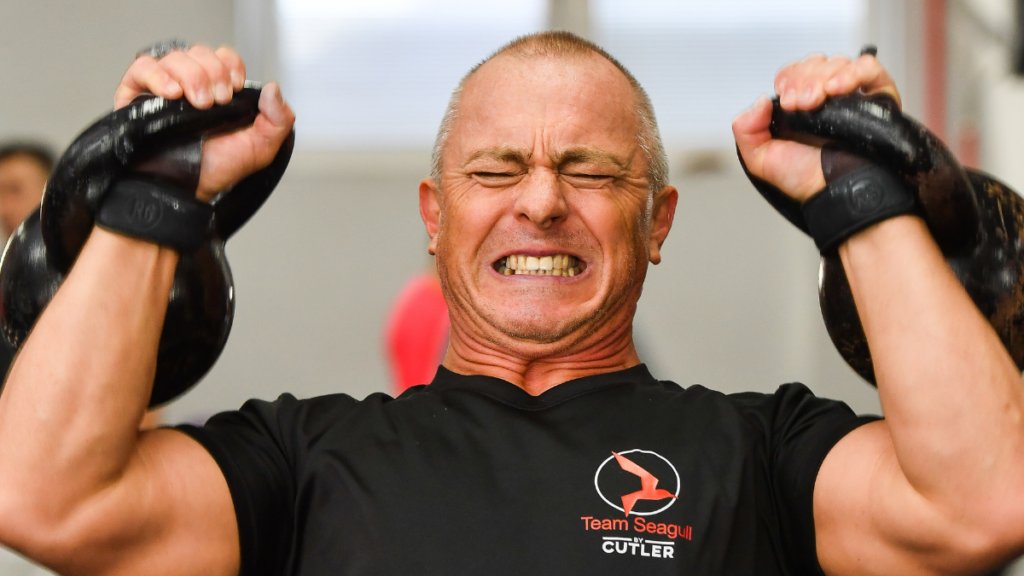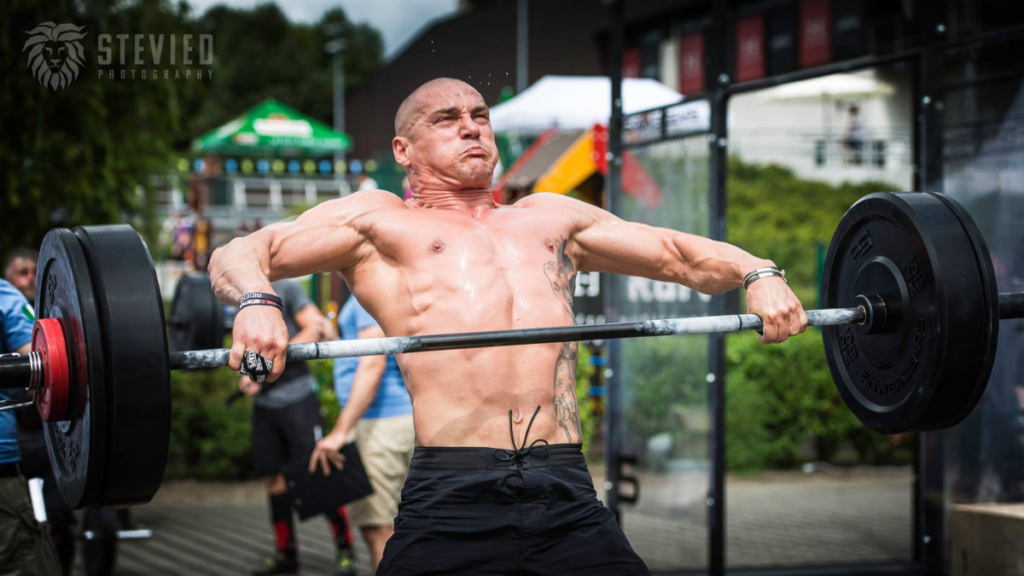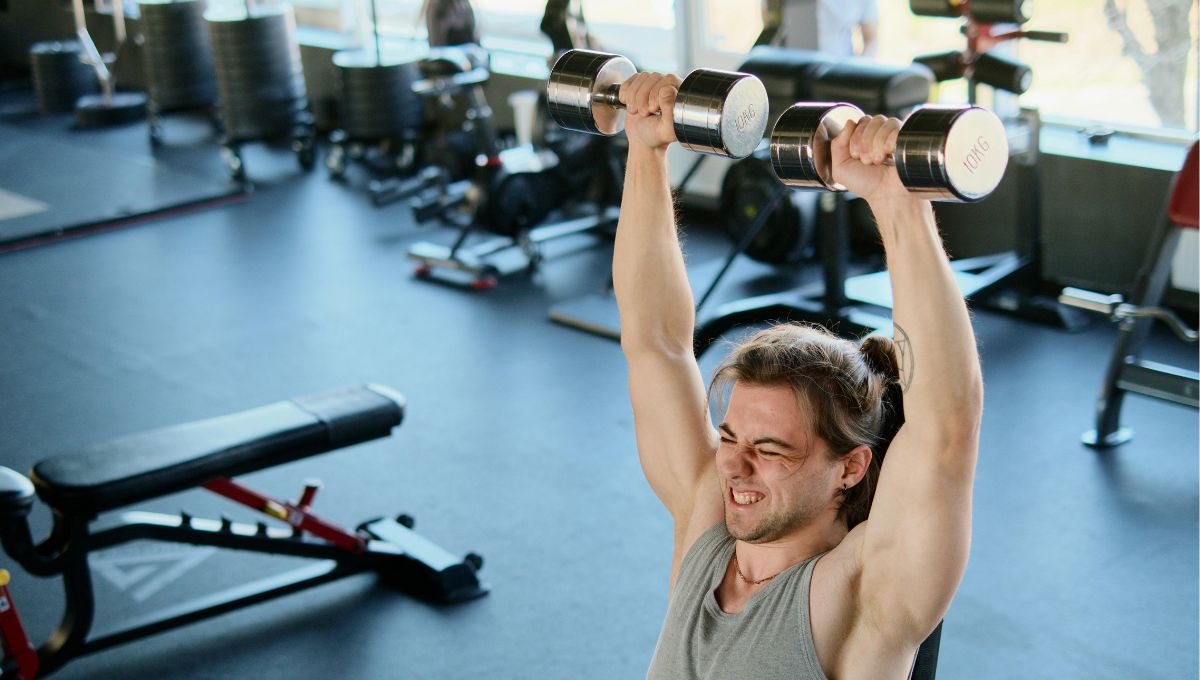


The Arnold press has remained popular for decades because it combines a dumbbell shoulder press with a controlled rotation at the bottom of each repetition. It looks more complex than a conventional dumbbell press, and that complexity can make it feel like a more complete upper body exercise. It can be a valuable movement, but it is not a magic shortcut to bigger arms and shoulders.
The honest answer is that the Arnold press is an excellent shoulder exercise that also challenges the triceps. It can help you build muscular shoulders, improve pressing control, and add useful variety to your training. However, it should not replace direct biceps work if bigger arms are your main goal, and it is not automatically superior to every other overhead press.


What makes it worthwhile is the combination of shoulder flexion, pressing strength, and control through a large comfortable range of motion. When performed well, it gives the front and side regions of the deltoids plenty of work, while the triceps help finish each repetition. For beginners and experienced lifters alike, it can be an effective tool when it fits their mobility, experience, and goals.
What Is the Arnold Press?
The Arnold press is named after Arnold Schwarzenegger, who helped popularize the movement during the golden era of bodybuilding. You begin seated or standing with dumbbells held in front of the shoulders, palms facing toward your body. As you press the dumbbells upward, you rotate the palms away from you until they face forward near the top position. You then reverse the movement under control as the dumbbells return to the start.
The exercise differs from a conventional dumbbell shoulder press because the rotation changes the starting position and adds another coordination demand. A standard dumbbell press usually starts with the palms facing forward or at a slight inward angle. The Arnold press begins with the elbows more in front of the body, then moves gradually into an overhead pressing position.
This does not mean the Arnold press creates completely unique muscle growth. Muscle growth is driven primarily by sufficient mechanical tension, productive training volume, appropriate effort, and progressive overload. Research consistently shows that resistance training can increase muscle size across a range of loading strategies when sets are performed with adequate effort and enough volume is completed over time.
Which Muscles Does the Arnold Press Train?
Deltoids
The deltoid is the large muscle that gives the shoulder its rounded appearance. It has three main regions: anterior, lateral, and posterior. The Arnold press is most likely to emphasize the anterior deltoid, which helps raise the arm forward and overhead, alongside the lateral deltoid, which contributes to lifting the arm away from the body.
Overhead pressing exercises are a reliable way to train the anterior deltoid because this part of the shoulder is heavily involved when the arm moves into flexion. The lateral deltoid also contributes, although lateral raises may offer a more direct way to load this region for people whose main goal is shoulder width.
The Arnold press can be useful because the dumbbells allow each arm to move independently. This can make the movement feel more natural for some lifters than a barbell press. It also means each side must contribute rather than allowing one arm to compensate for the other.
Triceps
The triceps sit on the back of the upper arm and are responsible for extending the elbow. Every overhead press requires elbow extension, so the triceps work hard as you drive the dumbbells toward the top position.
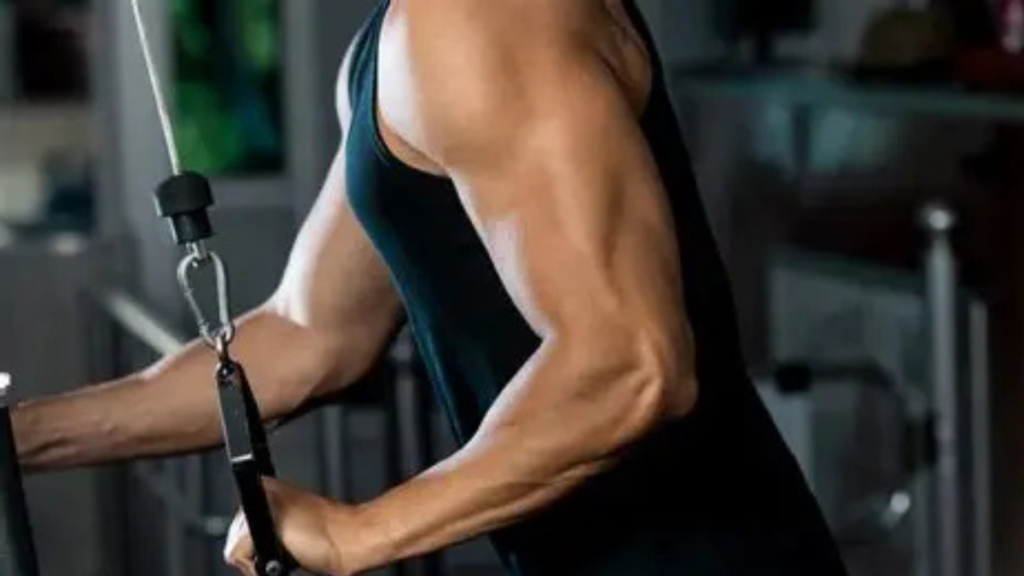
The Arnold press can contribute to stronger and more muscular triceps, especially for beginners who are still gaining strength from almost any well performed pressing movement. However, it is not a full arm solution by itself. The triceps receive meaningful stimulation, but direct exercises such as cable pressdowns, overhead extensions, and close grip pressing can make it easier to accumulate sufficient triceps training volume.
Upper Chest and Upper Back Stabilizers
The upper chest may contribute modestly when the elbows are in front of the torso at the bottom of the movement. However, the Arnold press should still be considered a shoulder press rather than a chest exercise.
The muscles around the shoulder blade also work to provide a stable base for pressing. These include the trapezius and serratus anterior. Healthy overhead movement requires the shoulder blade and upper arm to move together in a coordinated way. This is one reason why shoulder control matters as much as the amount of weight on the dumbbells.
Is It Really an Arm and Shoulder Combo Exercise?
The Arnold press deserves the shoulder part of the description. It trains the shoulders effectively and gives the triceps a substantial supporting role. Calling it a complete arm exercise would be less accurate because it does very little for the biceps.
The biceps bend the elbow and assist with movements that bring the forearm toward the upper arm. During an Arnold press, the elbow is extending rather than flexing, so the biceps are not loaded in the way they are during curls, chin ups, or rows. The rotation involved in the Arnold press may create a sensation in the arms, but sensation alone does not mean the biceps are receiving a strong growth stimulus.
If you want bigger arms, the Arnold press can sit alongside direct biceps and triceps training. This is a more complete approach. Research on resistance training volume suggests that higher weekly set volumes can produce greater hypertrophy, although the ideal amount differs between individuals and must be balanced with recovery.
For most people, the Arnold press is best viewed as a shoulder focused compound exercise with an important triceps benefit. It can help make your arms look more athletic by developing the deltoids and triceps, but curls and other direct arm movements still have a clear place in a muscle building program.
Benefits of the Arnold Press
It Creates a Large, Controlled Range of Motion
A comfortable range of motion can help you train a muscle effectively. The Arnold press starts with the dumbbells near the front of the shoulders and finishes with the arms overhead. This produces a long path for the load to travel and challenges control through several joint positions.
Research comparing resistance training at different ranges of motion generally supports using a full, pain free range whenever practical. Full range training can be especially useful for building strength across a broad movement pattern and for exposing muscles to tension at different lengths.
The key phrase is pain free. You do not need to force the dumbbells lower than your shoulder comfort allows. If the bottom position causes pinching, pain, or instability, choose a different pressing variation or adjust the range.
It Builds Coordination as Well as Strength
The rotation makes the Arnold press more demanding than a simple straight up and down press. Your wrists, elbows, shoulders, and shoulder blades need to move in a controlled sequence. This can make lighter loads feel challenging and may help lifters pay closer attention to technique.
That does not make the exercise better for everyone. More complex movements require more practice, and technique can break down when fatigue is high. Beginners should learn the movement with light dumbbells and should not treat the rotating element as a reason to use heavy weights too soon.
It Can Add Productive Variety
Exercise variation can help training remain engaging and can slightly change the way a muscle is loaded. Variation is useful when it supports consistent, progressive training rather than replacing effective movements every week.
The Arnold press works well as one option in a shoulder program that also includes conventional presses, lateral raises, rear deltoid work, rows, and pulling exercises. This combination gives the shoulders both pressing stimulus and balanced work for the muscles that support posture and shoulder function.
How to Perform the Arnold Press

Set Up Correctly
Sit on an upright bench with your feet planted firmly on the floor. A seated version reduces the temptation to lean backward and turn the movement into an exaggerated incline press. You can also perform it standing, but that requires more torso control and is usually harder to learn.
Hold the dumbbells in front of your shoulders with your palms facing toward your body. Keep your wrists neutral and avoid allowing the dumbbells to bend the wrists backward. Your elbows should be slightly in front of your torso rather than pulled far behind it.
Brace your midsection before each repetition. Keep your rib cage controlled instead of flaring it aggressively upward. This helps keep the movement focused on the shoulders rather than shifting stress into the lower back.
Press and Rotate Smoothly
Begin pressing the dumbbells upward while gradually rotating the palms away from your body. The rotation should feel smooth rather than rushed. By the time the dumbbells reach the top position, your palms will usually face forward or slightly inward.
Finish with the dumbbells overhead without forcing the shoulders into an uncomfortable position. Lower the weights slowly, reversing the rotation as you return to the start. A controlled lowering phase is important because eccentric muscle actions contribute to muscular adaptation and help you maintain good positioning.
Do not let the dumbbells crash together at the top or drop rapidly at the bottom. Treat each repetition as a controlled press, not a fast arm rotation with a press attached to it.
Common Arnold Press Mistakes
Using too much weight is the most common error. A lifter may be strong enough to perform a conventional dumbbell press with a certain load, but the Arnold press requires more control at the bottom position. Excessive weight often causes the elbows to drift, the lower back to arch, and the rotation to become rushed.
Another mistake is rotating first and pressing second. The movement should be a continuous, coordinated action. If you rotate the dumbbells fully before starting the press, you have simply turned the exercise into a conventional shoulder press with an awkward start.
Some lifters also lower the dumbbells too far. The bottom position should be controlled and comfortable. There is no prize for forcing the elbows behind the body or pushing through shoulder pain. Training through pain can make it harder to maintain useful technique and may aggravate an existing problem.
Finally, do not neglect other shoulder work. The Arnold press emphasizes the front portion of the deltoids, which already receives a lot of work from bench presses, push ups, and other pressing exercises. Lateral raises, rear deltoid exercises, and rowing movements help create a more balanced shoulder program.
How to Program the Arnold Press for Muscle Growth
For muscle growth, use a load that allows you to maintain a controlled range of motion and finish your sets close to muscular fatigue. Moderate repetitions are practical for this exercise because they allow you to use enough load for tension while preserving technique.
A useful starting point is two to four sets of six to 12 repetitions once or twice per week. Start conservatively if you are new to overhead pressing. Add repetitions first, then increase the load when you can complete the top of your target repetition range with good form.
Resistance training research indicates that muscle hypertrophy can occur with both lighter and heavier loads when training effort and total work are sufficient. For the Arnold press, the best load is usually one that challenges you without causing a breakdown in your shoulder position, wrist control, or torso posture.
Place the Arnold press early in a shoulder workout if it is one of your priority lifts. If your main goal is maximum strength in a conventional overhead press, use that lift first and perform Arnold presses later as a muscle building accessory.
Who Should Use the Arnold Press?
The Arnold press can suit lifters who want more shoulder training variety, enjoy dumbbell pressing, and can move their arms overhead comfortably. It is particularly useful for people who find a neutral or inward starting hand position more comfortable than beginning every press with the palms facing forward.
It may be less suitable for people with current shoulder pain, major restrictions in overhead mobility, or a history of painful pressing. In those cases, a neutral grip dumbbell press, landmine press, machine press, or a reduced range variation may be more appropriate. Persistent shoulder pain should be assessed by a qualified healthcare professional.
Are Bar Facing Burpees the Perfect Exercise for Burning Body Fat?
The perfect exercise is the one you can perform safely, progress consistently, and recover from while it moves you toward your goal. The Arnold press can certainly be part of that equation, but it is not mandatory.
Final Verdict
The Arnold press is not the perfect all in one arm and shoulder movement, but it is a very good shoulder exercise with a meaningful triceps benefit. It can build muscle, improve pressing control, and make your training more enjoyable when performed with sound technique and sensible loading.
Use it to develop the front and side portions of the shoulders, support triceps growth, and add variety to your pressing routine. Pair it with direct biceps work, lateral raises, rows, and rear deltoid exercises if you want well developed arms and balanced shoulders.
The rotation is not what builds muscle by itself. Consistent training, quality repetitions, progressive overload, adequate weekly volume, and recovery are what make the difference. Get those fundamentals right, and the Arnold press can become a highly effective addition to your program.
References
- American College of Sports Medicine, 2009. American College of Sports Medicine position stand. Progression models in resistance training for healthy adults. Medicine and Science in Sports and Exercise, 41(3), pp. 687 to 708.
- Botton, C.E., Ugrinowitsch, C., Bini, D., Cyrino, E.S. and Ritti Dias, R.M., 2013. Neuromuscular response to different shoulder exercises. Journal of Strength and Conditioning Research, 27(9), pp. 2479 to 2486.
- Kraemer, W.J. and Ratamess, N.A., 2004. Fundamentals of resistance training: Progression and exercise prescription. Medicine and Science in Sports and Exercise, 36(4), pp. 674 to 688.
- Schoenfeld, B.J., Ogborn, D. and Krieger, J.W., 2017. Dose response relationship between weekly resistance training volume and increases in muscle mass: A systematic review and meta analysis. Journal of Sports Sciences, 35(11), pp. 1073 to 1082.
- Schoenfeld, B.J., Grgic, J., Ogborn, D. and Krieger, J.W., 2017. Strength and hypertrophy adaptations between low versus high load resistance training: A systematic review and meta analysis. Journal of Strength and Conditioning Research, 31(12), pp. 3508 to 3523.
- Schoenfeld, B.J., Grgic, J., Van Every, D.W. and Plotkin, D.L., 2021. Loading recommendations for muscle strength, hypertrophy, and local endurance: A re examination of the repetition continuum. Sports, 9(2), p. 32.
- Welsch, E.A., Bird, M. and Mayhew, J.L., 2005. Electromyographic activity of the pectoralis major and anterior deltoid muscles during three upper body lifts. Journal of Strength and Conditioning Research, 19(2), pp. 449 to 452.
Key Takeaways
| Point | What it means |
|---|---|
| Main muscles trained | The Arnold press primarily trains the anterior and lateral deltoids, with substantial help from the triceps. |
| Arm building value | It supports triceps development but does not replace direct biceps training. |
| Best use | Use it as a shoulder focused compound lift in a balanced upper body program. |
| Technique priority | Keep the rotation smooth, control the lowering phase, and use a pain free range of motion. |
| Muscle growth | Progressively add repetitions or load over time while maintaining good form and adequate weekly training volume. |
| Main limitation | It is not automatically better than a conventional dumbbell press and may not suit people with painful or restricted shoulders. |