

If your goal is wider looking arms, hammer curls are usually the better choice than preacher curls. That does not mean preacher curls are ineffective. They are an excellent way to train the biceps with strict form and can contribute significantly to arm size. However, hammer curls bring more of the brachialis and brachioradialis into the movement. These muscles sit beneath and beside the biceps, so developing them can make the entire upper arm look thicker from the front and side.
The important detail is that no long term study has directly compared hammer curls with preacher curls for muscle growth. You cannot honestly claim that one has been proven to build more total arm width than the other. Still, anatomy, electromyography research, and studies on exercise specific muscle growth give us a useful practical answer.


For men who want arms that look broad even when relaxed, hammer curls should be a regular part of the program. Preacher curls are best used alongside them to add high quality, controlled biceps volume.
What Makes an Arm Look Wider?
The biceps brachii gets most of the attention because it is the obvious muscle when you flex your arm. It has two heads and contributes to elbow flexion and forearm supination, which means turning your palm upward. A larger biceps can improve the front of the arm and create a more pronounced peak, although peak shape is also strongly influenced by genetics.
Arm width is not only about the biceps brachii. The brachialis lies underneath it and attaches to the ulna in the forearm. Because the brachialis is located beneath the biceps, adding size to it can push the biceps outward and create a fuller upper arm. The brachioradialis runs from the upper arm down the thumb side of the forearm. It is particularly visible around the outer elbow and upper forearm, where it helps create a thicker transition between the arm and forearm.
A wider arm therefore comes from building several elbow flexors, not simply trying to isolate the biceps with one curl variation. This is where the comparison between hammer curls and preacher curls becomes useful.
How Hammer Curls Work
A hammer curl is performed with a neutral grip, meaning the palms face each other throughout the movement. You can use dumbbells, a rope attachment, or a neutral grip cable handle. The elbow flexes as the dumbbell rises, but the wrist does not rotate into a fully supinated position.
This grip changes the job of the elbow flexors. The biceps brachii remains active, but it loses some of the advantage it has in a fully supinated curl. The brachialis continues to flex the elbow regardless of forearm position, while the brachioradialis can contribute strongly when the forearm is neutral.
Research comparing curl variations has found that changing the grip changes muscle activity. Neutral grip curls can produce more brachioradialis activity than a conventional supinated curl, while supinated curls can favor biceps brachii activity. Muscle activity measured during a workout is not a guarantee of long term hypertrophy, but it supports the anatomical case for including hammer curls when arm width is the goal.
Hammer curls also have a practical advantage. Many lifters can train them hard without needing to aggressively supinate the forearm. This can make the exercise a comfortable option for people whose wrists or elbows do not tolerate heavy straight bar curls well. Comfort alone does not make an exercise superior, but it matters because a pain free movement is easier to progress consistently.
Why Hammer Curls Can Make Arms Look Broader
The brachialis is a substantial elbow flexor that sits under the biceps. It does not create a new biceps head or change your genetic muscle shape. What it can do is add muscle to the area beneath the biceps, increasing the thickness of the upper arm. The brachioradialis also adds visible size nearer the elbow and upper forearm.
That means hammer curls have a useful visual role. They train the elbow flexors with a grip that spreads more work beyond the biceps itself. If your current routine relies entirely on supinated curls, hammer curls are a sensible way to add variety without simply repeating the same stimulus.
This does not mean the biceps is inactive during hammer curls. It still contributes to elbow flexion. The difference is that hammer curls are less exclusively biceps focused than preacher curls performed with a supinated grip.
How Preacher Curls Work
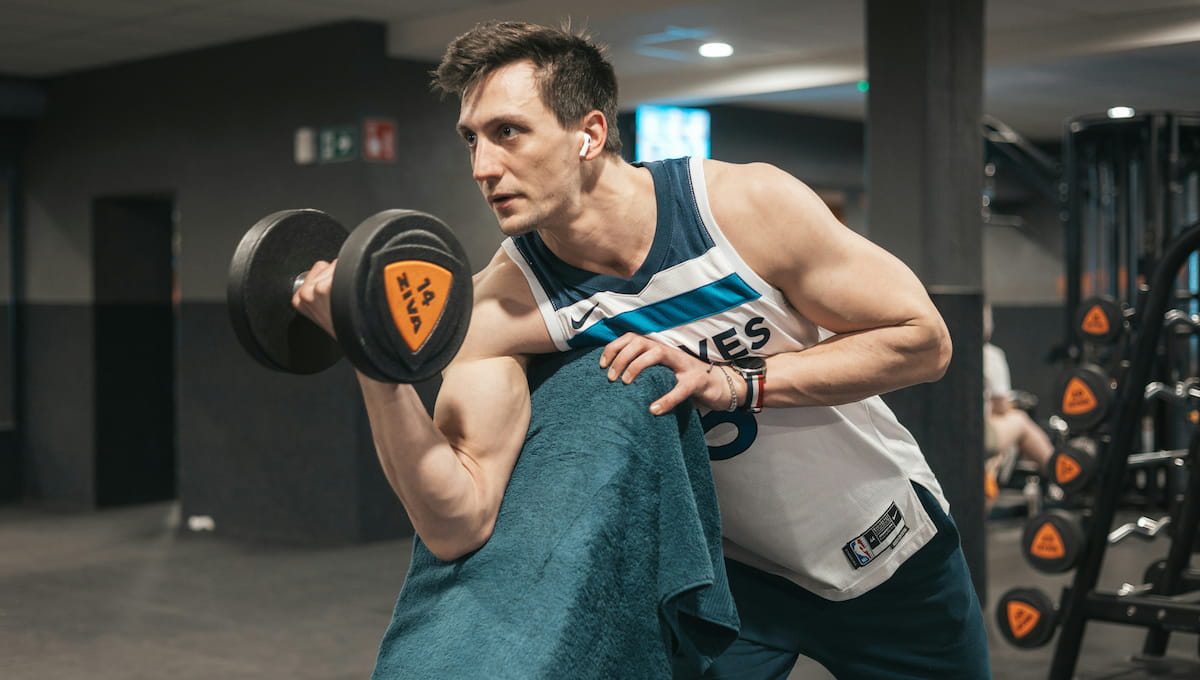
A preacher curl supports the upper arm against an angled pad. This limits shoulder movement and makes it harder to use momentum from the hips, torso, or shoulders. You can perform the movement with an EZ bar, straight bar, dumbbell, machine, or cable.
The setup makes preacher curls especially useful for strict biceps training. Because the upper arm is fixed in front of the body, the exercise reduces the temptation to swing the weight upward. This allows you to focus on elbow flexion, use a controlled eccentric phase, and keep the target muscles under tension.
Preacher curls are commonly performed with a supinated grip. That position gives the biceps brachii an important role because the biceps both flexes the elbow and supinates the forearm. If you want a curl that strongly emphasizes the biceps and makes cheating difficult, preacher curls are a very good option.
What the Research Says About Preacher Curls
A recent eight week randomized trial compared preacher curls with incline curls in untrained young women. Both groups gained muscle thickness in the elbow flexors. The incline curl produced greater growth at the proximal portion of the elbow flexors, while the preacher curl produced greater growth at the distal portion.
This is valuable evidence because it shows that exercise selection can affect where growth is observed within a muscle group. It also confirms that preacher curls can build the elbow flexors effectively when trained progressively. However, the study did not compare preacher curls with hammer curls, and it did not establish that preacher curls are best for whole arm width.
Preacher curls may be particularly valuable if your standard curls are loose, rushed, or heavily assisted by the shoulders. The pad creates a repeatable position and makes it easier to judge whether you are actually progressing. For biceps hypertrophy, that consistency is extremely useful.
Hammer Curls vs Preacher Curls for Wider Biceps
If the question is which exercise builds the biceps more directly, preacher curls have the advantage. Their supported position and common supinated grip make them a highly focused biceps exercise. They are a strong choice for men who want to improve biceps size, improve curl strength, and reduce cheating.
Blow Up Your Pecs Using These 3 Exercises in the Gym
If the question is which exercise is more likely to make the upper arm look wider, hammer curls have the practical advantage. Their neutral grip gives the brachialis and brachioradialis a larger role, and those muscles add thickness beneath and beside the biceps.
The best answer is not to treat this as an either or decision. Hammer curls and preacher curls have different strengths. A complete arm program can use hammer curls to build thickness through the elbow flexors and preacher curls to provide strict, biceps focused work.
If you can only choose one exercise, choose hammer curls when your priority is a broader arm appearance. Choose preacher curls when your priority is a more isolated biceps movement with very little room for momentum. If you have time for both, include both and make steady progress.
How to Program Both Exercises for Growth
Muscle growth depends much more on consistent hard training, sufficient weekly volume, and progressive overload than on finding one magical curl. Research on resistance training shows that multiple sets performed regularly can promote hypertrophy across a wide range of loads, provided sets are challenging.
For most men, a useful starting point is to perform direct biceps work twice per week. Begin with six to 10 hard weekly sets across hammer curls, preacher curls, and other pulling exercises. If you are recovering well and your performance is improving, you can gradually add volume. More is not automatically better, especially if your elbows, wrists, or forearms begin to ache.
A simple approach is to perform hammer curls first on one training day and preacher curls first on another. The exercise performed first is usually the one you can load and execute with the most energy. Rotating the priority allows both movements to progress.

For hammer curls, use a controlled neutral grip and keep your upper arms close to your torso. Avoid swinging your shoulders forward to start each repetition. Lower the dumbbells under control until the elbow is close to full extension, then curl smoothly without twisting the wrist.
For preacher curls, set the pad so your armpits sit comfortably near the top without forcing the shoulders upward. Keep your chest against the bench and lower the weight under control. Do not aggressively snap into the bottom position. The elbow is more vulnerable when the arm is nearly straight, especially if the load is heavy and the lowering phase is careless.
A Simple Two Day Approach
On the first upper body session, perform three sets of hammer curls for eight to 12 repetitions. Use a load that leaves you close to failure by the end of each set while keeping the movement controlled. Follow this with other back and arm work as needed.
On the second upper body session, perform three sets of preacher curls for 10 to 15 repetitions. A slightly higher repetition range can help you keep the exercise strict and avoid loading the bottom position recklessly. Add weight only when you can complete the top of the target range with clean form.
Over several weeks, track the load, repetitions, and quality of execution. When you can perform more repetitions at the same load with identical form, increase the resistance slightly. This matters more than changing exercises every week.
The Verdict
Hammer curls are the better single choice for men who want wider looking arms. They train the biceps while also placing meaningful demand on the brachialis and brachioradialis, two muscles that add thickness around the upper arm and elbow.
Preacher curls remain one of the best tools for strict biceps training. They reduce momentum, make progress easier to measure, and can build the elbow flexors effectively. They are not inferior. They simply serve a different purpose.
For the best overall result, train both. Use hammer curls to build arm thickness and preacher curls to add controlled biceps volume. Then focus on the fundamentals that actually drive growth: hard sets, gradual progression, enough recovery, and patience.
Key Takeaways
| Goal or question | Best answer |
|---|---|
| Best single exercise for wider looking arms | Hammer curls, because they train the biceps, brachialis, and brachioradialis with a neutral grip |
| Best exercise for strict biceps isolation | Preacher curls, because the pad limits momentum and keeps the upper arm supported |
| Do hammer curls build the biceps? | Yes, but they distribute more work across the elbow flexors than a supinated preacher curl |
| Do preacher curls build arm width? | Yes, they can build the elbow flexors, but they are less specifically suited to developing the outer arm muscles targeted by a neutral grip |
| Best long term strategy | Use both exercises across the week and progress them with controlled form |
| Suggested weekly starting volume | Six to 10 hard direct sets for the elbow flexors, split across two sessions |
References
- Currier, B.S., McLeod, J.C., Banfield, L., Beyene, J., Welton, N.J., D’Souza, A.C., Keogh, J.A.J., Lin, L., Coletta, G., Yang, A., Colenso-Semple, L., Lau, K.J., Verboom, A. and Phillips, S.M. (2023) ‘Resistance training prescription for muscle strength and hypertrophy in healthy adults: a systematic review and Bayesian network meta analysis’, British Journal of Sports Medicine, 57(18), pp. 1211–1220.
- Kassiano, W., Costa, B., Kunevaliki, G., Lisboa, F., Stavinski, N., Prado, A., Tricoli, I., Francsuel, J., Nunes, J.P., Ribeiro, A.S. and Cyrino, E.S. (2025) ‘Distinct muscle growth and strength adaptations after preacher and incline biceps curls’, preprint.
- Leitão, B.F.M., Albarello, J.C.S., Halmenschlager, G.H., de Salles, B.F. and Matta, T.T. (2024) ‘Exercise selection plays an important role in inducing non uniform acute responses on elbow flexors muscle thickness’, Journal of Bodywork and Movement Therapies, 40, pp. 1097–1101.
- Schoenfeld, B.J., Ogborn, D. and Krieger, J.W. (2017) ‘Dose response relationship between weekly resistance training volume and increases in muscle mass: a systematic review and meta analysis’, Journal of Sports Sciences, 35(11), pp. 1073–1082.
- Signorile, J.F., Zink, A.J. and Szwed, S.P. (2002) ‘A comparative electromyographical investigation of muscle utilization patterns using various hand positions during the lat pull down’, Journal of Strength and Conditioning Research, 16(4), pp. 539–546.