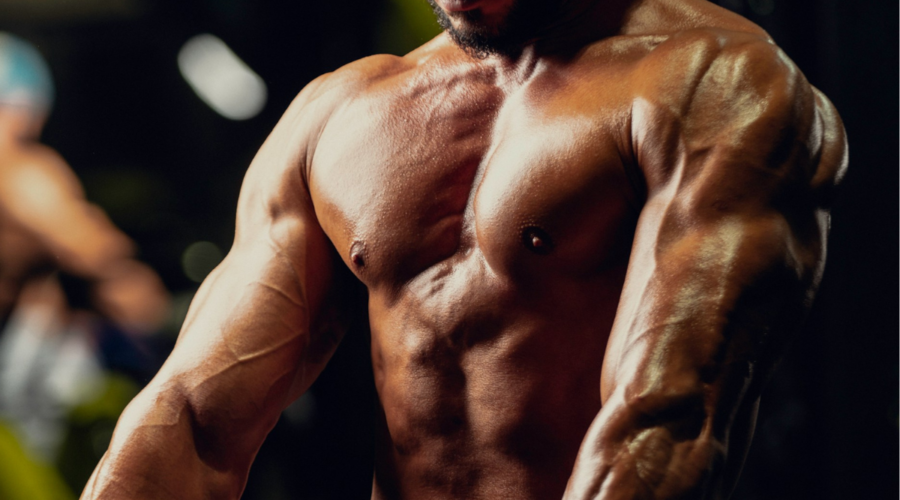


Dumbbells can be all you need to build noticeably bigger, stronger, and more balanced arms. They are accessible, versatile, and allow each side of your body to work independently. That matters because stronger arms are not simply the result of doing endless curls. Real progress comes from training the biceps and triceps with enough hard work, using a full range of motion, and steadily making your sessions more demanding over time.
Your triceps make up most of your upper arm muscle mass, while your biceps contribute heavily to the shape seen from the front. The brachialis, which sits underneath the biceps, and the forearm muscles also affect how thick and athletic your arms look. A smart dumbbell plan should therefore include movements that challenge the elbow flexors and elbow extensors from more than one angle.


The good news is that you do not need a complicated arm day packed with exercises. Use the three tips below consistently, track your performance, and give your body enough food and recovery to adapt. That is how dumbbell training starts to change the size, shape, and strength of your arms.
Tip 1: Give the Triceps at Least as Much Attention as the Biceps
Many people who want bigger arms immediately think about biceps curls. Curls are useful, but they are only part of the picture. The triceps are the larger muscle group of the upper arm, so building them can make a major difference to your arm circumference and the way your arms look in a T shirt.
The triceps have three heads, called the lateral, medial, and long heads. The long head crosses both the shoulder and elbow joints. This means its contribution can change depending on your upper arm position during an exercise. Including both pressing and overhead dumbbell extensions gives you a more complete way to train the triceps.
Start With a Heavy Dumbbell Pressing Movement
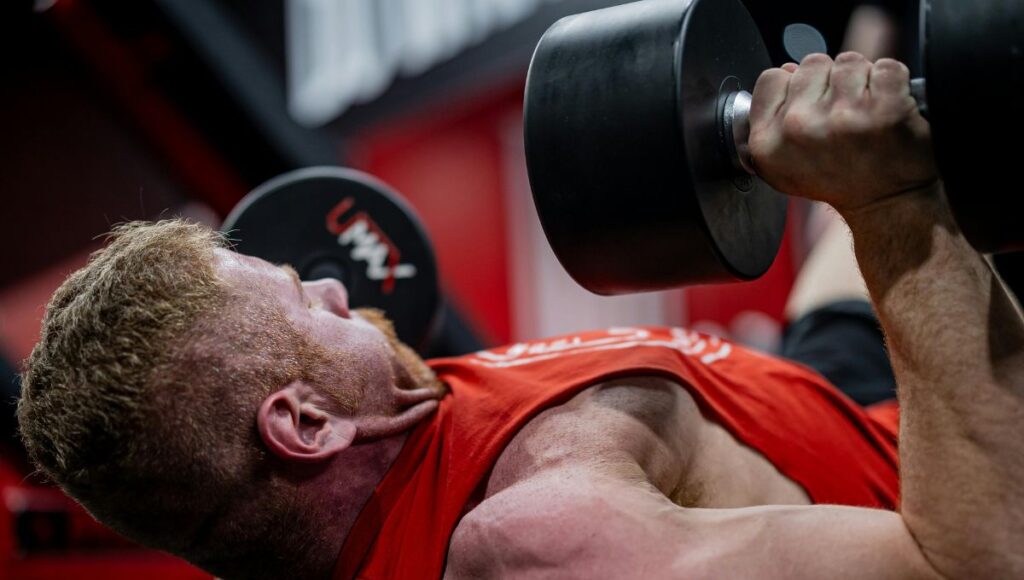
A close grip dumbbell floor press or neutral grip dumbbell bench press should be one of the foundations of your arm training. These compound exercises allow you to use more load than an isolation movement, while training the chest, shoulders, and triceps together.

Keep your elbows reasonably close to your sides rather than flaring them widely. Lower the dumbbells with control, pause briefly when appropriate, and press them back up powerfully. Your triceps work hard to extend the elbows during every repetition.
Choose a load that allows you to perform around six to twelve controlled repetitions. The final few repetitions should feel difficult, but your form should remain stable. Research consistently shows that muscle growth can occur across a broad range of loads when sets are performed close enough to muscular failure. You do not need to use the heaviest weights in the gym, but you do need to make the working sets challenging.
Add Overhead Dumbbell Extensions for the Long Head
After pressing, use an overhead dumbbell triceps extension. You can perform this seated, standing, or lying on a bench. Hold one dumbbell with both hands, lower it behind your head under control, then extend your elbows until your arms are straight.
The overhead position lengthens the long head of the triceps because the shoulder is flexed. Training muscles at longer lengths can be particularly productive for hypertrophy when it is performed with good control and an appropriate range of motion. This is not a reason to force painful positions. It is a reason to use the movement deliberately and lower the dumbbell as far as your shoulder mobility allows comfortably.
Aim for two to four sets of eight to fifteen repetitions. Keep your upper arms as still as possible. If your elbows flare excessively or your lower back arches hard, reduce the weight. The purpose is to load the triceps, not turn the exercise into a full body movement.
Tip 2: Use Curls That Train the Biceps and Brachialis Through a Full Range
The biceps are responsible for elbow flexion, but they also assist with turning the palm upward. This is why a basic dumbbell curl is valuable, especially when you start with your palms facing inward and rotate them as you lift. However, relying on only one curl variation can leave gains on the table.
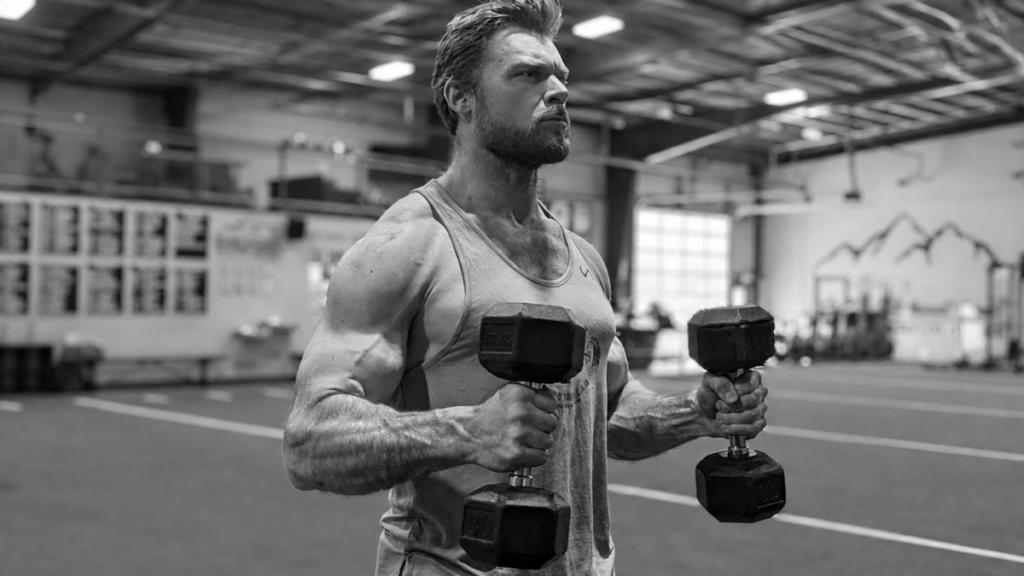
Different dumbbell curl variations can emphasize slightly different functions and positions. You do not need to chase a perfect isolation exercise, because all curls involve several elbow flexor muscles. Instead, choose variations that you can perform with control, load progressively, and feel in the target muscles.
Make the Incline Dumbbell Curl Your Main Biceps Builder
The incline dumbbell curl is one of the best choices for building the biceps because it places the upper arm behind the torso. This starts the biceps in a lengthened position and makes it harder to use momentum.
Set an adjustable bench to a modest incline and lie back with your arms hanging naturally toward the floor. Begin with your palms facing forward or slightly inward. Curl the dumbbells until your biceps are fully contracted, then lower slowly until your elbows are straight again.
Do not let your shoulders roll forward at the bottom. Keep your shoulder blades gently pulled back against the bench, and focus on moving at the elbow. A controlled lowering phase is useful because muscles are capable of producing high forces while lengthening, and resistance training that includes both lifting and lowering phases is effective for building muscle and strength.
Choose a weight that you can control for eight to fifteen repetitions. If you have to swing the dumbbells, shorten the range, or lose your shoulder position, the load is too heavy for the exercise.
Use Hammer Curls to Add Thickness
Hammer curls are performed with a neutral grip, meaning your palms face each other. This position can place more emphasis on the brachialis and brachioradialis while still training the biceps. Since the brachialis sits beneath the biceps, developing it can help make the upper arm look thicker from the front and side.
Stand tall with the dumbbells at your sides. Curl them toward your shoulders without turning your palms upward. Keep your elbows close to your body and avoid leaning back. You can curl both dumbbells together or alternate sides.
Hammer curls are particularly useful if regular supinated curls bother your wrists or elbows. They are also an excellent final exercise after incline curls because they let you continue training the elbow flexors with a different hand position. Perform two to three sets of ten to fifteen repetitions, stopping when you can no longer maintain a smooth path.
Tip 3: Progress Your Training Instead of Repeating the Same Workout Forever
The most effective dumbbell exercises will not transform your arms if they remain at the same difficulty for months. Your body adapts to a repeated training stimulus. To keep building muscle, you need progressive overload, which means gradually asking your muscles to do more meaningful work over time.
Progressive overload does not only mean adding weight every workout. Dumbbells often increase in fixed jumps, and those jumps can be too large for smaller muscle groups. You can also progress by completing more repetitions with the same weight, adding a set, improving your range of motion, using stricter technique, or reducing unnecessary rest between sets.
Track Repetitions Before Adding Weight
Use a rep range for each exercise. For example, perform three sets of eight to twelve repetitions on incline dumbbell curls. Start with a weight you can use for eight controlled repetitions on each set. Over the following sessions, try to add repetitions while maintaining the same clean form.
Once you can complete twelve repetitions on all three sets, move to the next available dumbbell weight. Your repetitions may fall back toward eight, which is normal. Build them up again over time.
3 Best Beginner Dumbbell Exercises for a Muscular and Thick Back
This simple progression system prevents guesswork. It also gives you a clear measure of improvement. A training log can be a notebook, a phone note, or an app. Record the exercise, dumbbell weight, sets, repetitions, and any note about form or discomfort.
Train Close to Failure, Not Recklessly to Failure
For muscle growth, sets need to be sufficiently demanding. You should usually finish a working set with only a small number of good repetitions left in reserve. For many people, stopping with roughly one to three possible repetitions remaining is a practical approach. This gives the muscle a strong stimulus while reducing the chance that poor form takes over the set.
Going to absolute failure is not required on every set. It can create more fatigue and make it harder to maintain quality across the rest of the workout. Save true failure for occasional final sets of safer isolation exercises if you enjoy using it, and only when your technique remains sound.
A productive arm session might include three hard sets of a dumbbell press, three sets of overhead extensions, three sets of incline curls, and two or three sets of hammer curls. This gives you enough focused work without turning the session into endless volume.
Recover Well Enough to Grow
Muscle is built after training, not during it. Resistance exercise provides the signal, but sleep, nutrition, and rest support the adaptation. Total weekly training volume is an important driver of hypertrophy, yet more is not always better if your elbows ache, your performance falls, or you cannot recover between sessions.
Training your arms directly two or three times per week is often a useful starting point. Spread your sets across the week rather than doing every exercise in one massive session. This can improve the quality of your work because you are less fatigued during each set.
Protein intake also matters. Evidence suggests that consuming enough protein supports gains in lean mass from resistance training, with benefits leveling off for many people at a daily intake around 1.6 grams per kilogram of body weight. Individual needs can vary depending on body size, total calorie intake, training volume, and goals. If you are trying to gain muscle, a modest calorie surplus can also help support progress.
A Simple Dumbbell Arm Plan
Use the following structure twice per week, ideally with at least one rest day between sessions. Start with one or two easier warm up sets for the first press and curl, then complete the working sets with focused effort.
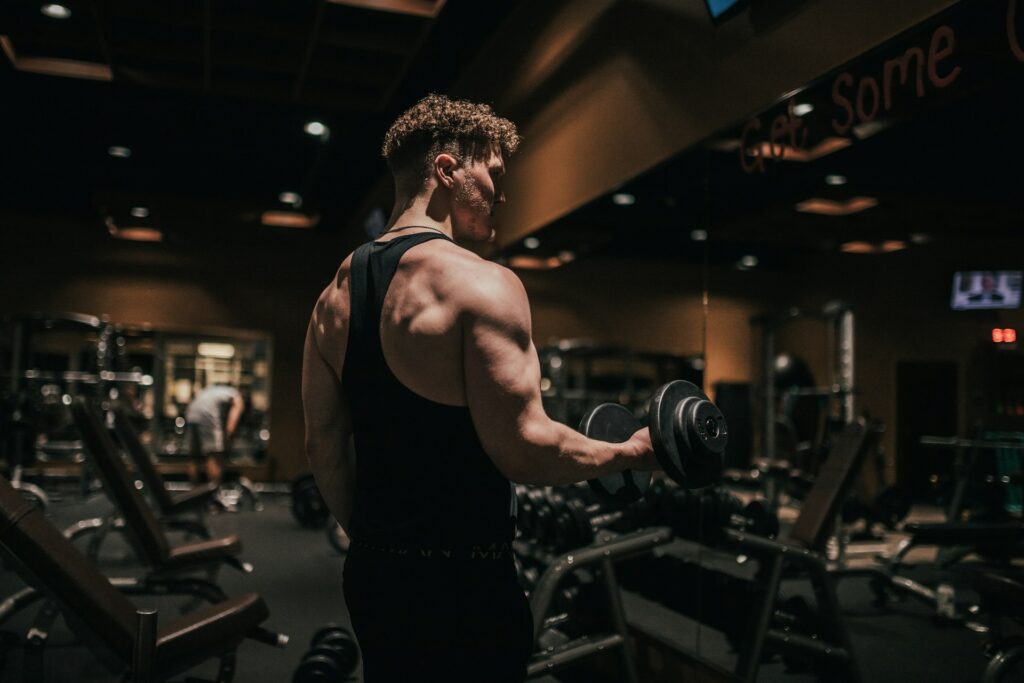
On the first session, perform neutral grip dumbbell presses for three sets of six to ten repetitions. Follow with overhead dumbbell triceps extensions for three sets of ten to fifteen repetitions. Then complete incline dumbbell curls for three sets of eight to twelve repetitions and hammer curls for two sets of ten to fifteen repetitions.
On the second session, use a dumbbell floor press for three sets of eight to twelve repetitions. Follow with lying dumbbell triceps extensions for three sets of ten to fifteen repetitions. Perform standing alternating dumbbell curls for three sets of eight to twelve repetitions, then finish with cross body hammer curls for two sets of ten to fifteen repetitions.
Rest for around two minutes after demanding presses and one to two minutes after curls and extensions. Longer rests can help you preserve performance when sets are difficult, while shorter rests can be practical for lighter isolation work. The key is to rest long enough to perform your next set well.
The Bottom Line
Transforming your arms with dumbbells is not about finding a secret curl variation. It is about building the triceps as seriously as the biceps, using exercises that challenge the muscles through a controlled range of motion, and progressing the work over time.
Start with a small number of reliable movements. Press and extend for your triceps. Curl with both supinated and neutral grips for your biceps, brachialis, and forearms. Train hard enough to create a reason for your muscles to adapt, but recover well enough to repeat that work consistently.
Give the plan at least eight to twelve weeks of focused effort before judging the results. Measure your arm circumference, record your dumbbell weights and repetitions, and take occasional progress photos in similar lighting. Those objective markers will show you whether your training is moving in the right direction.
References
- Grgic, J., Schoenfeld, B.J., Skrepnik, M. and Davies, T.B. (2022) ‘Effects of resistance training performed to repetition failure or non failure on muscular strength and hypertrophy: A systematic review and meta analysis’, Journal of Sport and Health Science, 11(2), pp. 202 to 211.
- Krieger, J.W. (2010) ‘Single versus multiple sets of resistance exercise for muscle hypertrophy: A meta analysis’, Journal of Strength and Conditioning Research, 24(4), pp. 1150 to 1159.
- Maeo, S., Jespersen, J.G., Jacobsen, A.B., Kjaer, M., Holm, L. and Crameri, R.M. (2021) ‘Higher muscle hypertrophy following resistance training at longer versus shorter muscle lengths’, Frontiers in Physiology, 12, 746063.
- Morton, R.W., Murphy, K.T., McKellar, S.R., Schoenfeld, B.J., Henselmans, M., Helms, E., Aragon, A.A., Devries, M.C., Banfield, L., Krieger, J.W. and Phillips, S.M. (2018) ‘A systematic review, meta analysis and meta regression of the effect of protein supplementation on resistance training induced gains in muscle mass and strength in healthy adults’, British Journal of Sports Medicine, 52(6), pp. 376 to 384.
- Schoenfeld, B.J., Ogborn, D. and Krieger, J.W. (2017) ‘Dose response relationship between weekly resistance training volume and increases in muscle mass: A systematic review and meta analysis’, Journal of Sports Sciences, 35(11), pp. 1073 to 1082.
- Schoenfeld, B.J., Grgic, J., Ogborn, D. and Krieger, J.W. (2017) ‘Strength and hypertrophy adaptations between low versus high load resistance training: A systematic review and meta analysis’, Journal of Strength and Conditioning Research, 31(12), pp. 3508 to 3523.
- Schoenfeld, B.J., Grgic, J., Van Every, D.W. and Plotkin, D.L. (2021) ‘Loading recommendations for muscle strength, hypertrophy, and local endurance: A re examination of the repetition continuum’, Sports, 9(2), 32.
- Schoenfeld, B.J., Pope, Z.K., Benik, F.M., Hester, G.M., Sellers, J., Nooner, J.L., Schnaiter, J.A., Bond Wilson, J.M., Arent, S.M., Hwang, P.S. and De Souza, E.O. (2016) ‘Longer interset rest periods enhance muscle strength and hypertrophy in resistance trained men’, Journal of Strength and Conditioning Research, 30(7), pp. 1805 to 1812.
Key Takeaways
| Tip | What to do | Why it works |
|---|---|---|
| Build your triceps | Combine dumbbell pressing with overhead extensions | The triceps contribute most of the muscle mass in the upper arm, and different shoulder positions challenge them effectively. |
| Use more than one curl | Pair incline curls with hammer curls | This trains the biceps, brachialis, and forearm muscles through different hand and shoulder positions. |
| Progress every few weeks | Add repetitions first, then add dumbbell weight | Gradual overload gives your muscles a continuing reason to adapt and grow. |
| Work hard with clean form | Finish most sets with only one to three good repetitions left | Challenging sets support muscle growth without making every set a form breaking grind. |
| Prioritize recovery | Train arms two or three times weekly and eat enough protein | Consistent training, adequate recovery, and sufficient protein support strength and muscle gains. |