

Walk into almost any gym on a Monday evening, and you will hear the familiar clang of iron plates sliding onto barbells. Among all the exercises performed in gyms across the world, the barbell bench press holds a unique cultural status.
It is the universal metric of upper body strength, the standard icebreaker question among gym-rats, and a core test of athletic prowess. Almost everyone who lifts has wondered how their personal best measures up against the rest of the lifting community.
So let’s find out how your score stacks up.
Comparing your maximum effort to someone who is twenty years younger or fifty pounds heavier rarely tells an accurate story. Raw strength is heavily influenced by factors such as training experience, body weight, biological sex, and chronological age. A single number on a bar means very little without the surrounding context of human physiology.

To determine where your bench press truly ranks, you need to understand how age shifts neuromuscular efficiency, muscle mass distribution, and joint integrity over time. Science provides clear population data and strength standards that allow lifters to evaluate their current numbers realistically. By examining strength retention models and anatomical norms, you can discover whether your current one repetition maximum places you in the average range, makes you an advanced athlete, or puts you in elite territory for your age bracket.
The Science of the One Repetition Maximum
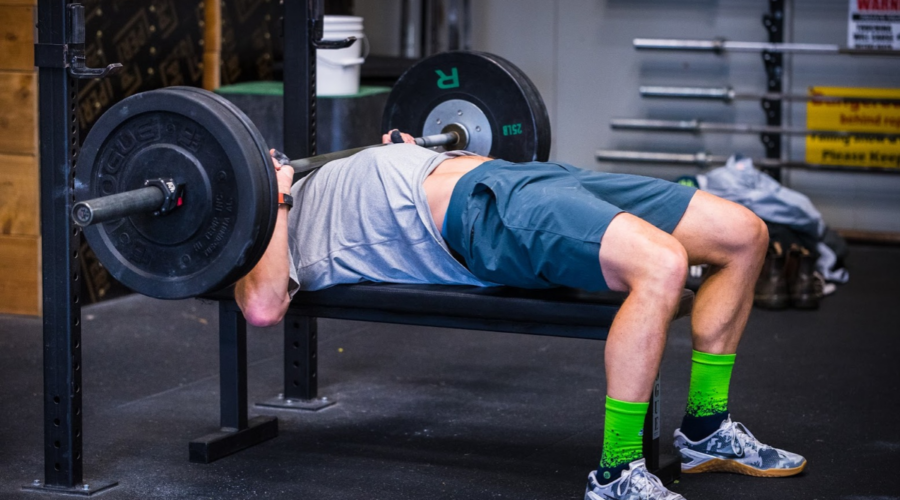
The one repetition maximum represents the maximum amount of weight an individual can lift for a single, complete repetition through a full range of motion with correct form. In exercise physiology, this metric is regarded as the gold standard for assessing maximal muscular strength of the upper body pushing musculature, primarily targeting the pectoralis major, anterior deltoids, and triceps brachii.
Testing a true maximum effort places extreme demands on both the musculoskeletal system and the central nervous system. When you lower a heavy barbell to your chest and drive it upward, your motor units must fire at maximum frequency while recruiting high-threshold fast-twitch muscle fibers. This neural drive naturally changes across your lifespan, which explains why peak power generation follows a predictable physiological curve.
To evaluate strength fairly across different demographics, exercise scientists express bench press capacity using body weight ratios rather than absolute weight numbers. Lifting a two hundred pound barbell carries a completely different physiological meaning for a one hundred fifty pound athlete than it does for a two hundred fifty pound athlete. Using body weight multipliers normalizes data, giving lifters an objective baseline regardless of their frame size.
Physiology, Aging, and Muscular Strength
The human body reaches its natural biological peak for muscle mass and maximum force production between the ages of twenty and thirty. During this period, circulating anabolic hormone levels remain high, tendon stiffness is optimal for energy transfer, and muscle protein synthesis operates at maximum efficiency. As individuals progress past their third decade, natural physiological shifts begin to alter strength potential.
The aging process introduces a gradual decline in muscle tissue known as sarcopenia. Starting around age thirty, adults can lose approximately three to eight percent of their muscle mass per decade if they do not participate in structured resistance training. This loss predominantly affects Type II fast-twitch muscle fibers, which are responsible for generating explosive force during heavy compound movements like the bench press.
Despite these natural declines, dedicated weightlifters often maintain impressive levels of strength well into their later decades. Regular resistance exercise stimulates neural adaptations, improves motor unit recruitment, and promotes muscle hypertrophy, effectively slowing down age-related strength losses. Understanding how age affects muscle architecture allows you to benchmark your progress accurately without comparing yourself to unfair standards.
Bench Press Strength Standards for Men
Strength categories are typically divided into five distinct levels of proficiency based on training experience and relative body weight performance. Beginners are individuals who have practiced the exercise for a few months and developed basic mechanics. Intermediate lifters have trained consistently for at least a year. Advanced lifters have multiple years of structured progressive overload under their belt, while elite athletes represent the top tier of competitive strength performance.

The following table outlines standard male bench press performance categories expressed as a multiplier of total body weight across adult age groups. To calculate your expected weight bracket, multiply your total body weight in pounds by the decimal value corresponding to your age bracket and skill tier.
| Age Group | Beginner | Intermediate | Advanced | Elite |
| 20 to 29 years | 0.80x bodyweight | 1.25x bodyweight | 1.65x bodyweight | 2.00x bodyweight |
| 30 to 39 years | 0.75x bodyweight | 1.20x bodyweight | 1.55x bodyweight | 1.90x bodyweight |
| 40 to 49 years | 0.70x bodyweight | 1.10x bodyweight | 1.45x bodyweight | 1.75x bodyweight |
| 50 to 59 years | 0.65x bodyweight | 1.00x bodyweight | 1.30x bodyweight | 1.60x bodyweight |
| 60 to 69 years | 0.55x bodyweight | 0.85x bodyweight | 1.15x bodyweight | 1.40x bodyweight |
| 70+ years | 0.45x bodyweight | 0.75x bodyweight | 1.00x bodyweight | 1.20x bodyweight |
A thirty-five year old male weighing one hundred eighty pounds who falls into the intermediate category would aim for a one repetition maximum of approximately two hundred sixteen pounds. That same individual reaching an advanced level would push toward two hundred seventy-nine pounds.
Bench Press Strength Standards for Women
Female strength standards reflect physiological differences in absolute muscle mass distribution, bone structure, and upper body motor unit density. While men typically possess a higher proportion of upper body lean mass relative to total weight, women demonstrate remarkable capability for muscle quality improvements and relative strength development through targeted training.
Female strength progression often shows incredible endurance and resilience to fatigue due to metabolic advantages in Type I muscle fiber utilization. However, absolute peak force production standards are adjusted to reflect natural baseline anatomical differences.
The following table provides body weight multipliers for female lifters across age brackets and experience levels.
| Age Group | Beginner | Intermediate | Advanced | Elite |
| 20 to 29 years | 0.50x bodyweight | 0.80x bodyweight | 1.10x bodyweight | 1.40x bodyweight |
| 30 to 39 years | 0.45x bodyweight | 0.75x bodyweight | 1.05x bodyweight | 1.35x bodyweight |
| 40 to 49 years | 0.42x bodyweight | 0.70x bodyweight | 0.95x bodyweight | 1.25x bodyweight |
| 50 to 59 years | 0.38x bodyweight | 0.62x bodyweight | 0.85x bodyweight | 1.10x bodyweight |
| 60 to 69 years | 0.32x bodyweight | 0.52x bodyweight | 0.72x bodyweight | 0.95x bodyweight |
| 70+ years | 0.25x bodyweight | 0.42x bodyweight | 0.60x bodyweight | 0.80x bodyweight |
A one hundred forty pound female lifter in her late twenties achieving an intermediate benchmark would aim for a single press of one hundred twelve pounds. Hitting an advanced standard at the same body weight would require a lift of one hundred fifty-four pounds.
Variables That Influence Your Bench Press Score
While age and body weight establish the primary framework for strength norms, several mechanical and physiological variables explain why two lifters of identical age can produce vastly different maximum scores. Understanding these factors helps you refine your technique and set realistic goals.
Limb Length and Anatomical Leverage
Segment lengths play a massive role in biomechanical efficiency during the bench press. Lifters with shorter arm lengths possess a shorter stroke distance, meaning they do less total mechanical work to move the bar from the chest to lock out. Conversely, lifters with long upper arm bones face longer moment arms across the shoulder joint, which demands significantly greater torque production from the chest and shoulders.

Joint Integrity and Recovery Capacity
As lifters age, connective tissues such as tendons and cartilage require longer adaptation times compared to muscle tissue. Collagen synthesis rates decrease with age, meaning heavy loading cycles must be managed carefully. Older athletes often find that their muscular system can produce the force required for heavy weights, but their shoulder joint complex demands smarter volume management to prevent overuse injuries.
3 Huge Benefits of EZ Bar Curls for Beginners that Want Bigger Biceps
Training Consistency and History
Cumulative training age often overrides chronological age when determining strength outputs. A fifty year old lifter who has trained consistently for twenty years will almost always outperform a twenty-five year old who has only been lifting for six months. Long-term training builds dense neural pathways and increases muscle fiber cross-sectional area, creating a solid foundation that resists age-related decline.
Key Takeaways
| Metric | Core Summary |
| Peak Strength Window | Human strength naturally peaks between ages twenty and thirty due to optimal hormonal balance and maximum Type II muscle fiber density. |
| Relative Strength Ratio | Evaluating strength as a multiplier of body weight provides a far more accurate performance measure than looking at absolute weight alone. |
| Impact of Aging | Muscle mass declines at roughly three to eight percent per decade past age thirty, but structured strength training dramatically slows this process. |
| Biological Differences | Women display high capacity for relative strength adaptations, with female standards adjusted for baseline upper body muscular distribution. |
| Structural Mechanics | Individual limb lengths, joint integrity, and cumulative training age heavily influence personal bench press potential across all age groups. |
References
- American College of Sports Medicine, 2009. American College of Sports Medicine position stand. Progression models in resistance training for healthy adults. Medicine and Science in Sports and Exercise, 41(3), pp.687-708.
- Ahtiainen, J.P., Walker, S., Peltonen, H., Holviala, J., Sillanpaa, E., Karavirta, L., Sallinen, J., Mero, A.A., Hulmi, J.J., Ojasto, M., Silk, R. and Hakkinen, K., 2016. Heterogeneity in resistance training-induced muscle hypertrophy and strength gain in men and women of different ages. Age, 38(1), pp.10-22.
- Ballor, D.L., Becque, M.D. and Katch, V.L., 1987. Physiological responses to resistance training in older adults. Sports Medicine, 4(6), pp.411-421.
- Doherty, T.J., 2003. Invited review: Aging and sarcopenia. Journal of Applied Physiology, 95(4), pp.1717-1727.
- Hakkinen, K., Alen, M., Kallinen, M., Izquierdo, M., Jokelainen, K., Lassila, H., Malkia, E., Kraemer, W.J. and Newton, R.U., 1998. Muscle baselines, muscle fiber characteristics, and force production capacity in middle-aged and older men and women. The Journals of Gerontology Series A: Biological Sciences and Medical Sciences, 53(6), pp.B415-B423.
- Izquierdo, M., Ibanez, J., Gorostiaga, E.M., Garrues, M., Zuniga, A., Anton, A., Larrion, J.L. and Hakkinen, K., 1999. Maximal strength and power characteristics in middle-aged and older athletes and nonathletes. Journal of Applied Physiology, 86(5), pp.1581-1595.
- Kraemer, W.J. and Ratamess, N.A., 2004. Fundamentals of resistance training: progression and exercise prescription. Medicine and Science in Sports and Exercise, 36(4), pp.674-688.
- Lexell, J., Taylor, C.C. and Sjostrom, M., 1988. What is the cause of the ageing atrophy? Total number, size and proportion of different fiber types studied in whole vastus lateralis muscle from 15-83-year-old men. Journal of the Neurological Sciences, 84(2-3), pp.275-294.
- Walston, J.D., 2012. Sarcopenia in older adults. Current Opinion in Rheumatology, 24(6), pp.623-627.