


It was 2017 when we first decided to try the ketogenic diet for the first time and we were incredibly nervous about it. The thought of eating high fat and changing our metabolism was daunting.
The diet goes against almost every single piece of health and dietary advice we had ever heard or studied.




However, we were desperate. Lindsay was having such severe digestive problems that we committed to trying keto for one month, and then we would re-evaluate. Two weeks in, we were sure we’d stick to it. Lindsay’s digestive problems were resolved and her energy levels drastically increased. Nic had better mental clarity than ever before. Not to mention our body compositions were both improving.
Because of our own success stories, Nic became a certified Ketogenic Living Health Coach, and has been testing the ketogenic diet and CrossFit for over a year now.

–
Fast forward to 2020 and keto seems to be running rampant these days. Miraculous stories of weight loss, health transformations, and so much more circulate all over the internet and within fitness groups. One community where keto is only just being explored is the world of CrossFit®.
You may have heard that the ketogenic diet and CrossFit® don’t mix. Many people think that because CrossFit® is extremely “glycolytic” – meaning that the exercise is fuelled primarily by glucose – any diet that is not high in carbohydrates will not work.
We are going to explore the science and facts behind the ketogenic diet and CrossFit®, and explain why the keto diet is at least as good as a typical diet for CrossFit® and also includes some unique benefits for CrossFit athletes.
The official CrossFit.com newsletter and website have begun to include many studies on the benefits of the ketogenic diet, and there is even a CrossFit® approved course on the ketogenic diet titled Nutrition Network Professional Training in LCHF/Ketogenic Nutrition. CrossFit HQ seems to be endorsing the high fat low carb (HFLC) diet quite strongly this past year.
This is Part One of a series of posts covering different aspects of CrossFit® and the impact the ketogenic diet has on each one. Here, you’ll learn about the studies that have been done on the ketogenic diet and its effects on CrossFit® in particular, as well as a ketosis, energy systems, and why this funky metabolic state can actually be very beneficial for overall health and athletic performance, specifically CrossFit®.
KETOSIS: A SHORT HISTORY
The metabolic state known as ketosis, in which the body burns fat (instead of carbohydrates) for energy, in the form of ketone bodies, is actually as old as mankind itself. Ketone bodies are produced during times of extended fasting, and most people often produce some ketone bodies in the early morning before they eat breakfast.
Going for many hours without food can cause a small production in ketones. This study highlights the fact that ancient people relied heavily on fat for their energetic needs. In fact, another study claims that it was the increased consumption of fat from bone marrow and brains that jump-started human evolution to have the large brain we have today.
In the modern lens, there are many benefits to the state of ketosis, including: weight loss, lowered blood sugar, improved cholesterol and reduced triglycerides, reduced risk of heart disease, and increase in cognitive performance, between others.
The most basic way to look at the keto diet is that the body is consuming mostly fat for fuel, instead of carbohydrates.
When fat is consumed, it is broken down into free fatty acids (FFA) that can be used directly by cells for energy, or it can go to the liver, where it is broken down into ketone bodies, hence the name ketogenic diet.
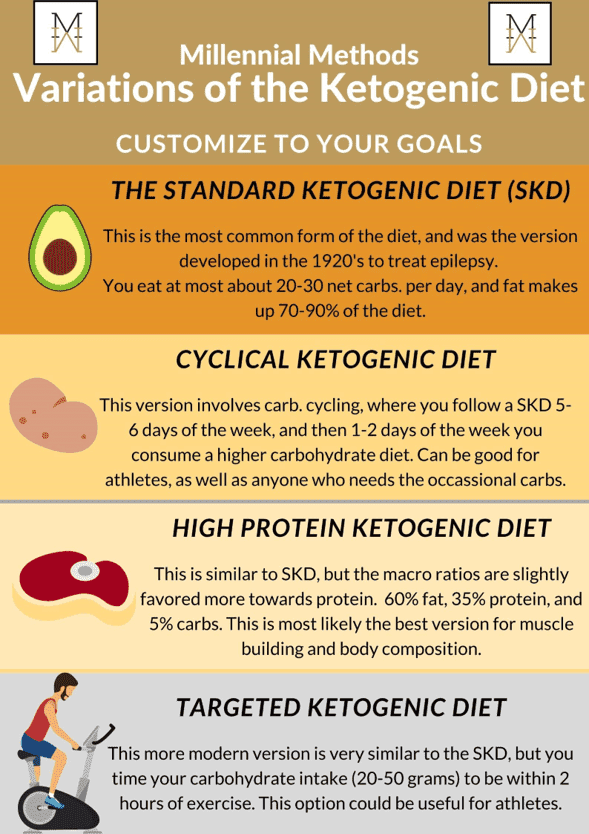
There are modified versions of the ketogenic diet with different macronutrient breakdowns:
–
As you can see, keto is not even a one-size-fits-all diet but can actually be more lenient than some would have you believe – especially once you’re “fat-adapted,” meaning your body is efficiently using fat for energy production.
Throughout this series, you’ll get a better understanding on the best variation of keto for CrossFit®, overall athletic performance, and overall health and longevity specifically.
WHAT MAKES SOMEONE GOOD AT CROSSFIT® AND WHY YOU SHOULD CARE
Let’s take a scientific approach by analysing the “Physiological Performance Measures as Indicators of CrossFit® Performance,” study, which was done on average CrossFit athletes and measured the following:
- VO2max test
- 3-minute all out running test (3MT)
- a Wingate anaerobic test (WAnT)
- the CrossFit total (to measure total body strength)
- the following CrossFit benchmark workouts: Fran, Grace, and Nancy.
What they found was the following:
- For Fran – back squat strength explained 42% of the variance of performance
- For Nancy – VO2max explained 68% of the variance
- For the CrossFit Total – Anaerobic peak power explained 57% of the variance
This study reveals you have to be strong, have a solid VO2max, and a solid anaerobic peak power to be a good all-around CrossFitter. The interesting takeaway here is that different benchmark WOD’s depend on different abilities, such as Nancy mostly depending on a solid VO2max.
Key Metrics for CrossFit® Success
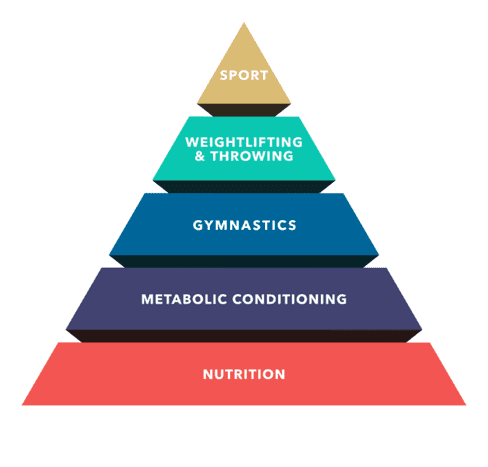
CrossFit® has created an overall template based on “What is Fitness?” in which they provide a theoretical hierarchy for developing an athlete. See the pyramid below:
–
Nutrition – As CrossFit’s article states: “The quality and constituent elements of an athlete’s diet influence metabolism and therefore the molecular foundations of muscle, bone, and the nervous system.”
We couldn’t agree more with this, and by the end of this series, you will understand why the ketogenic diet more than adequately checks the box.
Metabolic Conditioning – The next most important component consists of “cardiovascular sufficiency.” This could be summarised as the health of the cardiovascular system at all levels of exercise intensity.
We will soon discuss the different energy systems and their contribution to the CrossFit® conundrum.
The additional layers of the pyramid include gymnastics, weightlifting and throwing, and sport.
Building off of what we have covered thus far, I would contend that to be successful at CrossFit® (and life) one needs to have the following attributes:
- Physical preparedness – Gymnastics, Strength, Endurance, Power, Speed, Cardiovascular Fitness
- Body composition – High lean mass and low-fat mass
- The ability to recover – Sleep, Inflammation, Oxidative Damage
- Mental health – Strong neural health and functioning
- General health and wellness – Strong physiological health markers
There are studies available for the impact that keto has on each of these categories, a couple of which will be discussed to determine their overall impact on a CrossFitter’s life.
Before this, it’s important we understand the different energy systems and their impact on CrossFit®, as this will be important in determining if keto can work for CrossFit®.
Energy System Overview
Current exercise physiology dictates that there are three predominant energy systems present in the human body:
- Aerobic System
- Anaerobic Lactic Acid System
- Anaerobic Phosphocreatine System (PCr)
All three energy systems are always in constant flux, with the body drawing on the different systems in different amounts, depending on the activity. The body does not usually completely close off one system, it just downregulates and upregulates the different systems to keep everything running optimally.
Typically, the lower to moderate intensities of exercise use the Aerobic system, fuelled by mostly fat and maybe some carbohydrates.
High intensities use the Anaerobic Lactic Acid System by breaking down carbohydrates into energy.
Highest intensities are mostly fuelled by pure adenosine triphosphate (ATP) from the Anaerobic Phosphocreatine System (PCr), in which ATP (the ultimate creator of energy for the body) is directly broken down by the body to create energy.
With that information, we have now set the stage for what is important to be good at all aspects of CrossFit®.
KETO AND CROSSFIT® STUDIES
A short note on studies performed on the ketogenic diet:
It’s important to consider that many studies that claim to find that keto is “bad” for athletic performance usually don’t allow the study participants to become fully “fat-adapted” to the ketogenic diet.
When transitioning from a carbohydrate-based diet to a ketogenic diet, there is a transition phase in which the body is not using any energy source efficiently. This has been dubbed the “keto flu.”
While the severity of the keto flu varies drastically (I personally had no symptoms at all), there are strategies to minimize this short-term loss of energy. It usually takes the body around 1-2 months to become fully fat-adapted; however, with proper guidance this time can be drastically reduced through smart implementation of the keto diet.
First Study: Effects on Body Composition, Blood Parameters and Performance of the Keto Diet on CrossFit Athletes
Let’s start with an exciting study on keto and CrossFit®. This one is called The Three-Month Effects of a Ketogenic Diet on Body Composition, Blood Parameters, and Performance Metrics in CrossFit® Trainees: A Pilot Study.
This study included two groups, a ketogenic diet (KD) group which followed a 12-week ketogenic diet plan, and a control group. All participants followed a similar CrossFit® training regimen throughout the study.
Findings from the study show that the KD group lost fat mass on average of 12.4%, significantly more than the control group, and no significant change in performance was found (the metrics tested were 1 RM back squat, 400m run times, and VO2Max).
Overall, because the change in total lean body mass was insignificant in both groups and the performance metrics stayed the same, the study shows that the improvement from the KD group was the loss of fat mass and improved body composition.
The study abolishes the notion that keto is bad for Anaerobic Performance.
It’s important to note that, as the body transitions into running off of fat for fuel, the body loses fluids and glycogen at the beginning, and then slowly restores those glycogen stores, so lean body mass measurements can be skewed against keto in the beginning.
What this means for CrossFit® is that better body composition means better movement, and ultimately, better performance. This first study illustrates that the ketogenic diet and CrossFit® can work well together!
Second Study: Keto and CrossFit, Effects on Exercise Metabolism
In this section, we review a study done specifically on CrossFit® athletes who went on the ketogenic diet for about a month. This study determines that Keto and CrossFit® are perfectly compatible.
The study is titled Effect of a four-week ketogenic diet on exercise metabolism in CrossFit® trained athletes, and looked at recreational CrossFit® athletes. They took pre-measurements, then put them on a four-week ketogenic diet (KD), and performed the incremental cycling test (ICT) again to determine oxygen uptake, carbon dioxide exhalation (which will tell you how much fat and sugar they are burning), and energy expenditure.
What they found was that the males had a notable increase in fat utilisation at intensities up to 80% of VO2max. The females also saw increased fat utilisation. This means that the body can learn to use fat more efficiently during exercise if you begin training your body to use fat for fuel with a ketogenic diet.
I think this bodes well for CrossFit® because, if you are still burning fat at higher exercise intensity, a virtually unlimited fuel source on your body, then you are sparing your precious, limited glycogen stores for those max effort bursts of intensity.
The fat-based athlete is not immediately beginning to deplete their glycogen, but they are saving it for higher intensity efforts.
A higher amount of fat was also burned at higher workout intensities than before the KD.
KETO AND CROSSFIT – IT CAN WORK
I hope this has piqued your interest regarding the ketogenic diet and CrossFit®. Hopefully, after reading this, you feel we have established what parameters should be examined for CrossFit® performance and have started to unravel the impact of the ketogenic diet on those parameters.
You now can see that the ketogenic diet and CrossFit can work well together. The KD diet caused better body composition with no loss in performance. But the question still stands, is the ketogenic diet an optimal diet for CrossFit®?
Stay tuned for more posts in this series as we explore the ketogenic diet and CrossFit®. Part Two will examine the ketogenic diet and its impact on various aspects of athletic performance for CrossFit® including strength, gymnastics, endurance, and weightlifting.
–
Nic and Lindsay are certified Ketogenic Living Health Coaches, accredited by both NASM (National Academy of Sports Medicine) and AFAA (Athletics and Fitness Association of America).
Collectively known as the Millennial Keto Couple, Nic and Lindsay run Millennial Methods to help others fix underlying health issues or optimise their body composition and athletic performance through keto. You can find more of their work under: https://www.millennialmethods.com/8-week-keto-fit-challenge.
All content within this article is provided for general information only, and should not be treated as a substitute for the medical advice of your own doctor or nutritionist. Please consult a health care professional before drastically changing your diet.