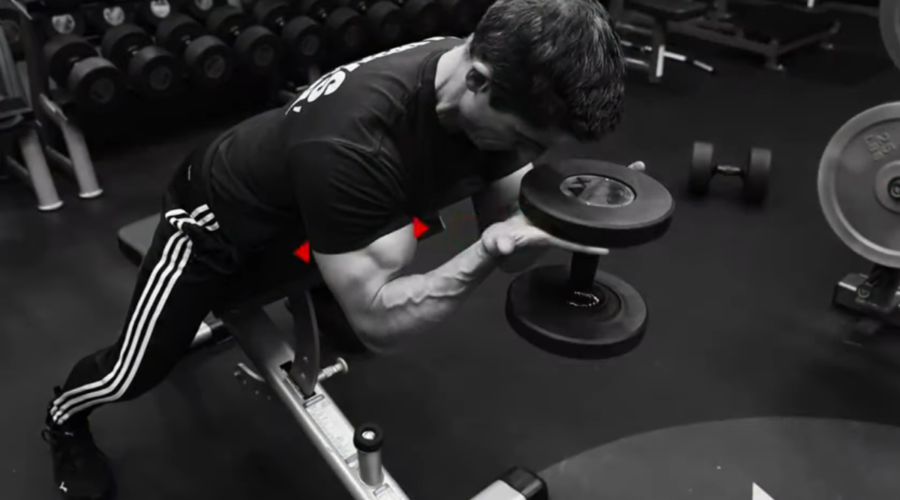


Everyone wants bigger, stronger arms, but not every biceps exercise delivers the same results. While classics like barbell curls, preacher curls, and incline dumbbell curls have earned their place in strength training, a less familiar movement has quietly gained popularity among physique athletes and fitness enthusiasts. It is called the waiter curl.
The waiter curl looks simple. You hold one dumbbell with both hands underneath the top plate, almost as if you were carrying a tray in a restaurant, then curl the weight upward while keeping your elbows close to your body. The movement feels different from traditional curls because your hands remain close together and your wrists stay in a neutral position throughout the lift.



Some lifters claim it creates an incredible biceps pump and builds thicker arms faster than conventional curls. Others argue it is simply another variation with no unique benefits. So is the waiter curl really the perfect arm exercise for muscular biceps?
The answer depends on what you mean by perfect. Science suggests it offers several advantages, but it also has clear limitations. Understanding how the biceps work and what drives muscle growth makes it much easier to decide whether the waiter curl deserves a place in your training.
What Is the Waiter Curl?
The waiter curl is a bilateral dumbbell curl performed with both hands supporting a single dumbbell underneath one of its plates.
Instead of gripping a handle in each hand, both palms support the weight from below. During the movement, the dumbbell travels in a vertical path from around waist height toward the upper chest while the elbows remain tucked close to the sides.
This grip changes several aspects of the exercise. Wrist rotation is almost eliminated, both arms work together, and the exercise naturally encourages strict technique because swinging the weight is much more difficult.
Although the movement looks unusual, the muscles involved are familiar.
Which Muscles Does the Waiter Curl Work?
The primary muscle is the biceps brachii. The biceps has two heads. The long head sits on the outside of the upper arm and contributes to the famous biceps peak. The short head sits on the inside and contributes to overall arm thickness.
How Many Push Ups Should Beginners Be Able to Do?
The waiter curl also recruits the brachialis, which lies underneath the biceps. Developing this muscle can make the arms appear larger because it pushes the biceps upward. The brachioradialis, located in the forearm, also assists during elbow flexion.
Because both hands stabilize one weight together, the forearm muscles, finger flexors, and wrist stabilizers remain active throughout the lift.
Why Muscle Growth Happens
To judge any exercise fairly, it helps to understand what actually causes muscles to grow. Research consistently identifies mechanical tension as the primary driver of hypertrophy. When muscles produce force while under load, they experience adaptations that increase muscle size over time. Training volume also plays a major role. Multiple sets performed close to muscular failure stimulate greater growth than minimal training.
Metabolic stress and muscle damage may also contribute, although they appear less important than progressive overload and sufficient training volume.
This means the best exercise is rarely the one that feels hardest. Instead, it is the one that allows you to repeatedly expose the target muscle to high levels of tension while recovering well enough to improve over time.
What Makes the Waiter Curl Different?
A Neutral Wrist Position
Many lifters experience wrist discomfort during heavy barbell curls or straight bar EZ bar curls. The waiter curl naturally places the wrists in a comfortable neutral position. This reduces unwanted joint stress while allowing the elbows to perform most of the work.
For people with previous wrist irritation, this alone can make the exercise much more comfortable.
Strict Technique
Cheating becomes much harder. Because both hands support one dumbbell, excessive swinging immediately disrupts the movement. Lifters naturally slow down and maintain better control during both the lifting and lowering phases. Controlled repetitions generally increase time under tension and reduce momentum, helping the biceps remain loaded throughout the movement.
Constant Muscle Tension
The unique grip encourages continuous squeezing of the dumbbell while curling. This often produces an intense muscle contraction, particularly near the top of the range of motion.
Although feeling a stronger contraction does not automatically produce greater hypertrophy, maintaining muscular tension during controlled repetitions is generally associated with effective resistance training.

Can You Lift Heavy Enough?
One limitation of the waiter curl is loading. Holding one dumbbell underneath the plate becomes increasingly awkward as the weight gets heavier. Grip security often becomes the limiting factor before the biceps are fully challenged. For beginners this rarely matters.
For advanced lifters curling very heavy dumbbells, other exercises may allow greater loading while maintaining safety. Fortunately, muscle growth does not require maximal loads. Research consistently shows that moderate and even relatively light loads can produce significant hypertrophy when sets are performed close to failure. Therefore, the waiter curl remains an excellent choice within moderate repetition ranges of approximately 10 to 20 repetitions.
The Mind Muscle Connection
One area where the waiter curl often shines is the mind muscle connection. The unusual grip encourages lifters to focus on squeezing the biceps rather than simply moving the weight.
Research suggests experienced lifters can increase activation of specific muscles by intentionally focusing attention on them during an exercise. While this does not replace progressive overload, improving concentration may increase training quality, especially during moderate repetition sets.
Many bodybuilders intentionally use this strategy during isolation exercises. The waiter curl naturally encourages it.
How to Perform the Waiter Curl Correctly
- Stand upright with your feet approximately shoulder width apart.
- Hold one dumbbell underneath the top plate using both palms.
- Keep your elbows close to your torso throughout the movement.
- Curl the dumbbell upward toward your chest by bending your elbows.
- Pause briefly near the top while squeezing your biceps as hard as possible.
- Lower the weight slowly until your elbows are fully extended.
- Repeat using controlled repetitions without swinging your body.
The Best Exercises to Pair With the Waiter Curl
Because the waiter curl emphasizes strict contraction, combining it with exercises that emphasize stretched positions creates a balanced program.
- Incline dumbbell curls provide significant loading while the muscle is lengthened.
- Cable curls maintain tension throughout the movement because resistance remains relatively constant.
- Hammer curls increase brachialis development while also strengthening the forearms.
- Pull ups performed with a supinated grip provide additional heavy biceps stimulation alongside compound back training.
Together, these movements create a comprehensive approach to arm development.
Who Should Use the Waiter Curl?
The waiter curl is an excellent option for beginners because it teaches controlled technique while reducing excessive body movement. Intermediate lifters often benefit from the improved muscle contraction and comfortable wrist position.
Advanced bodybuilders may use it as a finishing exercise to increase metabolic stress after heavier compound and isolation work. It is also valuable for people returning from mild wrist irritation who find straight bar curls uncomfortable.
However, competitive strength athletes focused on maximizing absolute loading may still rely more heavily on barbell and cable variations.
Is It the Perfect Arm Exercise?
The waiter curl is not a magic exercise. No single movement builds massive arms by itself. Instead, it is an effective variation that combines strict technique, comfortable joint positioning, and excellent muscle contraction.
Its biggest strengths are control, comfort, and the ability to isolate the biceps with minimal momentum. Its biggest weakness is limited loading compared with traditional barbell or dumbbell curls and a reduced emphasis on training the biceps at long muscle lengths.
For most people, the smartest approach is not replacing every curl with waiter curls. Instead, include it alongside other proven exercises to expose the muscles to different angles, loading patterns, and ranges of motion. When combined with progressive overload, adequate protein intake, sufficient recovery, and consistent training, the waiter curl can absolutely contribute to bigger, stronger, and more muscular biceps.
It may not be the perfect arm exercise, but it is certainly one of the most underrated.
Key Takeaways
| Topic | Takeaway |
|---|---|
| Primary muscles | Targets the biceps brachii while also training the brachialis, brachioradialis, and forearm stabilizers. |
| Main advantage | Encourages strict technique and a strong muscle contraction with minimal momentum. |
| Best rep range | Around 10 to 20 repetitions performed close to muscular failure. |
| Loading potential | Limited compared with heavy barbell curls because grip becomes the limiting factor. |
| Best use | Secondary hypertrophy exercise after compound pulling movements. |
| Should it replace all curls? | No. It works best alongside incline curls, cable curls, hammer curls, and other proven variations. |
| Overall verdict | An excellent but underrated biceps exercise that supports muscle growth when included in a well designed training program. |
References
- American College of Sports Medicine. (2009). Progression models in resistance training for healthy adults. Medicine & Science in Sports & Exercise, 41(3), 687-708.
- Gentil, P., Soares, S. and Bottaro, M. (2015). Single versus multi joint resistance exercises for muscle strength and hypertrophy. Sports Medicine, 45(6), 841-851.
- Grgic, J., Schoenfeld, B.J. and Latella, C. (2020). Resistance training intensity and muscle hypertrophy. Sports Medicine, 50(7), 1201-1222.
- Maeo, S., Ando, Y., Kanehisa, H. and Kawakami, Y. (2021). Effect of muscle length during resistance training on muscle hypertrophy. Scandinavian Journal of Medicine & Science in Sports, 31(5), 1031-1042.
- Schoenfeld, B.J. (2010). The mechanisms of muscle hypertrophy and their application to resistance training. Journal of Strength and Conditioning Research, 24(10), 2857-2872.
- Schoenfeld, B.J., Ogborn, D. and Krieger, J.W. (2017). Dose response relationship between weekly resistance training volume and increases in muscle mass. Journal of Sports Sciences, 35(11), 1073-1082.
- Schoenfeld, B.J., Grgic, J., Ogborn, D. and Krieger, J.W. (2019). Strength and hypertrophy adaptations between low load and high load resistance training. Journal of Strength and Conditioning Research, 33(Suppl. 1), S1-S18.
- Signorile, J.F., Zink, A.J. and Szwed, S.P. (2002). A comparative electromyographical investigation of muscle utilization patterns using various hand positions during the biceps curl. Journal of Strength and Conditioning Research, 16(4), 541-548.
- Wakahara, T., Fukutani, A., Kawakami, Y. and Yanai, T. (2013). Nonuniform muscle hypertrophy. Medicine & Science in Sports & Exercise, 45(11), 2158-2169.