

Walk into almost any commercial gym and you will see rows of cable machines, resistance machines, and specialized equipment promising bigger muscles. While these tools can certainly help, they are not essential. If I had to build a muscular upper body from scratch using only free weights, I would have no hesitation. A pair of dumbbells, a barbell, a bench, and some weight plates are more than enough.
Free weights remain one of the most effective ways to develop muscle mass because they allow natural movement patterns, recruit stabilizing muscles, and make progressive overload straightforward. They also provide enormous exercise variety without requiring expensive equipment.


The approach below focuses on building a complete upper body, including the chest, back, shoulders, arms, and upper traps, while maximizing muscle growth according to current scientific evidence.
Why Free Weights Are More Than Enough
The primary driver of muscle growth is not the equipment you use. It is applying sufficient mechanical tension, training close to muscular failure, accumulating enough weekly volume, and recovering properly.
Research consistently shows that when training volume and effort are matched, free weights and machines produce similar increases in muscle size. The deciding factor is how hard you train rather than whether the resistance comes from a machine or a dumbbell.
How Long Must You Be Able to Hold a Plank?
Free weights offer several practical advantages. They allow unrestricted movement that matches individual anatomy. They improve coordination and stability because more muscles contribute to controlling the load. They also make compound exercises easier to perform, allowing you to train multiple muscle groups simultaneously. For someone looking to build an impressive upper body, free weights can provide every stimulus needed.
The Principles I Would Follow
Before choosing exercises, I would focus on the variables that science has repeatedly shown matter most.
Progressive Overload
Muscles only grow when they are challenged beyond what they have previously experienced. This can mean adding weight to the bar, performing more repetitions with the same load, improving technique, increasing training volume, or reducing rest periods over time. Progressive overload remains one of the most fundamental principles of resistance training and is essential for continued muscle growth.
Train Close to Failure
You do not need to reach complete muscular failure on every set. However, studies show that stopping within one to three repetitions of failure produces excellent hypertrophy while reducing unnecessary fatigue. Every working set should feel challenging.
Prioritize Weekly Volume
Research suggests that around ten to twenty challenging sets per muscle group each week produces excellent hypertrophy for most lifters. Beginners often make excellent progress with the lower end of this range, while experienced lifters frequently benefit from higher volumes provided recovery is adequate.
Use a Variety of Rep Ranges
Muscle growth can occur across a broad range of repetitions.
- Heavy sets of five to eight repetitions build strength and create high mechanical tension.
- Moderate sets of eight to twelve repetitions remain a classic hypertrophy range.
- Higher repetition sets of twelve to twenty repetitions can also stimulate muscle growth when performed close to failure.
Using all three ranges throughout the week provides variety while reducing repetitive joint stress.
The Exercises I Would Build Around
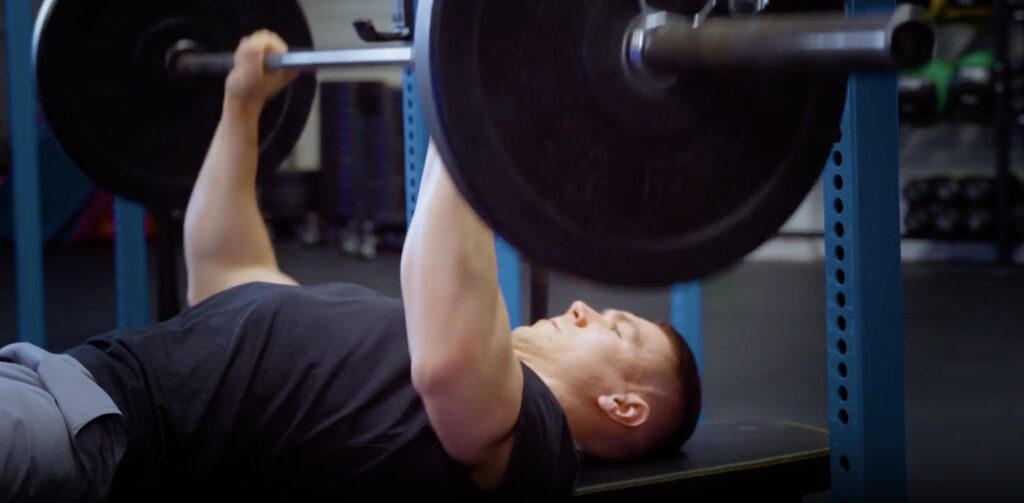
Flat Barbell Bench Press
If I could only choose one exercise for chest development, it would be the flat barbell bench press. The movement allows heavy loading while training the pectoralis major, anterior deltoids, and triceps simultaneously.
Heavy pressing builds overall upper body strength while providing one of the strongest growth stimuli for the chest. I would perform it early in the workout while fresh.
Incline Dumbbell Press
The upper chest often receives less attention than the middle portion of the pectorals. An incline dumbbell press places greater emphasis on the clavicular fibers while allowing a larger range of motion than many barbells.
Because each arm works independently, dumbbells also help correct side to side strength differences. The deeper stretch achieved with dumbbells may further enhance muscle growth by increasing mechanical tension at longer muscle lengths.
One Arm Dumbbell Row
A wide, thick back creates the appearance of a powerful upper body. The one arm dumbbell row trains the latissimus dorsi, rhomboids, trapezius, rear deltoids, and biceps while allowing excellent control over technique. Using one arm at a time also improves stability and lets you focus on achieving a full stretch and contraction.
Barbell Bent Over Row
The bent over row complements vertical pulling movements by emphasizing back thickness. It challenges the upper back while strengthening the spinal erectors and core. Maintaining strict technique with controlled repetitions helps maximize muscle activation while reducing unnecessary momentum.
Standing Barbell Overhead Press
Broad shoulders dramatically improve the appearance of the upper body. The standing overhead press develops the anterior and lateral deltoids while heavily recruiting the triceps and upper chest. Standing rather than sitting increases trunk stability demands and develops total body strength alongside shoulder size.
Dumbbell Lateral Raise
No exercise isolates the middle deltoids as effectively as the lateral raise. Wide shoulders contribute enormously to the classic V shaped physique.

Using moderate weights with strict technique produces constant tension throughout the movement. Slow lowering phases help maximize muscle stimulation.
Rear Delt Dumbbell Fly
The rear deltoids are often neglected despite their importance for posture, shoulder health, and balanced development. Rear delt flyes strengthen the muscles responsible for shoulder extension and horizontal abduction while adding depth to the upper back. Balanced shoulder development also reduces the risk of muscular imbalances.
Barbell Curl
Big arms remain a priority for many lifters. The standing barbell curl allows consistent loading of both heads of the biceps while making progressive overload easy. Keeping the elbows fixed throughout the movement ensures the biceps perform the majority of the work.

Incline Dumbbell Curl
The incline curl stretches the biceps into a longer starting position than traditional curls. Growing evidence suggests exercises that challenge muscles under stretch may produce greater hypertrophy than shorter range movements alone. Using lighter weights with controlled movement helps maximize this advantage.
Lying Dumbbell Triceps Extension
The triceps make up roughly two thirds of the upper arm. The long head of the triceps crosses the shoulder joint, making overhead and stretched positions particularly valuable for growth. Lying dumbbell extensions create substantial tension through a large range of motion.
Dumbbell Shrugs
Well developed upper traps complete the appearance of a muscular upper body. Heavy dumbbell shrugs allow extremely high loading while keeping technique relatively simple. Holding the top contraction briefly enhances muscular activation.
The Workout I Would Follow
I would train the upper body twice each week. This frequency provides enough volume for muscle growth while allowing recovery between sessions.
Workout One
- Flat Barbell Bench Press for four sets of six to eight repetitions.
- Barbell Bent Over Row for four sets of six to eight repetitions.
- Standing Barbell Overhead Press for three sets of eight to ten repetitions.
- One Arm Dumbbell Row for three sets of ten to twelve repetitions.
- Barbell Curl for three sets of eight to twelve repetitions.
- Lying Dumbbell Triceps Extension for three sets of ten to twelve repetitions.
- Dumbbell Lateral Raise for three sets of fifteen repetitions.
Workout Two
- Incline Dumbbell Press for four sets of eight to twelve repetitions.
- One Arm Dumbbell Row for four sets of eight to twelve repetitions.
- Standing Barbell Overhead Press for three sets of six to eight repetitions.
- Rear Delt Dumbbell Fly for three sets of twelve to fifteen repetitions.
- Incline Dumbbell Curl for three sets of ten to fifteen repetitions.
- Lying Dumbbell Triceps Extension for three sets of ten to fifteen repetitions.
- Dumbbell Shrugs for three sets of twelve repetitions.
How Hard I Would Train
Every working set would finish with approximately one to three repetitions left before failure. This intensity provides a strong stimulus for hypertrophy without accumulating excessive fatigue.
Warm up thoroughly before the first compound movement, then use consistent technique on every repetition. Quality matters more than simply moving heavier weights.
Final Thoughts
If every cable machine disappeared tomorrow, I would not change my goal of building a muscular upper body. Free weights have helped generations of athletes develop strength and size because they provide everything required for muscle growth. Compound lifts create the foundation, isolation exercises fill in the details, progressive overload keeps improvements coming, and proper nutrition and recovery allow those improvements to become permanent.
There is nothing magical about expensive equipment. Consistent effort, intelligent programming, and patience remain the real secrets behind building a jacked upper body. Master a handful of proven free weight exercises, train hard week after week, and your physique will steadily improve.
Key Takeaways
| Principle | Recommendation |
|---|---|
| Main Goal | Build muscle through progressive overload and consistent training |
| Weekly Frequency | Train the upper body twice per week |
| Weekly Volume | Aim for approximately 10 to 20 challenging sets per muscle group |
| Intensity | Finish most working sets with 1 to 3 repetitions left in reserve |
| Primary Compound Lifts | Bench press, overhead press, bent over row, dumbbell row |
| Key Isolation Exercises | Lateral raises, rear delt flyes, curls, triceps extensions, shrugs |
| Rep Ranges | Use 6 to 20 repetitions depending on the exercise |
| Protein Intake | Approximately 1.6 to 2.2 grams per kilogram of body weight daily |
| Sleep | Aim for 7 to 9 hours each night |
| Biggest Mistake | Failing to progressively overload while maintaining proper technique |
References
- American College of Sports Medicine. (2009). Progression models in resistance training for healthy adults. Medicine & Science in Sports & Exercise, 41(3), 687-708.
- Grgic, J., Schoenfeld, B.J., Orazem, J. and Sabol, F. (2022). Effects of resistance training performed to repetition failure or non failure on muscular strength and hypertrophy. Journal of Sport and Health Science, 11(2), 202-211.
- Morton, R.W., Murphy, K.T., McKellar, S.R., Schoenfeld, B.J., Henselmans, M., Helms, E., Aragon, A.A., Devries, M.C., Banfield, L., Krieger, J.W. and Phillips, S.M. (2018). A systematic review, meta analysis and meta regression of protein supplementation on resistance training induced gains in muscle mass and strength. British Journal of Sports Medicine, 52(6), 376-384.
- Schoenfeld, B.J. (2010). The mechanisms of muscle hypertrophy and their application to resistance training. Journal of Strength and Conditioning Research, 24(10), 2857-2872.
- Schoenfeld, B.J., Grgic, J., Ogborn, D. and Krieger, J.W. (2017). Strength and hypertrophy adaptations between low load and high load resistance training. Journal of Strength and Conditioning Research, 31(12), 3508-3523.
- Schoenfeld, B.J., Ogborn, D. and Krieger, J.W. (2016). Effects of resistance training frequency on measures of muscle hypertrophy. Sports Medicine, 46(11), 1689-1697.
- Schoenfeld, B.J., Grgic, J., Van Every, D.W. and Plotkin, D.L. (2021). Loading recommendations for muscle strength, hypertrophy, and local endurance. Strength and Conditioning Journal, 43(1), 32-41.
- Wackerhage, H., Schoenfeld, B.J., Hamilton, D.L., Lehti, M. and Hulmi, J.J. (2019). Stimuli and sensors that initiate skeletal muscle hypertrophy following resistance exercise. Journal of Applied Physiology, 126(1), 30-43.
- Wilk, M., Golas, A., Krzysztofik, M., Nawrocka, M. and Zajac, A. (2020). The effects of eccentric cadence on power and strength in resistance exercise. International Journal of Environmental Research and Public Health, 17(13), 4574.