

Gym wisdom loves tidy rules of thumb like squatting one-and-a-half or two times your body weight as proof of real leg strength, yet those quick shortcuts often overlook how human anatomy and scaling laws work in practice.
Judging two lifters simply by dividing the weight on the bar by their scale weight sounds straightforward, but biomechanics and exercise physiology tell a much deeper story.
Let’s dive into how these relationships shift as you get bigger, and how much you should lift based on your size and weight.
Why Simple Bodyweight Ratios Can Mislead You
For decades, lifters have leaned on simple weight-per-pound ratios to decide whether a squat number is impressive, average, or disappointing. Calling a lift a double-bodyweight squat gives an instant mental picture, yet it treats human strength as though it rises in a neat straight line alongside scale weight.
Exercise science research on allometric scaling demonstrates that maximal strength increases with body mass using a fractional exponent rather than a simple one-to-one ratio, meaning heavier lifters typically move heavier total loads while lighter lifters often post higher relative ratios per pound of body weight.
This happens largely because body volume and total mass expand faster than muscle cross-sectional area when a person becomes larger across three dimensions. In addition, a barbell back squat requires moving your own torso and upper body along with the barbell, which means heavier lifters already carry more mass through every single repetition even before plates are added to the bar. Relying strictly on a basic bodyweight ratio can flatter smaller athletes while making taller or heavier lifters look artificially weak even when their force production is right on track.
What Actually Drives Your Squat Numbers
Two lifters can step onto the scale at the exact same weight and still walk away with vastly different squat capabilities. Skeletal muscle mass across the quadriceps, glutes, adductors, and spinal erectors supplies the contractile force needed to control the descent and drive the barbell back up out of the bottom position.
Research examining strength performance and body composition indicates that lean body mass is strongly associated with maximal lifting output, whereas extra body fat adds scale weight without contributing contractile force to the lift.
Individual anatomy and training history also shape how much weight you can realistically squat with clean mechanics. Biomechanical studies on squat performance show that femur length, tibia length, torso angle, and stance width alter joint moments at the hips, knees, and lower back, which changes how load is distributed across working muscles. At the same time, consistent exposure to progressive resistance training builds neural efficiency, motor unit recruitment, and structural muscle growth that develop over months and years rather than overnight.
How Squat Benchmarks Scale Across Bodyweights
Even though limb lengths, depth standards, and training experience create wide individual variation, structured strength tables still give lifters a practical way to gauge current progress and set realistic goals. Viewing a chart as a helpful milestone guide rather than a strict judgment keeps your focus on steady improvement rather than ego comparisons.
Whether you weigh 145 pounds or 225 pounds, your training age and consistency determine which tier fits you best right now.
Squat Reference Guide for Adult Men
| Bodyweight | Beginner (1RM) | Novice (1RM) | Intermediate (1RM) | Advanced (1RM) |
|---|---|---|---|---|
| 145 lbs (66 kg) | 110 lbs (50 kg) | 150 lbs (68 kg) | 195 lbs (88 kg) | 250 lbs (113 kg) |
| 165 lbs (75 kg) | 125 lbs (57 kg) | 175 lbs (79 kg) | 225 lbs (102 kg) | 290 lbs (132 kg) |
| 185 lbs (84 kg) | 140 lbs (64 kg) | 195 lbs (88 kg) | 255 lbs (116 kg) | 325 lbs (147 kg) |
| 205 lbs (93 kg) | 155 lbs (70 kg) | 215 lbs (98 kg) | 280 lbs (127 kg) | 360 lbs (163 kg) |
| 225 lbs (102 kg) | 170 lbs (77 kg) | 235 lbs (107 kg) | 305 lbs (138 kg) | 390 lbs (177 kg) |
Squat Reference Guide for Adult Women
| Bodyweight | Beginner (1RM) | Novice (1RM) | Intermediate (1RM) | Advanced (1RM) |
|---|---|---|---|---|
| 115 lbs (52 kg) | 60 lbs (27 kg) | 85 lbs (39 kg) | 115 lbs (52 kg) | 150 lbs (68 kg) |
| 135 lbs (61 kg) | 70 lbs (32 kg) | 100 lbs (45 kg) | 135 lbs (61 kg) | 175 lbs (79 kg) |
| 155 lbs (70 kg) | 80 lbs (36 kg) | 115 lbs (52 kg) | 155 lbs (70 kg) | 200 lbs (91 kg) |
| 175 lbs (79 kg) | 90 lbs (41 kg) | 125 lbs (57 kg) | 170 lbs (77 kg) | 220 lbs (100 kg) |
| 195 lbs (88 kg) | 100 lbs (45 kg) | 140 lbs (64 kg) | 185 lbs (84 kg) | 240 lbs (109 kg) |
Pay attention to how the numbers step upward as body weight climbs in both tables. Absolute weight on the bar rises consistently with body size, while the relative ratio per pound of body weight eases slightly in heavier tiers, matching nonlinear allometric scaling rather than indicating a flaw in larger lifters. Working steadily to move up one tier over structured training blocks is far more rewarding than chasing an arbitrary ratio that ignores your body proportions and training history.
Smart Ways to Build a Stronger Squat for Your Frame
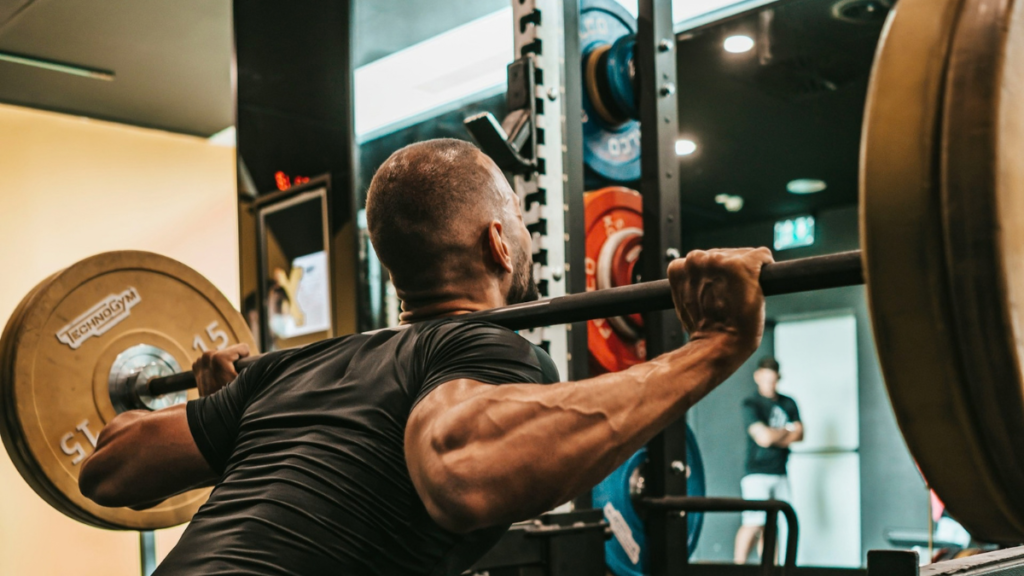
Knowing where your numbers stand is only valuable when it helps you plan smarter workouts over the next several weeks and months. Resistance training research on loading shows that heavier loads, often around eighty percent or more of your one-repetition maximum for lower-repetition sets, are especially effective for developing maximal strength, while moderate loads taken close to failure also support hypertrophy across the quads, glutes, and adductors. Pairing heavy primary squats with targeted assistance movements for your legs and trunk builds both raw force and structural durability.
Consistent depth, steady bracing, and sensible recovery between sessions matter just as much as adding plates to the bar. Creating solid intra-abdominal pressure before descending, hitting a repeatable depth on every working set, and giving your lower body enough recovery between heavy squat days allow your strength to climb smoothly over time. Focus on clean mechanics and gradual progression over months rather than comparing your lift to whoever happens to be squatting in the next rack.
Key Takeaways for Scaling Squat Strength
| Topic | Main Takeaway |
|---|---|
| Bodyweight Ratios | Simple bodyweight ratios can mislead because strength scales nonlinearly with body mass and ignores frame differences. |
| Body Composition | Lean muscle mass drives squatting force, whereas extra body fat adds weight without contributing contractile strength. |
| Anatomy and Training Age | Limb proportions, torso angles, and consistent training experience shape realistic squat milestones across weight classes. |
| Smart Progression | Heavy compound squats, targeted leg accessories, repeatable depth, and adequate recovery drive steady strength gains. |
References
- Cholewa, J.M., Ruiz, R.J., Santiago, A. and Zanchi, N.E., 2019. Anthropometrics and powerlifting performance: The influence of body composition and segment lengths. Journal of Human Kinetics, 68(1), pp.197-206.
- Dooman, C.S. and Vanderburgh, P.M., 2000. Allometric modeling of the bench press and squat: Who is the strongest regardless of body mass? Journal of Strength and Conditioning Research, 14(1), pp.32-36.
- Schoenfeld, B.J., Grgic, J., Van Every, D.W. and Plotkin, D.L., 2021. Loading recommendations for muscle strength, hypertrophy, and local endurance: A re-examination of the repetition continuum. Sports, 9(2), p.32.
- Solberg, P., Paulsen, G., Sjøberg, N.S. and Rønnestad, B.R., 2023. Association of strength performance in bench press and squat with anthropometric variables in resistance-trained men and women. Sports, 11(1), p.19.