For many lifters, a 100kg bench press is the first major strength milestone that feels truly meaningful. It is heavy enough to demand genuine upper body strength, sound lifting mechanics, purposeful programming, and months of consistent work. It is also a benchmark that many gym goers chase for years without quite reaching.
The reason is usually simple. They spend too much time testing the final lift and not enough time building the qualities that make it possible. A successful 100kg bench press is not just a strong chest. It is the result of muscle mass, pressing skill, force production, triceps strength, upper back stability, confidence under load, and the ability to recover from productive training.


Before you attempt 100kg, these four benchmark sets are useful targets:
- 60kg for 20 repetitions.
- 70kg for 14 repetitions.
- 80kg for 8 repetitions.
- 90kg for 4 repetitions.
They are not magic numbers, and no repetition formula can perfectly predict every person’s one repetition maximum. Individual differences in technique, limb length, muscle fiber characteristics, and experience with high intensity lifting all matter. However, these targets provide a practical way to assess whether you have built the broad strength base needed to press 100kg with good form.
Why These Four Numbers Matter
A one repetition maximum is the final expression of several physical qualities. Heavy singles are important because you need experience handling substantial loads, but max attempts alone are a poor way to build strength. Repeatedly testing your limit creates fatigue and gives you little opportunity to accumulate the high quality training volume that supports muscle growth and technical improvement.
The four benchmarks work because they cover different points on the strength spectrum. The lighter sets challenge muscular endurance and work capacity. The middle sets combine meaningful load with enough repetitions to build muscle and reinforce sound technique. The heavier sets develop the ability to produce force while remaining stable and coordinated under pressure.
When you can bench press 60kg for 20 controlled repetitions, you have developed a useful level of pressing capacity. Your chest, triceps, and shoulders can tolerate repeated work, while your upper back and trunk must stay stable across a long set. When you can bench press 90kg for four good repetitions, you are already handling 90 percent of the target weight for multiple reps. That suggests that the force production required for 100kg is close.
The key word is balance. A lifter who can perform only heavy triples may lack the muscle and work capacity needed for long term progress. Another lifter may have excellent endurance but struggle when loads become demanding. Building both qualities gives you a more reliable route to the milestone.
What Each Benchmark Tells You
60kg for 20 Repetitions
This is the volume benchmark. Twenty repetitions with 60kg requires control, muscular endurance, and a fair amount of local fatigue resistance in the chest, shoulders, and triceps. It also exposes weak technique. If your upper back loses position, your elbows flare uncontrollably, or the bar path becomes inconsistent after ten repetitions, you have identified an area that needs attention.
Higher repetition work can contribute to hypertrophy when sets are performed hard enough and total training volume is sufficient. More muscle mass does not automatically guarantee a bigger bench press, but it increases the potential for force production. A larger and stronger chest and triceps give you more physical capacity to turn into pressing strength later.
This set should not be a bouncing, rushed effort. Use a controlled descent, touch the bar consistently on the chest, and press with the same technique you would use on a heavy set. If you can complete 20 clean repetitions with one or two repetitions still in reserve, you have a strong base for the next phase.
70kg for 14 Repetitions
This is a useful bridge between endurance and strength. Fourteen repetitions with 70kg is demanding enough to require meaningful muscle mass and technique, but it is still light enough to create productive training volume.
This target is particularly useful for lifters who have been training in very low repetition ranges for too long. It shows that you can accumulate work without breaking down. That matters because bench press progress depends on repeated exposure to quality sets over months, not a handful of maximal lifts.
A 70kg set of 14 also gives you confidence. The weight is no longer just a warm up, but you are moving it for enough repetitions to see that your pressing capacity is improving. As the number of repetitions rises, the target of 100kg begins to feel more realistic rather than abstract.
80kg for 8 Repetitions
This is the classic strength and hypertrophy benchmark. Eight repetitions at 80kg requires a solid combination of muscle, force production, and technical consistency. It is heavy enough that you cannot rely on endurance alone, yet it still provides enough repetition practice to improve your groove under load.
For many lifters, this is where the relationship to a 100kg bench press becomes obvious. Common prediction equations often estimate a one repetition maximum around the 100kg mark from a clean set of eight at 80kg. Those equations are estimates rather than promises, but they become more useful when they agree with other performance markers.
To make the set meaningful, keep the range of motion consistent. The bar should touch the chest on every repetition. Your feet should remain planted, your shoulders should stay pulled back against the bench, and the final repetitions should not become half reps or assisted lifts. If you can bench 80kg for eight repetitions with steady technique, you have developed a substantial portion of the strength needed for 100kg.
90kg for 4 Repetitions
This is the most specific benchmark because it puts you close to the target load. Four repetitions at 90kg show that you can maintain tension, stability, and bar control when the weight is heavy enough to demand full concentration.
This set develops neural efficiency. As loads increase, the nervous system must recruit more motor units and coordinate them effectively. Heavy bench pressing also teaches you how to stay tight through the upper back, legs, core, and grip while producing force through the chest and triceps.
A clean set of four at 90kg does not mean you must be able to bench 100kg that same day. Some lifters perform better with repetitions than with singles, while others are particularly good at heavy one rep efforts. Still, it is a strong sign that a well timed 100kg attempt is within reach, especially if you have also achieved the lighter benchmarks.
The Relationship Between Repetitions and Maximal Strength
Strength coaches have used repetition performance to estimate maximal strength for decades. When the lift, technique, range of motion, and effort level are consistent, submaximal sets can provide a useful estimate of one repetition maximum performance.
The relationship is not exact because repetitions at a given percentage of maximum vary between individuals. An experienced powerlifter may perform fewer repetitions at 80 percent of maximum than a newer lifter with better muscular endurance. That is why it is better to use several benchmarks instead of relying on only one calculation.
If 70kg for 14, 80kg for 8, and 90kg for 4 all point toward the same approximate maximum, you have stronger evidence that your strength is well rounded. You are not depending on one exceptional set. You have developed endurance, muscle building volume tolerance, strength, and familiarity with heavier loads.
Build Muscle Before You Expect Peak Strength
The bench press depends heavily on the pectoral muscles, triceps, anterior deltoids, and the muscles that stabilize the shoulder blades and upper back. If these tissues are underdeveloped, there is only so much progress that better programming can produce.
This is why phases of moderate repetition training matter. Sets in the range of roughly six to 15 repetitions are efficient for accumulating hard training volume. They allow you to practice the lift, challenge the target muscles, and recover more effectively than if every workout consisted of near maximal attempts.
Use the bench press itself as the main movement, then add sensible assistance work that addresses your weak points. Close grip bench pressing can build triceps strength and improve lockout performance. Incline dumbbell pressing can add pressing volume through a long range of motion. Rows and pulldowns help build the upper back strength required to create a stable platform on the bench. Overhead pressing can develop the shoulders, although it should be programmed carefully if your pressing volume is already high.
The goal is not to collect endless exercises. The goal is to strengthen the muscles and positions that let you bench press more effectively.
Train Heavy Enough to Learn the Skill
Once you have built a base, you must spend time with heavier loads. Maximal strength is specific. A lifter who trains only sets of 15 may build plenty of muscle but still lack the coordination and confidence to press 100kg.
This is where sets of three to six repetitions become valuable. They expose you to heavier weights without the excessive fatigue of constant maximal singles. You learn to unrack the bar with control, hold your upper back position, use leg drive, lower the weight under control, and press in a repeatable path.
Two or three bench press sessions per week can work well when volume is managed intelligently. One session can emphasize heavier work, one can focus on moderate repetitions, and an optional third session can use lighter technique work or a close grip variation. Training a movement more often gives you more chances to practice it, but extra sessions only help if you can recover from them.
Technique Makes Strength Transfer to the Bar
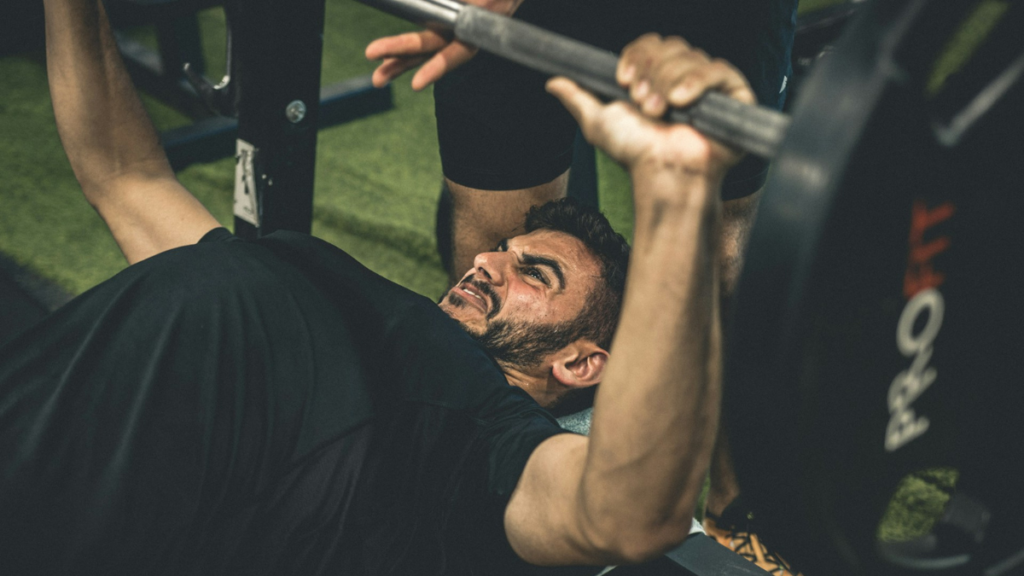
A stronger chest will not fully show up in your bench press if you are unstable on the bench. Start each repetition by setting your upper back firmly against the pad. Keep your shoulder blades pulled back and down, maintain contact between your feet and the floor, and create tension before the bar leaves the rack.
Lower the bar under control to a consistent point on your chest. The most effective bar path is rarely perfectly vertical. For many lifters, the bar travels slightly down and forward during the descent before moving back toward the shoulders as it is pressed. This allows the chest, shoulders, and triceps to contribute efficiently.
Do not turn every hard set into a form breakdown contest. If your hips rise, your shoulders lose contact, or the bar bounces off your chest, the set has stopped measuring the strength you want to build. Clean repetitions are more useful than inflated numbers.
Recovery Determines Whether Training Works
Your body gets stronger after training, not during it. The workout provides the stimulus, but recovery allows the muscles, connective tissues, and nervous system to adapt. Lifters often plateau because they add more sets, more exercises, and more heavy attempts while ignoring sleep, nutrition, and fatigue.
Aim for consistent sleep, adequate daily protein, enough calories to support your goal, and regular rest days. Most adults should target seven to nine hours of sleep per night, especially when they are training hard. If your elbows and shoulders ache continuously, your bar speed is falling, and every session feels worse than the last, you may need a reduction in training volume rather than more effort.
A deload week can also be useful after several hard weeks. Reduce the load, the number of sets, or both for a short period, then return to harder training with fresher joints and better performance.
Make Your 100kg Attempt Count
When you have hit the benchmarks, do not test 100kg at the end of an exhausting workout. Spend one or two weeks practicing singles that feel controlled, such as 90kg or 95kg, while reducing overall volume. This lets fatigue fall without losing the strength you have built.
Before You Chase Bigger Arms, Build These 3 Foundations
On test day, warm up gradually. Use enough lighter sets to feel prepared, but avoid wasting energy. Set up carefully, use the same technique you have practiced throughout training, and treat the 100kg attempt as a normal repetition with a heavier bar.
A 100kg bench press is a satisfying milestone, but it should be the result of training rather than the entire purpose of it. Build the foundation first, and the final lift becomes much more likely to move.
References
- American College of Sports Medicine (2009) ‘American College of Sports Medicine position stand: Progression models in resistance training for healthy adults’, Medicine & Science in Sports & Exercise, 41(3), pp. 687–708.
- Grgic, J., Schoenfeld, B.J., Davies, T.B., Lazinica, B., Krieger, J.W. and Pedisic, Z. (2018) ‘Effect of resistance training frequency on gains in muscular strength: A systematic review and meta analysis’, Sports Medicine, 48(5), pp. 1207–1220.
- Helms, E.R., Aragon, A.A. and Fitschen, P.J. (2014) ‘Evidence based recommendations for natural bodybuilding contest preparation: Nutrition and supplementation’, Journal of the International Society of Sports Nutrition, 11, 20.
- LeSuer, D.A., McCormick, J.H., Mayhew, J.L., Wasserstein, R.L. and Arnold, M.D. (1997) ‘The accuracy of prediction equations for estimating 1 RM performance in the bench press, squat, and deadlift’, Journal of Strength and Conditioning Research, 11(4), pp. 211–213.
- Madsen, N. and McLaughlin, T. (1984) ‘Kinematic factors influencing performance and injury risk in the bench press exercise’, Medicine & Science in Sports & Exercise, 16(4), pp. 376–381.
- Schoenfeld, B.J., Ogborn, D. and Krieger, J.W. (2017) ‘Dose response relationship between weekly resistance training volume and increases in muscle mass: A systematic review and meta analysis’, Journal of Sports Sciences, 35(11), pp. 1073–1082.
- Schoenfeld, B.J., Peterson, M.D., Ogborn, D., Contreras, B. and Sonmez, G.T. (2015) ‘Effects of low versus high load resistance training on muscle strength and hypertrophy in well trained men’, Journal of Strength and Conditioning Research, 29(10), pp. 2954–2963.
- Williams, T.D., Tolusso, D.V., Fedewa, M.V. and Esco, M.R. (2017) ‘Comparison of periodized and non periodized resistance training on maximal strength: A meta analysis’, Sports Medicine, 47(10), pp. 2083–2100.
- Fullagar, H.H.K., Skorski, S., Duffield, R., Hammes, D., Coutts, A.J. and Meyer, T. (2015) ‘Sleep and athletic performance: The effects of sleep loss on exercise performance, and physiological and cognitive responses to exercise’, Sports Medicine, 45(2), pp. 161–186.
Key Takeaways
| Benchmark | Main quality developed | Why it matters for a 100kg bench press |
|---|---|---|
| 60kg for 20 repetitions | Muscular endurance and work capacity | Builds the ability to handle productive training volume and reinforces technique under fatigue |
| 70kg for 14 repetitions | Muscle building volume and pressing capacity | Shows that your chest, shoulders, and triceps can produce repeated high quality reps |
| 80kg for 8 repetitions | Strength and hypertrophy | Provides a strong practical indicator that your one repetition maximum is approaching 100kg |
| 90kg for 4 repetitions | Heavy load coordination and force production | Demonstrates that you can control near target weight for multiple clean repetitions |