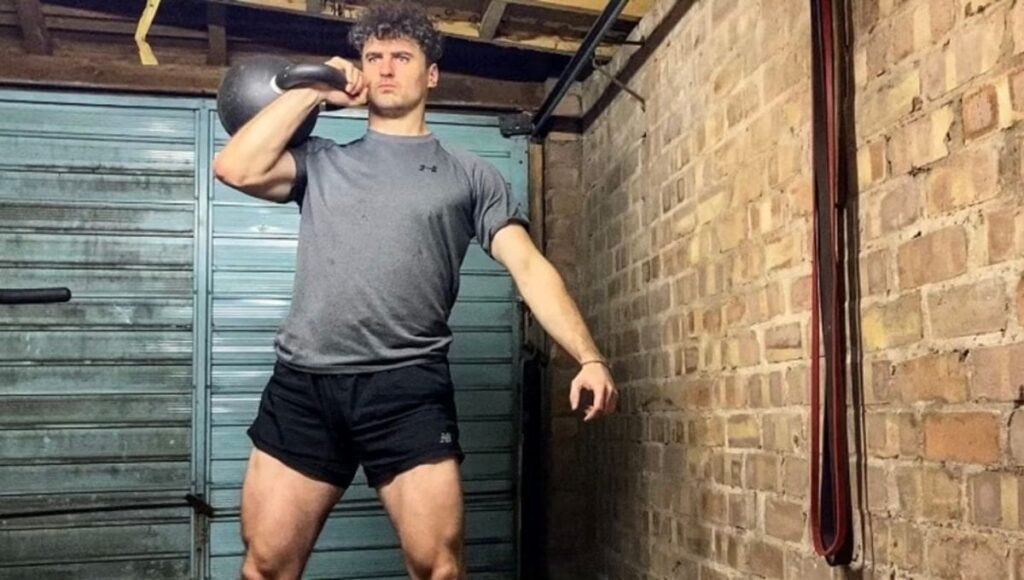
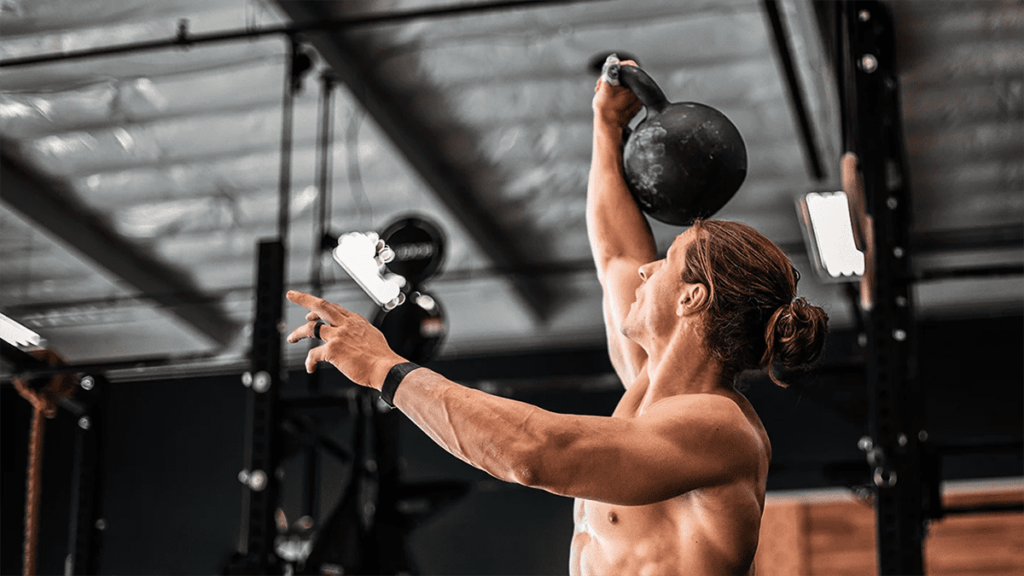
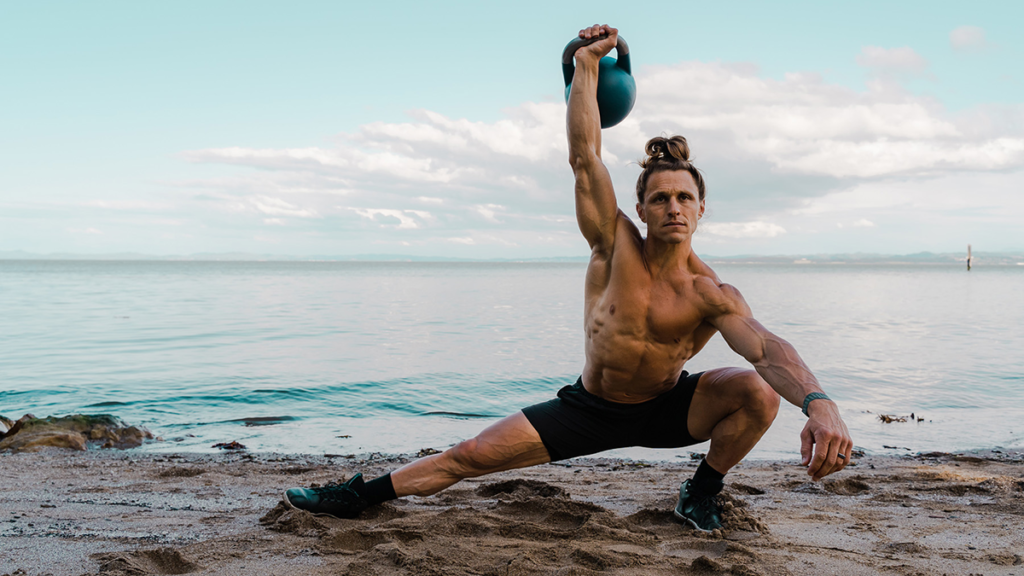
The kettlebell has become a staple in strength and conditioning, but one variation still flies under the radar even among experienced lifters. The bottoms up kettlebell press is a deceptively simple movement where you hold the kettlebell upside down with the heavy bell balanced above the handle while pressing it overhead.
At first glance, it looks like a circus trick. In reality, it is one of the most effective exercises for developing shoulder stability, grip strength, coordination, and full body tension at the same time.


Unlike a traditional overhead press, the bottoms up version forces your body to stabilize an unstable load. The kettlebell constantly tries to tip over, and every muscle from your hand to your core has to work together to keep it balanced. That unique challenge makes it a favorite among physical therapists, strength coaches, and performance specialists.
The biggest surprise is that you do not need a heavy kettlebell to benefit. In fact, lighter loads often produce greater improvements in stability because the exercise depends on control rather than brute strength.
So, is this the most perfect exercise you’ve never tried? While no single movement deserves that title for everyone, the science suggests the bottoms up kettlebell press comes remarkably close for improving upper body function, joint health, and athletic performance.
What Is the Bottoms Up Kettlebell Press?
In a standard kettlebell overhead press, the bell hangs below your hand. During a bottoms up press, you flip the kettlebell upside down so the heavy bell sits directly above the handle. This changes everything.
The center of mass moves much farther away from your hand, dramatically increasing instability. Small changes in wrist position immediately affect balance, forcing continuous corrections from the muscles of the fingers, forearm, wrist, shoulder, and trunk.
How Much Should You Be Able to Bench Press?
The exercise usually begins with the kettlebell held in the rack position before being pressed overhead under complete control. Every stage of the lift requires precise coordination because losing balance means the kettlebell tips over. That constant requirement for stability is what separates this exercise from conventional pressing variations.
Why Stability Changes the Training Effect
Muscles do not only create movement. They also resist unwanted movement. The bottoms up kettlebell press creates an environment where resisting movement becomes just as important as producing force. Instead of simply pushing weight overhead, your nervous system must continuously coordinate dozens of muscles to keep the kettlebell balanced.
Research shows unstable loading increases activation of stabilizing muscles throughout the shoulder complex while improving neuromuscular coordination. This means your body becomes better at organizing muscle activity rather than simply producing more force. That is an important distinction because shoulder injuries often occur due to poor movement control instead of insufficient strength.
For athletes and recreational lifters alike, improving movement quality can translate into healthier shoulders and more efficient lifting mechanics.
Grip Strength Becomes the Limiting Factor
One of the first things people notice is how demanding the exercise is on the hands. The kettlebell handle must remain perfectly vertical throughout the press. Any loss of grip pressure allows the bell to rotate. The muscles of the fingers and forearms work continuously through isometric contractions to maintain control. Unlike crushing a gripper or holding a heavy barbell, the grip demands constantly change as the kettlebell wobbles.
Grip strength is far more important than many people realize. Research has consistently shown that greater grip strength is associated with healthier aging, better physical function, lower disability risk, and even reduced all cause mortality. While the bottoms up press is not designed specifically as a grip exercise, it develops grip endurance and coordination in ways that traditional strength exercises often miss.
Better grip also supports heavier deadlifts, pull ups, rows, carries, climbing performance, and many athletic skills requiring strong hand control.
A Shoulder Stability Exercise Disguised as a Press
The shoulder is the most mobile joint in the human body. That mobility comes at the cost of stability. Instead of relying on deep bony structures like the hip, the shoulder depends heavily on muscles such as the rotator cuff and scapular stabilizers to maintain healthy movement. The bottoms up press demands exceptional shoulder control.
The rotator cuff must constantly stabilize the head of the humerus while the muscles around the shoulder blade coordinate upward rotation and maintain joint position. Electromyography studies comparing unstable and stable resistance exercises consistently show increased activation of stabilizing muscles when instability is introduced.
This makes the movement valuable for building resilient shoulders capable of handling both sports and everyday lifting. That does not mean it replaces heavy overhead pressing. Instead, it complements traditional strength work by improving movement quality.
Why Athletes Benefit So Much
Elite athletes rarely move in perfectly stable environments. Whether throwing, sprinting, grappling, climbing, or changing direction, they must generate force while maintaining joint control. The bottoms up kettlebell press challenges exactly those qualities.
The exercise improves proprioception, which is the body’s awareness of joint position and movement. Better proprioception contributes to faster corrections during athletic activity and may reduce injury risk by improving motor control. Athletes in combat sports, baseball, tennis, volleyball, football, basketball, and CrossFit often benefit because overhead stability directly influences performance in throwing, striking, and lifting.
The movement also reinforces coordination between the upper body and trunk, improving force transfer across the kinetic chain.
It May Improve Shoulder Health
Many shoulder rehabilitation specialists incorporate bottoms up kettlebell exercises during later stages of recovery. That is because the exercise naturally encourages proper shoulder positioning without requiring excessively heavy loads. The instability forces gradual activation of the rotator cuff while promoting controlled movement throughout the pressing pattern.
Importantly, this does not mean everyone with shoulder pain should immediately begin performing bottoms up presses. Pain requires proper assessment, and rehabilitation programs should always be individualized. However, once appropriate movement has been restored, the exercise can become an effective progression for rebuilding shoulder confidence and stability.
Research on neuromuscular shoulder training supports the use of stability focused exercises for improving joint control and reducing recurrent dysfunction.
The Nervous System Gets a Bigger Workout
Strength is not only about muscles. The nervous system determines how effectively muscles communicate and coordinate. Because the kettlebell constantly shifts, every repetition becomes a motor learning task. The brain receives continuous sensory feedback from the hand, wrist, elbow, shoulder, and trunk before making rapid adjustments.
Motor learning research consistently shows that variable and challenging movement environments improve coordination more effectively than repetitive predictable tasks. This is one reason the exercise often feels mentally exhausting despite using relatively light loads. The nervous system remains fully engaged throughout every repetition.
Why Lighter Is Usually Better
One of the biggest mistakes beginners make is choosing a kettlebell that is too heavy. Unlike conventional pressing, success depends on perfect balance rather than maximal force production.

Many experienced lifters struggle with a 12 kilogram or 16 kilogram kettlebell during their first attempts. Using lighter loads allows better movement quality, more successful repetitions, and greater improvements in coordination. As stability improves, heavier kettlebells become manageable.
This approach also aligns with motor learning principles, where high quality repetitions produce better long term skill acquisition than repeated failures.
How to Perform the Bottoms Up Press Correctly
- Start with a light kettlebell and clean it carefully into the rack position before flipping it upside down.
- Grip the handle firmly while keeping the wrist neutral.
- Brace your core and squeeze your glutes before beginning the press.
- Move slowly as you press overhead while keeping the forearm vertical and the kettlebell balanced directly above the hand.
- Avoid leaning backward or allowing the ribs to flare.
- At the top position, pause briefly while maintaining complete control before lowering the kettlebell with the same slow tempo.
- Every repetition should look identical.
- If the kettlebell begins wobbling excessively, reduce the weight or stop the set.
- Quality matters far more than quantity.
Common Mistakes
The most common error is using too much weight. Heavy kettlebells often force compensations that defeat the purpose of the exercise. Another mistake is rushing the movement. Fast repetitions remove the stability challenge that makes the exercise valuable.
Many people also lose wrist position, allowing the hand to bend backward. Maintaining a neutral wrist improves force transfer and reduces unnecessary joint stress. Poor trunk control is another frequent problem. Excessive leaning transforms the exercise into a compensation pattern instead of a controlled press.
Is It Really the Perfect Exercise?
No exercise deserves to be called perfect. Heavy squats remain unmatched for lower body strength. Deadlifts excel at building posterior chain power. Pull ups remain outstanding for upper body pulling strength.
However, the bottoms up kettlebell press occupies a unique place because it develops multiple qualities simultaneously. Few exercises challenge grip strength, shoulder stability, core stiffness, motor control, coordination, proprioception, and overhead mechanics within a single movement.
It also delivers those benefits with relatively light loads, making it accessible across many training populations. If your current workouts focus only on lifting heavier weights, adding one or two sets of bottoms up presses each week may expose weaknesses you never realized existed while helping build stronger, healthier movement patterns. Perhaps that is why so many coaches consider it one of strength training’s best kept secrets.
Key Takeaways
| Key Point | Why It Matters |
|---|---|
| Bottoms up pressing creates instability | The unstable load increases demand on grip, shoulder stabilizers, and coordination. |
| Grip strength improves naturally | The exercise requires constant hand and forearm activation to keep the kettlebell balanced. |
| Shoulder health may benefit | The movement promotes rotator cuff activation and improved joint control when appropriately programmed. |
| The core works throughout every repetition | The trunk resists unwanted movement while supporting efficient overhead mechanics. |
| Light weights are usually more effective | Technique and balance matter far more than lifting heavy kettlebells. |
| Athletes gain coordination benefits | Improved proprioception and neuromuscular control can support better movement quality during sport. |
| It complements heavy strength training | The exercise builds stability and control rather than replacing traditional presses. |
References
- Behm, D.G. and Anderson, K., 2006. The role of instability with resistance training. Journal of Strength and Conditioning Research, 20(3), pp.716 to 722.
- Behm, D.G., Drinkwater, E.J., Willardson, J.M. and Cowley, P.M., 2010. Canadian Society for Exercise Physiology position stand. The use of instability to train the core in athletic and non athletic conditioning. Applied Physiology, Nutrition, and Metabolism, 35(1), pp.109 to 112.
- Cronin, J., Lawton, T., Harris, N., Kilding, A. and McMaster, D.T., 2017. A brief review of handgrip strength and sport performance. Journal of Strength and Conditioning Research, 31(11), pp.3187 to 3217.
- Granacher, U., Muehlbauer, T., Doerflinger, B., Strohmeier, R. and Gollhofer, A., 2011. Promoting strength and balance in adolescents during physical education. Effects of a short term resistance training. Journal of Strength and Conditioning Research, 25(4), pp.940 to 949.
- Kibler, W.B., Sciascia, A. and Wilkes, T., 2012. Scapular dyskinesis and its relation to shoulder injury. Journal of the American Academy of Orthopaedic Surgeons, 20(6), pp.364 to 372.
- Leong, D.P., Teo, K.K., Rangarajan, S., Lopez Jaramillo, P., Avezum, A., Orlandini, A., Seron, P., Ahmed, S.H., Rosengren, A., Kelishadi, R. and Yusuf, S., 2015. Prognostic value of grip strength. Findings from the Prospective Urban Rural Epidemiology study. The Lancet, 386(9990), pp.266 to 273.