

A strong back is one of the biggest differences between average gym goers and elite lifters. Whether you watch Olympic weightlifters, powerlifters, bodybuilders, or top CrossFit athletes, you will notice one common pattern. They never neglect their back training.
A well developed back improves strength, posture, athletic performance, and injury resistance. It also provides the foundation for bigger lifts in almost every major movement. Squats, deadlifts, presses, Olympic lifts, carries, and even sprinting all depend on a strong upper and lower back.


The best athletes do not perform dozens of random exercises. Instead, they consistently return to a handful of proven movements that deliver the greatest return on training time. Scientific research supports this approach. Compound pulling exercises consistently produce greater muscle activation, strength gains, and functional carryover than relying only on isolation work.
These are the three back exercises that elite lifters almost never skip and the science explains exactly why they work so well.
Why Back Training Matters More Than Most People Think
The back is not one muscle. It is a complex system that includes the latissimus dorsi, trapezius, rhomboids, rear deltoids, teres major, spinal erectors, and numerous smaller stabilizers. Each muscle has a unique role during training. The lats create shoulder extension and adduction. The traps stabilize and move the shoulder blades. The rhomboids retract the scapulae. The spinal erectors maintain spinal position under heavy loads.
When these muscles work together efficiently, they create a stable base for force production. Research consistently shows that improving upper back strength enhances pressing performance, deadlift mechanics, and overall lifting efficiency. Strong back muscles also contribute to shoulder health. The shoulder joint relies heavily on muscular stability because it sacrifices structural stability for mobility. Balanced pulling volume helps maintain healthy shoulder mechanics and may reduce the likelihood of overuse injuries.
Elite lifters understand that back training is not simply about building a wider physique. It is about creating the structural support needed for years of productive training.
Exercise 1: Pull Ups
Why Elite Lifters Prioritize Them
Few exercises challenge the upper body as effectively as the pull up. Unlike machine based alternatives, pull ups require the entire body to stabilize while producing force through multiple joints.
The exercise primarily targets the latissimus dorsi while heavily recruiting the biceps, lower trapezius, rhomboids, posterior deltoids, and core muscles.
Electromyography research has consistently shown high activation of the lats during pull ups, often matching or exceeding many popular lat pulldown variations. Because the movement uses body weight instead of fixed resistance, stabilizing muscles must work harder throughout every repetition.

Elite athletes frequently add weight using a dipping belt once body weight pull ups become relatively easy. This progressive overload keeps the movement effective for years.
Benefits Beyond Muscle Growth
Pull ups improve relative strength, which refers to how strong you are compared to your own body weight. This quality is important for athletes across nearly every sport. Improved pulling strength also transfers well to climbing, wrestling, gymnastics, obstacle racing, rowing, and Olympic lifting.
Research comparing free weight and machine based training consistently shows that exercises demanding greater stabilization produce broader neuromuscular adaptations. Pull ups are an excellent example of this principle.
How to Perform Them Correctly
- Begin from a dead hang with your hands slightly wider than shoulder width.
- Pull your elbows toward your ribs while driving your chest upward.
- Focus on moving your shoulders rather than simply bending your elbows.
- Lower under control until your arms are fully extended before beginning the next repetition.
- Avoid swinging excessively or using momentum.
Elite lifters prioritize quality movement over simply accumulating repetitions.
Exercise 2: Barbell Bent Over Row
The King of Horizontal Pulling
If pull ups dominate vertical pulling, the bent over row owns the horizontal plane. This classic exercise develops thickness across the middle back while simultaneously strengthening the spinal erectors, glutes, hamstrings, and core.
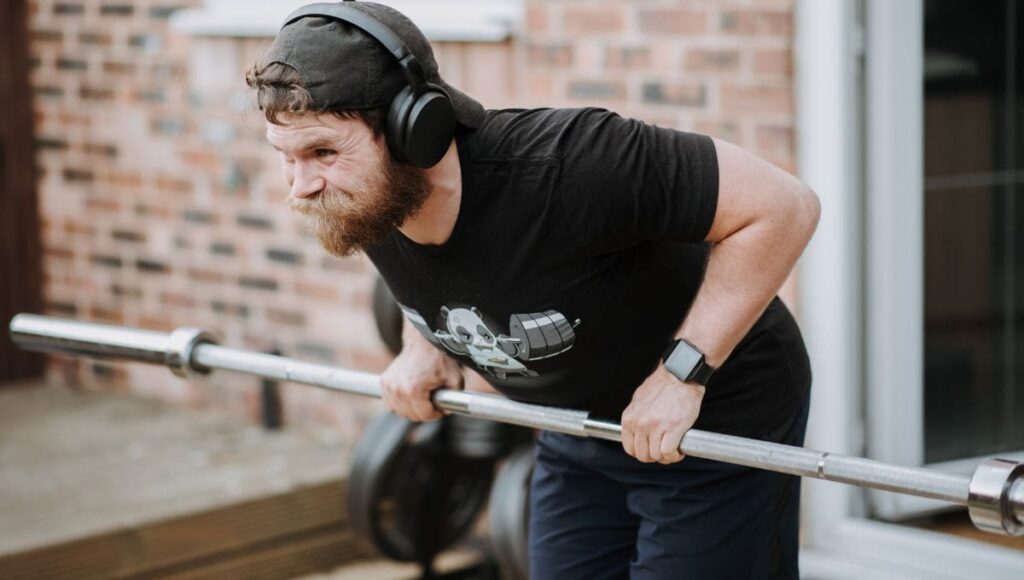
Unlike chest supported rowing machines, the bent over row requires maintaining a strong hip hinge throughout the entire set. That means the posterior chain works continuously while the upper back performs the pulling movement.
Elite powerlifters often consider heavy rows essential assistance work because they reinforce the muscles responsible for maintaining spinal position during deadlifts and squats.
The Science Behind Heavy Rows
Electromyography studies consistently report high activation of the latissimus dorsi, middle trapezius, rhomboids, posterior deltoids, and lumbar extensors during bent over rows.
Research also demonstrates that multi joint free weight exercises stimulate greater coordination between muscle groups than many machine based alternatives.
This coordination is especially valuable during maximal strength efforts where force must transfer efficiently through the entire kinetic chain.
Common Technical Mistakes
- The most common error is allowing the torso angle to become increasingly upright during each repetition.
- Elite lifters maintain a stable torso while rowing explosively toward the lower ribs or upper abdomen.
- The lower back should remain neutral throughout the movement.
Exercise 3: Romanian Deadlift
More Than a Hamstring Exercise
Many people think of Romanian deadlifts primarily as a hamstring movement. Elite lifters know they are equally valuable for developing the entire posterior chain, especially the spinal erectors.
Unlike conventional deadlifts, Romanian deadlifts maintain constant tension throughout the set. The spinal erectors work continuously to stabilize the trunk while the glutes and hamstrings generate force through hip extension.
Because the upper back must also remain rigid, nearly every muscle on the posterior side of the body contributes to successful execution.
Why Posterior Chain Strength Matters
The posterior chain is responsible for producing force in jumping, sprinting, lifting, and throwing. Weak spinal erectors often become the limiting factor during heavy squats and deadlifts.
Research has repeatedly demonstrated that hip dominant exercises significantly improve posterior chain strength while increasing muscle thickness in the lumbar extensors.
Romanian deadlifts also teach athletes to control loaded hip hinging, which carries over directly into countless sporting movements.
Proper Execution
- Begin with the bar held against the thighs.
- Push the hips backward while maintaining a slight bend in the knees.
- Lower the bar close to the legs until hamstring flexibility limits further movement without rounding the lower back.
- Drive the hips forward to return to standing.
- The movement should feel controlled from start to finish rather than rushed.
How Often Should You Train Your Back?
Evidence suggests that training each muscle group at least twice per week generally produces greater hypertrophy than once weekly when total training volume is matched.
Elite athletes often spread pulling exercises across multiple sessions instead of performing all back work on one day. For example, pull ups may appear after pressing workouts, rows after squats, and Romanian deadlifts alongside lower body training.
This distribution allows higher quality performance while managing fatigue more effectively. Progressive overload remains the most important variable. Adding weight, repetitions, or total training volume over time consistently drives adaptation regardless of exercise selection.
Recovery Is Where Growth Happens
Elite lifters train hard, but they also recover intelligently. Muscle protein synthesis depends on adequate dietary protein, sufficient calories, and quality sleep. Most evidence suggests consuming approximately 1.6 to 2.2 grams of protein per kilogram of body weight each day supports maximal muscle growth for resistance trained individuals.
Sleep also plays a critical role in recovery, hormonal regulation, motor learning, and strength development. Without adequate recovery, even the best exercise selection cannot maximize progress.
Final Thoughts
Elite lifters are remarkably consistent in their exercise selection because they understand that fundamentals produce extraordinary results over time.
Pull ups, bent over rows, and Romanian deadlifts continue appearing in championship level training programs because they develop strength, muscle mass, posture, and athletic performance simultaneously.
Rather than chasing endless exercise variation, focus on mastering these three movements. Train them with excellent technique, progressively increase the challenge over time, and recover properly between sessions.
The science and decades of elite performance point toward the same conclusion. The basics still work, and these three exercises remain among the most effective back builders ever tested.
Key Takeaways
| Exercise | Primary Benefit | Main Muscles Worked | Why Elite Lifters Keep It |
|---|---|---|---|
| Pull Up | Builds vertical pulling strength and relative strength | Latissimus dorsi, biceps, lower trapezius, rhomboids | High muscle activation with excellent athletic carryover |
| Bent Over Row | Increases upper back thickness and total pulling strength | Lats, traps, rhomboids, rear deltoids, spinal erectors | Strengthens the entire posterior chain while improving rowing power |
| Romanian Deadlift | Develops posterior chain strength and spinal stability | Hamstrings, glutes, spinal erectors, upper back | Improves hip hinge mechanics and supports heavier compound lifts |
References
- Ahtiainen, J.P., Pakarinen, A., Alen, M., Kraemer, W.J. and Häkkinen, K. (2003) ‘Muscle hypertrophy, hormonal adaptations and strength development during strength training in strength trained and untrained men’, European Journal of Applied Physiology, 89(6), pp. 555 to 563.
- Andersen, V., Fimland, M.S., Brennset, O., Haslestad, L., Lundteigen, M.S., Skalleberg, K., Saeterbakken, A.H. and Aagaard, P. (2014) ‘Muscle activation and strength in squat and deadlift variations’, Journal of Strength and Conditioning Research, 28(11), pp. 3042 to 3052.
- Boeckh Behrens, W.U. and Buskies, W. (2000) Fitness Strength Training: The Best Exercises and Methods for Sport and Health. Reinbek: Rowohlt.
- Gentil, P., Fisher, J. and Steele, J. (2017) ‘A review of the acute effects and long term adaptations of single and multi joint exercises during resistance training’, Sports Medicine, 47(5), pp. 843 to 855.
- Grgic, J., Schoenfeld, B.J., Davies, T.B., Lazinica, B., Krieger, J.W. and Pedisic, Z. (2018) ‘Effect of resistance training frequency on gains in muscular strength’, Sports Medicine, 48(5), pp. 1207 to 1220.
- Lehman, G.J., Buchan, D.D., Lundy, A., Myers, N. and Nalborczyk, A. (2004) ‘Variations in muscle activation levels during traditional latissimus dorsi weight training exercises’, Journal of Strength and Conditioning Research, 18(4), pp. 845 to 849.
- Morton, R.W., Murphy, K.T., McKellar, S.R., Schoenfeld, B.J., Henselmans, M., Helms, E., Aragon, A.A., Devries, M.C., Banfield, L., Krieger, J.W. and Phillips, S.M. (2018) ‘A systematic review, meta analysis and meta regression of protein supplementation on resistance training induced gains in muscle mass and strength in healthy adults’, British Journal of Sports Medicine, 52(6), pp. 376 to 384.
- Schoenfeld, B.J. (2010) ‘The mechanisms of muscle hypertrophy and their application to resistance training’, Journal of Strength and Conditioning Research, 24(10), pp. 2857 to 2872.
- Schoenfeld, B.J., Ogborn, D. and Krieger, J.W. (2016) ‘Effects of resistance training frequency on measures of muscle hypertrophy: A systematic review and meta analysis’, Sports Medicine, 46(11), pp. 1689 to 1697.
- Snarr, R.L. and Esco, M.R. (2013) ‘Electromyographical comparison of traditional and suspension push ups, pull ups, and inverted rows’, Journal of Human Kinetics, 39, pp. 75 to 83.